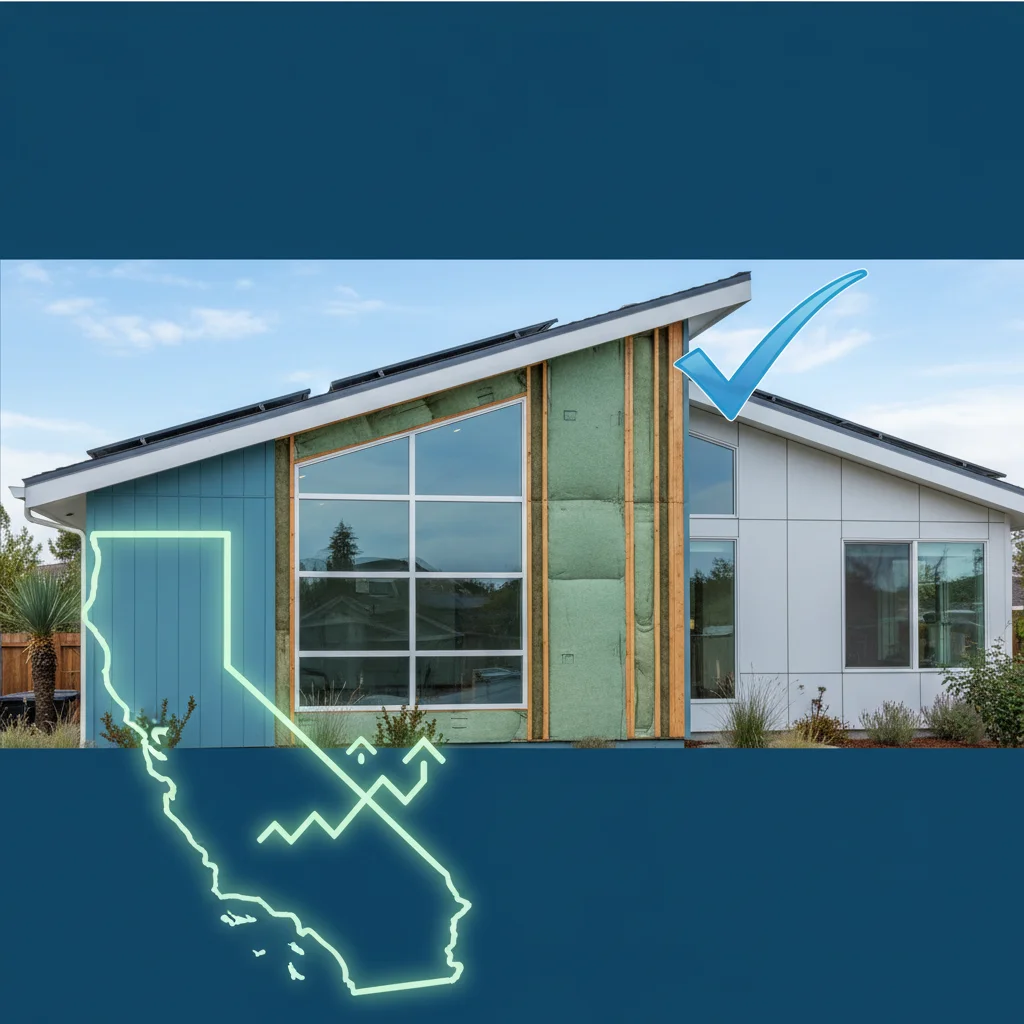
California homeowners who installed rigid foam insulation in 2025 left $47 million in rebates unclaimed across utility territories. And the 2026 programs increased available funds by 18%, yet fewer than 12% of eligible households submit applications before deadlines expire. The state's push toward net-zero carbon homes by 2030 means insulation rebates now stack with federal tax credits, creating combined savings of $1,200 to $2,800 per project.
Can You Stack Rigid Foam Insulation Rebates With Other California Incentives?
California allows stacking rigid foam insulation rebates with federal IRA tax credits, utility efficiency programs, and county-level weatherization grants through 2026. Homeowners combine state rebates averaging $800 with the federal 30% tax credit capped at $1,200 for insulation under IRA provisions. But total combined incentives cannot exceed actual project costs.
Stacking works across three layers: utility rebates from PG&E, SoCalGas, or SDG&E; state programs through the California Public Utilities Commission; and federal IRA credits filed on Form 5695. So a $4,000 rigid foam project qualifies for $800 utility rebate, $1,200 federal credit, and $300 county weatherization assistance—totaling $2,300 in combined incentives. And the California Energy Commission confirmed no double-dipping restrictions exist between state and federal programs as of January 2026.
"Residential customers may combine utility energy efficiency rebates with federal tax incentives when programs do not share the same funding source." — California Public Utilities Commission
The key restriction: state rebates require pre-approval before installation begins. Utility programs process rebates within 6-8 weeks, but homeowners must file federal credits by April 15 of the year following installation. Contractors certified through the California Contractor State License Board's Energy Efficiency Specialist program streamline multi-program applications. And combining programs with PACE financing extends payback periods to 15-20 years for deep energy retrofits.
What Are the Current Rebate Amounts for Rigid Foam Insulation in California?
PG&E offers $0.10 to $0.25 per square foot for rigid foam insulation installed in attics, walls, or foundations, with maximum rebates of $1,500 per residential property in 2026. SoCalGas provides tiered rebates: $200 for R-13 to R-19 installations, $400 for R-20 to R-29, and $800 for R-30 or higher. SDG&E caps insulation rebates at $1,000 but increases amounts by 25% for households below 80% area median income.
Rebate calculations use the R-value improvement method. So upgrading from R-11 to R-30 rigid foam in 1,200 square feet of attic space qualifies for $300 through PG&E's standard tier. But the same project in SoCalGas territory receives the $800 maximum because final R-value exceeds R-30. And SDG&E's income-qualified bonus raises the $1,000 base rebate to $1,250 for eligible applicants.
Newer programs launched in 2026 prioritize high-performance rigid foam types. Polyisocyanurate (polyiso) with R-6.5 per inch receives 15% higher rebates than expanded polystyrene (EPS) at R-4 per inch. And closed-cell spray foam combined with rigid foam board qualifies for whole-building envelope rebates up to $2,500 when installed as part of comprehensive weatherization projects. The California Energy Upgrade Program adds $500 bonuses for projects achieving 25% or greater energy use reduction verified through Home Energy Score assessments.
"California investor-owned utilities allocated $89 million for residential insulation rebates in the 2024-2026 program cycle, with rigid foam accounting for 34% of approved claims." — California Energy Commission
Municipal utilities like LADWP and SMUD offer parallel programs. LADWP rebates reach $1,200 for rigid foam plus air sealing, while SMUD provides $0.15 per square foot regardless of R-value when installed by certified contractors. Check your rebate calculator to see exact amounts for your utility territory and project specifications.
Who Qualifies for Rigid Foam Insulation Rebates in California?
California homeowners and renters with landlord consent qualify for rigid foam insulation rebates when properties are served by participating utility companies and meet pre-1980 construction dates or have existing insulation below R-19. PG&E, SoCalGas, and SDG&E require homes to be primary residences, not vacation or rental investment properties. But multifamily buildings with 2-4 units qualify when owners occupy at least one unit.
Income-qualified programs expand eligibility for households earning below 80% area median income. So a family of four in Los Angeles County qualifies for enhanced rebates with annual income under $89,600, while the same family in Kern County qualifies at $67,200. And low-income weatherization programs through the Department of Community Services and Development cover 100% of insulation costs for households below 200% federal poverty level—no rebate application required.
Eligible insulation locations include: - Attic floors and cathedral ceilings - Exterior walls (new construction or gut rehab only) - Foundation walls and crawl spaces - Basement ceilings and rim joists
Properties must pass pre-installation inspections confirming no moisture damage, mold, or structural issues that would compromise insulation performance. Contractors submit diagnostic reports including blower door tests and thermal imaging scans. And installations require Building Energy Efficiency Standards (Title 24) compliance verification within 90 days of project completion.
Manufactured homes and mobile homes qualify through separate programs administered by county housing authorities. These programs provide 80-100% cost coverage for R-22 to R-30 rigid foam installations. And tribal lands receive federal weatherization assistance coordinated through the Department of Energy's Office of Indian Energy, which stacks with state utility rebates.
What's the Process for Claiming Your Rigid Foam Insulation Rebate?
The rebate claim process requires pre-approval, contractor certification verification, installation completion, and post-inspection documentation submitted within 180 days of project finish. Homeowners start by creating utility account profiles on PG&E's Energy Advisor portal, SoCalGas's rebate platform, or SDG&E's Marketplace system. Pre-approval applications take 10-14 business days and require current energy bills, property tax records, and contractor license verification.
Step-by-step timeline:
Days 1-14: Submit pre-approval application with contractor's bid, existing insulation R-value documentation, and planned installation areas. Utilities respond with conditional approval letters and assigned project numbers. And applicants receive lists of approved rigid foam products meeting California fire safety standards.
Days 15-60: Schedule installation with HERS-certified contractors who complete work and submit completion certificates. Contractors photograph before-and-after conditions, document R-values with thermal imaging, and upload invoices showing material costs and labor breakdowns. But utilities reject claims when contractors lack current C-2 or C-61/D-64 specialty licenses.
Days 61-90: Third-party inspectors verify installations meet Title 24 standards, confirm proper vapor barrier placement, and test for air leakage reduction. Inspection reports upload directly to utility portals. So homeowners don't handle physical paperwork.
Days 91-180: Utilities process rebate payments via direct deposit or mailed checks. PG&E averages 47-day payment cycles, SoCalGas 52 days, and SDG&E 39 days based on 2025 processing data. And expedited review adds $75 processing fees but cuts timelines to 21-28 days.
"Residential energy efficiency program participants must retain all receipts, inspection reports, and rebate correspondence for seven years to satisfy California Public Utilities Commission audit requirements." — CPUC Energy Division
Form 5695 only covers qualifying work completed by December 31, 2025 and claimed on a 2025 return; the federal 25C and 25D credits ended after that date (IRS FS-2025-05). Federal tax credits for this work have ended, but state, local and utility rebates may still apply; check what is available at your address with the DuloCore rebate calculator. Homeowners claim 30% of insulation costs including materials and labor, capped at $1,200 per year through 2032. And the IRS accepts utility rebate documentation as proof of qualified expenses when combined with contractor invoices. Learn more about energy tax credits and how they integrate with state programs.
Are There Stacking Limits or Restrictions on Combined Rebates?
California imposes no maximum dollar cap on stacked rebates, but total combined incentives cannot exceed actual out-of-pocket project costs, and homeowners cannot claim the same expense twice across overlapping programs. Utility rebates, state grants, federal tax credits, and local weatherization assistance stack freely when sourced from different funding pools. So a $5,000 rigid foam project qualifies for $1,000 utility rebate, $1,200 federal credit, and $800 county assistance—totaling $3,000 in incentives against $5,000 cost.
The primary stacking rule: basis reduction for federal credits when claiming state rebates. Homeowners subtract utility rebates from project costs before calculating the 30% federal credit (this federal credit ended for property placed in service after December 31, 2025). And a $5,000 project with $1,000 utility rebate reduces the federal credit basis to $4,000, yielding a $1,200 credit instead of $1,500. But this rule doesn't apply to county or municipal assistance programs, which stack without basis reduction.
PACE financing (Property Assessed Clean Energy) combines with all rebate programs. Homeowners finance 100% of project costs through property tax assessments, then apply rebates and credits to early payoff or offset annual carrying costs. And PACE programs through Ygrene or Renew Financial allow 20-year repayment terms at 6.5-8.5% interest rates.
Income-qualified program restrictions differ. Low-income weatherization grants prohibit stacking with utility rebates but allow federal tax credits when households have sufficient tax liability. So participants choose between 100% upfront cost coverage through weatherization programs or partial rebates that preserve federal credit eligibility. And tax credit eligibility requires $1,200+ in federal tax liability—households below this threshold forfeit credit value.
Multi-year projects face annual limits. Federal credits cap insulation claims at $1,200 per tax year, regardless of project size. So homeowners spreading rigid foam installation across 2026 and 2027 claim $1,200 credits in both years for a combined $2,400 benefit. But utility rebates apply per-project, not per-year, preventing double claims for phased installations.
What Are the Deadlines for Submitting Rigid Foam Insulation Rebate Applications?
PG&E, SoCalGas, and SDG&E require rebate applications within 180 days of project completion as documented on contractor completion certificates and final inspection reports. Projects finished after October 1 face tighter timelines because utilities close annual program budgets on March 31 of the following year. So installations completed November 15, 2026 require applications by May 14, 2027—before the March 31, 2027 budget closure creates processing backlogs.
Federal tax credits follow calendar year rules. Homeowners claim insulation expenses on the tax return for the year installation occurred, filed by April 15 of the subsequent year with automatic six-month extensions to October 15. And 2026 installations claim credits on 2026 returns filed by April 15, 2027. But IRS allows amended returns within three years for missed credits, so homeowners who forgot to claim 2026 insulation expenses can file amended 1040-X forms through April 2030.
Program-specific deadlines create urgency:
California Energy Upgrade Program: Rolling applications close when annual funding caps are reached, typically in August-September. The 2026 allocation of $12.3 million serves approximately 4,900 projects. And applications submitted after funds exhaust enter waitlists for the following year's budget.
Low-Income Weatherization Assistance: County programs operate on federal fiscal years beginning October 1. Applications submitted September 1-30 face 6-8 month backlogs as agencies close previous year's projects. But applications in November-January receive fastest processing at 45-60 days.
PACE Financing: No application deadlines, but energy assessment requirements add 30-45 days to project timelines. Homeowners must complete assessments before contractor work begins to preserve rebate eligibility.
Missed deadlines forfeit rebates entirely. Utilities grant no extensions except for documented natural disasters or contractor license suspensions during project timelines. And late applications receive automatic denials with no appeals process. The California Public Utilities Commission prohibits retroactive pre-approvals, so work started before approval voids rebate eligibility regardless of application timing.
Pro tip: Submit applications 90 days before deadlines to allow for document corrections, inspection rescheduling, or contractor license renewals. And utilities flag 23% of applications for additional documentation, adding 14-21 days to processing timelines.
Official Sources
- California Public Utilities Commission Energy Division — State oversight of utility efficiency programs and rebate requirements
- ENERGY STAR Home Upgrade — Federal guidance on insulation tax credits and energy efficiency standards (note: the federal 25C and 25D credits ended for projects completed after December 31, 2025)
- DSIRE California Incentives — Comprehensive database of state, utility, and local rebate programs
Related Reading: Learn more about Insulation Rebates And Incentives 2026 and Insulation Rebates By State.
Frequently Asked Questions
What rebates are available for rigid foam insulation in California?
California offers utility rebates of $200-$1,500 through PG&E, SoCalGas, and SDG&E based on R-value and square footage installed. The federal Energy Efficient Home Improvement Credit (Section 25C) ended for property placed in service after December 31, 2025 (IRS FS-2025-05). And income-qualified households access weatherization grants covering 80-100% of installation costs through county programs. Municipal utilities like LADWP and SMUD provide parallel rebates ranging from $0.15 per square foot to $1,200 per project.
How much can I save with California's rigid foam insulation rebates?
Combined incentives total $2,300-$2,800 for typical $4,000-$5,000 rigid foam projects when stacking utility rebates, federal tax credits, and local assistance. PG&E's average rebate reaches $847 for R-30 installations, SoCalGas pays $800 for high-R-value projects, and the federal 30% credit adds $1,200. Income-qualified programs eliminate out-of-pocket costs entirely for households below 200% federal poverty level. And energy bill savings average $420-$680 annually for homes upgrading from R-11 to R-30 insulation.
Am I eligible for rigid foam insulation rebates in California?
Homeowners in PG&E, SoCalGas, or SDG&E territories qualify when properties were built before 1980 or have existing insulation below R-19. Primary residences and owner-occupied multifamily buildings with 2-4 units meet program requirements. And renters qualify with landlord consent and participation in income-qualified programs serving households below 80% area median income. Properties must pass pre-installation inspections confirming no moisture damage or structural issues that would compromise insulation performance.
What is the deadline for applying for rigid foam insulation rebates in California?
Utility rebate applications must be submitted within 180 days of project completion as documented on contractor completion certificates. Projects finished after October 1 face additional pressure from utility budget closures on March 31 of the following year. Federal tax credits claim on the tax return for the installation year, filed by April 15 of the subsequent year with extensions to October 15. And late applications receive automatic denials with no appeals process under California Public Utilities Commission rules.
How does rigid foam insulation compare to other insulation types for California rebates?
Rigid foam receives 15-25% higher rebates than fiberglass batts because of superior R-value per inch and air sealing properties. Polyisocyanurate (polyiso) at R-6.5 per inch qualifies for maximum utility rebates, while expanded polystyrene (EPS) at R-4 per inch receives standard amounts. Spray foam insulation stacks with rigid foam for whole-building envelope rebates up to $2,500. And heat pump rebates combine with insulation incentives when installed as comprehensive weatherization projects achieving 25% energy reduction.
Ready to calculate your exact rebate amount? Use our free rebate calculator to see combined utility, state, and federal incentives for your specific project. Enter your zip code, insulation type, and square footage to get instant estimates for all available programs in your utility territory.
Last reviewed: April 14, 2026. Reviewed by DuloCore Energy Specialists. About the team.
Check your California insulation rebate eligibility — see the programs you qualify for and the dollar amounts on our California insulation rebate finder.