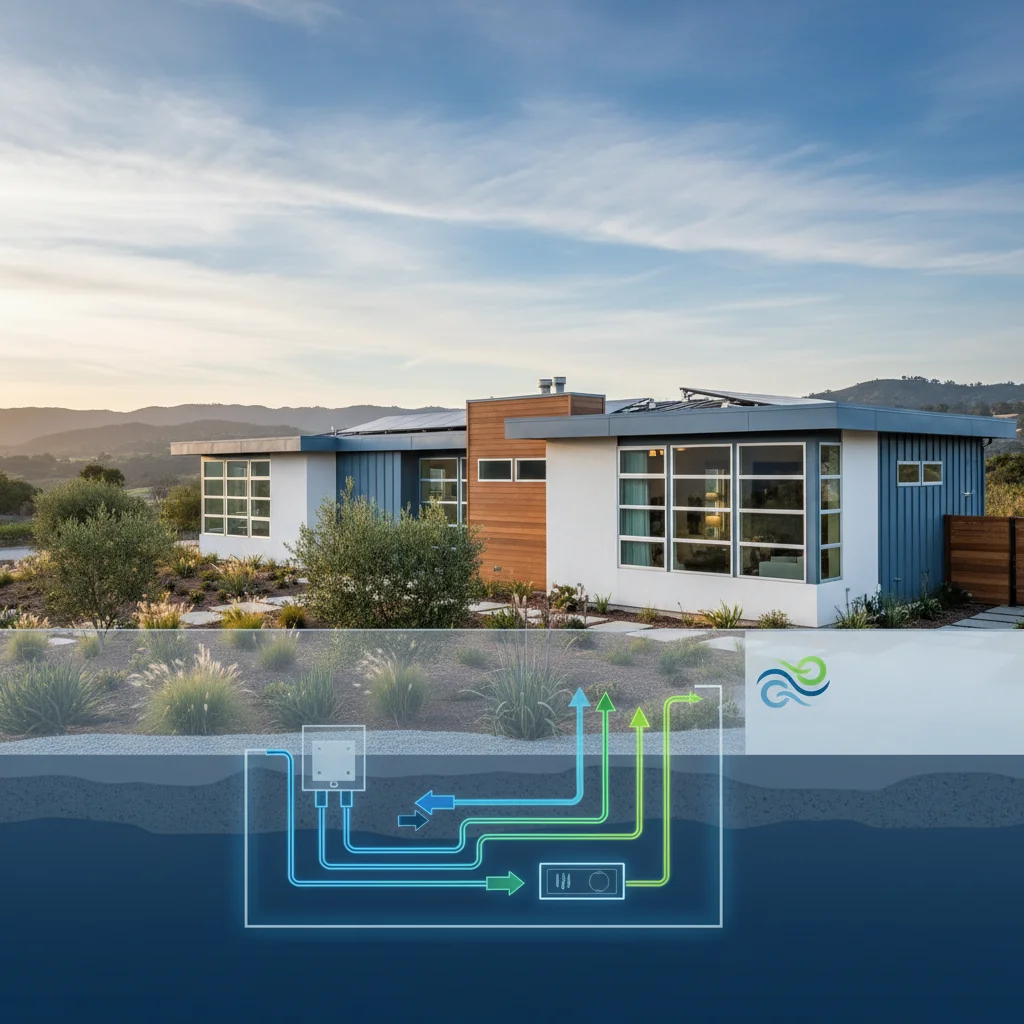
California homeowners paid an average of $2,847 for electricity in 2025, with 41% of that cost going to heating and cooling. Geothermal heat pumps cut those HVAC costs by 30-70% by tapping into stable underground temperatures of 50-60°F year-round, eliminating the need for natural gas furnaces and traditional air conditioners.
What's the Actual Payback Period for Geothermal Systems in California Homes?
Residential geothermal systems in California achieve payback periods of 5-10 years depending on property size, soil conditions, and replaced HVAC system efficiency. Systems cost $15,000-$30,000 installed, save $1,200-$3,000 annually on utility bills; the federal 30% credit ended for expenditures made after December 31, 2025 (IRS FS-2025-05).
But the payback calculation depends on more than energy savings. Geothermal systems eliminate gas line connections, reduce fire insurance premiums in wildfire zones by 8-12%, and add 4-6% to property resale value according to National Association of Realtors data. So a $25,000 system on a $600,000 home creates $24,000-$36,000 in resale value while generating $2,000 in annual savings.
And the federal IRA tax credit cuts upfront costs by 30%—a $25,000 system drops to $17,500 after the credit. California's TECH Clean California initiative offers additional incentives of $500-$3,000 for heat pump installations in eligible utility territories. Combined incentives reduce effective payback periods to 4-7 years for most residential installations.
Property characteristics significantly impact payback speed. Homes replacing electric resistance heating see 7-year paybacks, while homes replacing high-efficiency gas furnaces in mild climates may take 12-15 years to break even on equipment costs alone.
"Geothermal heat pumps are the most energy-efficient heating and cooling systems available, using 25% to 50% less electricity than conventional heating or cooling systems." — U.S. Department of Energy
How Does Geothermal Compare to Solar, Heat Pumps, and Traditional HVAC in California?
Geothermal systems deliver coefficient of performance (COP) ratings of 3.5-5.0, meaning they produce 3.5-5 units of heating or cooling per unit of electricity consumed. Air source heat pumps achieve COP 2.5-3.5, traditional electric resistance heating reaches COP 1.0, and gas furnaces convert only 78-96% of fuel to heat.
| System Type | Upfront Cost | Annual Operating Cost | 30-Year Total Cost | Federal Incentive |
|---|---|---|---|---|
| Geothermal Heat Pump | $20,000-$30,000 | $600-$1,200 | $38,000-$66,000 | 30% tax credit (this federal credit ended for expenditures made after December 31, 2025) |
| Air Source Heat Pump | $5,000-$12,000 | $900-$1,800 | $32,000-$66,000 | 30% tax credit |
| Solar + Air Source HP | $20,000-$35,000 | $400-$900 | $32,000-$62,000 | 30% tax credit both |
| Gas Furnace + AC | $8,000-$15,000 | $1,500-$2,500 | $53,000-$90,000 | None |
And geothermal systems operate silently compared to air source heat pumps, which require noisy outdoor condenser units. Geothermal ground loops remain buried and invisible, preserving property aesthetics while air source units create 50-60 decibel noise levels during operation.
But solar panels complement geothermal systems instead of replacing them. A 6 kW solar array generates 8,000-10,000 kWh annually in California, enough to power a geothermal heat pump's 4,000-6,000 kWh yearly consumption plus household electricity needs. Combined systems achieve net-zero energy performance with total equipment costs of $35,000-$50,000 before incentives.
Learn more about combining technologies in our guide to heat pump rebates and energy tax credits.
How Long Will a Residential Geothermal System Last and What's the Maintenance Cost?
Geothermal ground loops carry 50-year warranties and typically last 100+ years, while indoor heat pump equipment operates for 20-25 years—double the 10-12 year lifespan of conventional air conditioners and furnaces. The buried polyethylene piping experiences no exposure to UV radiation, weather, or corrosive elements that degrade outdoor HVAC equipment.
Annual maintenance costs range from $150-$300 for filter changes, refrigerant level checks, and pump inspections. Traditional HVAC systems require $200-$400 in yearly maintenance for both furnace and air conditioner units. So geothermal systems reduce maintenance expenses by 25-40% over their operating life.
And geothermal equipment replacements involve only indoor components. A heat pump compressor replacement costs $2,000-$4,000 at the 20-year mark, but the ground loop infrastructure remains functional indefinitely. Conventional systems require complete outdoor condenser and indoor furnace replacements every 10-15 years at $8,000-$15,000 per replacement cycle.
California's climate extends equipment life compared to extreme temperature regions. Geothermal systems in moderate coastal zones experience less thermal stress than units in Arizona desert heat or Minnesota winter cold, adding 3-5 years to typical compressor lifespans.
What Are the Upfront Costs and Available Rebates for California Geothermal Installation?
Residential geothermal installations in California cost $15,000-$30,000 depending on system size, property geology, loop configuration, and existing ductwork condition. Horizontal ground loops require 0.25-0.5 acres of yard space and cost $15,000-$20,000 for typical 2,000-2,500 square foot homes. Vertical loops work on smaller lots, requiring only 400-600 square feet but costing $20,000-$30,000 due to drilling expenses of $10-$30 per foot to depths of 150-400 feet.
The federal Residential Clean Energy Credit (Section 25D) ended for expenditures made after December 31, 2025, and the IRS treats an expenditure as made when installation is completed (IRS FS-2025-05). Check current state, local and utility incentives for your address with the DuloCore rebate calculator. And California's TECH Clean California offers $500-$3,000 performance-based incentives for heat pump installations in PG&E, SCE, SoCalGas, and SDG&E territories.
| Rebate Program | Amount | Income Limit | Deadline | Application Method |
|---|---|---|---|---|
| Federal IRA Tax Credit | Ended Dec 31, 2025 | — | Ended Dec 31, 2025 | — |
| TECH Clean California | $500-$3,000 | None | Ongoing (funding available) | Through participating contractor |
| Local Utility Rebates | $500-$2,500 | Varies | Varies | Utility-specific application |
And property-assessed clean energy (PACE) financing programs like CaliforniaFIRST allow homeowners to finance geothermal installations through property tax assessments, spreading $20,000-$30,000 costs over 10-20 years at 5-8% interest rates.
But installation costs vary significantly based on soil composition. Rocky terrain adds $3,000-$8,000 to drilling costs, while sandy or loamy soil allows faster, cheaper installation. Calculate your savings based on your specific property conditions and energy usage.
The federal Residential Clean Energy Credit (Section 25D) ended for expenditures made after December 31, 2025, and the IRS treats an expenditure as made when installation is completed (IRS FS-2025-05).
Are You Eligible for California Geothermal Incentives and Tax Credits in 2026?
The federal Residential Clean Energy Credit (Section 25D) ended for expenditures made after December 31, 2025, and the IRS treats an expenditure as made when installation is completed (IRS FS-2025-05). Federal tax credits for this work have ended, but state, local and utility rebates may still apply; check what is available at your address with the DuloCore rebate calculator.
California's TECH Clean California targets heat pump installations in specific utility territories including PG&E, SCE, SoCalGas, and SDG&E service areas. The program requires installation by participating contractors who submit performance verification data including system COP ratings and HERS testing results. Incentives range from $500 for small systems to $3,000 for whole-home installations replacing gas heating.
But low-income households qualify for enhanced incentives under California's Equity programs. The SOMAH (Solar on Multifamily Affordable Housing) and DAC-SASH (Disadvantaged Communities Single-family Affordable Solar Homes) programs offer additional rebates of $2,000-$5,000 for qualifying homeowners in census tracts designated as disadvantaged communities.
And property owners can claim both federal tax credits and state/utility rebates simultaneously—incentives stack instead of reducing each other. A $25,000 geothermal installation qualifies for $7,500 federal credit and $1,500-$3,000 California rebates, reducing net cost to $14,000-$16,000.
Check current geothermal tax credit eligibility and requirements before starting your installation project.
What's the Installation Timeline and Process for a California Geothermal System?
Geothermal installations in California take 3-7 days for horizontal loop systems and 5-10 days for vertical drilling configurations. The process starts with soil thermal conductivity testing, property survey for loop placement, and HVAC load calculations to determine required system capacity. Contractors drill test bores or excavate trenches, install ground loops, connect indoor heat pump equipment, and perform system commissioning and performance verification.
And permitting timelines add 2-6 weeks before installation begins. California building departments require HVAC permits, electrical permits, and well permits for closed-loop systems. Some jurisdictions mandate geological surveys or groundwater protection plans before approving vertical loop installations.
But seasonal factors impact installation costs and timelines. Winter and spring installations allow easier ground excavation when soil moisture levels remain high, while summer's dry, hard ground increases drilling time and equipment wear. Contractors offer 10-20% discounts during slower winter months from November through February.
Property-specific challenges extend timelines. Homes with shallow bedrock, high water tables, or underground utilities require specialized drilling techniques that add 2-5 days. And installing ductwork in homes without existing HVAC systems adds $3,000-$8,000 and 3-5 days to project duration.
Explore how HVAC system rebates apply to geothermal installations in your area.
Official Sources
- U.S. Department of Energy Geothermal Heat Pumps — Federal guidance on geothermal technology, efficiency ratings, and installation best practices
- IRS Residential Clean Energy Credit — Official tax credit amounts, eligibility requirements, and filing instructions for geothermal installations (note: the federal 25C and 25D credits ended for projects completed after December 31, 2025)
- DSIRE California Programs — Database of state incentives for renewables and efficiency including current California rebate programs
Related Reading: Learn more about Geothermal Noise Level Residential California.
Frequently Asked Questions
What are the eligibility requirements for California geothermal rebates?
California geothermal rebates require installation by licensed contractors in participating utility territories including PG&E, SCE, SoCalGas, and SDG&E service areas. Systems must meet Energy Star certification standards with minimum COP ratings of 3.3 for heating and EER 16.2 for cooling. And contractors submit performance verification data including HERS testing results to qualify for $500-$3,000 incentives through TECH Clean California.
How much can you save with a geothermal heat pump in California?
California geothermal heat pumps save $1,200-$3,000 annually on combined heating and cooling costs compared to traditional gas furnaces and air conditioners. Homes in hot inland valleys like Fresno or Bakersfield save $2,000-$3,000 yearly by eliminating summer air conditioning bills of $300-$450 per month. Coastal homes save $1,200-$1,800 annually with lower cooling demands but year-round heating efficiency gains.
What is the process for applying for California geothermal incentives?
Form 5695 only covers qualifying work completed by December 31, 2025 and claimed on a 2025 return; the federal 25C and 25D credits ended after that date (IRS FS-2025-05). California's TECH Clean California rebates process through participating contractors who submit installation documentation and performance data directly to program administrators. And homeowners receive rebate payments 4-8 weeks after installation completion and verification.
Are there current deadlines for California geothermal rebate programs?
The federal Residential Clean Energy Credit (Section 25D) ended for expenditures made after December 31, 2025, and the IRS treats an expenditure as made when installation is completed (IRS FS-2025-05). TECH Clean California operates on ongoing funding with no fixed deadline, but individual utility programs may reach funding caps and close enrollment. Contact your utility provider to verify current 2026 program availability and remaining funding before starting installation.
How does a geothermal system compare to air source heat pumps in California?
Geothermal systems cost $15,000-$30,000 installed versus $5,000-$12,000 for air source heat pumps, but deliver 30-50% higher efficiency with COP ratings of 3.5-5.0 compared to air source COP 2.5-3.5. And geothermal systems maintain consistent performance in extreme temperatures while air source units lose 20-40% heating capacity when outdoor temperatures drop below 40°F during winter cold snaps in mountain and desert regions.
Ready to find out exactly how much you can save? Use our free rebate calculator to get personalized estimates based on your home size, current heating system, and local utility rates. Enter your zip code and energy bills to see your potential savings, payback period, and available incentives in under 60 seconds.
Updated on April 14, 2026. Fact-checked by DuloCore Editors. About our research team.
Check your California heat pump rebate eligibility — see the programs you qualify for and the dollar amounts on our California heat pump rebate finder.