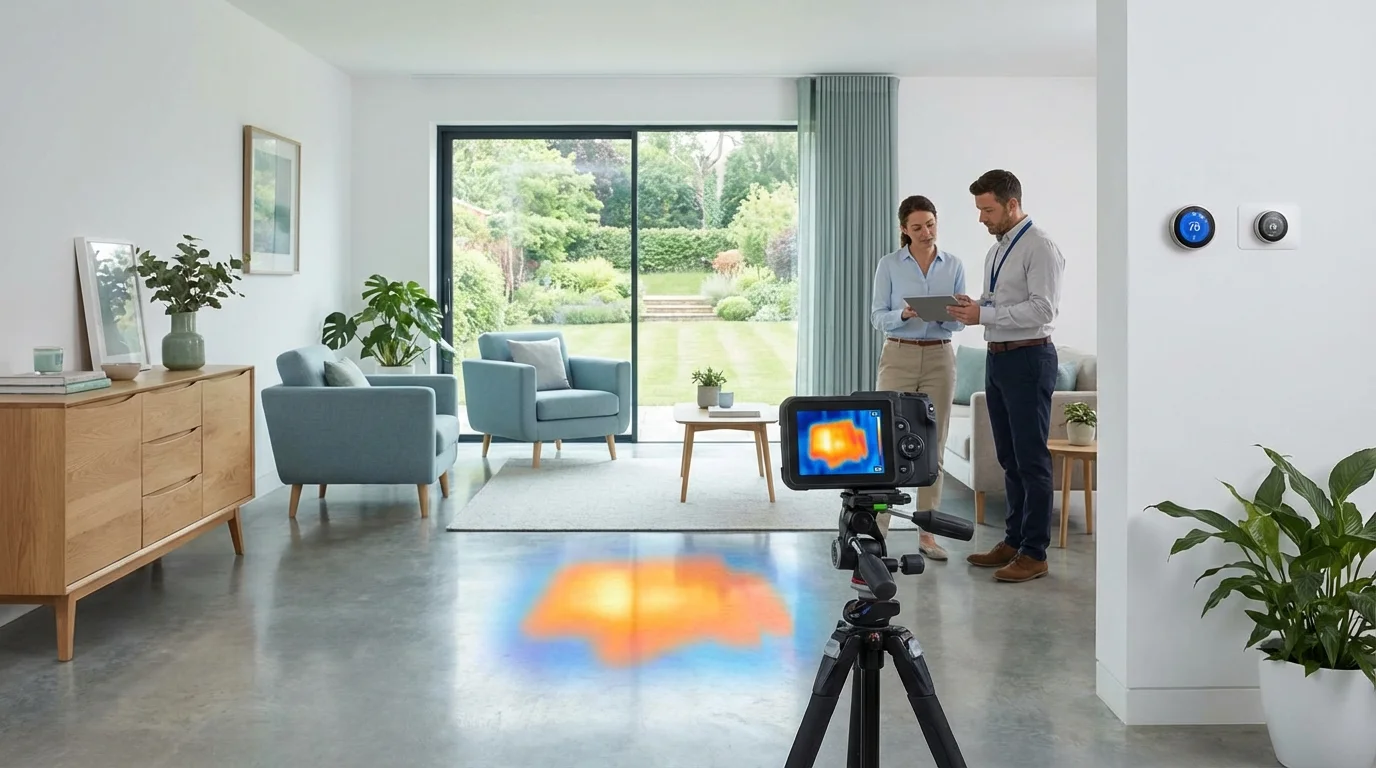
Floors account for over 10% of a home's total heat loss, a silent drain on your wallet every winter. Without a proper assessment, your radiant heating system is fighting a losing battle against thermal inefficiency, leaking warmth and money directly into the ground or unconditioned spaces below. So this inefficiency often goes unnoticed until energy bills spike 15-25% higher than expected. An energy audit pinpoints this exact waste.
What is a Radiant Floor Heating Energy Audit, and Why Is It Crucial for Home Efficiency?
A radiant floor heating energy audit is a specialized diagnostic service that uses tools like infrared thermography and blower door tests to identify heat loss and system inefficiencies. For 2026, this audit quantifies energy waste, verifies proper insulation, and provides a data-driven roadmap for upgrades.
A professional energy audit focused on radiant floor heating is the first step toward reducing home energy consumption. So it moves beyond guesswork, using thermal imaging to visualize exactly where heat is escaping through your floors, foundation, and walls. And auditors check for adequate subfloor insulation (a minimum of R-5 is often required), boiler or heat pump efficiency, and correct zoning control. But the real value is the final report, a document that outlines specific, cost-effective improvements. It provides the necessary documentation for securing state and utility rebates, often unlocking incentives that cover up to 50% of the cost of the audit itself. This diagnostic process ensures that any investment in your heating system delivers a measurable return by targeting the most critical areas of energy loss first, directly impacting your home's overall efficiency and comfort.
How Much Can I Save? What Rebates and Incentives Are Available for Radiant Floor Heating Energy Audits in My State and From My Utility?
Homeowners save between $150 and $500 on the cost of a specialized audit through 2026 state and utility rebates. These programs incentivize the diagnostic step, with the final rebate amount depending on local funding and the scope of the recommended upgrades implemented afterward.
The savings from a radiant floor heating energy audit come in two forms: the upfront rebate for the audit itself and the long-term energy bill reductions. So many utility providers offer a direct rebate of $150 or cover 50% of the audit cost, whichever is less. And some state-level programs, like those in Massachusetts or California, bundle the audit rebate with larger incentives for insulation and system upgrades. For example, completing an audit unlocks access to an additional $1,200 for insulation improvements under the 2026 IRA framework. But these programs are location-dependent. The most accurate way to find incentives is to use a comprehensive rebate calculator that aggregates local utility offers, state grants, and federal energy tax credits. This ensures you capture every available dollar, turning a diagnostic expense into a direct investment with a clear payback.
Am I Eligible? What Are the Income Limits and Specific Equipment Requirements for Radiant Floor Heating Energy Audit Rebates?
Eligibility for a 2026 radiant floor heating audit rebate is determined by homeownership, location within a participating utility's service area, and sometimes income level. Equipment requirements typically mandate that the audit is performed by a BPI-certified professional to qualify for the incentive.
To qualify for most audit rebates, the primary requirement is that the property is a primary residence served by a participating utility. And some programs, particularly those funded by federal grants, have income limits. For instance, enhanced rebates are often available to households earning less than 80% of the Area Median Income (AMI). So this can increase the rebate amount from $150 to as much as $300 or cover 100% of the audit cost. The audit itself must be conducted by a certified technician, often one from the Building Performance Institute (BPI). This requirement guarantees a standardized, high-quality assessment. After the audit, any recommended upgrades, like installing new hydronic tubing or an ENERGY STAR certified boiler, must meet specific efficiency ratings to qualify for further rebates, such as those for heat pump rebates.
How Do I Apply? What's the Application Process, Deadline, and Current Funding Status for These Energy Audit Incentives?
The application process for a 2026 audit rebate typically involves pre-authorization from your utility, scheduling the audit with a certified contractor, and submitting the final report and invoice online. Most programs have a rolling deadline, but funding is allocated annually and can be depleted by Q4.
Applying for a radiant floor heating energy audit rebate follows a clear, multi-step process. First, homeowners must visit their utility's website or a centralized state energy portal to confirm program availability and funding status for 2026. And many require a pre-approval application before any work begins. So once approved, you select a program-approved contractor to perform the audit. After the service, you submit the paid invoice, the detailed audit report, and the completed rebate application form through an online portal. Deadlines are typically December 31, 2026, but it's critical to act early.
"Many state and local governments offer incentives for energy-efficient home improvements. Check with your state and local governments for rebate programs." — U.S. Department of Energy
Funding is finite and allocated on a first-come, first-served basis. So waiting until the end of the year risks finding the program's funds have already been exhausted.
Can I Combine Incentives? What Are the Stacking Rules and Contractor Requirements for Maximizing My Radiant Floor Heating Audit Savings?
Homeowners can stack a 2026 audit rebate with federal tax credits and equipment rebates, often covering up to 60% of a project's total cost. Stacking rules require that each incentive applies to a different part of the project, and all work must be done by licensed, insured contractors.
Maximizing savings involves strategically layering, or "stacking," multiple incentives. For example, you can use a $150 utility rebate for the initial home energy audit. And the audit's findings can then qualify you for a separate state rebate of $1,000 for adding subfloor insulation. The federal Energy Efficient Home Improvement Credit (Section 25C) ended for property placed in service after December 31, 2025 (IRS FS-2025-05). Federal tax credits for this work have ended, but state, local and utility rebates may still apply; check what is available at your address with the DuloCore rebate calculator. But the key rule is that you can't "double-dip" by applying two rebates to the exact same cost. The contractor is also critical; most programs mandate the use of licensed and insured professionals who are often required to be certified by the BPI. Using an uncertified contractor will automatically disqualify your project from receiving any rebates or tax credits, so verifying credentials beforehand is essential.
Radiant Floor Heating Energy Audit Rebate Comparison (2026 Programs)
| Program / Utility | Rebate Amount | Income Eligibility | Application Deadline |
|---|---|---|---|
| State Energy Fund (NY) | Up to $500 | None | Dec 15, 2026 |
| PG&E (CA) | 75% of cost up to $250 | <120% AMI for max | Rolling (funds vary) |
| Mass Save (MA) | $150 flat rebate | None | Dec 31, 2026 |
Official Sources
- DSIRE — A comprehensive database of state, local, utility, and federal incentives and policies that promote renewable energy and energy efficiency.
- ENERGY STAR — A federal program run by the EPA that provides a searchable database of rebates available for ENERGY STAR certified products.
"A home energy assessment, also known as a home energy audit, can help you understand the whole picture of your home's energy use, comfort, and safety." — U.S. Department of Energy
Frequently Asked Questions About Radiant Floor Heating Energy Audits and Rebates
What are the eligibility requirements for a radiant floor heating energy audit rebate?
Eligibility for a 2026 audit rebate typically requires that you are the homeowner, the property is your primary residence, and you are a customer of a participating utility. Some state programs have additional requirements, such as mandating the use of a BPI-certified auditor. For income-based programs, your household income must fall below a certain threshold, often 80% or 120% of the Area Median Income (AMI).
How much can I expect to save with a radiant floor heating energy audit rebate?
Homeowners typically receive a direct rebate of $150 to $500 for the audit itself in 2026. The true savings come from implementing the audit's recommendations, which can reduce annual heating costs by 15-30%. For example, a $300 audit that identifies a need for $1,500 in insulation can lead to over $400 in yearly energy savings, providing a payback in under 4 years.
What is the process for scheduling a radiant floor heating energy audit for rebate purposes?
The process begins with checking your utility's website for a list of pre-approved, certified energy auditors. After confirming your eligibility for the 2026 rebate program, you contact one of the listed contractors directly to schedule the assessment. It's crucial to mention you are applying for the utility rebate, as the contractor will need to provide specific documentation for your application.
Are there specific deadlines for submitting radiant floor heating energy audit rebate applications?
Yes, most 2026 rebate programs have a firm application deadline, commonly December 31, 2026. However, funding is often limited and distributed on a first-come, first-served basis. So it is strongly advised to complete the audit and submit your application by Q3 to avoid the risk of depleted program funds. Always verify the specific deadline with your local utility provider.
Is a radiant floor heating energy audit covered under general home energy improvement rebates?
Yes, a specialized radiant floor heating audit is often eligible under broader home energy assessment rebate programs. Utilities typically offer a rebate, such as $150, for a comprehensive audit that includes thermal imaging of floors. This initial audit then serves as the required first step to unlock larger rebates for subsequent upgrades like insulation or boiler replacement, often totaling over $2,000 in combined incentives.
Find Your Radiant Floor Heating Rebates Now
Stop guessing how much you can save. Use the DuloCore rebate calculator to instantly find every federal, state, and utility incentive available for your radiant floor heating energy audit and upgrades in 2026.
Calculate Your Savings in 2 Minutes
Updated on April 14, 2026. Fact-checked by DuloCore Editors. About our research team.