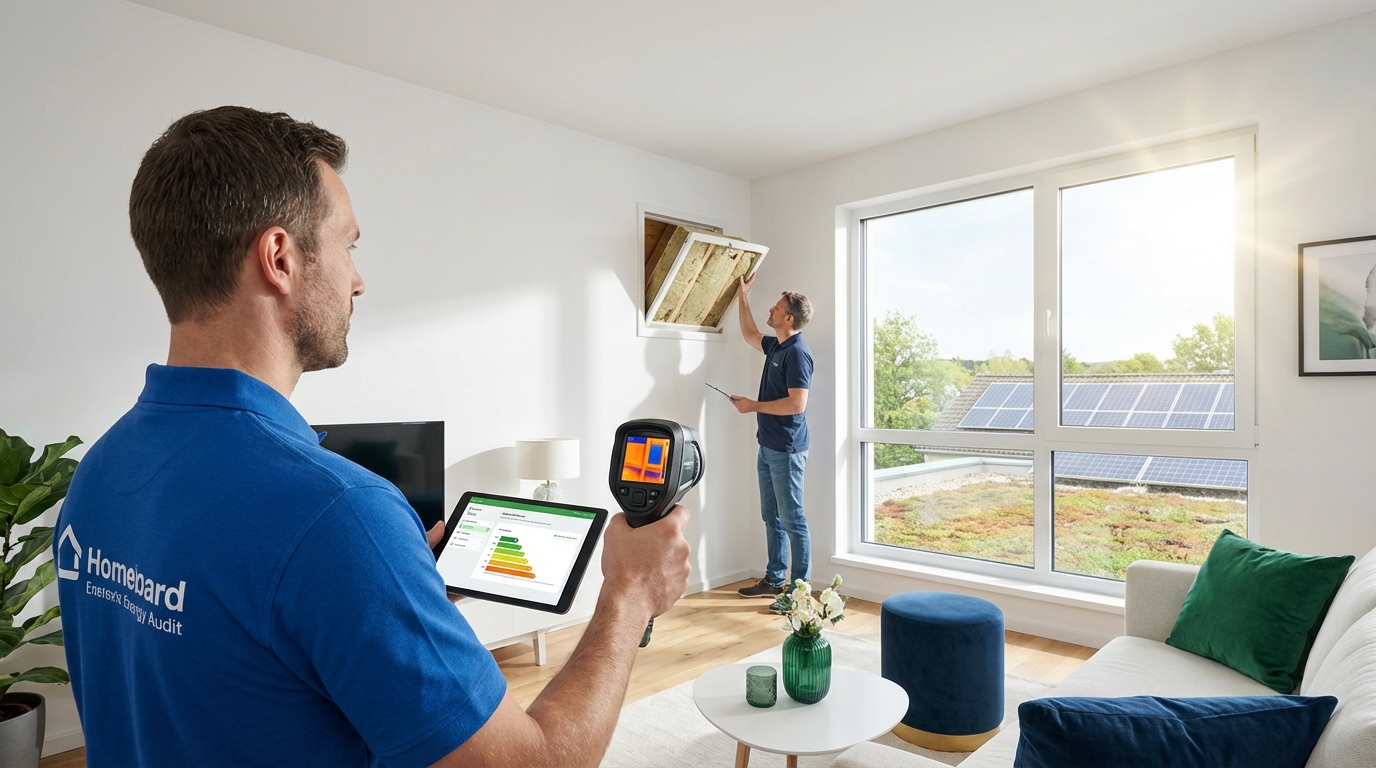
Up to 30% of a home’s heating and cooling energy is lost through undetected air leaks in walls, windows, and ductwork. This invisible drain on your finances happens year-round, silently increasing your utility bills every single month. And without a clear diagnostic, homeowners are just guessing at solutions, often wasting thousands on upgrades that don't fix the root problem. So the first step to cutting energy waste isn't a new furnace; it's a comprehensive assessment.
What is a Professional Home Energy Audit and Why is it a Smart Investment?
A professional home energy audit is a comprehensive evaluation of a home's energy consumption, identifying air leaks and insulation gaps through diagnostic testing. For 2026, it serves as a prerequisite for accessing up to $8,000 in federal Inflation Reduction Act (IRA) electrification rebates and state-level incentives.
A home energy audit, also called an energy assessment, provides a detailed roadmap for improving your home's efficiency. But it's not just about finding problems. It's about prioritizing fixes that deliver the highest return on investment. The audit report details specific actions, from air sealing the attic to upgrading insulation, that will cut your energy bills by 5% to 30%. So what does a 30% air loss mean for your wallet? For the average U.S. household, that's over $500 in wasted energy costs annually according to the Department of Energy. But a professional energy audit pinpoints these exact issues, unlocking a clear roadmap to savings and qualifying you for thousands in home improvement rebates. It's the essential first step before undertaking any energy-efficient upgrades.
What Rebates and Financial Incentives Are Available for Home Energy Audits and Upgrades in My [State/Utility Area]?
State and utility energy audit rebates are financial incentives designed to lower the upfront cost of an assessment, often covering 50-100% of the fee. In 2026, many programs offer instant rebates of $150 to $500 or provide the audit for a reduced co-pay of just $50.
Financial incentives for home energy audits vary dramatically by location, but they are widely available. For example, the Mass Save program in Massachusetts offers no-cost energy assessments for eligible homeowners. And many utilities across the country provide similar programs with rebates that cover a portion of the audit cost, often up to $300. But the audit itself is just the beginning. The real value comes from the upgrades it unlocks. An audit is the required gateway to accessing thousands in federal energy tax credits and state-specific rebates for things like insulation, air sealing, and new windows. So completing an audit not only identifies savings opportunities but also provides the documentation needed to claim these lucrative incentives.
"A home energy audit helps you pinpoint where your house is losing energy and what you can do to save money." — U.S. Department of Energy
Am I Eligible for Energy Audit Grants? Understanding Income Limits and Qualified Equipment
Energy audit grants are programs, often federally funded and state-administered, that provide no-cost audits and upgrades to low- and moderate-income households. For 2026, eligibility is typically set at or below 80% of the Area Median Income (AMI), qualifying a family for comprehensive weatherization services.
Eligibility for energy audit grants is almost always tied to household income relative to the Area Median Income. For instance, the federal Weatherization Assistance Program (WAP) provides an average of $8,000 in energy efficiency services per home at no cost to families who qualify. But you must meet the income requirements, which are updated annually. So you need to check your state's WAP administrator for the 2026 income thresholds. These programs go beyond a simple audit; they often include the installation of qualified equipment like insulation, air sealing materials, and sometimes even new heating systems. And the audit is the first step in the process, identifying which upgrades your home needs most to maximize health, safety, and energy savings.
How Do I Apply for Home Energy Audit Programs and What Are the Deadlines and Funding Status?
The application process for a home energy audit program typically involves contacting your local utility or a state-approved energy services organization to schedule an assessment. Most 2026 programs operate on a first-come, first-served basis until annual funds, often between $1 million and $10 million, are depleted.
Applying for an energy audit rebate is straightforward. The first step is to visit your utility's website or the DSIRE database of state incentives to find programs in your area. And most applications are simple online forms where you provide your address and utility account number. But program funding is finite. Deadlines are often rolling, meaning the program closes once the allocated budget for 2026 is exhausted. So it's critical to apply early in the calendar year. Some states have waitlists, while others simply close applications until the next funding cycle. Use our free rebate calculator to find active programs and check their current funding status before you schedule your audit.
| Program Example (2026) | Max Rebate Amount | Typical Income Limit | Application Deadline |
|---|---|---|---|
| Utility Audit Rebate | $300 | None | Rolling (until funds last) |
| State Weatherization Grant | $8,000+ (for upgrades) | <80% Area Median Income | Varies by state |
| Home Electrification (IRA) | $150 (for audit) | <150% Area Median Income | September 30, 2031 |
Who Can Perform My Professional Energy Audit? Understanding Contractor Requirements and Stacking Rules for Incentives.
A professional energy audit must be performed by a certified energy advisor or a contractor accredited by an organization like the Building Performance Institute (BPI). For 2026, many rebate programs require the auditor to be on a pre-approved list maintained by the state or utility administrator.
Not just any contractor can perform an audit that qualifies for rebates. Your state or utility will have a list of certified professionals. And these contractors have specialized training and use diagnostic tools like blower doors and infrared cameras.
"Many states and utilities offer incentives for home energy assessments and for the installation of energy efficiency upgrades." — DSIRE
So choosing an uncertified auditor will invalidate your eligibility for incentives. It's also important to understand stacking rules. In many cases, you can combine a utility rebate for the audit with state and federal incentives for the resulting upgrades, like new heat pump rebates. But some programs have anti-stacking rules, so you must confirm with the program administrator which incentives can be combined to maximize your total savings, which can exceed $10,000.
Official Sources
- Department of Energy (DOE) Energy Saver — Official U.S. government resource for home energy savings, audits, and information on federal rebate programs.
- Database of State Incentives for Renewables & Efficiency (DSIRE) — The most comprehensive source for up-to-date information on state, local, utility, and federal incentives for energy efficiency.
Related Reading: Learn more about Diy Vs Professional Energy Audit Cost and Home Energy Audit Tax Deduction.
Frequently Asked Questions
How much does a professional home energy audit typically cost?
A professional home energy audit typically costs between $300 and $700 in 2026. But many utility programs offer free or heavily discounted audits, sometimes for as little as a $50 co-pay for their customers. So it's essential to check with your local electric or gas provider before scheduling, as you can often get the service for a fraction of the market price.
What specific tests and procedures are performed during a professional home energy audit?
A professional audit includes several key diagnostic tests. The technician will perform a blower door test to measure your home's overall air leakage rate. And they will use an infrared camera to visually identify insulation gaps and air leaks in walls and ceilings. They also inspect ductwork, insulation levels, and combustion safety on appliances like furnaces and water heaters, providing a comprehensive report within 7-10 days.
Is a professional home energy audit truly worth the investment for homeowners?
Yes, a professional energy audit is worth the investment. It provides a prioritized action plan that can reduce annual energy bills by 5% to 30%, saving the average family over $500 per year. And the audit is often a required first step to unlock thousands of dollars in state and federal rebates for upgrades like insulation and new HVAC systems, delivering a return far greater than its initial cost.
What are the eligibility requirements to schedule a professional home energy audit?
The primary eligibility requirement is being a customer of the sponsoring utility or a resident of the state offering the program. Some income-based programs require your household income to be below 80% or 150% of the Area Median Income. For most market-rate utility programs in 2026, the only requirement is that you are the homeowner or have the owner's permission to conduct the audit.
How does a professional energy audit help me qualify for home improvement rebates?
A professional energy audit serves as the official documentation required by many rebate programs. The audit report validates the need for specific upgrades, such as adding 12 inches of attic insulation or air sealing a leaky basement. And this report becomes part of your application for state and federal incentives, proving that the work is medically necessary for the health of your home and qualifies for funding.
Unlock Your Home's Savings Potential
Stop guessing where your home is wasting energy. A professional home energy audit is the first step to lower utility bills and unlocking thousands in rebates. Use our free tool to see what incentives you qualify for in 2026.
Calculate Your Savings NowUpdated on April 14, 2026. Fact-checked by DuloCore Editors. About our research team.