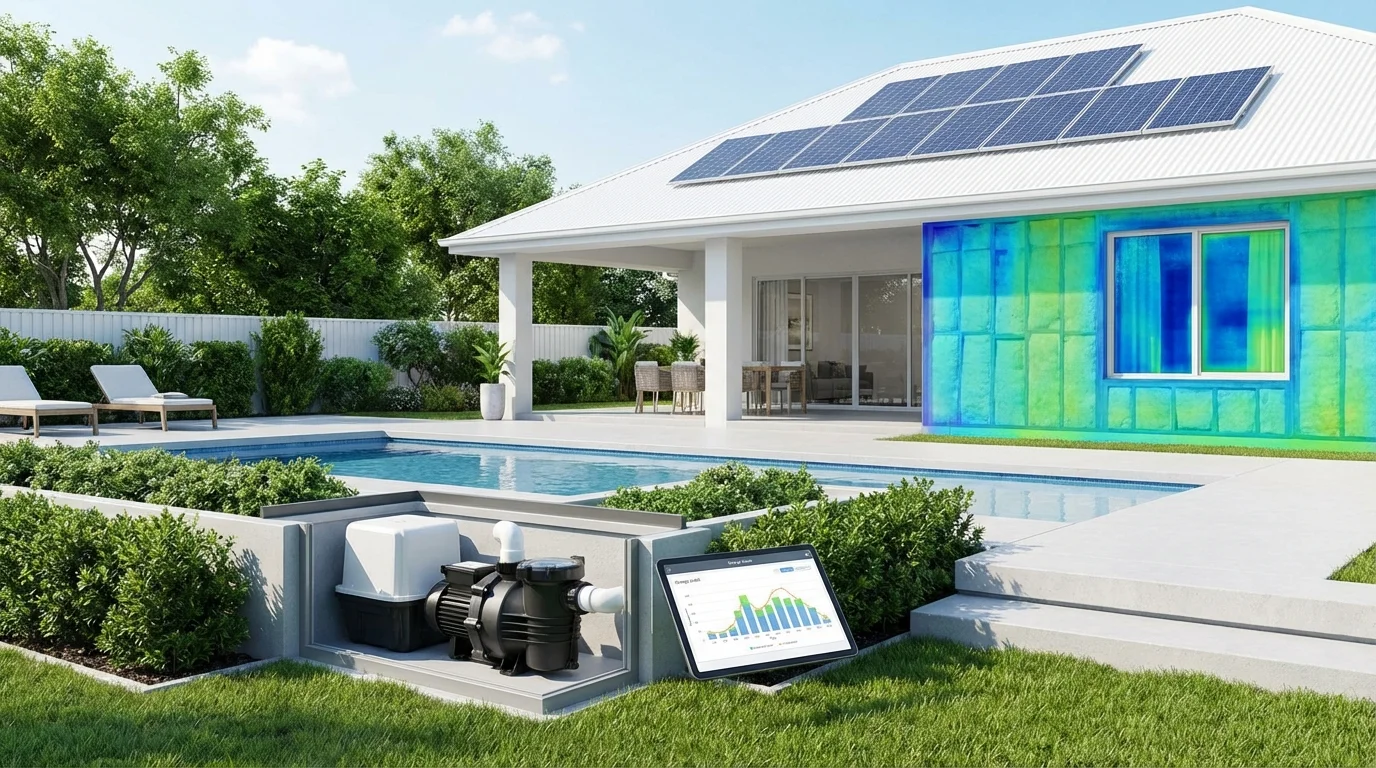
A single-speed pool pump is often the second-largest energy consumer in a home, costing homeowners up to $500 annually in unnecessary electricity charges. Upgrading after an energy audit cuts this expense by up to 90%, yet millions of inefficient pumps continue to operate, wasting both energy and money every single day.
How Much Can I Save on My Pool Pump Energy Bill, and What Rebates Are Available in My State or Utility Area?
A pool pump energy audit identifies savings opportunities by upgrading to a variable-speed model, which reduces energy use by up to 90%. So, this translates to annual bill savings of $300 to $450 for the average pool owner in 2026. Rebates vary by location.
So what? Why does this matter? The core issue is that older, single-speed pool pumps run at a constant high speed, consuming between 1,500 and 2,500 watts per hour. And according to the Department of Energy, this makes them one of the most energy-intensive appliances in a home. But a professional home energy audit quantifies this waste, revealing that a variable-speed pump operating at lower speeds consumes as little as 200 watts. So, this audit provides the specific data needed to justify an upgrade and unlock utility rebates designed to reduce grid strain. The savings aren't just theoretical; they are a direct result of correcting a 90% inefficiency.
A pool pump energy audit reveals that replacing an outdated single-speed pump with an ENERGY STAR certified variable-speed model saves homeowners between $300 and $450 annually on electricity bills. And in 2026, state and utility rebate programs offer direct incentives ranging from $100 to $400 for these qualifying upgrades. For instance, California's programs offer up to $400, while Florida utilities provide around $250. But these programs are location-specific and require verification. So, homeowners must check with their local utility provider for precise rebate amounts and eligibility. Use our free rebate calculator to find your exact savings. The audit itself often identifies these programs as part of its final report, streamlining the path to lower energy costs.
"ENERGY STAR certified in-ground pool pumps are, on average, 65% more energy-efficient than standard models." — ENERGY STAR
Does My Pool Pump or Household Qualify for Energy Audit Savings and Rebates, Including Income Limits?
Household qualification for pool pump rebates in 2026 hinges on purchasing an ENERGY STAR certified variable-speed model and meeting local utility requirements. And some programs, particularly those funded by federal grants, include income limits, typically capping eligibility at 80% to 150% of the Area Median Income (AMI).
Qualification for pool pump rebates depends on specific criteria set by the utility or state program. So, the primary requirement is purchasing and installing a new, ENERGY STAR certified variable-speed pool pump. And many programs require the homeowner to be a customer of the sponsoring utility. But some 2026 programs also have income-based restrictions, especially those tied to the IRA's Home Energy Rebates. For these, eligibility is often tiered, with households earning below 80% of the Area Median Income (AMI) receiving the largest rebates, sometimes covering 100% of the equipment cost up to a cap of $1,000. So, higher-income households above 150% AMI are often ineligible for these specific enhanced rebates but still qualify for standard utility incentives or federal energy tax credits.
What's the Step-by-Step Application Process for Pool Pump Energy Rebates, and Are There Specific Contractor Requirements?
The application process for 2026 pool pump rebates involves a pre-approval, installation by a licensed contractor, and submission of final invoices. So, many utility programs mandate that the installer holds a state-specific license (e.g., C-53 in California) to ensure proper installation and energy savings verification.
The application process typically follows four steps. First, the homeowner confirms eligibility and reserves funds through the utility's online portal, often requiring a recent energy bill. Second, they hire a qualified contractor; many rebate programs maintain a list of pre-approved or licensed professionals required for the installation. And this step is critical, as improper installation voids both warranties and rebate eligibility. Third, after the ENERGY STAR variable-speed pump is installed, the contractor provides a detailed, itemized invoice. So, the final step is submitting this invoice, the completed rebate application form, and proof of purchase online before the program's deadline. The rebate is then issued as a check or bill credit within 6-8 weeks.
What Are the Deadlines and Current Funding Status for Pool Pump Energy Audit and Rebate Programs?
Most 2026 state and utility pool pump rebate programs operate on a calendar or fiscal year basis, with application deadlines typically falling on December 31, 2026. And funding is allocated annually and distributed on a first-come, first-served basis, often becoming fully subscribed by Q4.
Deadlines for pool pump rebates are strict and non-negotiable. So, for 2026, most utility programs require applications to be submitted by the end of the calendar year, though some have earlier deadlines in Q3 or Q4. And the funding status is a crucial factor; these programs are allocated a fixed budget each year. Once the funds are exhausted, the program closes to new applicants until the next funding cycle, regardless of the official deadline. For example, popular programs in states like Arizona and Texas often deplete their funds by October. But homeowners can check the current funding status on their utility's rebate website. So, applying early in the year is the most effective strategy to ensure a rebate is secured before the program's budget is fully claimed. Waiting until the summer swimming season is a common mistake that leads to missed savings.
Can I Combine or "Stack" Multiple Rebates to Maximize My Pool Pump Energy Savings?
Homeowners can often combine or "stack" multiple incentives for a new variable-speed pool pump in 2026. And this includes pairing a local utility rebate of $100-$400 with state-level incentives or manufacturer discounts. So, this strategy reduces the net installation cost by 50% or more.
Stacking rebates is a powerful strategy for maximizing savings on a new pool pump. The most common combination involves a direct cash rebate from a local utility company (e.g., $250 from Duke Energy) and a separate manufacturer's rebate (e.g., $50 from Pentair). And in some states, additional incentives are available through broader energy efficiency programs. However, it's essential to read the terms for each program. But some government-funded programs, like certain IRA provisions, explicitly prohibit combining their rebates with other federal incentives for the same equipment. So, a homeowner can typically stack a local utility rebate with a federal tax credit but cannot claim two separate federal grants for the same pump. Reviewing the rules on platforms like the DSIRE database is a necessary step.
Pool Pump Rebate Program Comparison (2026)
| Program / Location | Rebate Amount | Key Eligibility Requirement | 2026 Deadline |
|---|---|---|---|
| CA Utilities (PG&E, SCE) | Up to $400 | ENERGY STAR Certified VSP | Dec 31, 2026 |
| FL Power & Light (FPL) | $250 | Must be an FPL customer | Dec 31, 2026 |
| Austin Energy (TX) | $300 | Installation by approved contractor | Sept 30, 2026 |
| Salt River Project (AZ) | $200 | Must replace a single-speed pump | April 30, 2026 |
Official Sources
- ENERGY STAR — Official federal resource detailing the benefits and certification requirements for energy-efficient pool pumps.
- Database of State Incentives for Renewables & Efficiency (DSIRE) — A comprehensive national database of state, local, utility, and federal incentives for energy efficiency, including pool pumps.
"Saving energy is a great way to reduce your carbon footprint. When you consume less power, you reduce the amount of toxic fumes released by power plants, conserve the earth’s natural resources, and protect ecosystems from destruction." — U.S. Department of Energy
Related Reading: Learn more about Radiant Barrier Energy Savings.
Frequently Asked Questions
Who qualifies for pool pump energy audit rebates?
Qualification for 2026 rebates typically requires being a customer of the sponsoring utility and replacing an existing single-speed pump with a new, ENERGY STAR certified variable-speed model. Some programs, especially those with enhanced rebates over $500, also have income limits, often restricting eligibility to households earning less than 150% of the Area Median Income (AMI).
How much can I typically save on my energy bill after a pool pump audit?
After a pool pump audit and subsequent upgrade to an ENERGY STAR variable-speed model, a typical homeowner saves between $300 and $450 on their annual electricity bill. The exact savings depend on local electricity rates, pool size, and the pump's daily runtime, but a 70-90% reduction in pump-related energy consumption is standard.
What is the process for getting a pool pump energy audit and applying for savings?
The process begins with scheduling an audit with your utility or a certified technician to confirm high energy usage. After receiving the report, purchase a qualifying ENERGY STAR pump. Next, have a licensed contractor install it. Finally, submit the rebate application online with the paid invoice and proof of purchase before the program's 2026 deadline.
Are there deadlines to claim pool pump energy audit savings or rebates?
Yes, all rebate programs have strict deadlines. For 2026, most utility programs require applications to be submitted by December 31, 2026. However, funding is limited and distributed on a first-come, first-served basis. Popular programs often run out of money by Q4, so applying as early in the year as possible is crucial.
How do the energy savings from a new variable-speed pump compare to my old pump post-audit?
A new variable-speed pump uses up to 90% less energy than an old single-speed model. An audit reveals that a single-speed pump consumes a constant 2,000 watts. In contrast, a variable-speed pump runs at a lower speed for longer periods, consuming as little as 200 watts. This difference results in annual savings of $300-$450.
Unlock Your Pool Pump Savings Now
Stop overpaying on your energy bills. Use DuloCore’s free Rebate Calculator to instantly find every pool pump rebate and tax credit you qualify for in your area.
Calculate Your SavingsLast reviewed: April 14, 2026. Reviewed by DuloCore Energy Specialists. About the team.