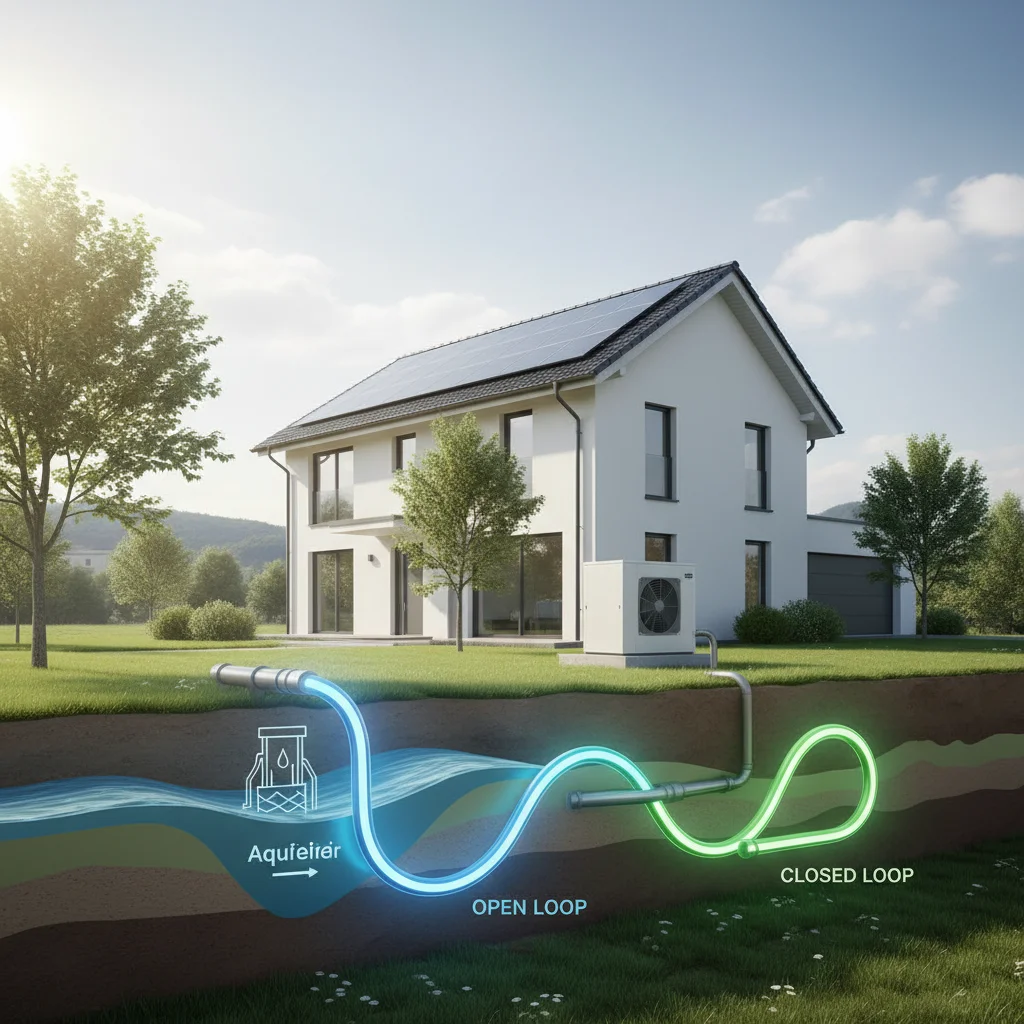
Installing a geothermal heat pump can cut home heating and cooling costs by 30-60% annually—but choosing between open loop and closed loop systems means the difference between a $15,000 installation and a $30,000 one. The wrong choice for your property can add $10,000 in unnecessary drilling costs or create maintenance headaches that erase your energy savings.
What's the difference between open loop and closed loop geothermal systems?
Open loop geothermal systems pump groundwater directly from a well through the heat pump and discharge it into a pond, stream, or separate well. Closed loop systems circulate antifreeze solution through sealed underground pipes in continuous loops—either horizontally in shallow trenches or vertically in deep boreholes. Open loop systems cost $10,000-$18,000 installed while closed loop systems run $15,000-$30,000 depending on loop configuration and soil conditions.
So why does this matter? The system type determines your installation cost and ongoing maintenance requirements. And property characteristics like water table depth and available land area often eliminate one option entirely.
Which geothermal system qualifies for rebates in 2026?
The federal Residential Clean Energy Credit (Section 25D) ended for expenditures made after December 31, 2025, and the IRS treats an expenditure as made when installation is completed (IRS FS-2025-05). Federal tax credits for this work have ended, but state, local and utility rebates may still apply; check what is available at your address with the DuloCore rebate calculator. The system must meet ENERGY STAR certification requirements with a Coefficient of Performance (COP) of at least 3.3 for closed loop systems or 3.6 for open loop configurations. State and utility rebates vary by location but California's TECH Clean California program offers $3,000-$7,000 for qualifying geothermal installations through participating utilities in 2026.
"Geothermal heat pumps are among the most efficient heating and cooling technologies available, using 25% to 50% less electricity than conventional systems." — U.S. Department of Energy
How much can you save with an open loop vs closed loop system over 25 years?
A properly sized geothermal system saves $800-$1,500 annually on heating and cooling costs compared to conventional HVAC systems. Over a 25-year lifespan, that translates to $20,000-$37,500 in energy savings. Closed loop systems typically deliver 10-15% higher efficiency than open loop configurations because sealed loops maintain consistent heat transfer fluid properties and avoid mineral buildup that degrades open loop heat exchanger performance over time.
And the savings compound when you factor in avoided replacement costs. A conventional furnace and air conditioner require replacement every 15-20 years while geothermal ground loops last 50+ years. So a homeowner installing geothermal in 2026 avoids at least one complete HVAC replacement worth $8,000-$12,000.
What's the typical payback period for each geothermal system type?
Open loop systems achieve payback in 5-8 years when adequate groundwater is available because lower upfront costs offset their slightly reduced efficiency. Closed loop systems reach payback in 7-12 years depending on local energy costs and available incentives. Use our free rebate calculator to estimate your specific payback period based on your home size, location, and current heating costs.
But payback period calculations change with available state and utility rebates; federal tax credits no longer apply (IRS FS-2025-05).
| System Type | Installation Cost | Annual Savings | Payback Period | Ground Loop Lifespan |
|---|---|---|---|---|
| Open Loop | $10,000-$18,000 | $800-$1,200 | 5-8 years | 25+ years |
| Closed Loop Horizontal | $15,000-$25,000 | $900-$1,400 | 8-12 years | 50+ years |
| Closed Loop Vertical | $20,000-$30,000 | $1,000-$1,500 | 8-11 years | 50+ years |
How long do open loop and closed loop geothermal systems actually last?
The indoor heat pump unit lasts 20-25 years regardless of loop type when properly maintained. But closed loop ground loops outlast open loop wells by a factor of two—sealed HDPE pipe loops remain functional for 50+ years while open loop wells require redevelopment or replacement every 20-30 years due to mineral encrustation and biological fouling. And pump replacement costs $800-$1,500 for open loop systems every 7-10 years compared to essentially zero maintenance for closed loops.
So total cost of ownership over 50 years heavily favors closed loop configurations despite higher installation costs. A homeowner installing an open loop system in 2026 faces well redevelopment costs of $2,000-$5,000 around 2046 plus two additional heat pump replacements by 2076.
Open loop vs closed loop: Which system offers better long-term ROI?
Closed loop vertical systems deliver the highest ROI in most scenarios because 50-year ground loop lifespan and minimal maintenance requirements offset 30-50% higher installation costs. But open loop systems win on properties with abundant high-quality groundwater and discharge options where installation costs stay below $15,000. And horizontal closed loop configurations offer middle-ground ROI on properties with sufficient land area but challenging drilling conditions that make vertical loops prohibitively expensive.
Calculate your specific ROI using the rebate calculator with your actual energy costs and available incentives. Or consult a certified geothermal installer for a site-specific feasibility analysis—soil thermal conductivity, water table depth, and local drilling costs create order-of-magnitude variation in total project economics.
Official Sources
- U.S. Department of Energy Geothermal Heat Pumps — Technical specifications and efficiency standards for residential geothermal systems
- ENERGY STAR Geothermal Heat Pump Requirements — Federal certification standards and qualified product listings
- DSIRE Database — Comprehensive state and utility rebate program directory
Frequently Asked Questions
What is the difference between open loop and closed loop geothermal systems?
Open loop systems pump groundwater directly through the heat pump and discharge it elsewhere while closed loop systems circulate sealed antifreeze solution through underground pipes. Open loop configurations require adequate groundwater supply and discharge location. Closed loop systems work anywhere but cost 30-60% more to install. Both deliver 300-500% heating efficiency compared to 95% for gas furnaces.
How much money can you save with an open loop geothermal system?
Open loop geothermal systems save $800-$1,200 annually on heating and cooling costs compared to conventional HVAC in moderate climates. A typical 2,000 square foot home in Northern California replacing a natural gas furnace and electric air conditioner sees payback in 6-8 years. Annual savings increase to $1,500+ in regions with extreme temperatures or high electricity rates above $0.25/kWh.
Is an open loop or closed loop geothermal system better for my home?
Properties with water table depths under 100 feet and discharge options favor open loop systems due to 30-40% lower installation costs. Closed loop configurations work better on smaller lots without adequate groundwater or in areas with strict groundwater discharge regulations. And closed loop vertical systems deliver highest efficiency and longest lifespan despite premium installation costs of $20,000-$30,000 for drilling.
What are the installation costs for open loop vs closed loop geothermal?
Open loop system installation costs $10,000-$18,000 including heat pump, well pump, and heat exchanger. Horizontal closed loop systems cost $15,000-$25,000 depending on trench length and soil conditions. Vertical closed loop installations run $20,000-$30,000 because drilling boreholes 150-400 feet deep costs $10-$30 per linear foot. But state incentives reduce net costs by $3,000-$7,000 in 2026.
Can you use an open loop geothermal system in any climate?
Open loop geothermal systems work in any climate where adequate groundwater is available year-round at 45-75°F temperatures. But freezing conditions require discharge piping burial below frost line depth of 24-48 inches. And arid regions with water tables deeper than 200 feet make open loop installations cost-prohibitive compared to closed loop alternatives. Water quality issues like high iron content or acidity add $1,500-$3,000 for stainless steel heat exchangers.
Ready to find out how much you can save with geothermal? Use our free rebate calculator to get personalized savings estimates, available incentives, and payback period for both open loop and closed loop systems based on your exact location and home characteristics.
Updated: April 14, 2026 — fact-checked by DuloCore Research. About our editorial process.
Check your California heat pump rebate eligibility — see the programs you qualify for and the dollar amounts on our California heat pump rebate finder.