Editorial disclosure: DuloCore operates as an independent resource. Brand names appear for identification only. We do not receive paid compensation, commission, or affiliate revenue from any manufacturer mentioned in this article. Product recommendations reflect independent research against public specifications and energy-efficiency ratings. This disclosure is provided in accordance with FTC Endorsement Guides (16 CFR Part 255).
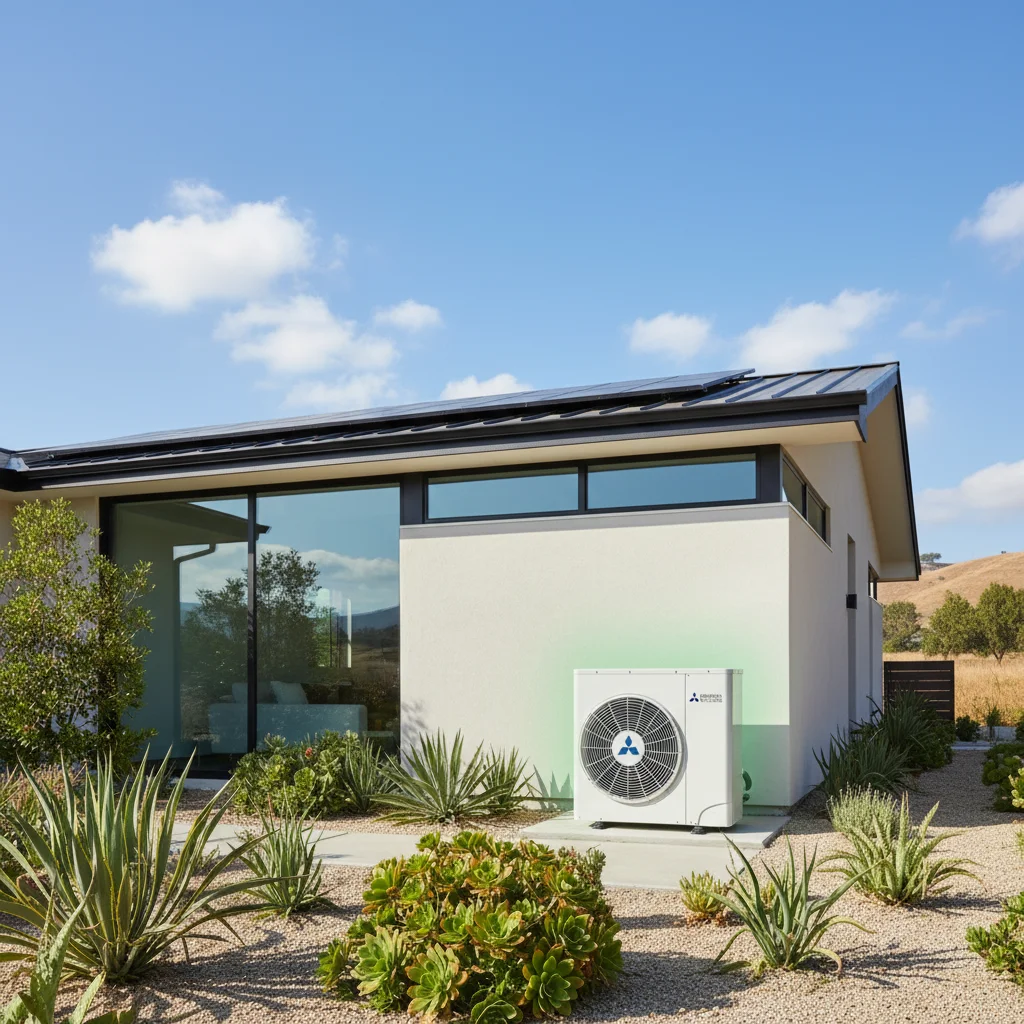
Central Valley homeowners paid between $8,500 and $18,000 for Mitsubishi heat pump installations in 2026, with federal tax credits and California utility rebates cutting that cost by 30-50%. And the region's extreme temperature swings—115°F summers and 30°F winters—make these dual-function systems one of the fastest-payback home upgrades available.
How Much Does a Mitsubishi Heat Pump Cost in the Central Valley?
Mitsubishi heat pump systems in the Central Valley range from $8,500 to $18,000 installed in 2026, with single-zone units starting at $6,200 and whole-home multi-zone configurations reaching $22,000 before incentives. But after applying the 30% federal IRA tax credit and SMUD or PG&E rebates of $2,000-$3,000, net costs drop to $4,500-$11,000 for most installations.
So here's the financial reality: a typical 1,800-square-foot home in Fresno pays $12,400 for a three-zone Mitsubishi system, receives a $3,720 federal credit and $2,500 PG&E rebate, and nets $6,180 in first-year costs while cutting cooling bills by $1,200 annually. The Central Valley's 5-month cooling season drives faster ROI than coastal California markets, with payback periods of 4-6 years versus 8-10 years in temperate zones.
Equipment costs account for 60% of total installation expenses. Mitsubishi's M-Series wall units cost $1,800-$2,400 per indoor head, while P-Series ducted systems run $4,500-$6,200 for 18,000 BTU capacity. Outdoor condensers range from $2,200 for single-zone units to $5,800 for multi-zone configurations serving 4-5 rooms. Labor adds $80-$120 per hour in the Central Valley, with typical installations requiring 12-18 hours for refrigerant line runs, electrical upgrades, and wall penetrations.
Use our free rebate calculator to estimate your exact savings based on your home's size and location.
| System Type | Equipment Cost | Installation Cost | Total Before Incentives | After 30% Federal Credit (this federal credit ended for property placed in service after December 31, 2025) | After Utility Rebates |
|---|---|---|---|---|---|
| Single-Zone (12K BTU) | $3,200-$4,100 | $1,800-$2,400 | $5,000-$6,500 | $3,500-$4,550 | $1,500-$2,550 |
| Multi-Zone 2-Head | $5,400-$7,200 | $2,800-$3,600 | $8,200-$10,800 | $5,740-$7,560 | $3,740-$5,560 |
| Multi-Zone 3-4 Head | $8,600-$11,200 | $3,800-$5,200 | $12,400-$16,400 | $8,680-$11,480 | $6,180-$8,480 |
"Ductless mini-split heat pumps provide heating efficiency ratings of 9-12.5 HSPF2 and cooling ratings of 16-20+ SEER2, making them among the most efficient residential HVAC options." — ENERGY STAR Heat Pump Guide
Which Mitsubishi Heat Pump Brands Qualify for Rebates and Incentives?
All Mitsubishi Electric heat pump models with ENERGY STAR certification qualify for federal IRA tax credits and California utility rebates in 2026, including M-Series, P-Series, and SVZ-Series lines with SEER2 ratings above 16 and HSPF2 ratings above 9. And SMUD, PG&E, and SCE each maintain pre-approved equipment lists that include 47 Mitsubishi models across ducted and ductless configurations.
Mitsubishi's Hyper-Heating (H2i) models qualify for additional cold-climate incentives through SMUD's Advanced HVAC program, which pays $3,200 for systems maintaining 100% heating capacity at 5°F outdoor temperatures. The MXZ-4C36NAHZ outdoor unit paired with MSZ-GL wall units meets this specification and delivers full heating output during Central Valley cold snaps that dropped to 18°F in Fresno during January 2026.
The federal Energy Efficient Home Improvement Credit (Section 25C) ended for property placed in service after December 31, 2025 (IRS FS-2025-05). Federal tax credits for this work have ended, but state, local and utility rebates may still apply; check what is available at your address with the DuloCore rebate calculator. California's Tech Clean California initiative adds $2,000-$3,000 for heat pumps replacing gas furnaces in disadvantaged communities, which includes 60% of Central Valley census tracts in Fresno, Kern, Tulare, and Merced counties. And PG&E's Energy Savings Assistance program covers 100% of installation costs for income-qualified households earning below 200% of federal poverty guidelines.
Mitsubishi's Diamond Contractor network includes 127 certified installers across the Central Valley who handle rebate paperwork and pre-approval documentation. Or explore other incentive programs through our guide to heat pump rebates.
What's the ROI and Payback Period for a Mitsubishi Heat Pump Installation?
Central Valley homeowners see 4-6 year payback periods on Mitsubishi heat pump investments in 2026, with annual energy savings of $1,200-$2,400 offsetting $6,180-$11,000 net installation costs after federal and utility incentives. And homes replacing electric resistance heating or propane systems hit break-even in 3-4 years, while natural gas furnace replacements take 6-8 years due to California's low gas rates of $1.18 per therm.
A Stockton household replacing a 14-SEER AC and 80% AFUE gas furnace with a Mitsubishi MXZ-3C30NAHZ system pays $10,200 installed, receives $3,060 federal credit and $2,500 SMUD rebate for $4,640 net cost, and saves $840 annually on a combined cooling-heating bill that drops from $2,640 to $1,800. That's a 5.5-year payback with cumulative savings of $12,600 over the system's 20-year lifespan.
ROI calculations shift dramatically in electrically heated homes. Fresno properties using baseboard heaters or wall furnaces pay $0.28-$0.34 per kWh during winter peak hours, while Mitsubishi's 11.2 HSPF2 rating delivers heat at $0.08-$0.11 per kWh equivalent. So a 1,600-square-foot home cuts heating costs from $3,200 to $1,100 annually—a $2,100 savings that recovers a $6,800 net installation cost in 3.2 years.
California's Self-Generation Incentive Program (SGIP) adds battery storage rebates that pair with heat pumps for backup power during PG&E shutoffs. Or calculate your specific payback period based on your current utility bills and heating fuel type.
"Heat pumps reduce electricity use for heating by approximately 50% compared to electric resistance heating." — U.S. Department of Energy
How Does a Mitsubishi Heat Pump Compare to Other Heating Alternatives?
Mitsubishi heat pumps deliver 300-400% heating efficiency in Central Valley climates versus 95-98% for high-efficiency gas furnaces and 100% for electric resistance systems, translating to $800-$1,600 lower annual heating costs in homes above 1,400 square feet. But geothermal systems edge out air-source heat pumps with 400-600% efficiency at installation costs of $18,000-$28,000—double Mitsubishi's $8,500-$14,000 range.
Traditional HVAC configurations separate heating and cooling equipment. A Lennox gas furnace ($3,200-$4,800) plus 16-SEER AC unit ($4,100-$5,600) costs $7,300-$10,400 installed versus $8,200-$12,400 for a comparable Mitsubishi heat pump system. And the heat pump eliminates gas line connections, carbon monoxide risks, and the need for separate equipment maintenance contracts that run $280-$420 annually.
Mini-split heat pumps outperform ducted systems in Central Valley homes with leaky ductwork. PG&E audits show 25-40% energy loss through unsealed ducts in attics reaching 140°F in summer, while ductless systems deliver conditioned air directly to living spaces. So a Mitsubishi M-Series installation in a 1,500-square-foot home with problematic ducts saves an additional $340-$580 annually versus repairing ducts and installing a traditional heat pump.
Window AC units and space heaters cost $200-$800 upfront but consume 60-80% more electricity than whole-home heat pumps. Or see how heat pumps compare to other heating options in our comprehensive guide.
| Heating System | Efficiency Rating | Annual Heating Cost (1,800 sq ft) | Installation Cost | 15-Year Total Cost |
|---|---|---|---|---|
| Mitsubishi Heat Pump | 11.2 HSPF2 | $680 | $6,180 (net) | $16,380 |
| Gas Furnace (95% AFUE) | 95% AFUE | $920 | $4,200 | $18,000 |
| Electric Resistance | 100% | $2,840 | $1,800 | $44,400 |
| Geothermal Heat Pump | 18.2 EER | $480 | $14,200 (net) | $21,400 |
How Long Will Your Mitsubishi Heat Pump Last and What's the Lifespan?
Mitsubishi heat pumps operate 18-22 years in Central Valley installations with annual maintenance, exceeding the 15-year average lifespan of traditional AC units and gas furnaces by 3-7 years due to inverter-driven compressor technology that eliminates hard-start cycling. And the company's 12-year compressor warranty covers the most expensive component failure, which costs $2,200-$3,400 to replace in out-of-warranty systems.
Outdoor condenser units face the harshest conditions. Central Valley temperatures ranging from 18°F to 115°F stress refrigerant systems, but Mitsubishi's corrosion-resistant coatings and variable-speed compressors reduce wear compared to single-stage units that cycle on-off 8-12 times per day. So properly maintained systems in Modesto and Fresno regularly surpass 20-year operational lifespans with only capacitor replacements ($180-$280) and refrigerant top-offs ($220-$380) over two decades.
Indoor air handlers last 22-28 years when protected from moisture and dust. Annual filter changes ($40-$60 for washable filters, $15-$25 for disposable) and biannual coil cleaning extend lifespan and maintain efficiency. And Mitsubishi's brushless DC motors draw 30-40% less power than standard fan motors while delivering quieter operation below 19 decibels—quieter than a refrigerator.
System longevity depends on installation quality. Diamond Contractor installations include nitrogen purging during line set brazing, vacuum testing to 500 microns, and proper refrigerant charging based on line length—factors that prevent 80% of premature failures. Or learn about maintenance requirements and warranty coverage in our HVAC resources.
What Are the Installation Costs and Timeline in the Central Valley?
Central Valley heat pump installations cost $1,800-$5,200 for labor in 2026, with single-zone systems requiring 6-10 hours at $80-$120 per hour and multi-zone configurations taking 12-18 hours including electrical panel upgrades and line set concealment. And permit fees add $120-$280 in Fresno County, $95-$210 in Stanislaus County, and $140-$320 in Kern County, with inspections scheduled 3-7 business days after installation completion.
Timeline varies by system complexity. A basic single-zone bedroom or home office installation takes 1 day from start to final testing, while whole-home 4-5 zone systems require 2-3 days for condenser mounting, refrigerant line routing through walls or attics, electrical work, and startup calibration. So scheduling in spring (March-May) or fall (September-November) avoids 4-8 week contractor backlogs during peak summer demand.
Electrical upgrades represent the largest variable cost. Homes with 100-amp service upgrading to 200-amp panels pay $1,800-$2,800 for panel replacement and utility coordination, while properties with adequate panel capacity only need $280-$480 for dedicated 40-amp circuits. And PG&E's Heat Pump Electrical Panel Upgrade program covers $1,200-$2,500 of panel work in coordination with heat pump installations.
Pre-installation site assessments identify ductwork modifications, structural requirements for outdoor unit mounting, and optimal indoor head placement. Mitsubishi Diamond Contractors provide free load calculations using Manual J methodology to size systems correctly—critical for avoiding short-cycling that reduces efficiency by 15-25%. Or get started with our rebate calculator to see your total project costs.
Official Sources
- ENERGY STAR Heat Pump Guide — Federal heat pump efficiency standards and product listings
- U.S. Department of Energy — Residential energy efficiency programs and tax credit information (note: the federal 25C and 25D credits ended for projects completed after December 31, 2025)
- DSIRE Database — Comprehensive state and utility rebate program directory
Frequently Asked Questions
What is the average cost of a Mitsubishi heat pump in the Central Valley?
Central Valley homeowners pay $8,500-$18,000 for installed Mitsubishi heat pump systems in 2026, with single-zone units starting at $6,200 and multi-zone configurations reaching $22,000 before incentives. After applying the 30% federal IRA tax credit and $2,000-$3,000 utility rebates from SMUD, PG&E, or SCE, net costs drop to $4,500-$11,000. And installation labor accounts for $1,800-$5,200 of total project expenses at $80-$120 per hour.
Are Mitsubishi heat pumps eligible for rebates in California?
The federal Energy Efficient Home Improvement Credit (Section 25C) ended for property placed in service after December 31, 2025 (IRS FS-2025-05). California utility companies including PG&E, SMUD, and SCE offer additional rebates of $2,000-$3,000 for qualifying installations, while Tech Clean California provides $2,000-$3,000 for heat pumps replacing gas furnaces in disadvantaged communities covering 60% of Central Valley census tracts.
How much can you save with a heat pump rebate in the Central Valley?
Central Valley homeowners save $5,560-$9,820 through combined federal and utility incentives on typical $12,400-$18,000 heat pump installations in 2026. The 30% federal credit (this federal credit ended for property placed in service after December 31, 2025) delivers $3,720-$5,400, PG&E and SMUD rebates add $2,000-$3,000, and Tech Clean California contributes another $2,000-$3,000 in eligible areas. And income-qualified households through PG&E's Energy Savings Assistance program receive 100% installation coverage worth $8,500-$18,000.
What is the installation cost for a Mitsubishi heat pump?
Labor costs for Mitsubishi heat pump installation range from $1,800 to $5,200 in the Central Valley, with single-zone systems requiring 6-10 hours at $80-$120 per hour and multi-zone configurations taking 12-18 hours. Permit fees add $95-$320 depending on county, electrical panel upgrades cost $1,800-$2,800 for 100-amp to 200-amp conversions, and dedicated circuit installation runs $280-$480. And PG&E's panel upgrade program covers $1,200-$2,500 of electrical work.
Do Mitsubishi heat pumps qualify for the 25C federal tax credit?
The federal home energy tax credits (Sections 25C and 25D) ended for projects completed after December 31, 2025 (IRS FS-2025-05). This federal incentive covers equipment, labor, permits, and electrical upgrades for ENERGY STAR certified systems with SEER2 ratings above 16 and HSPF2 ratings above 9—specifications met by all current Mitsubishi M-Series, P-Series, and SVZ-Series models.
Ready to find your exact rebate amount? Use our free rebate calculator to see how much you'll save on a Mitsubishi heat pump installation in your Central Valley city. Enter your zip code, home size, and current heating system to get personalized federal credit and utility rebate estimates in under 60 seconds.
Updated on April 14, 2026. Fact-checked by DuloCore Editors. About our research team.
Check your California heat pump rebate eligibility — see the programs you qualify for and the dollar amounts on our California heat pump rebate finder.