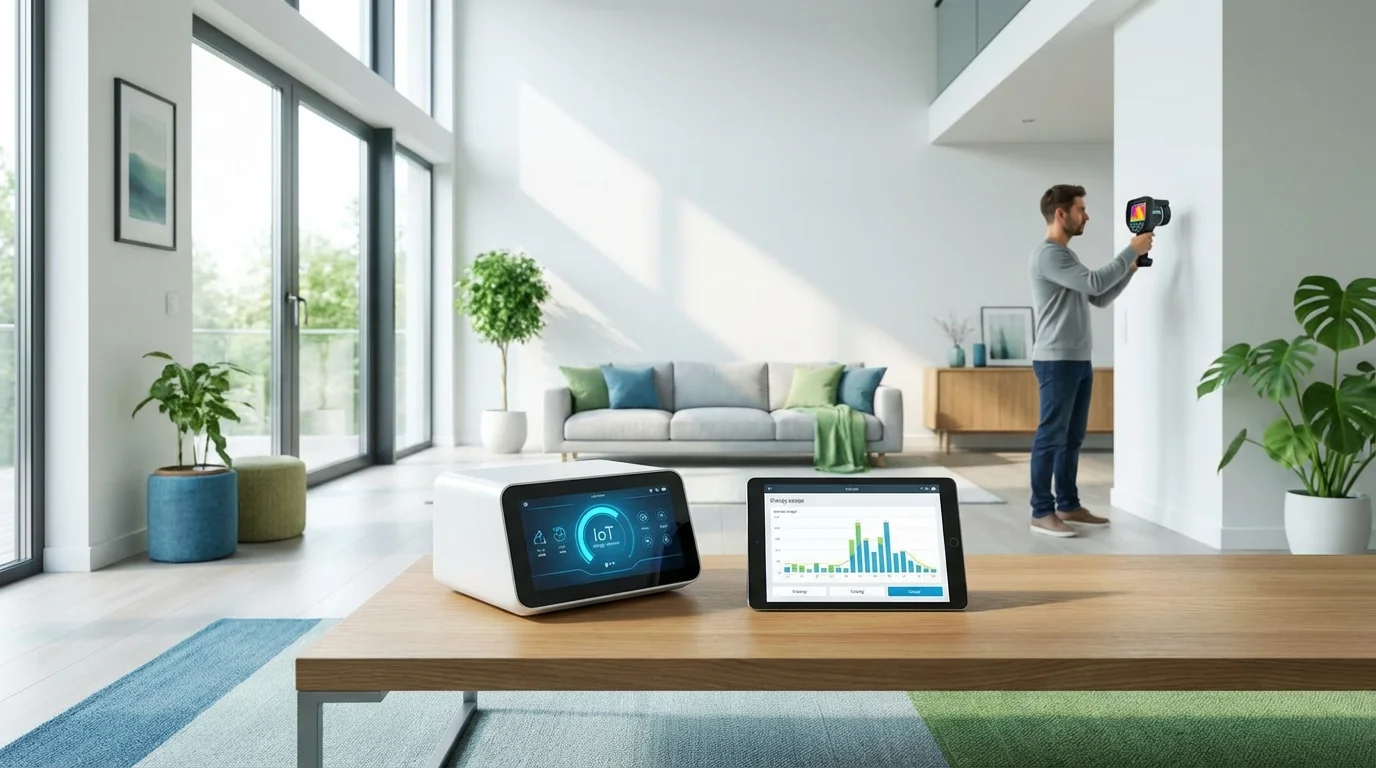
The average U.S. household has at least 25 "energy vampires"—electronics that draw power even when turned off or in standby mode, costing homeowners up to $200 per year in wasted electricity. IoT energy monitoring devices expose this hidden consumption in real-time, giving you direct control over your utility bills without guesswork. And this granular data is the first step toward identifying where to make impactful, cost-saving upgrades.
What financial incentives are available for IoT energy monitoring devices?
IoT energy monitoring device incentives are financial programs from utilities and states that offer cash-back rebates and tax credits in 2026. These programs provide direct rebates from $50 to $150 for qualifying smart thermostats and whole-home energy monitors, reducing the initial purchase price for homeowners.
Financial incentives for IoT energy monitoring devices primarily come from state governments and local utility providers. So these programs aim to reduce grid strain by encouraging energy-conscious behavior. Rebates typically range from $50 for a smart thermostat to $150 for a more advanced circuit-level monitoring system. And some programs bundle these devices with larger efficiency projects, like a home energy audit, to unlock higher rebate tiers. The federal Inflation Reduction Act (IRA) framework also provides support for energy efficiency upgrades, and while it doesn't always specify monitors, they often qualify as part of a larger project eligible for energy tax credits. But homeowners must verify that their specific device model appears on their utility's qualified products list to receive the incentive.
Am I eligible for rebates and grants on IoT energy monitoring systems?
Eligibility for IoT energy monitoring system rebates in 2026 depends on homeownership, geographic location within a specific utility's service area, and sometimes income level. Many programs require the applicant to be the homeowner and a current customer of the sponsoring utility company.
Eligibility rules are strict and non-negotiable. So homeowners must reside in the specified service territory, such as PG&E in California or Con Edison in New York. And some state programs, funded through federal grants, set income limits to prioritize low-to-moderate income (LMI) households, offering them rebates that cover up to 100% of the device cost. But for most standard utility rebates, income is not a factor. The primary requirements are being a residential customer and purchasing a new, qualifying ENERGY STAR® certified device. Verification often involves submitting a recent utility bill with the application.
How do I apply for incentives and what are the key deadlines?
The application process for IoT energy monitoring incentives involves purchasing a qualifying device, completing a program-specific application form, and submitting it with proof of purchase by the 2026 program deadline. Most programs operate on an annual cycle with deadlines typically set for December 31, 2026.
Applying for a rebate is a multi-step process that demands attention to detail. First, confirm your eligibility and identify a qualifying product from your utility's approved list. So after purchasing the device, you must complete the application form, which is usually available online. And you'll need to attach a dated sales receipt or invoice that clearly shows the model number and purchase price. Some programs offer instant rebates at the point of sale through participating retailers, which simplifies the process. But for post-purchase rebates, submission deadlines are critical; many 2026 programs have a final submission date of December 31, 2026, or 90 days from the purchase date, whichever comes first.
How can I maximize my savings and navigate specific program rules?
Maximizing savings involves stacking multiple incentives, such as a $75 utility rebate with a state tax credit, and selecting devices that unlock additional rebates for larger projects. Navigating program rules requires verifying contractor requirements and equipment eligibility lists before any purchase in 2026.
To get the most financial benefit, homeowners combine offers. For example, a $50 rebate from a utility for a smart thermostat can be stacked with a state-level credit if available. So this effectively doubles the savings on a single device. And installing an IoT monitor helps identify bigger energy hogs, like an old HVAC system, which qualifies for its own set of heat pump rebates worth up to $8,000. Use our free rebate calculator to find all available savings in your area. But be aware that some programs require installation by a licensed contractor, so a DIY installation would disqualify you from the rebate. Always check the program's specific terms and conditions before you buy.
Which states and utility companies offer the best IoT energy monitoring programs?
In 2026, states like California, Massachusetts, and New York lead with the most robust IoT energy monitoring programs, offering rebates from $75 to $150. Utility providers such as Pacific Gas and Electric (PG&E), Mass Save, and Austin Energy feature well-funded, accessible rebate options.
Certain regions offer more aggressive incentives. California's Self-Generation Incentive Program (SGIP) and utility-run initiatives from PG&E and Southern California Edison (SCE) provide substantial rebates for smart home devices that help manage grid load. And in the Northeast, the Mass Save program in Massachusetts offers rebates of up to $100 on qualifying smart thermostats. Texas residents served by Austin Energy can receive up to a $150 rebate for installing a whole-home energy monitor. These programs are popular and often funded on a first-come, first-served basis, so it's critical for homeowners to apply early in the 2026 calendar year before funds are depleted.
"Saving money is one of the biggest reasons to make your home more energy efficient. But making energy-efficient choices can also make your home more comfortable and durable, and help protect the environment." — U.S. Department of Energy
2026 IoT Energy Monitoring Incentive Comparison
| Program / Provider | Rebate Amount | Key Eligibility | Application Deadline |
|---|---|---|---|
| Mass Save (MA) | Up to $100 | Must be a residential customer of a participating utility. | December 31, 2026 |
| PG&E (CA) | $50 - $120 | Must be a PG&E residential electric customer. | Varies by program |
| Austin Energy (TX) | Up to $150 | Must be an Austin Energy residential customer; home built before 2010. | September 30, 2026 |
Official Sources
- DSIRE — A comprehensive database of state and federal incentives and policies for renewable energy and energy efficiency.
- ENERGY STAR — The official U.S. government-backed symbol for energy efficiency, providing product lists and savings information.
Frequently Asked Questions
What types of IoT energy monitoring devices qualify for rebates?
Qualifying devices typically include ENERGY STAR® certified smart thermostats from brands like Nest and Ecobee, as well as whole-home energy monitors that attach to your electrical panel, such as Sense or Emporia Vue. Utility programs maintain specific lists of eligible models, so homeowners must verify their chosen device is on the list before purchase to ensure it qualifies for the 2026 rebate.
How much can I expect to save with an IoT energy monitoring device rebate?
Homeowners can expect to save between $50 and $150 per device through a direct rebate. For a smart thermostat costing $200, a $75 rebate reduces the upfront cost by over 35%. Whole-home monitors, which can cost $300 or more, often receive larger rebates around the $150 mark from select utility programs in 2026.
What is the application process for an IoT energy monitoring device rebate?
The application process generally requires four steps. First, confirm eligibility with your local utility. Second, purchase a qualifying device from their approved product list. Third, complete the online or mail-in application form. Finally, submit the form along with a dated receipt or invoice before the program's 2026 deadline, which is often within 90 days of purchase.
Are there specific deadlines for IoT energy monitoring device rebate applications?
Yes, deadlines are strict. Most utility programs run on an annual cycle and require applications to be submitted by December 31, 2026. However, some have rolling deadlines, such as 60 or 90 days from the date of purchase. Because funding is often limited, it is best to apply as early in the year as possible before the program's budget is exhausted.
Do whole-home or individual appliance IoT monitors offer different rebate amounts?
Yes, rebate amounts often differ based on the device's capability. A single smart thermostat typically qualifies for a rebate between $50 and $100. A more comprehensive whole-home energy monitor that tracks circuit-level usage often qualifies for a higher rebate, ranging from $100 to $150, because it provides more valuable data for managing grid demand.
Find Your IoT Device Rebates Instantly
Don't leave money on the table. Use DuloCore's free rebate calculator to see how much you can save on IoT energy monitors and other home upgrades in your area.
Calculate Your Savings NowUpdated: April 14, 2026 — fact-checked by DuloCore Research. About our editorial process.