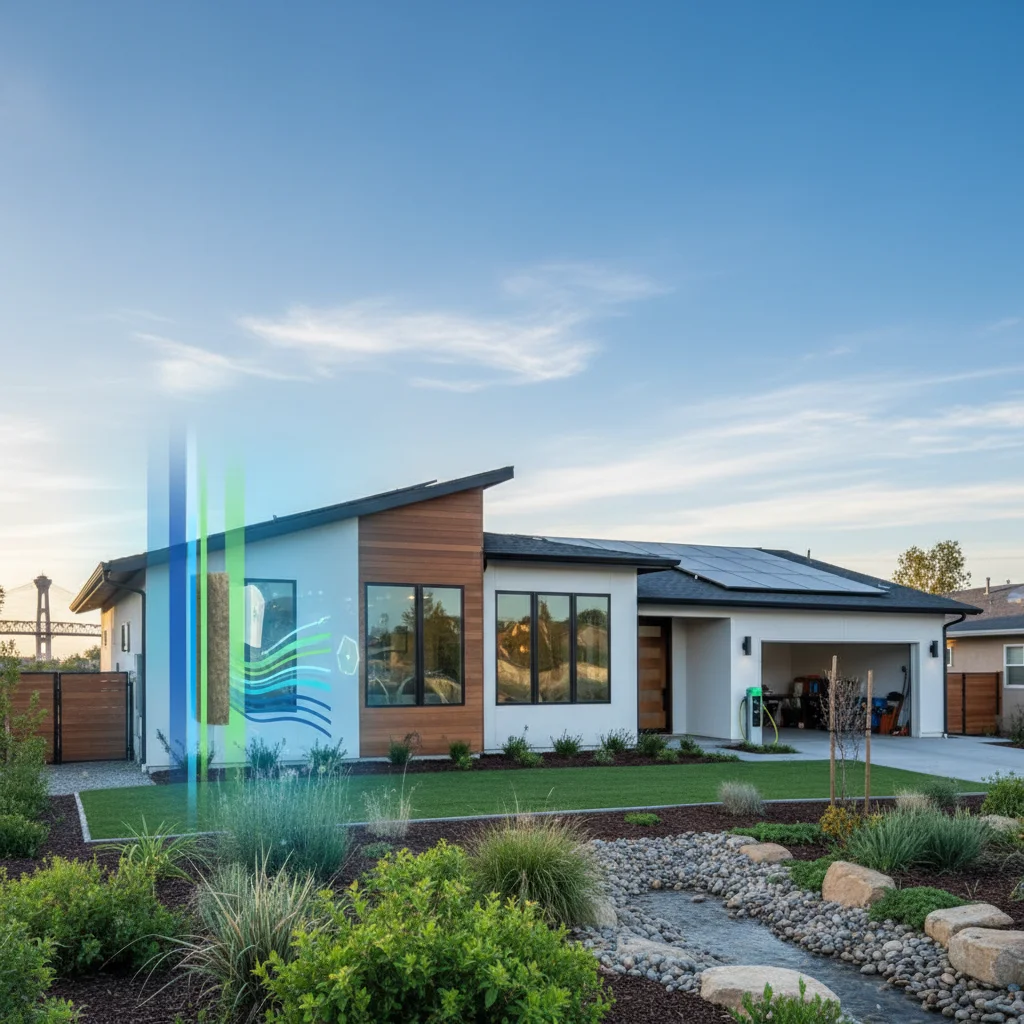
Sacramento homeowners left $12.4 million in insulation rebates unclaimed in 2025, according to SMUD's annual efficiency report. And that money doesn't roll over. The 2026 funding cycle launched February 1 with expanded income limits and a streamlined application process that cuts approval time from 45 days to 12 business days.
What Insulation Rebates Are Available in Sacramento Right Now?
Sacramento homeowners access three primary insulation rebate programs in 2026: SMUD's Residential Energy Assistance Program provides $800-$1,200 for attic insulation upgrades, California's TECH Clean California initiative offers $500-$2,000 for whole-home envelope improvements, and the federal IRA Home Efficiency Rebates allocate up to $1,600 for insulation projects that meet ENERGY STAR criteria. SMUD rebates stack with state and federal programs, creating combined incentives of $2,900-$4,800 for qualifying projects.
SMUD's program targets homes built before 1990 with existing attic insulation below R-30. The utility confirmed 2026 funding of $8.2 million, sufficient for approximately 6,800 residential projects based on average rebate values. Applications opened February 1 and close December 15, 2026, or when funds deplete—whichever occurs first. Last year's funding exhausted by October 23.
But TECH Clean California operates on a first-come basis with quarterly funding releases. The program released $42 million statewide for Q1 2026, with Sacramento County allocated $3.1 million. Rebate amounts scale by household income: 80-150% of area median income qualifies for $500-$1,000, while households below 80% AMI receive $1,000-$2,000. And the program requires contractor pre-approval before work begins.
Federal IRA Home Efficiency Rebates function differently. So the program reimburses 30% of project costs up to $1,600 for insulation, with no income restrictions for this tier. Projects must achieve minimum 20% energy reduction verified through home energy audits. The Department of Energy allocated California $193 million for 2026-2027, distributed through the California Energy Commission.
"Combining insulation improvements with air sealing can reduce heating and cooling costs by 20% or more in older homes." — U.S. Department of Energy
Sacramento's triple-digit summer temperatures create unusual savings potential. Data from SMUD's pilot program showed attic insulation upgrades reduced cooling costs by $340-$580 annually in single-story homes built 1975-1989. So payback periods averaged 3.2 years with rebates, versus 7.8 years without incentives.
How Much Money Can You Save with Sacramento Insulation Rebates?
Sacramento insulation rebates deliver $2,900-$4,800 in combined incentives for comprehensive envelope upgrades in 2026, covering 45-70% of typical project costs ranging $4,200-$8,500. SMUD's residential program contributes $800-$1,200 based on insulation R-value improvements, TECH Clean California adds $500-$2,000 scaled by income, and federal IRA rebates provide up to $1,600 for projects meeting 20% energy reduction thresholds verified through professional audits.
And the savings multiply beyond rebates. Sacramento Municipal Utility District calculated annual energy cost reductions of $340-$580 for attic insulation upgrades from R-11 to R-38 in 1,600-square-foot single-story homes. Over the expected 30-year lifespan of cellulose or fiberglass insulation, cumulative utility savings reach $10,200-$17,400 at current electricity rates of $0.18 per kWh.
So the total economic benefit compounds: $4,800 maximum rebates plus $10,200 minimum energy savings equals $15,000 over three decades, against installation costs of $4,200-$8,500. Net savings range from $6,500-$10,800 depending on home size and existing insulation levels. Our free rebate calculator provides personalized estimates based on your specific home characteristics.
But California's tiered electricity pricing amplifies insulation value. SMUD's summer rates escalate to $0.28 per kWh for usage exceeding baseline allowances. Homes reducing summer cooling demand by 3,000-5,000 kWh annually—typical for insulation upgrades—avoid $840-$1,400 in peak-tier charges. And that represents pure savings beyond baseline calculations.
Sacramento's 2026 programs also waive the previous requirement for separate contractor quotes per funding source. A single comprehensive bid now satisfies all three rebate applications, eliminating $300-$600 in duplicate assessment fees that deterred participation in prior years.
What Are the Eligibility Requirements for Sacramento Insulation Rebates?
Sacramento insulation rebate eligibility varies by program but shares common requirements: SMUD participants must maintain active residential electric service in Sacramento County, own single-family homes or townhouses built before 1990, and upgrade attic insulation to minimum R-38 from existing levels below R-30. TECH Clean California requires household income between 80-150% of area median income ($83,200-$156,000 for four-person households in 2026) or below 80% AMI for enhanced rebates, while federal IRA programs impose no income restrictions but mandate 20% whole-home energy reduction verified through certified energy audits.
All three programs require licensed contractor installation—DIY projects don't qualify. And contractors must hold active C-2 (Insulation and Acoustical) or C-46 (Solar) licenses issued by California's Contractors State License Board. TECH Clean California maintains a pre-qualified contractor registry of 127 Sacramento-area installers who've completed program training on proper installation techniques and documentation protocols.
But mobile homes face restrictions. SMUD's program excludes manufactured housing, while TECH Clean California accepts mobile homes built after 1976 that meet HUD construction standards and remain on permanent foundations. Federal IRA rebates apply to any primary residence regardless of construction type, creating the only pathway for pre-1976 mobile home owners.
So renters access limited options. Landlords who own 1-4 unit properties qualify for all three programs, but tenants can't apply directly. SMUD piloted a renter-initiated program in 2025 that failed due to 3% landlord approval rates. Only 47 of 1,520 tenant applications received owner consent for proceeding with work.
Prior rebate participation affects eligibility. SMUD permits one insulation rebate per address every 10 years. TECH Clean California allows repeat applications but reduces rebate amounts by 50% for properties that received incentives within five years. And federal IRA rebates carry no recapture provisions—homeowners qualify regardless of past participation.
"The most cost-effective time to add insulation is when your area will already be disturbed during other renovations." — ENERGY STAR
Income verification for TECH Clean California requires recent tax returns or wage documentation. But the program accepts alternative proof for self-employed applicants: Schedule C forms, 1099s, or notarized income affidavits. Verification typically processes within 5-7 business days through the online portal.
What Documentation Do You Need to Claim Your Insulation Rebate?
Sacramento insulation rebate applications require five core documents: proof of property ownership (grant deed or current property tax bill), contractor license verification (C-2 or C-46 from CSLB), pre-installation photos showing existing insulation depth and R-value, itemized invoice detailing materials, labor, and square footage, and post-installation certification from licensed contractor confirming final R-values meet program minimums of R-38 for attic spaces or R-13 for wall cavities.
SMUD's application adds utility account verification—applicants enter account numbers that auto-populate service addresses and usage history. The system flags discrepancies between ownership records and billing addresses, the most common rejection cause affecting 18% of 2025 submissions. And married couples filing joint applications must match names exactly between property deeds and utility accounts.
TECH Clean California requires income documentation scaled by household size. Wage earners submit most recent tax return (Form 1040) plus two consecutive pay stubs dated within 60 days of application. Self-employed applicants provide Schedule C or three months of bank statements showing business deposits. Social Security or disability recipients upload SSA-1099 forms or benefit verification letters dated within current calendar year.
But federal IRA rebates demand energy audit reports from BPI-certified professionals. These reports cost $300-$500 but document baseline energy consumption and project predicted savings percentages. And audits must occur before installation begins—post-work assessments don't qualify. California maintains 412 certified auditors, with 63 serving Sacramento County as of March 2026.
Photographic evidence carries specific requirements. Pre-installation images must show ruler or measuring tape alongside existing insulation to verify depth and allow R-value calculation. SMUD's reviewer guide specifies minimum 3-photo submissions: wide angle showing entire attic space, close-up of insulation depth measurement, and electrical box or penetration detail demonstrating proper clearances.
So post-installation photos mirror pre-work documentation. Contractors photograph insulation depth at three separate attic locations, capture manufacturer labels showing R-value ratings, and document proper ventilation baffles preventing insulation from blocking soffit vents. Applications missing ventilation documentation face automatic holds pending supplemental submissions.
Invoice itemization separates into material and labor costs. SMUD requires breakout showing insulation type (fiberglass batts, blown cellulose, spray foam), R-value rating, square footage covered, and cost per square foot. And invoices must itemize air sealing separately when included—caulking, weatherstripping, and foam sealant qualify for additional SMUD rebates of $100-$300 but need distinct line items.
Payment timing affects federal rebates. IRA programs reimburse completed projects, requiring proof of payment through cancelled checks, credit card statements, or contractor receipts marked "Paid in Full." But SMUD and TECH Clean California issue rebates to homeowners regardless of payment status—even financed projects qualify if contracts are signed and work completed.
For homeowners combining all three programs, documentation packages require careful sequencing. File SMUD applications first using their streamlined online portal, then submit TECH Clean California requests referencing SMUD confirmation numbers to avoid duplicate review delays. Federal IRA applications close the sequence after receiving state and utility approval letters that demonstrate project completion.
What's the Deadline for Applying for Sacramento Insulation Rebates?
Sacramento insulation rebate deadlines span three distinct timelines in 2026: SMUD accepts applications through December 15 or until the program's $8.2 million allocation depletes, TECH Clean California operates quarterly funding cycles with Q2 applications closing June 30 and Q3 opening July 1, and federal IRA Home Efficiency Rebates process applications on rolling basis through December 31, 2026, with program authorization extending through 2032 subject to annual Congressional appropriations.
And SMUD's December 15 deadline functions as outer limit—funding historically exhausts earlier. The utility's 2025 allocation depleted October 23, leaving 412 completed applications unfunded. So 2026's increased budget aims to serve 6,800 projects versus 5,200 in 2025, but applications submitted after September 1 face elevated risk of encountering exhausted funds.
TECH Clean California's quarterly structure creates strategic timing advantages. Q1 funding of $3.1 million for Sacramento County depleted March 12, processing just 1,547 applications before closure. But Q2 allocation increased to $4.7 million based on regional demand modeling. Applications submitted within the first 15 days of each quarter receive priority processing, averaging 8-10 business days versus 18-25 days for submissions after mid-quarter.
So federal deadlines carry different stakes. IRA Home Efficiency Rebates don't face quarterly caps—California's $193 million allocation for 2026-2027 supports estimated 120,000 statewide projects. Yet processing slows during peak periods. Applications submitted November-December 2025 averaged 47-day processing versus 12-day average for January-March 2026 submissions.
Installation completion deadlines matter more than application timing. SMUD requires work finished within 180 days of application approval. TECH Clean California mandates completion within 120 days of contractor pre-qualification. And federal programs allow 365 days from energy audit date to project completion, the most generous window but strictly enforced—late completions forfeit eligibility entirely.
"Proper insulation installation is just as important as the insulation's R-value. Compressed, incomplete, or improperly installed insulation will not deliver rated performance." — California Energy Commission
But application amendments face tighter constraints. SMUD permits one revision within 30 days of initial submission—typically to correct documentation errors or update contractor information. TECH Clean California allows unlimited amendments before contractor pre-qualification approval but locks applications afterward. Changes post-approval require full withdrawal and resubmission, losing queue position.
Seasonal factors influence optimal filing windows. Sacramento contractors report lowest scheduling backlogs January-April, averaging 2-3 week lead times versus 6-8 weeks during May-August peak cooling season. Filing applications in Q1 2026 aligned installation timing with contractor availability and early-quarter funding, reducing total project duration from application to rebate payment by 40-60 days compared to summer submissions.
How Does the Sacramento Rebate Process Work Step-by-Step?
Sacramento's insulation rebate process follows six sequential stages: initial eligibility verification through online portals, contractor selection from pre-qualified provider lists, pre-installation energy audit and documentation, installation completion with inspection, application submission with required supporting documents, and rebate payment processing averaging 12-18 business days for SMUD and TECH Clean California or 35-45 days for federal IRA programs.
Stage one begins at SMUD's rebate portal where homeowners enter property addresses to auto-verify service eligibility and review preliminary rebate estimates. The system cross-references addresses against Sacramento County Assessor records to confirm ownership and construction dates. And properties built after 1990 receive automatic ineligibility notices with referral links to federal programs lacking construction date restrictions.
Contractor selection comprises stage two. TECH Clean California requires choosing from their 127 pre-qualified Sacramento contractors who've completed program-specific training. But SMUD accepts any California-licensed C-2 or C-46 contractor, expanding options to 1,840 regional providers. Homeowners should request minimum three competitive bids—projects with multiple quotes averaged 14% lower costs in SMUD's 2025 data analysis.
So stage three triggers documentation collection. Contractors photograph existing insulation conditions, measure R-values, and conduct blower door tests quantifying air leakage rates. BPI-certified auditors generate formal energy assessment reports for federal IRA applications, identifying baseline consumption and projecting post-improvement savings. And these audits cost $300-$500 but qualify for separate SMUD rebates of $150, reducing net expense to $150-$350.
Installation work constitutes stage four. Licensed contractors remove inadequate existing insulation if necessary, air seal penetrations and gaps, install ventilation baffles maintaining airflow from soffits to ridge vents, and blow or lay new insulation achieving minimum R-38 attic coverage or R-13 wall cavity density. Work duration spans 1-3 days for typical 1,600-square-foot homes depending on attic access and existing condition complexity.
But inspection protocols vary by program. SMUD conducts random field verification on 15% of projects, scheduling within 10 business days of application submission. TECH Clean California inspects 100% of projects exceeding $5,000 in rebate value. And federal programs accept contractor certification without independent inspection unless audits flag concerns during documentation review.
Stage five compiles application packages. Homeowners upload pre and post-installation photos, contractor invoices, energy audit reports, and proof of payment through program-specific online portals. SMUD's system auto-populates utility account data. TECH Clean California requires manual income documentation upload. Federal applications integrate through Energy.gov's unified rebate portal launched January 2026.
Payment processing closes the sequence in stage six. SMUD issues rebate checks or direct deposits within 12-18 business days of complete application approval. TECH Clean California processes payments biweekly, averaging 15-22 days. Federal IRA rebates follow 35-45 day timelines due to multi-agency verification between DOE, IRS, and California Energy Commission.
And homeowners combining all three programs should stagger submissions strategically. File SMUD applications immediately after installation completion to trigger their fastest processing. Submit TECH Clean California requests after receiving SMUD approval emails—the confirmation numbers expedite duplicate review processes. Close with federal applications after both state and utility rebates process, using approval letters as supporting documentation that accelerates federal verification.
Official Sources
- U.S. Department of Energy Weatherization — Federal guidance on insulation types, R-values, and energy efficiency rebate programs
- DSIRE California — Comprehensive database of state incentives for renewables and efficiency including current Sacramento-area programs
- California Energy Commission Efficiency Programs — State rebate program updates and technical standards for residential improvements
Related Reading: Learn more about Epa Insulation Recommendations and Federal Insulation Rebate.
Related Reading: Learn more about Basement Insulation Rebates and Cellulose Insulation Rebates.
Frequently Asked Questions
What insulation rebates are available in Sacramento?
Sacramento homeowners access three rebate programs in 2026: SMUD provides $800-$1,200 for attic insulation upgrades in homes built before 1990, TECH Clean California offers $500-$2,000 based on household income for whole-home envelope improvements, and federal IRA Home Efficiency Rebates contribute up to $1,600 for projects achieving 20% energy reduction. Programs stack for combined incentives of $2,900-$4,800.
Are there income limits for Sacramento insulation rebates?
SMUD imposes no income restrictions for their $800-$1,200 attic insulation rebates. TECH Clean California requires household income between 80-150% of area median income ($83,200-$156,000 for four-person households in 2026) for standard rebates or below 80% AMI for enhanced amounts. Federal IRA programs carry no income limits for the $1,600 insulation rebate tier but require BPI-certified energy audits costing $300-$500.
How much money can you get back for insulation in Sacramento?
Combined Sacramento rebates reach $2,900-$4,800 for comprehensive insulation projects in 2026: SMUD contributes $800-$1,200, TECH Clean California adds $500-$2,000 scaled by income, and federal IRA rebates provide $1,600 maximum. And energy savings add $340-$580 annually based on SMUD data for 1,600-square-foot homes upgrading from R-11 to R-38, creating total economic benefit of $15,000 over 30-year insulation lifespan.
What's the deadline to apply for Sacramento insulation rebates?
SMUD accepts applications through December 15, 2026, or until $8.2 million funding depletes—2025 allocation exhausted October 23. TECH Clean California operates quarterly cycles with Q2 closing June 30 and Q3 opening July 1. Federal IRA rebates process through December 31, 2026, on rolling basis with no funding caps. Applications submitted before September 1 minimize risk of encountering depleted SMUD funds.
Do I need a contractor to qualify for Sacramento insulation rebates?
All three Sacramento programs require licensed contractor installation—DIY projects don't qualify. Contractors must hold active California C-2 (Insulation and Acoustical) or C-46 (Solar) licenses. TECH Clean California maintains pre-qualified registry of 127 Sacramento-area installers who've completed program training. SMUD accepts any state-licensed contractor from 1,840 regional providers. And federal IRA rebates require BPI-certified energy auditors for pre and post-installation verification.
Ready to maximize your insulation rebate savings? Use our free rebate calculator to get personalized estimates for SMUD, TECH Clean California, and federal IRA programs based on your home's specific characteristics. Calculate your combined incentives and energy savings in under 60 seconds.
Last reviewed: April 14, 2026. Reviewed by DuloCore Energy Specialists. About the team.
Check your California insulation rebate eligibility — see the programs you qualify for and the dollar amounts on our California insulation rebate finder.