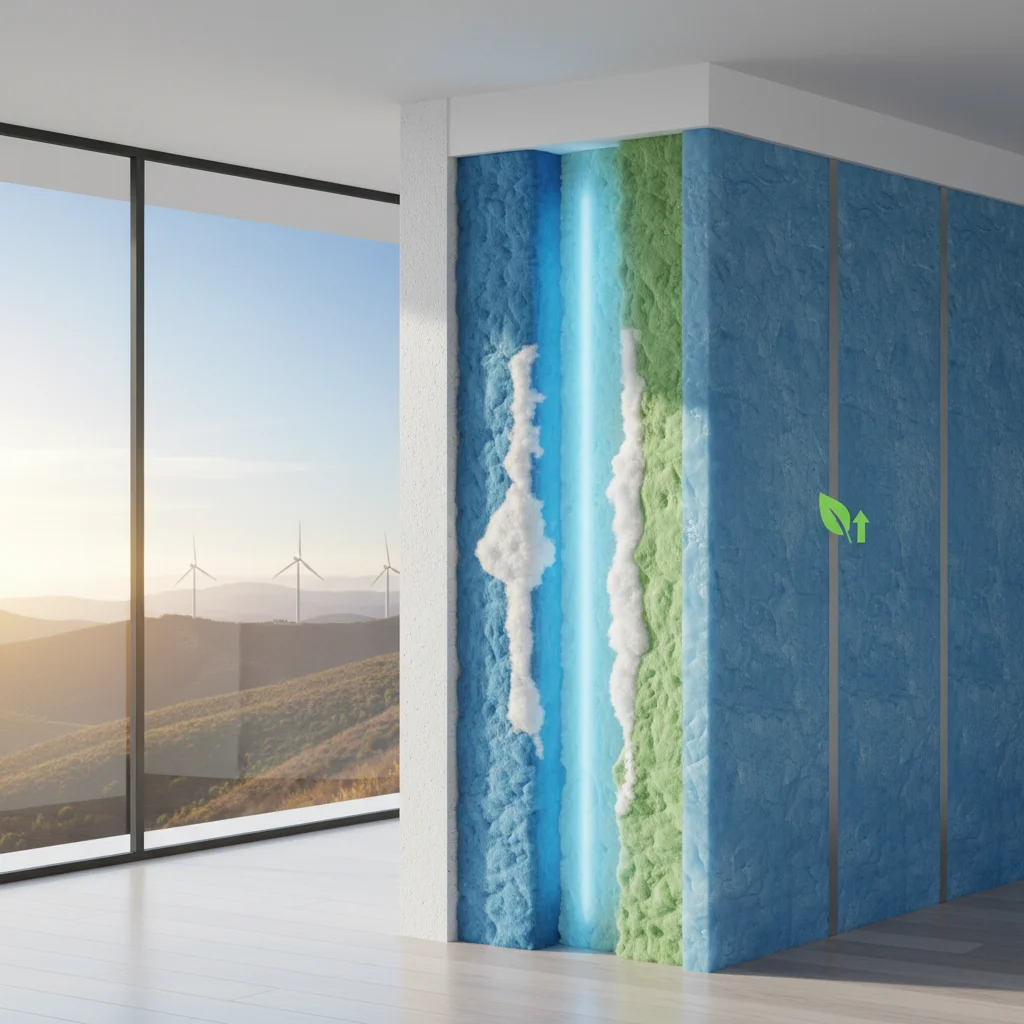
Insulation R-value Requirements California
Insulation R-Value Requirements California: everything you need to know about eligibility, amounts, and the application process.
California's Title 24 Building Energy Efficiency Standards require R-38 minimum in attic spaces and R-13 in wall cavities for new construction—but homes built before 2008 often fall 40-60% below these thresholds, costing homeowners $300-$800 annually in wasted heating and cooling. And with 2026 state rebates covering up to $1,200 for insulation upgrades, bringing older homes to code now delivers immediate energy savings plus substantial financial incentives.
What Are the R-Value Requirements for Insulation in California Homes?
California Title 24 standards mandate R-38 attic insulation and R-13 wall insulation for Climate Zone 1-16 residential construction as of 2026. Homes built before the 2008 Title 24 update typically contain R-19 to R-30 attic insulation and R-0 to R-11 wall insulation, creating 20-40% energy efficiency gaps compared to current code.
So homeowners upgrading from R-19 to R-38 attic insulation save $240-$480 annually on HVAC costs in California's inland valleys (Climate Zones 12-14), according to the California Energy Commission. But coastal zones (1-5) see smaller savings of $120-$200 annually due to milder temperature swings. And the upfront cost ranges from $1.50 to $3.50 per square foot installed, meaning a 1,500-square-foot attic upgrade costs $2,250 to $5,250 before rebates.
Title 24 divides California into 16 climate zones with varying R-value requirements. Climate Zone 16 (mountains above 5,000 feet) requires R-49 attic insulation and R-21 wall insulation—28% higher than coastal zones. Climate Zones 6-15 (inland valleys and deserts) require R-38 attic and R-13 to R-15 walls. Climate Zones 1-5 (coastal) require R-30 to R-38 attic and R-13 walls. Homeowners can verify their zone at the California Energy Commission Climate Zone Tool.
Which Insulation Types Qualify for California Rebates and What Specifications Matter?
California's 2026 Tech Clean California program covers fiberglass batts (R-3.2 to R-4.3 per inch), blown-in cellulose (R-3.6 to R-3.8 per inch), spray foam (R-6.0 to R-7.0 per inch), and mineral wool (R-3.0 to R-3.3 per inch) when installed to meet or exceed Title 24 minimum R-values. Rebates require third-party HERS (Home Energy Rating System) verification and installation by a CalCERTS-certified contractor to qualify for the $800 to $1,200 incentive tier.
Spray foam delivers the highest R-value per inch at R-6.0 to R-7.0, making it ideal for wall cavities with limited depth—a 3.5-inch stud bay reaches R-21 to R-24.5 with closed-cell spray foam versus R-13 to R-15 with fiberglass batts. But spray foam costs $3.00 to $5.00 per square foot installed, compared to $1.50 to $2.50 for fiberglass or cellulose. And cellulose contains 85% recycled content, qualifying for additional green building incentives in Bay Area jurisdictions.
The energy tax credits framework under the Inflation Reduction Act provides a federal tax credit covering 30% of insulation installation costs when part of a whole-home energy audit, capped at $1,200 annually for building envelope improvements. So a $4,000 insulation upgrade qualifies for $1,200 federal credit plus $800 to $1,200 state rebate, reducing net cost to $1,600 to $2,400.
How Much Can You Save with California Insulation Rebates and What's Your Payback Period?
Upgrading from R-19 to R-38 attic insulation in California's Climate Zone 12 (Sacramento) saves $360 annually on a 2,000-square-foot home with natural gas heating and electric cooling, based on 2026 PG&E rate schedules. Combined with $1,200 state rebate and $1,200 federal tax credit, total incentives of $2,400 reduce a $4,500 installation cost to $2,100 net—delivering a 5.8-year payback period at current energy prices.
Annual savings scale with climate zone intensity and existing insulation levels. Climate Zone 13 (Fresno) homeowners upgrading from R-11 to R-38 save $520 annually due to extreme summer cooling loads exceeding 100°F. Climate Zone 3 (Oakland) homeowners upgrading the same range save $180 annually with milder temperature swings. And homes with electric resistance heating see 40-60% higher savings than natural gas heating due to California's $0.32 to $0.45 per kWh residential electric rates versus $1.80 to $2.20 per therm gas rates.
The state's Tech Clean California program prioritizes low-income households with enhanced rebates of $1,600 to $2,000 for insulation upgrades when combined with heat pump rebates through the same application. Use the rebate calculator to estimate your specific savings based on home size, climate zone, and existing insulation levels.
How Does California's Insulation Compare to Other Energy-Efficient Upgrade Options?
Insulation delivers $0.08 to $0.12 annual savings per dollar invested over 20 years, compared to $0.15 to $0.22 for heat pump HVAC systems and $0.10 to $0.18 for attic radiant barriers in California's inland climate zones. But insulation requires zero maintenance and lasts 30-50 years, while heat pumps need replacement every 15-20 years at $8,000 to $15,000 per system.
Attic insulation upgrades pair effectively with air sealing to maximize savings—sealing ducts and penetrations before adding insulation prevents the "Swiss cheese effect" where conditioned air escapes through gaps. The Lawrence Berkeley National Laboratory found California homes with R-38 insulation but unsealed ducts lose 20-30% of HVAC energy, reducing actual savings to $180-$250 annually versus the theoretical $360. And duct sealing costs $800 to $1,500, adding $0.06 to $0.10 per dollar in lifetime savings.
Window replacement delivers lower energy savings than insulation in most California climates—$120 to $180 annually for $8,000 to $12,000 installed dual-pane windows versus $240 to $360 annually for $2,500 to $4,500 insulation upgrades. But windows provide aesthetic and resale value benefits that insulation doesn't. And cool roof coatings ($1,500 to $3,000) save $80 to $140 annually in cooling costs, making insulation the higher-ROI building envelope improvement in 14 of 16 California climate zones.
How Long Will Your New Insulation Last and When Will You Need to Replace It?
Fiberglass and mineral wool insulation lasts 80-100 years without performance degradation when properly installed and protected from moisture, according to the Department of Energy. Cellulose insulation lasts 20-30 years before settling reduces R-value by 15-20%, requiring top-off installations to restore original performance. And spray foam lasts 30-50 years with minimal settling but can't be easily removed or supplemented if building codes change.
Moisture exposure cuts insulation lifespan by 50-70%—wet fiberglass loses 40% of its R-value and compresses permanently, while cellulose develops mold at moisture levels above 20%. California's Title 24 requires vapor barriers in Climate Zones 14-16 (high desert and mountains) but not in coastal zones 1-5 where condensation risk is minimal. And homes with roof leaks or bathroom exhaust vented into attics need repairs before insulation upgrades to avoid premature failure.
"Insulation performance depends on proper installation—compressed fiberglass loses up to 50% of its rated R-value, and gaps around fixtures reduce whole-assembly performance by 20-30%." — U.S. Department of Energy
The California Energy Commission recommends attic insulation inspections every 10 years to check for settling, moisture damage, and pest intrusion. Homes with rodent or bat infestations need old insulation removed and replaced rather than topped off, costing $2.00 to $4.00 per square foot for removal plus $1.50 to $3.50 for new installation.
What's the Timeline and Process for Claiming California Insulation Rebates?
California's Tech Clean California rebate process requires pre-approval before installation, third-party HERS verification within 30 days of completion, and final payment processing within 60-90 days of submitting documentation. Homeowners apply through the California Energy Commission portal with utility bills, contractor quotes, and existing insulation photos to receive pre-approval within 10-15 business days.
HERS raters charge $150 to $300 for insulation verification inspections, covering thermal imaging scans, R-value depth measurements, and air sealing assessments. The rater uploads results to the CalCERTS database within 5 business days, triggering automatic rebate approval. And contractors receive payment directly from the state program within 60 days, reducing homeowner upfront costs in some cases.
Federal tax credits require IRS Form 5695 (Residential Energy Credits) filed with your annual tax return for the year installation was completed. The 30% credit under the Inflation Reduction Act applies to materials and labor costs but requires itemized receipts and Manufacturer's Certification Statements showing product R-values. And homeowners can claim both state rebate and federal credit for the same installation without double-dipping restrictions.
So the full incentive timeline spans 4-6 months from application to final payment: 2-3 weeks pre-approval, 1-3 weeks installation, 1 week HERS verification, 60-90 days state rebate payment, and 4-6 months for federal tax credit refund after filing returns.
Official Sources
- U.S. Department of Energy — Federal insulation guidelines, R-value requirements, and energy savings calculations
- California Energy Commission — Title 24 Building Energy Efficiency Standards and climate zone requirements
- Database of State Incentives for Renewables & Efficiency — Comprehensive California rebate and incentive program database
Related Reading: Learn more about Insulation Energy Audit Requirements and Insulation R Value Chart.
Frequently Asked Questions
What is the minimum R-value for insulation in California?
California Title 24 requires R-30 to R-49 attic insulation and R-13 to R-21 wall insulation depending on climate zone, with coastal areas requiring lower values and mountain regions requiring higher values. Climate Zone 16 (above 5,000 feet elevation) mandates R-49 attic and R-21 walls, while Climate Zones 1-5 (coastal) require R-30 to R-38 attic and R-13 walls as of 2026.
How do I know if my insulation meets California building code requirements?
Measure attic insulation depth and multiply by R-value per inch for your insulation type—fiberglass batts provide R-3.2 per inch, so 12 inches equals R-38. Alternatively, hire a HERS rater for $150 to $300 to conduct thermal imaging and depth measurements across your entire attic and wall cavities, identifying gaps and compressed areas that reduce effective R-value below code minimums.
What R-value insulation do I need for attic vs walls in California?
Attics require R-30 to R-49 depending on climate zone, while walls require R-13 to R-21, with attics always receiving 2-3 times higher R-value than walls due to greater heat gain and loss through roof surfaces. Climate Zone 12 (Sacramento) requires R-38 attic and R-13 walls, while Climate Zone 16 (Tahoe) requires R-49 attic and R-21 walls.
Are there rebates available for upgrading to higher R-value insulation in California?
California's Tech Clean California program provides $800 to $1,200 rebates for insulation upgrades meeting Title 24 standards in 2026, plus federal tax credits covering 30% of installation costs up to $1,200 annually under the Inflation Reduction Act. Combined incentives total $2,000 to $2,400 for qualifying whole-home insulation projects with HERS verification.
How much does it cost to upgrade insulation to meet California R-value standards?
Attic insulation upgrades cost $1.50 to $3.50 per square foot installed, meaning a 1,500-square-foot attic runs $2,250 to $5,250 before rebates. Wall insulation costs $2.00 to $5.00 per square foot depending on access—blown-in wall insulation through small holes costs $2.00 to $3.00 per square foot, while removing drywall for batt installation costs $4.00 to $5.00 per square foot.
Ready to upgrade your insulation and claim California rebates? Use our free rebate calculator to estimate your savings, payback period, and total available incentives based on your home's size, location, and current insulation levels. Get instant results and find CalCERTS-certified contractors in your area.
(note: the original Section 25C/25D credits expired December 31, 2025; they were replaced by updated credits under the Inflation Reduction Act) - Attic Insulation Cost - Attic Insulation Cost And Savings
Updated: April 14, 2026 — fact-checked by DuloCore Research. About our editorial process.
Find Your Rebates
Use our calculator to see how much you can save on your home improvement project.
Calculate My Savings