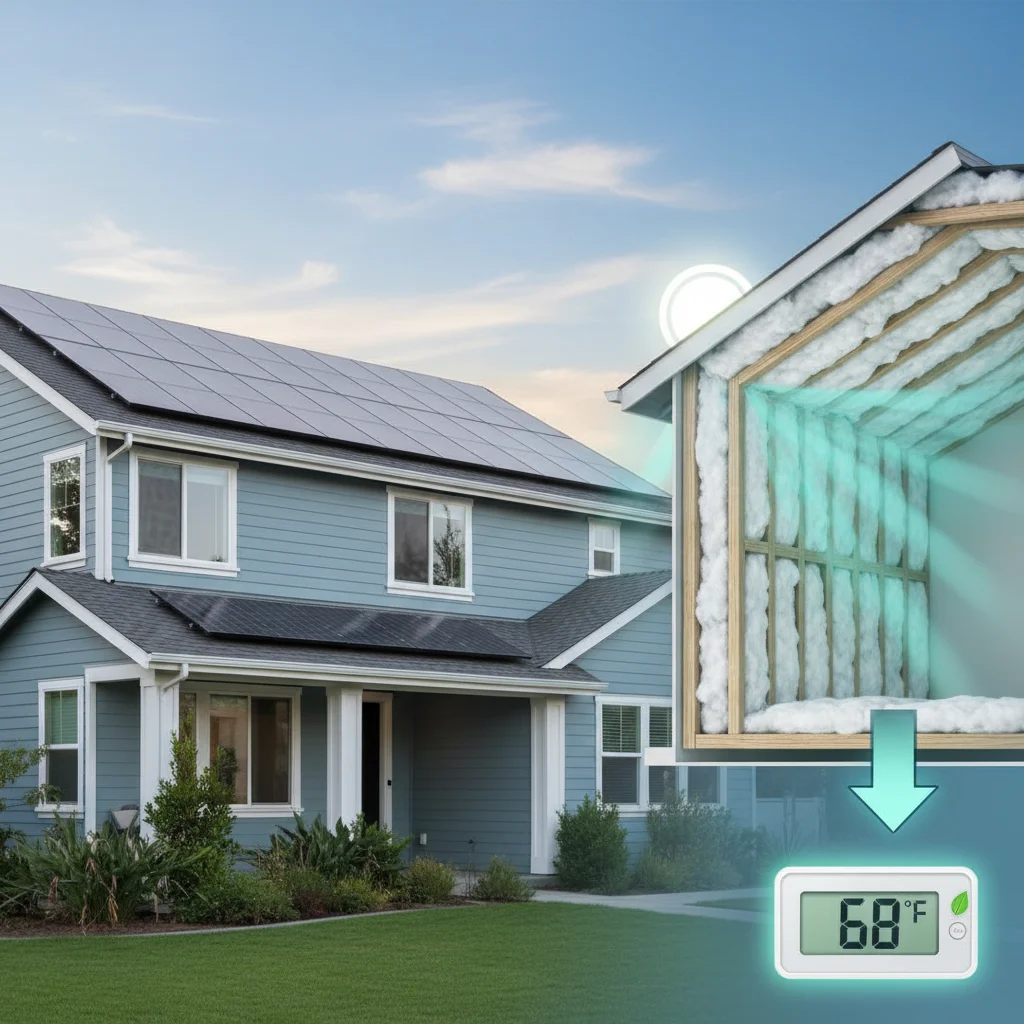
California homeowners waste $1.2 billion annually on heating and cooling costs that could be eliminated with proper insulation. And in 2026, state and federal programs are offering unprecedented funding to fix this—but most residents don't know which upgrades qualify or how much they'll actually save.
How Long Does It Take to Recoup Your Insulation Investment in California?
Attic insulation upgrades in California deliver payback periods of 2-4 years depending on climate zone and existing R-value. Homes in inland valleys (Climate Zones 12-16) recoup costs in 2-3 years, while coastal properties (Zones 3-7) see 3-4 year returns. And whole-home insulation packages generating $800-$1,200 annual savings pay for themselves in 3-5 years after rebates.
The fastest ROI comes from attic upgrades. California Energy Commission data shows that raising attic insulation from R-11 to R-38 saves Central Valley homeowners $45-$65 monthly on utility bills. And with 2026 rebates covering 50-80% of installation costs, the out-of-pocket investment drops to $800-$1,500 for most single-family homes.
But payback calculations must account for climate zone differences. Desert regions (Zones 14-15) see 15-20% higher cooling savings than coastal areas because of extreme summer temperatures exceeding 105°F for 60+ days annually. So the same R-38 attic upgrade saves Bakersfield residents $780 yearly versus $520 in San Francisco.
Wall insulation delivers slower returns—typically 5-8 years—because installation costs run $2,500-$4,500 for retrofit applications. And crawl space or basement insulation (less common in California) pays back in 6-10 years due to lower thermal impact in moderate climates.
"Homeowners upgrading from R-11 to R-38 attic insulation reduce heating and cooling energy use by 30-50% in mixed climates" — U.S. Department of Energy
Which California Climate Zones Benefit Most From Insulation Upgrades?
Climate Zones 12-16 (inland valleys and deserts) capture the highest insulation savings at $650-$950 annually, while coastal Zones 3-7 save $380-$520 yearly from identical R-value improvements. Temperature extremes drive savings potential—Fresno experiences 90°F+ temperatures 110 days per year versus San Diego's 15 days, creating 2.5x greater cooling demand and proportional insulation ROI.
The California Energy Commission divides the state into 16 climate zones based on heating degree days, cooling degree days, and marine influence. And zones with the widest daily temperature swings benefit most from thermal barriers because insulation reduces both winter heat loss and summer heat gain.
Central Valley cities (Sacramento, Stockton, Modesto, Fresno, Bakersfield) in Zones 12-13 see the fastest payback at 2-3 years. Desert communities (Palm Springs, Lancaster, Victorville) in Zones 14-15 follow at 3-4 years. But coastal residents in mild Zones 3-7 still save $380-$520 annually—enough to justify upgrades, just with slower ROI.
Mountain zones (Zones 1 and 16) present unique cases. High-elevation homes need insulation primarily for heating efficiency, with annual savings of $550-$750 driven by winter propane or electric heating costs. And these properties often lack adequate insulation entirely, making upgrades from R-11 to R-49 common.
Use our free rebate calculator to find your climate zone and estimated savings.
What's the True Lifespan of Different Insulation Materials in California's Climate?
Fiberglass batts maintain R-value performance for 80-100 years in California attics without settling or degradation, while blown cellulose lasts 60-80 years before minor settling reduces effectiveness by 5-10%. Spray foam insulation delivers 80-100+ year lifespans with zero performance decline, and rigid foam boards retain R-value for 50-75 years depending on moisture exposure and UV protection.
California's dry climate extends insulation longevity compared to humid regions. Moisture causes the majority of insulation failures—mold, compression, and R-value loss—but California's average relative humidity of 40-60% prevents these issues in properly ventilated attics and walls.
Fiberglass batts installed in 1940s California homes still measure within 3-5% of original R-value when inspected today. And this 80-100 year performance makes fiberglass the longest-lasting option at the lowest installed cost of $1.50-$2.50 per square foot.
Blown cellulose settles 1-2 inches over 20-30 years, reducing R-38 installations to effective R-35. But this 8-10% loss doesn't significantly impact energy savings, and cellulose costs just $1.25-$2.00 per square foot installed. So the slight performance decline over decades doesn't justify premium materials for most homeowners.
Spray foam (closed-cell) never settles, compresses, or loses R-value. And its air-sealing properties prevent the convective heat transfer that reduces other materials' effectiveness. But spray foam costs $3.50-$6.00 per square foot—2-3x fiberglass prices—so the lifespan advantage doesn't deliver superior ROI unless air sealing is critical.
How Much Can You Actually Save on Energy Bills With Insulation in California?
Upgrading attic insulation from R-11 to R-38 saves California homeowners $520-$950 annually depending on climate zone, home size, and heating/cooling system efficiency. Whole-home insulation packages (attic, walls, floors) generate $800-$1,500 yearly savings for 2,000-square-foot properties, with inland valley residents capturing the upper range and coastal homeowners seeing lower but still substantial reductions of $650-$900.
The California Energy Commission's Title 24 energy models show that every R-10 increase in attic insulation reduces annual HVAC energy use by 12-15% in mixed climates. And homes with electric heat pumps or air conditioning running 6+ months yearly see the highest absolute dollar savings because insulation reduces both heating and cooling loads.
Real-world data from Sacramento Municipal Utility District (SMUD) confirms these projections. Homeowners completing attic upgrades from R-11 to R-38 through SMUD rebate programs reported average monthly bill reductions of $48 in summer and $38 in winter—totaling $516-$672 annually depending on system efficiency.
But savings calculations must account for existing insulation levels. Homes with R-19 attic insulation upgrading to R-38 save $280-$420 yearly—roughly half the savings of R-11 to R-38 upgrades—because diminishing returns apply as R-values increase. So accurate baseline measurement determines realistic ROI projections.
Natural gas heating homes save less in absolute dollars ($380-$650 annually) than electric heating properties ($650-$950 yearly) because electricity costs $0.28-$0.42 per kWh versus natural gas at $1.80-$2.40 per therm—creating 2-3x higher heating bills for comparable energy use.
"Properly insulating your attic, walls, and floors can reduce heating and cooling costs by 15% on average" — ENERGY STAR
What Insulation Upgrades Qualify for California Rebates and Tax Credits?
Attic insulation upgrades to R-38 or R-49 qualify for California utility rebates of $400-$1,200 and federal energy tax credits covering 30% of installation costs up to $1,200 in 2026. Wall insulation, floor insulation, and air sealing improvements also qualify when installed by certified contractors and meet Title 24 energy code requirements. And low-income households access additional incentives through Energy Savings Assistance programs offering 100% cost coverage.
The federal Energy Efficient Home Improvement Credit (Section 25C) ended for property placed in service after December 31, 2025 (IRS FS-2025-05). Federal tax credits for this work have ended, but state, local and utility rebates may still apply; check what is available at your address with the DuloCore rebate calculator. These credits apply to both new construction and retrofit installations in existing homes. And homeowners can claim credits for multiple qualifying upgrades in the same tax year as long as the combined total doesn't exceed $1,200.
California utility companies operate distinct rebate programs with varying requirements. Pacific Gas & Electric (PG&E) offers $300-$800 attic insulation rebates for upgrading to R-38 or higher. Southern California Edison (SCE) provides $400-$1,000 rebates for whole-home insulation packages. And San Diego Gas & Electric (SDG&E) pays $500-$1,200 for Title 24-compliant insulation improvements.
Low-income residents qualify for Energy Savings Assistance (ESA) programs delivering 100% free insulation upgrades. Households earning less than 200% of federal poverty guidelines receive attic, wall, and floor insulation at no cost through utility-managed contractors. And seniors, disabled residents, and families receiving CalFresh or Medi-Cal automatically qualify regardless of income.
Air sealing work bundled with insulation upgrades increases rebate eligibility and effectiveness. Sealing attic bypasses, recessed lighting gaps, and duct leaks before adding insulation prevents the 20-30% efficiency loss caused by air infiltration. And utilities often require blower door testing to verify air sealing performance before approving insulation rebates.
Check the Database of State Incentives for Renewables & Efficiency for current California utility rebate details by zip code.
Insulation Installation Timeline and Process in California
Professional attic insulation installation takes 4-8 hours for typical 1,500-2,000 square foot California homes, with whole-home projects (attic, walls, crawl space) requiring 2-3 days. Energy audits and blower door testing add 2-3 hours before installation, and rebate inspection scheduling extends total project timelines to 2-4 weeks from initial contact to final approval.
The standard process begins with a comprehensive energy audit. Certified contractors measure existing R-values, identify air leaks with infrared cameras, and conduct blower door tests to quantify infiltration rates. And this 2-3 hour assessment determines which upgrades deliver the highest ROI and qualify for available rebates.
Air sealing happens before insulation installation. Contractors seal attic bypasses (plumbing vents, recessed lights, whole-house fans), close soffit gaps, and weatherstrip attic hatches. And spray foam or caulk applied to these penetrations prevents the convective loops that reduce insulation effectiveness by 20-30%.
Insulation installation follows air sealing within 1-2 days. Blown fiberglass or cellulose machines distribute material evenly across attic floors to specified R-values, taking 4-6 hours for standard attics. Wall insulation requires drilling access holes, blowing dense-pack cellulose into cavities, and patching holes—adding 6-8 hours for whole-home retrofits.
Post-installation inspections verify R-value compliance and proper air sealing. Utility rebate programs require third-party verification with depth measurements and photos. And this inspection step adds 3-7 days to project timelines depending on contractor scheduling and utility processing backlogs.
Rebate approval and payment processes take 4-8 weeks after inspection completion. Homeowners submit applications with contractor invoices, photos, and inspection reports. And utilities process payments on 30-60 day cycles, though some programs offer instant rebates applied at point of sale.
Official Sources
- U.S. Department of Energy: Insulation — Federal guidance on insulation types, R-values, and energy savings
- ENERGY STAR: Seal and Insulate — Comprehensive resources for home weatherization and insulation improvements
- Database of State Incentives for Renewables & Efficiency — State-by-state directory of rebates, tax credits, and energy efficiency programs (note: the federal 25C and 25D credits ended for projects completed after December 31, 2025)
Related Reading: Learn more about Attic Insulation Energy Savings and Caulking And Sealing Energy Savings.
Frequently Asked Questions
What types of insulation qualify for California energy savings rebates?
Attic insulation (blown fiberglass, blown cellulose, batt fiberglass, spray foam) meeting R-38 or R-49 requirements qualifies for California utility rebates. Wall insulation installed via dense-pack cellulose or injection foam in existing homes also qualifies when meeting Title 24 energy code standards. And floor or crawl space insulation achieves rebate eligibility when installed to R-19 or higher by certified contractors with post-installation verification.
How much money can you save with home insulation in California?
Attic insulation upgrades from R-11 to R-38 save $520-$950 annually depending on climate zone, with inland valley and desert homes capturing the upper range. Whole-home insulation packages save $800-$1,500 yearly for 2,000-square-foot properties. And combining insulation with air sealing increases savings by 15-25% because sealed homes retain conditioned air more effectively than insulation alone.
Are you eligible for insulation rebates if you rent your home in California?
Renters don't qualify for most California insulation rebates because programs require property ownership and long-term investment recovery. But landlords can claim rebates for rental property improvements and may pass savings to tenants through reduced utility bills. And low-income renters in multi-family buildings benefit from utility-sponsored Energy Savings Assistance programs offering free weatherization regardless of ownership status.
What is the deadline to apply for California insulation energy savings programs?
Most California utility insulation rebate programs operate year-round without specific deadlines, but annual funding caps mean early application ensures availability. The federal Energy Efficient Home Improvement Credit (Section 25C) ended for property placed in service after December 31, 2025 (IRS FS-2025-05). And low-income Energy Savings Assistance programs accept applications continuously until funding exhaustion, typically in Q3-Q4 of each budget year.
How long does it take to see energy savings after adding insulation?
Energy bill reductions appear in the first billing cycle after insulation installation—typically 30-45 days—with winter heating savings and summer cooling reductions varying by season. Homes completing insulation upgrades in spring see immediate cooling cost drops of $35-$65 monthly starting in June-July. And winter installations deliver heating bill reductions of $28-$52 monthly within 30 days as outdoor temperatures drop below 55°F.
Ready to calculate your insulation savings? Use our free rebate calculator to find your climate zone, estimate annual energy savings, and discover which California utility rebates and federal tax credits apply to your home. Get your personalized insulation ROI analysis in under 60 seconds.
Last reviewed: April 14, 2026. Reviewed by DuloCore Energy Specialists. About the team.
Check your California insulation rebate eligibility — see the programs you qualify for and the dollar amounts on our California insulation rebate finder.