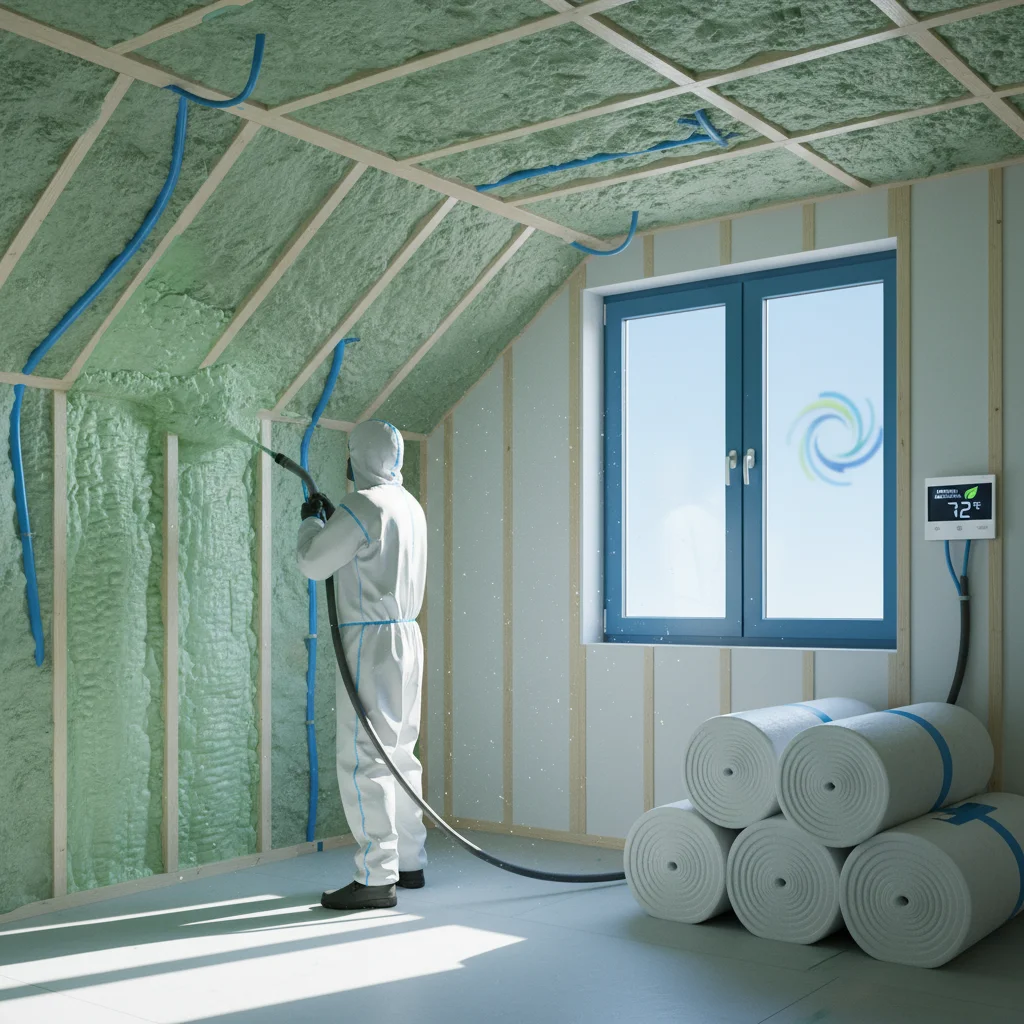
Homeowners installing insulation in 2026 pay between $1.50 and $7.00 per square foot depending on material type and installation complexity. The federal Energy Efficient Home Improvement Credit (Section 25C) ended for property placed in service after December 31, 2025 (IRS FS-2025-05). Federal tax credits for this work have ended, but state, local and utility rebates may still apply; check what is available at your address with the DuloCore rebate calculator. But without understanding which insulation types qualify for rebates and how installation specs affect both upfront costs and long-term savings, homeowners risk leaving thousands of dollars on the table.
How Much Does Insulation Cost Per Square Foot in 2026?
Insulation costs in 2026 range from $1.50 per square foot for basic fiberglass batts to $7.00 per square foot for closed-cell spray foam in difficult-to-access areas. And installation labor adds $0.50 to $2.50 per square foot depending on project complexity. So a 1,500-square-foot attic insulation project costs between $3,000 and $14,250 for materials and labor combined.
Fiberglass batts cost $1.50 to $2.50 per square foot installed and remain the most budget-friendly option for accessible attic spaces. Blown-in cellulose costs $2.00 to $3.50 per square foot and fills irregular spaces more effectively than batts. Open-cell spray foam costs $3.50 to $5.00 per square foot and provides superior air sealing. Closed-cell spray foam costs $5.00 to $7.00 per square foot and delivers the highest R-value per inch at R-6.0 to R-7.0 compared to fiberglass's R-2.9 to R-3.8.
But regional climate zones affect material selection and cost. Homes in Climate Zone 7 (northern states) require attic insulation of R-49 to R-60, needing 13 to 16 inches of fiberglass batts at $2,925 to $6,000 for a 1,500-square-foot attic. Homes in Climate Zone 3 (southern states) require R-30 to R-38, needing 8 to 10 inches at $1,800 to $3,750 for the same space.
What Types of Insulation Qualify for Rebates and Tax Credits in 2026?
The federal Energy Efficient Home Improvement Credit (Section 25C) ended for property placed in service after December 31, 2025 (IRS FS-2025-05).
Qualifying insulation types include fiberglass batts and rolls with minimum R-values of R-13 for walls and R-30 for attics in mild climates, blown-in cellulose meeting the same R-value thresholds, and spray foam systems that achieve code-required R-values while providing air sealing. So homeowners in Climate Zone 5 installing R-49 attic insulation at $4,500 receive a $1,200 credit (limited by annual cap, not the full 30% of $1,350).
California's Energy Upgrade California offers $500 to $4,000 for whole-home air sealing and insulation upgrades that reduce energy use by 10% or more. New York's Home Efficiency Rebate Program provides $1,600 to $8,000 for insulation improvements in low- and moderate-income households. And Michigan Saves offers zero-interest financing for insulation projects that meet ENERGY STAR standards.
"Proper insulation and air sealing can reduce heating and cooling costs by up to 20%, with payback periods of 2 to 6 years depending on climate zone and existing insulation levels." — ENERGY STAR Save Energy, Save Money
But rebate-eligible specifications often exceed minimum building code requirements. ENERGY STAR certification requires attic insulation of R-49 to R-60 in northern climates compared to code minimum R-38 to R-49. So upgrading from R-38 to R-60 costs an additional $0.75 to $1.25 per square foot but qualifies for larger utility rebates averaging $800 to $2,400.
Which Insulation Materials Have the Longest Lifespan and Best ROI?
Closed-cell spray foam insulation lasts 80 to 100 years without performance degradation and delivers the highest return on investment in cold climates with heating cost reductions of $800 to $1,400 annually. And blown-in cellulose lasts 20 to 30 years with minimal settling when properly installed. But fiberglass batts last 80 to 100 years if protected from moisture and physical damage.
Material longevity affects lifetime cost per square foot. Closed-cell spray foam costs $5.00 to $7.00 per square foot upfront but lasts 100 years at an annual cost of $0.05 to $0.07 per square foot. Blown-in cellulose costs $2.00 to $3.50 per square foot but requires replacement every 25 years at an annual cost of $0.08 to $0.14 per square foot. So spray foam's higher upfront cost pays off over decades of ownership.
Climate zone affects ROI calculations. Homeowners in Climate Zone 6 and 7 (Minnesota, Wisconsin, Maine) save $1,200 to $1,800 annually with proper attic insulation compared to an uninsulated attic. And payback periods range from 2.5 to 4.5 years for spray foam and 1.5 to 3 years for fiberglass batts. But homeowners in Climate Zone 2 (Florida, southern Texas) save $400 to $700 annually with payback periods of 5 to 9 years for spray foam.
Air sealing combined with insulation improves ROI by 15% to 25%. Homes with R-49 attic insulation but lacking air sealing lose 10% to 15% of heating and cooling energy through air leaks. So adding air sealing at $1.50 to $3.00 per square foot of living space reduces total energy loss and shortens payback periods by 6 to 18 months.
Check your potential savings with a free rebate calculator that factors in your climate zone, current insulation levels, and available incentives.
How Do Rebate-Eligible Insulation Specs Compare to Standard Installation?
Rebate-eligible insulation installations require R-values 10% to 30% higher than minimum building code and mandatory blower door testing to verify air leakage below 3.0 air changes per hour at 50 Pascals pressure. And standard installations meet minimum code requirements without performance verification testing.
ENERGY STAR certification requires attic insulation of R-49 in Climate Zones 3 and 4 compared to code minimum R-38. So achieving ENERGY STAR specs costs an additional $450 to $900 for a 1,500-square-foot attic but unlocks utility rebates averaging $800 to $2,400 that exceed the upgrade cost.
Blower door testing costs $200 to $400 and identifies air leakage paths that reduce insulation effectiveness by 20% to 40%. And homes testing above 5.0 ACH50 require additional air sealing costing $800 to $2,200 before qualifying for performance-based rebates. But this air sealing reduces heating and cooling costs by $300 to $600 annually beyond insulation savings alone.
Installation quality standards differ between rebate programs and standard work. Rebate-eligible installations require complete coverage without gaps or compression, vapor barriers in appropriate climates, and ventilation baffles to maintain airflow. Standard installations may leave 5% to 15% gaps around obstacles or compress batts that reduce effective R-value by 20% to 50%.
What's the Timeline and Process for Claiming Insulation Rebates in 2026?
The federal Energy Efficient Home Improvement Credit (Section 25C) ended for property placed in service after December 31, 2025 (IRS FS-2025-05). And state and utility rebate applications typically process within 6 to 12 weeks after submitting pre-approval applications, installation invoices, and blower door test results.
Pre-approval requirements vary by program. California's Energy Upgrade California requires homeowners to submit energy audit results and contractor bids before starting work. And New York's Home Efficiency Rebate Program requires income verification for low- and moderate-income households before approving incentive amounts of $1,600 to $8,000.
Documentation requirements include contractor invoices with itemized material and labor costs, manufacturer product certifications showing R-values and IECC compliance, and before-and-after blower door test results for performance-based rebates. So homeowners should request detailed invoices and certification documents from contractors before making final payment.
Processing times for state rebates range from 45 days in Massachusetts to 120 days in Michigan during peak application periods. And utility rebates from investor-owned utilities process faster at 30 to 60 days compared to municipal utilities at 60 to 90 days.
Learn more about available programs in our guide to insulation rebates and energy tax credits.
How Long Will Your Insulation Investment Last Before Needing Replacement?
Fiberglass batts and closed-cell spray foam last 80 to 100 years when protected from moisture intrusion and physical damage. And blown-in cellulose lasts 20 to 30 years with 10% to 20% settling over time that reduces R-value by 5% to 15%.
Moisture damage shortens insulation lifespan by 50% to 80%. Fiberglass batts exposed to roof leaks or condensation lose R-value permanently and require replacement within 2 to 5 years of moisture exposure. And blown-in cellulose settles 30% to 50% when wet, creating uninsulated voids that increase heating and cooling costs by $200 to $500 annually.
Maintenance inspections every 5 to 10 years identify performance issues before they affect energy costs. Attic inspections check for compression, settling, moisture staining, and gaps around penetrations. And thermal imaging costs $300 to $600 and reveals hidden insulation defects that increase energy loss by 15% to 40%.
Partial replacement costs less than full replacement when damage affects specific areas. Replacing 200 square feet of water-damaged fiberglass batts costs $400 to $800 compared to $3,000 to $6,000 for full attic replacement. So addressing moisture sources and repairing damaged sections extends total system lifespan to 60 to 80 years.
Official Sources
- IRS Energy Incentives for Individuals — Federal tax credits for energy-efficient home improvements including insulation. (note: the federal 25C and 25D credits ended for projects completed after December 31, 2025)
- ENERGY STAR Save Energy at Home — Recommended insulation R-values by climate zone and energy savings estimates.
- Department of Energy Save Energy, Save Money — Comprehensive guidance on insulation types, installation, and federal rebate programs.
Related Reading: Learn more about Blown In Insulation Cost Per Square Foot and Cellulose Insulation Cost Per Square Foot.
Frequently Asked Questions
How much does insulation installation cost per square foot in 2026?
Insulation installation costs $1.50 to $7.00 per square foot depending on material type and project complexity. Fiberglass batts cost $1.50 to $2.50 per square foot installed. Blown-in cellulose costs $2.00 to $3.50 per square foot. And spray foam costs $3.50 to $7.00 per square foot with closed-cell foam at the higher end delivering R-6.0 to R-7.0 per inch.
What factors affect the price of insulation per square foot?
Material type affects cost by 300% to 400% with spray foam costing $3.50 to $7.00 per square foot compared to fiberglass batts at $1.50 to $2.50. Installation complexity adds $0.50 to $2.50 per square foot for difficult-to-access areas. And climate zone requirements affect total project cost with northern homes needing 13 to 16 inches of insulation compared to 8 to 10 inches in southern climates.
Are there rebates available for insulation costs in 2026?
The federal Energy Efficient Home Improvement Credit (Section 25C) ended for property placed in service after December 31, 2025 (IRS FS-2025-05). State programs provide $500 to $8,000 in additional rebates. California's Energy Upgrade California offers $500 to $4,000 for whole-home upgrades. And New York's Home Efficiency Rebate Program provides $1,600 to $8,000 for income-qualified households.
How do different types of insulation compare in cost per square foot?
Fiberglass batts cost $1.50 to $2.50 per square foot and provide R-2.9 to R-3.8 per inch. Blown-in cellulose costs $2.00 to $3.50 per square foot with R-3.2 to R-3.8 per inch. Open-cell spray foam costs $3.50 to $5.00 per square foot at R-3.5 to R-3.6 per inch. And closed-cell spray foam costs $5.00 to $7.00 per square foot delivering the highest R-value at R-6.0 to R-7.0 per inch.
What is the average cost to insulate a house in 2026?
Insulating a 1,500-square-foot attic costs $3,000 to $14,250 depending on material choice and existing insulation levels. Whole-home insulation including walls, attic, and crawl space costs $8,000 to $35,000 for a 2,000-square-foot home. And combining insulation with air sealing adds $800 to $2,200 but reduces heating and cooling costs by $300 to $600 annually beyond insulation savings alone.
Ready to calculate your insulation rebate savings? Use DuloCore's free rebate calculator to find federal tax credits and state incentives available for your home's climate zone and insulation upgrade. Enter your ZIP code and project details to get personalized savings estimates in under 60 seconds.
Updated: April 14, 2026 — fact-checked by DuloCore Research. About our editorial process.
Check your California insulation rebate eligibility — see the programs you qualify for and the dollar amounts on our California insulation rebate finder.