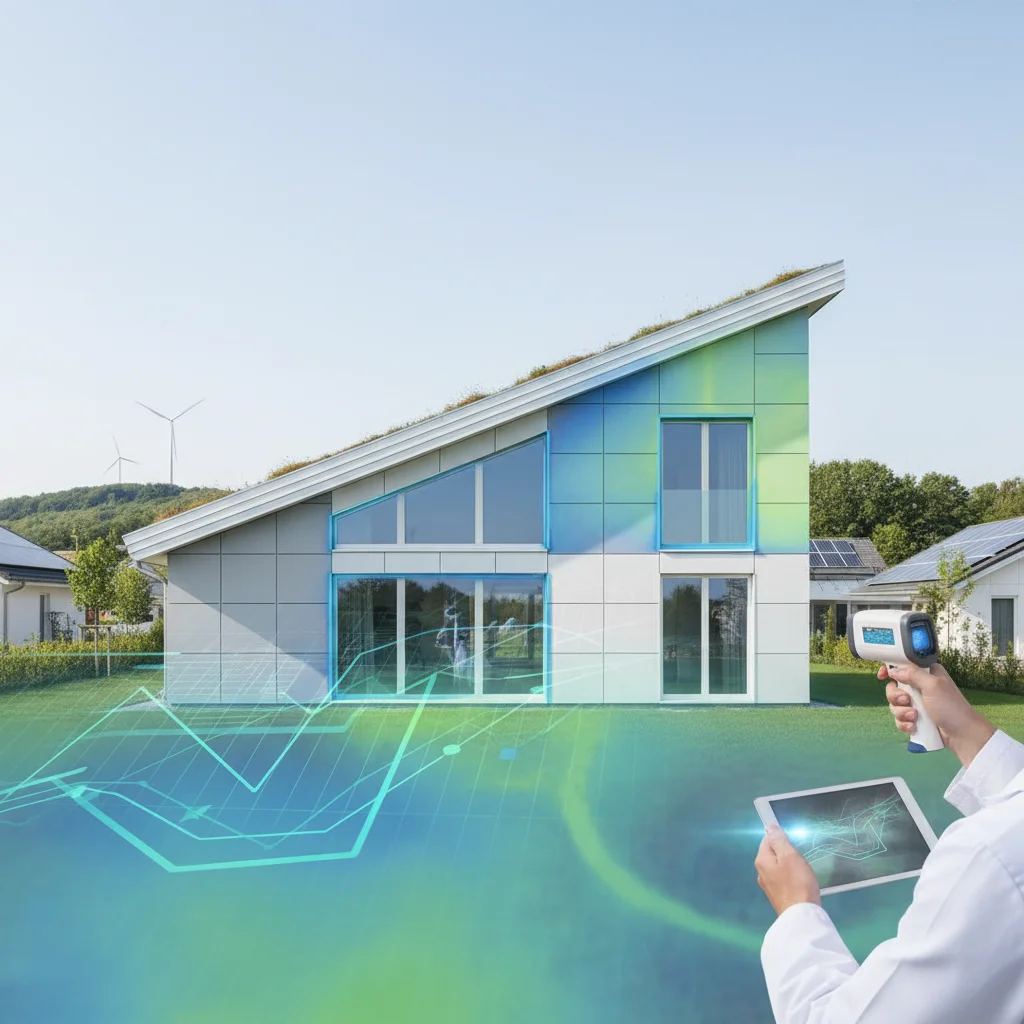
Most California homeowners lose $200-$400 annually through air leaks invisible to the naked eye. A standard visual inspection misses up to 60% of thermal deficiencies that infrared cameras detect in minutes. And utility companies now subsidize these audits at rates up to $150 per home through 2026 energy efficiency programs.
How Much Can You Save with Infrared Thermography Home Audits in California?
Infrared thermography home audits identify thermal inefficiencies that cost California homeowners $150-$500 annually in wasted energy. The technology detects temperature differences as small as 0.2°F across wall surfaces, revealing air leaks, missing insulation, and moisture intrusion that visual inspections miss.
California utilities offer audit rebates ranging from $50 to $150 per inspection through 2026. PG&E's Home Energy Checkup program covers 100% of audit costs for income-qualified households. So homeowners who fix identified issues save an average of $380 per year on heating and cooling costs, according to Department of Energy testing data.
And the equipment upgrades recommended after thermal audits—heat pumps, insulation upgrades, air sealing—qualify for stacked rebates totaling $4,000-$14,000 through California's TECH Clean California program and federal IRA tax credits. Use our free rebate calculator to estimate your total savings potential.
What Equipment Qualifies for Rebates and Tax Credits After a Thermal Audit?
Infrared audits identify specific upgrade opportunities that trigger rebate eligibility across seven equipment categories. Heat pump installations qualify for $3,000-$8,000 in combined California utility rebates plus 30% federal tax credits through 2032 under IRA provisions. But the audit report documentation proving existing system inefficiency is required for rebate approval.
Attic insulation upgrades to R-38 or higher receive $500-$1,200 from California utilities when thermal imaging shows R-value below R-19 in existing conditions. Air sealing measures documented through blower door testing post-audit qualify for $250-$400 additional rebates. And ENERGY STAR certified heat pump water heaters earn $500 rebates when infrared scanning reveals standby heat loss exceeding 2°F at tank surfaces.
Window replacement programs require thermal imaging proof of surface temperature differentials exceeding 8°F between interior and exterior panes. So homeowners stack TECH Clean California rebates with local utility incentives and IRA credits to reduce total project costs by 40-60%. Heat pump rebates now reach $14,000 for comprehensive electrification projects documented through thermal audit reports.
Do You Meet the Income Limits for Federal and State Rebate Programs?
California's enhanced rebate programs target households earning below 80% Area Median Income (AMI), translating to $96,000 for a family of four in Los Angeles County during 2026. TECH Clean California offers $3,000-$6,000 heat pump rebates at standard income levels but increases amounts to $6,000-$14,000 for households below 80% AMI. And federal IRA Home Efficiency Rebates administered through California starting late 2026 provide up to $8,000 in point-of-sale discounts exclusively for households under 80% AMI.
Income verification requires recent tax returns or three months of pay stubs submitted during rebate application. But verification occurs after audit completion, not before scheduling the thermal inspection. So contractors recommend completing the infrared audit first to identify upgrade opportunities, then confirming income eligibility before equipment purchase.
"Income-qualified households can receive up to $14,000 in rebates for heat pump installations when combined with federal and state programs." — California Energy Commission
What's the Step-by-Step Process to Apply for Rebates After Your Thermal Audit?
The rebate application process requires completing five sequential steps within specific timeframes after thermal audit completion. Schedule an infrared thermography audit through a certified BPI or RESNET professional—California utilities maintain searchable contractor directories with 300+ certified auditors statewide. And audits cost $200-$500 but receive full reimbursement through utility programs for income-qualified households.
Review the thermal imaging report within 7 days to identify equipment upgrade priorities ranked by annual energy savings potential. Obtain three contractor quotes for recommended upgrades, verifying each contractor holds California C-20 (HVAC) or C-2 (Insulation) licensing as required for rebate approval. Submit pre-approval applications to utility programs before purchasing equipment—retroactive rebates are denied in 80% of applications according to DSIRE USA tracking data.
Complete equipment installation with permitted work and final inspection sign-off. Submit final rebate paperwork within 90 days of installation completion, including thermal audit report, contractor invoices, proof of payment, and permit documentation. And processing times average 6-8 weeks for standard rebates, with payments issued via check or utility bill credit. Track application status through utility online portals updated weekly.
When Are the Deadlines for 2026 Rebate Applications and Funding Availability?
California utility rebate programs operate on annual funding cycles with applications accepted through December 31, 2026, or until allocated funds deplete. PG&E's $180 million TECH Clean California allocation historically exhausts by October in high-demand regions like the Bay Area. So submitting applications in Q1-Q2 2026 maximizes approval probability before waitlists develop.
The federal Energy Efficient Home Improvement Credit (Section 25C) ended for property placed in service after December 31, 2025 (IRS FS-2025-05). Federal tax credits for this work have ended, but state, local and utility rebates may still apply; check what is available at your address with the DuloCore rebate calculator. But California's Home Efficiency Rebate program launches in late 2026 with $193 million in one-time federal funding expected to support approximately 24,000 home upgrades. And first-come-first-served processing means early applicants in 2026-2027 secure the highest rebate amounts before program funds expire.
Some utility programs require audit completion within 12 months before equipment installation to maintain rebate eligibility. Thermal imaging reports older than 365 days require re-inspection for current conditions documentation. Energy tax credits for thermal audits and subsequent upgrades require filing Form 5695 with annual tax returns, with no carry-forward provisions for unused credit amounts.
Can You Stack Multiple Rebates and Tax Credits from Different Programs?
California allows stacking federal tax credits with state and utility rebates for cumulative savings reaching 60-70% of total project costs. A $12,000 heat pump installation qualifies for $3,600 in federal IRA tax credits (30% of costs), $3,000-$8,000 in TECH Clean California rebates depending on income, and $500-$1,000 in local utility incentives. And total combined incentives for this example project reach $7,100-$12,600.
But stacking rules prohibit claiming the same dollar amount through multiple programs—the federal tax credit calculates on net cost after subtracting state and utility rebates. So a homeowner receiving $8,000 in California rebates applies the 30% federal credit (this federal credit ended for property placed in service after December 31, 2025) to the remaining $4,000 out-of-pocket cost, yielding $1,200 in additional tax credits.
Timing matters for optimal stacking: claim utility rebates first through point-of-sale discounts, then calculate federal credits on the reduced net cost when filing taxes. And California's database cross-references applications to prevent duplicate claims—attempting to claim the same upgrade through multiple programs triggers automatic rejection and potential penalty assessments.
| Program | Maximum Amount | Income Requirement | Application Deadline |
|---|---|---|---|
| TECH Clean California | $14,000 | <80% AMI enhanced | December 31, 2026 |
| Federal IRA Tax Credit | Ended Dec 31, 2025 | — | Ended Dec 31, 2025 |
| PG&E Home Upgrade | $2,000 | None | Funds exhaustion |
| CA Home Efficiency Rebate | $8,000 | <80% AMI only | TBD late 2026 |
What Contractor Certifications and Qualifications Should You Verify?
California requires infrared thermography auditors to hold BPI Building Analyst certification or RESNET HERS Rater credentials to qualify for utility rebate program participation. BPI certification requires passing a 100-question written exam and field assessment demonstrating proficiency with thermal imaging equipment, blower door testing, and combustion safety analysis. And RESNET credentials require 40 hours of classroom training plus supervised field audits across five home types.
Verify contractor California Contractor State License Board (CSLB) licensing through the online database at cslb.ca.gov—thermal auditors performing diagnostic testing require C-2 (Insulation and Energy) or C-20 (HVAC) classifications. Check for active workers' compensation insurance and $1 million general liability coverage minimums required for utility program contractor networks. And confirm the contractor maintains calibrated thermal imaging equipment—FLIR or similar cameras require annual calibration certification to meet RESNET standards.
Request sample audit reports showing thermal imaging analysis with temperature differential measurements, blower door test results reporting air changes per hour (ACH), and prioritized upgrade recommendations with estimated annual savings per measure. So homeowners verify contractor experience through online reviews and Better Business Bureau ratings before scheduling $200-$500 audit investments.
Official Sources
- ENERGY STAR Home Upgrade — Federal guidance on home energy audits and equipment rebates
- DSIRE USA — Comprehensive database of state and federal energy incentive programs
- California Energy Commission — State rebate program details and income qualification thresholds
Frequently Asked Questions
What is infrared thermography and how does it help with home energy audits?
Infrared thermography uses thermal imaging cameras to detect surface temperature variations across walls, ceilings, windows, and doors. The technology identifies air leaks, insulation gaps, and moisture intrusion invisible to visual inspection. Cameras detect temperature differences as small as 0.2°F, revealing energy loss patterns that cost homeowners $200-$400 annually. Auditors capture thermal images during winter months when indoor-outdoor temperature differentials exceed 30°F for optimal contrast. And the resulting reports prioritize upgrade opportunities by annual energy savings potential, guiding cost-effective improvement decisions.
How much does an infrared thermography home audit cost?
Infrared thermography audits cost $200-$500 for comprehensive whole-home assessments in California, with prices varying by home size and regional labor rates. Basic thermal scans covering 1,500-2,000 square feet average $250-$350, while detailed reports for homes exceeding 3,000 square feet reach $450-$500. But California utilities reimburse 100% of audit costs for income-qualified households through programs like PG&E's Home Energy Checkup. And standard-income homeowners receive $50-$150 rebates reducing net audit costs to $100-$300 after utility incentives.
Can I get a rebate for an infrared thermography audit in California?
California utility programs provide $50-$150 rebates for thermal audits conducted by certified BPI or RESNET professionals during 2026. PG&E, SCE, SoCalGas, and SDG&E offer full reimbursement for income-qualified households earning below 80% Area Median Income. And municipal utilities including SMUD and LADWP maintain separate audit rebate programs with amounts ranging from $100-$200. Rebate applications require submitting audit completion certificates and contractor invoices through utility online portals within 60 days of inspection. But rebates apply only to audits performed by contractors enrolled in utility program networks.
What temperature differences can infrared thermography detect in my home?
Professional-grade thermal imaging cameras detect surface temperature variations as small as 0.1-0.2°F, though auditors focus on differences exceeding 5°F indicating significant energy loss. Wall sections with missing insulation show surface temperature variations of 8-15°F compared to properly insulated areas. And air leaks around windows and doors create temperature differentials of 10-20°F visible in thermal images during cold weather testing. Home energy audits using infrared technology identify thermal bridging through framing members showing 3-5°F temperature differences across stud locations. So auditors document all temperature variations exceeding 3°F for upgrade prioritization.
How long does an infrared thermography home inspection take?
Comprehensive infrared thermography inspections require 2-3 hours for typical single-family homes ranging from 1,500-2,500 square feet. Auditors spend 45-60 minutes capturing exterior thermal images, 60-90 minutes documenting interior conditions across all rooms, and 15-30 minutes conducting blower door testing to pressurize the home for enhanced air leak detection. And larger homes exceeding 3,000 square feet require 3-4 hours for complete thermal assessment including attic and crawlspace documentation. Report preparation adds 2-3 business days before homeowners receive final documentation with thermal images, temperature measurements, and upgrade recommendations.
Ready to maximize your home energy savings? Use our free rebate calculator to discover your total incentive eligibility across federal, state, and utility programs. Get personalized estimates in 60 seconds.
Last updated: April 14, 2026. Reviewed by the DuloCore Editorial Team. About our authors.