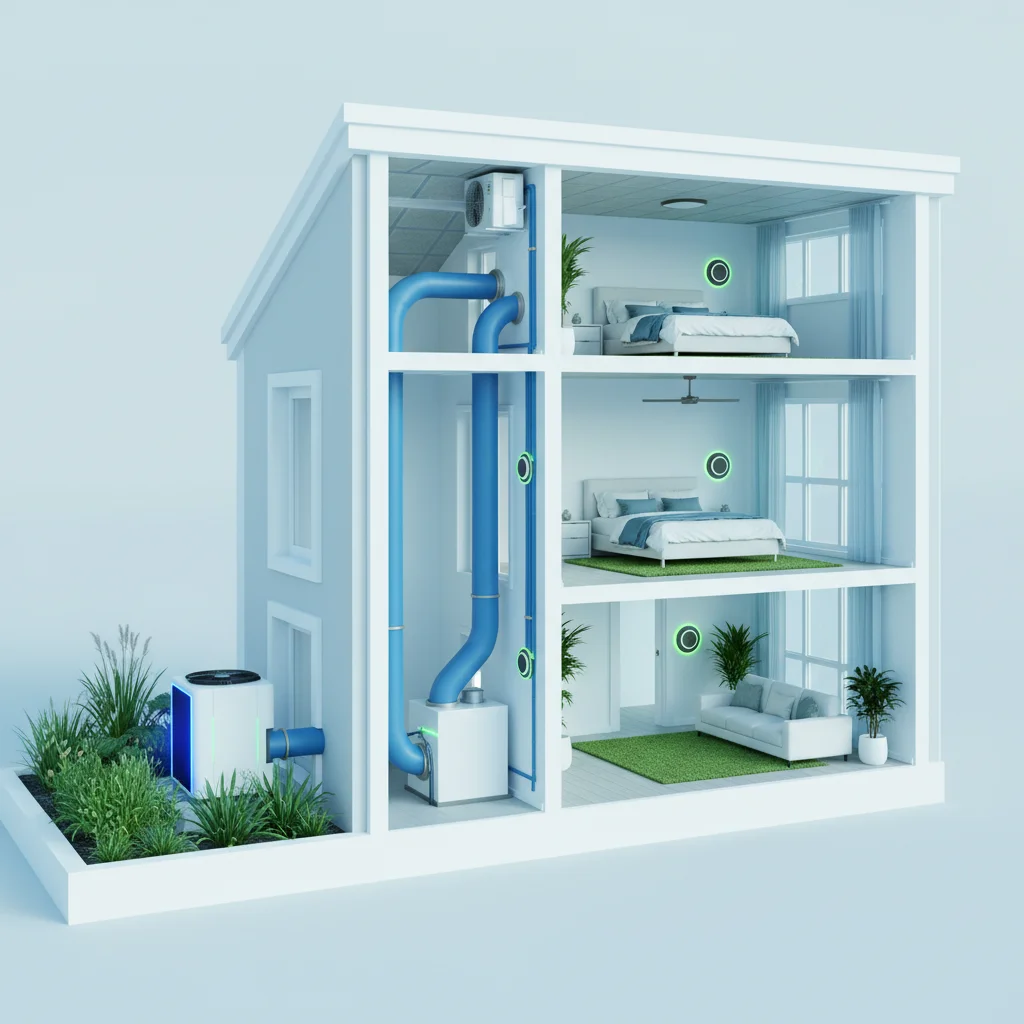
Homeowners waste $500 to $900 annually heating and cooling rooms they don't use. A family room set to 68°F while empty. A guest bedroom maintained at 72°F year-round. An HVAC zoning system eliminates this waste by creating independent temperature zones throughout a home, cutting energy bills 20% to 30% while extending equipment life by 5 to 7 years.
How Much Does an HVAC Zoning System Cost to Install?
HVAC zoning systems cost $2,000 to $3,500 for two-zone installations in 2026, with costs rising $500 to $800 per additional zone. Four-zone systems range from $3,500 to $7,000 depending on home size and existing ductwork compatibility. Wireless systems start at $1,800 for basic configurations, while smart zoning with learning thermostats reaches $8,500 for whole-home installations with 6+ zones.
Standard installations include motorized dampers at $150 to $300 each, a zone control panel priced at $400 to $900, and individual thermostats costing $100 to $350 per zone. Labor accounts for 40% to 50% of total project costs at $80 to $150 per hour for 8 to 16 hours of work. Homes with accessible ductwork pay $2,200 to $4,000, while properties requiring new duct runs or extensive modifications face $5,000 to $12,000 in total expenses. And retrofitting older HVAC systems adds $800 to $2,500 in compatibility upgrades including variable-speed blowers and bypass dampers.
Smart zoning systems with Wi-Fi thermostats and mobile app control cost $300 to $600 more than basic models. Ecobee and Nest learning thermostats integrate with zoning at $180 to $250 per unit, offering remote scheduling and energy usage tracking. But professional-grade zone controllers with occupancy sensors and humidity management reach $1,500 to $2,200 for the control panel alone. Two-story homes typically need 3 to 4 zones minimum, while ranch-style properties function effectively with 2 to 3 zones based on square footage and room layout.
"Zoning systems can save homeowners up to 30% on heating and cooling costs by eliminating the need to condition unused spaces." — U.S. Department of Energy
So homeowners spending $200 monthly on HVAC energy costs save $40 to $60 per month with proper zoning, recovering installation expenses in 3 to 6 years through reduced utility bills and extended equipment longevity.
What's the ROI and Payback Period for HVAC Zoning Systems?
HVAC zoning systems deliver 15% to 30% annual energy savings, generating $360 to $1,080 yearly reductions on $3,000 average cooling and heating costs in 2026. Systems priced at $3,500 reach breakeven in 3.2 to 9.7 years depending on climate zone, home size, and usage patterns. Homeowners in extreme climates—Phoenix summers or Minneapolis winters—achieve payback in 3 to 5 years, while moderate climate zones extend payback to 7 to 10 years.
Equipment longevity improvements add $2,000 to $4,000 in avoided replacement costs. Zoned systems reduce HVAC runtime by 20% to 35%, extending furnace and air conditioner lifespan from 12-15 years to 17-22 years. And reduced cycling decreases compressor wear, cutting repair frequency 40% compared to single-zone systems. Home value increases 1% to 2% with professionally installed zoning, adding $3,000 to $8,000 in resale value for $300,000 to $400,000 properties in markets prioritizing energy efficiency.
Total lifetime value reaches $8,000 to $15,000 over 15 years combining energy savings, avoided replacement costs, and home value gains. But upfront costs delay ROI for homeowners planning to sell within 3 to 5 years—simple programmable thermostats at $80 to $150 offer better short-term returns. Financing through PACE programs or utility rebate installment plans reduces effective payback by 1 to 2 years through lower monthly payments and immediate energy savings.
California's TECH Clean California program offers $500 to $1,500 instant rebates on qualifying smart thermostat installations paired with zoning systems, cutting net costs to $2,000 to $6,000. Use our free rebate calculator to estimate zoning system savings and available incentives based on your home's location and current HVAC configuration.
Are There Rebates or Tax Credits Available for Zone Control Systems?
The federal Energy Efficient Home Improvement Credit (Section 25C) ended for property placed in service after December 31, 2025 (IRS FS-2025-05). Federal tax credits for this work have ended, but state, local and utility rebates may still apply; check what is available at your address with the DuloCore rebate calculator. Homeowners pairing zoning with ENERGY STAR certified heat pumps claim up to $2,000 federal credits, reducing $10,000 combined installations to $8,000 net costs. And zoning installed during whole-system HVAC replacement qualifies when total project meets efficiency thresholds of 16 SEER2 for air conditioning or 9.5 HSPF2 for heating.
California utility rebates through PG&E, SCE, and SDG&E offer $200 to $800 for smart thermostat installations integrated with zoning controls in 2026. SCE's Energy Upgrade California program provides additional $500 to $1,200 rebates when zoning accompanies duct sealing and insulation improvements achieving 15% to 25% whole-home energy reductions. But rebates require licensed contractor installation and pre-approval documentation submitted before project start dates. Learn more about energy tax credits and how they apply to comprehensive HVAC upgrades.
State-specific incentives vary significantly—New York offers $500 to $1,000 through NYSERDA, Massachusetts provides $250 to $600 via Mass Save, and Oregon grants $300 to $700 through Energy Trust. Local municipal utility districts add $100 to $400 in stackable rebates for customers in specific service territories. So homeowners combining federal credits, state rebates, and utility incentives reduce $5,000 zoning installations to $2,500 to $3,500 net costs in high-incentive regions.
PACE financing programs in 38 states allow zoning system costs to transfer via property tax assessments over 10 to 20 years at 4% to 7% interest rates. And manufacturer rebates from Honeywell, Carrier, and Trane contribute $100 to $300 seasonal promotions during spring and fall installation periods. Check heat pump rebates for additional savings when combining zoning with efficient heating equipment.
How Do HVAC Zoning Costs Compare to Other Efficiency Upgrades?
HVAC zoning at $2,000 to $7,000 costs less than heat pump installations at $5,000 to $15,000 but more than programmable thermostats at $80 to $300. Attic insulation upgrades run $1,500 to $3,500 for 1,000 to 1,500 square feet, delivering 10% to 15% energy savings versus 20% to 30% from zoning. And air sealing costs $500 to $2,000 for whole-home weatherization, providing 5% to 12% efficiency gains with faster payback periods of 1 to 3 years.
Ductless mini-split systems offering room-by-room control cost $3,000 to $5,000 per indoor unit, reaching $9,000 to $25,000 for whole-home installations versus $3,500 to $7,000 for centralized zoning. But mini-splits eliminate ductwork energy losses of 20% to 30%, making them more efficient in poorly ducted homes. Smart thermostats at $180 to $300 deliver 8% to 15% savings without ductwork modifications, serving as lower-cost alternatives for homeowners with good existing HVAC systems.
Solar panel installations at $15,000 to $30,000 after federal credits offset 50% to 100% of electricity costs, while zoning reduces HVAC-specific consumption 20% to 30% of the total 35% to 50% residential energy share. So combining solar with zoning maximizes returns—panels generate savings on reduced consumption, accelerating payback from 10-12 years to 7-9 years. Window replacements cost $8,000 to $20,000 for whole-home upgrades, preventing 10% to 25% of heating and cooling losses but requiring 12 to 18 years for cost recovery.
| Upgrade Type | Cost Range | Annual Savings | Payback Period |
|---|---|---|---|
| HVAC Zoning | $2,000-$7,000 | $360-$1,080 | 3-10 years |
| Heat Pump | $5,000-$15,000 | $500-$1,500 | 5-15 years |
| Attic Insulation | $1,500-$3,500 | $300-$600 | 3-8 years |
| Smart Thermostat | $180-$300 | $150-$300 | 1-2 years |
| Mini-Split System | $9,000-$25,000 | $800-$2,000 | 6-12 years |
Zoning delivers the highest ROI when existing ductwork remains in good condition and homes feature multiple stories or distinct living zones with varying occupancy patterns. Learn more about HVAC efficiency strategies to determine optimal upgrade combinations for your home.
What Factors Affect the Total Cost of a Zoning System Installation?
Home size directly impacts zoning costs—1,500 square foot homes need 2 to 3 zones at $2,000 to $4,500, while 3,000+ square foot properties require 4 to 6 zones at $5,000 to $10,000. Each additional zone adds $500 to $800 in dampers, thermostats, and labor costs. Two-story homes need minimum 2 zones separating floors, while single-story layouts benefit from 3 zones dividing living areas, bedrooms, and utility spaces based on usage patterns.
Ductwork condition determines retrofit complexity—accessible ducts with adequate space for damper installation cost $1,200 to $1,800 in labor, while concealed or damaged ducts requiring extensive modifications reach $3,000 to $6,000. Homes lacking proper return air pathways need bypass dampers at $400 to $900 to prevent system pressure imbalances. And undersized ducts serving multiple zones require enlargement or supplemental returns at $1,500 to $4,000 to maintain proper airflow of 400 CFM per ton of cooling capacity.
HVAC equipment age affects compatibility costs—systems older than 10 years often need variable-speed blower upgrades at $800 to $2,000 to handle zone-specific airflow demands. Single-stage furnaces and air conditioners require additional control boards at $300 to $700 to interface with zone panels. But newer multi-stage or modulating systems integrate seamlessly, reducing installation costs $500 to $1,200 compared to older fixed-capacity equipment.
Control system sophistication ranges from basic hardwired thermostats at $100 each to smart learning systems at $250 to $400 per zone. Wireless installations save $400 to $1,200 in labor versus hardwired runs through finished walls. And integration with whole-home automation platforms—Control4, Crestron, or Savant—adds $1,500 to $5,000 in programming and interface costs. Geographic labor rates vary from $65 to $100 per hour in rural markets to $120 to $180 per hour in metropolitan areas, affecting total installation costs 25% to 40%.
How Long Does HVAC Zoning System Installation Take?
Standard 2 to 3 zone installations require 8 to 16 hours of labor over 1 to 2 days depending on ductwork accessibility and home layout in 2026. Contractors complete damper installation in 4 to 6 hours, zone panel mounting and wiring in 2 to 3 hours, and thermostat setup in 1 to 2 hours per zone. And system testing and balancing adds 2 to 4 hours ensuring proper airflow and temperature control across all zones.
Complex installations with 4+ zones, concealed ductwork, or multi-story layouts extend to 16 to 24 hours over 2 to 3 days. Homes requiring duct modifications or bypass damper installations add 4 to 8 hours. So total project timelines span 2 to 5 days including equipment delivery, installation, testing, and homeowner training on control systems. Most contractors schedule residential zoning during spring or fall when HVAC demand decreases, ensuring 1 to 2 week lead times versus 3 to 6 week delays during peak summer and winter seasons.
Wireless zoning systems reduce installation time 30% to 40% by eliminating thermostat wiring through finished walls. Battery-powered wireless thermostats and damper actuators install in 6 to 10 hours total, cutting labor costs $400 to $800. But wireless systems require battery replacement every 2 to 3 years at $20 to $40 per device. Retrofits into occupied homes proceed during business hours without requiring relocation, while new construction integrations occur during rough-in phases before drywall installation.
"Proper zoning system installation requires careful airflow balancing to prevent pressure imbalances that can damage HVAC equipment and reduce efficiency." — ENERGY STAR
Permit requirements vary by jurisdiction—California requires HVAC permits for zoning installations affecting system capacity or ductwork modifications, adding 1 to 3 weeks for approval and $150 to $400 in fees. And final inspections take 3 to 7 business days after installation completion. Check local building codes before project start to avoid delays.
Official Sources
- U.S. Department of Energy - Zoning Systems — Federal guidance on HVAC zoning efficiency and cost savings
- ENERGY STAR — HVAC equipment efficiency standards and qualified product listings
- DSIRE USA — Database of state incentives for renewables and efficiency including HVAC upgrades
Frequently Asked Questions
How much does an HVAC zoning system cost to install?
HVAC zoning systems cost $2,000 to $3,500 for basic 2-zone installations in 2026, with each additional zone adding $500 to $800. Four-zone systems range from $3,500 to $7,000 depending on home size, ductwork condition, and control system sophistication. Wireless smart zoning with learning thermostats reaches $8,500 for 6+ zone whole-home installations.
What rebates are available for HVAC zoning systems?
California utilities offer $200 to $800 for smart thermostat installations integrated with zoning controls through PG&E, SCE, and SDG&E programs in 2026. The federal Energy Efficient Home Improvement Credit (Section 25C) ended for property placed in service after December 31, 2025 (IRS FS-2025-05). And PACE financing spreads costs over 10 to 20 years via property tax assessments at 4% to 7% interest rates.
Is an HVAC zoning system worth the investment?
HVAC zoning systems deliver 15% to 30% annual energy savings worth $360 to $1,080 for homeowners spending $3,000 yearly on heating and cooling in 2026. Systems achieve payback in 3 to 10 years depending on climate and usage patterns, while extending HVAC equipment life 5 to 7 years and increasing home value 1% to 2%. But homes with good existing efficiency or plans to sell within 3 years see better returns from simpler upgrades like programmable thermostats.
How long does it take to install an HVAC zoning system?
Standard 2 to 3 zone installations require 8 to 16 hours of labor over 1 to 2 days in homes with accessible ductwork. Complex 4+ zone systems in multi-story properties extend to 16 to 24 hours over 2 to 3 days. And wireless zoning reduces installation time 30% to 40% by eliminating thermostat wiring, completing most projects in 6 to 10 hours. Permit approval adds 1 to 3 weeks in California.
Can I get a tax credit for installing an HVAC zoning system?
The federal Energy Efficient Home Improvement Credit (Section 25C) ended for property placed in service after December 31, 2025 (IRS FS-2025-05). Homeowners claim up to $2,000 federal credits on qualifying systems meeting 16 SEER2 cooling or 9.5 HSPF2 heating efficiency thresholds. And California utility rebates provide additional $200 to $1,200 when zoning accompanies comprehensive energy upgrades achieving 15%+ whole-home savings.
Ready to reduce energy costs with HVAC zoning? Use our free rebate calculator to discover available incentives and estimate your potential savings based on your home's location, size, and current HVAC system. Get personalized recommendations and connect with qualified local contractors for accurate installation quotes.
Last updated: April 14, 2026. Reviewed by the DuloCore Editorial Team. About our authors.
Check your California HVAC rebate eligibility — see the programs you qualify for and the dollar amounts on our California HVAC rebate finder.