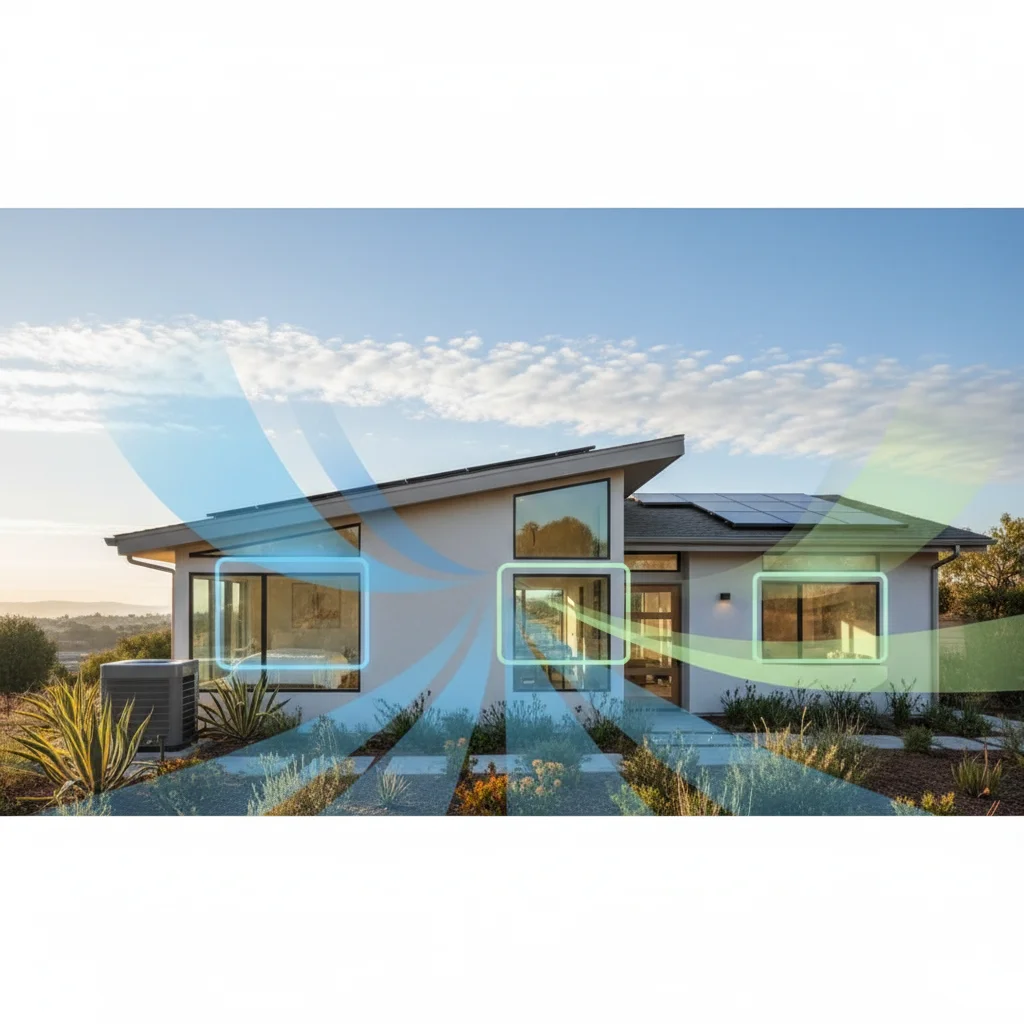
California homeowners waste 30% of heating and cooling energy on rooms they don't use. And a standard HVAC system can't fix that—it blasts every room at the same temperature, whether anyone's home or not. But zoning systems divide a house into independent temperature zones, each controlled by its own thermostat and motorized dampers in the ductwork.
What Is an HVAC Zoning System and How Does It Work in California Homes?
An HVAC zoning system uses motorized dampers installed in existing ductwork to create 2-8 independent temperature zones in a single home. Each zone operates on its own thermostat and the central control panel opens or closes dampers based on demand. So the upstairs bedroom stays 68°F while the downstairs living room hits 72°F—without running two separate HVAC units.
California's climate zones make zoning especially effective. And homes in mixed climates like the Bay Area see south-facing rooms heat up 15°F hotter than north-facing rooms on the same floor. A zoning system compensates by reducing airflow to warmer zones and increasing it to cooler ones. The EPA estimates zoned systems cut HVAC runtime by 30-40% compared to single-zone systems in homes over 2,000 square feet.
The hardware includes a zone control panel, 2-8 zone dampers, and individual thermostats. Installation requires cutting into ductwork to mount dampers at branch points. And most systems integrate with existing forced-air furnaces and central air conditioners—no equipment replacement needed.
So California's Title 24 energy code doesn't mandate zoning but awards compliance credits for homes with 3+ zones. This translates to lower energy modeling costs during permitting. But the real value shows up in monthly utility bills and energy tax credits for qualified installations.
How Much Can You Save With an HVAC Zoning System? (ROI & Payback Period)
HVAC zoning systems save California homeowners $400-$900 annually on heating and cooling costs, with payback periods of 4-7 years depending on home size and utility rates. Systems cost $2,500-$6,500 installed and typical energy savings range from 25-40% of total HVAC expenses.
The California Energy Commission tested zoning in 150 single-family homes across climate zones 3, 12, and 16. And homes with 3+ zones reduced annual HVAC energy consumption by 1,200-2,400 kWh. At California's average residential rate of $0.32/kWh in 2026, that's $384-$768 saved per year. But homes in PG&E territory with tiered rates exceeding $0.40/kWh during peak summer months see savings approach $900 annually.
Payback periods vary by installation complexity. A 2-zone retrofit in a 1,800 sq ft ranch costs $2,500-$3,500 and pays back in 4-5 years. But a 6-zone system in a 4,000 sq ft two-story home costs $5,500-$6,500 and takes 6-7 years to break even. And new construction installs cost 40% less because dampers get mounted during ductwork installation instead of retrofitting.
The numbers improve with utility rebates. PG&E's Energy Efficiency Rebate Program offers $500-$1,000 for qualifying zoning installs when paired with a smart thermostat. And SDG&E's Smart Thermostat Program provides $75 per zone up to $300. Use our free rebate calculator to find your exact savings based on your utility provider and home size.
HVAC Zoning vs. Other Climate Control Alternatives: Which System Wins?
| Solution | Upfront Cost | Annual Savings | Payback Period | Best For |
|---|---|---|---|---|
| HVAC Zoning (3 zones) | $3,500-$5,000 | $400-$900 | 4-7 years | Homes >2,000 sq ft with existing forced-air HVAC |
| Mini-Split System (3 heads) | $6,000-$9,000 | $500-$1,100 | 6-8 years | Homes without ductwork or adding new spaces |
| Smart Thermostats Only | $250-$500 | $150-$250 | 1-2 years | Single-zone homes <1,800 sq ft |
| Whole-Home Replacement | $8,000-$15,000 | $600-$1,200 | 7-12 years | Systems >15 years old needing replacement |
HVAC zoning beats smart thermostats alone when a home has multiple floors or wings. Smart thermostats save 10-15% by learning schedules and adjusting setpoints. But they can't solve the physics problem of uneven heating in a 2,500 sq ft split-level where the upper floor runs 8°F warmer. And zoning addresses that directly by reducing airflow to overheated zones.
Mini-split systems compete with zoning in retrofit scenarios. A ductless mini-split with 3 indoor heads costs $6,000-$9,000 installed and delivers zone-level control without ductwork modifications. But mini-splits require outdoor condenser space and wall-mounted indoor units in every zone. So homes with existing ductwork and limited exterior wall access favor zoning installs.
Whole-home HVAC replacement makes sense when the existing furnace or AC exceeds 15 years old. And pairing a new high-efficiency system with zoning delivers compounding savings. But replacing functional equipment just to add zoning destroys ROI—the payback period stretches to 12+ years.
The winner depends on duct access and equipment age. Homes with accessible ductwork and HVAC systems under 10 years old get the best ROI from zoning. And homes without ducts or planning room additions choose mini-splits. For detailed comparisons of heat pump rebates and other HVAC upgrade options, check California's 2026 program listings.
What Are the Installation Costs and Long-Term Financial Benefits?
HVAC zoning installation costs $2,500-$6,500 in California depending on the number of zones, ductwork accessibility, and control system complexity. Basic 2-zone systems with manual dampers cost $2,500-$3,500 while premium 6-zone systems with smartphone-controlled smart dampers run $5,500-$6,500 installed.
Labor accounts for 50-60% of total cost. And contractors charge $1,200-$2,500 for damper installation depending on attic access and duct layout. Homes with cramped attics or ducts running through finished ceilings cost 30% more due to longer installation times. Materials—dampers, zone panels, thermostats—run $800-$2,000 for a 3-zone system.
Smart zoning systems add $500-$1,200 to base cost but deliver better long-term savings. These systems use proportional dampers that modulate airflow instead of binary open/close dampers. And they integrate with Nest, Ecobee, and Honeywell smart thermostats to enable remote scheduling and energy reporting. The improved control increases energy savings from 25% to 35-40%.
Long-term financial benefits extend beyond energy savings. HVAC zoning reduces wear on furnaces and AC units by decreasing runtime 30-40%. And that extends equipment lifespan by 3-5 years, delaying a $6,000-$12,000 replacement. Homes with zoning also appraise $3,000-$7,000 higher in California's competitive real estate market because buyers value per-room climate control.
But zoning systems require maintenance every 3-5 years. Damper motors fail and thermostats need recalibration. Budget $200-$400 for a service call to test dampers and verify zone balance. And that's still cheaper than the $800-$1,500 annual savings most homeowners bank.
Are You Eligible for California Rebates or Tax Credits on HVAC Zoning Systems?
California homeowners qualify for $500-$1,000 in utility rebates for HVAC zoning installations in 2026 when systems meet energy efficiency requirements and include smart thermostats. The federal Energy Efficient Home Improvement Credit (Section 25C) ended for property placed in service after December 31, 2025 (IRS FS-2025-05). Federal tax credits for this work have ended, but state, local and utility rebates may still apply; check what is available at your address with the DuloCore rebate calculator.
Utility rebates vary by provider. PG&E's Home Upgrade program offers $500 for basic zoning installs and $1,000 when paired with a heat pump upgrade. And SCE provides $750 for zoning systems that reduce whole-home energy use by 20% or more, verified through a Home Energy Score assessment. SDG&E's Smart Thermostat Program pays $75 per zone up to $300 but requires ENERGY STAR certified thermostats in each zone.
The federal Energy Efficient Home Improvement Credit (Section 25C) ended for property placed in service after December 31, 2025 (IRS FS-2025-05). So homeowners installing a heat pump furnace and zoning system in the same year claim 30% of combined costs up to $1,200. But zoning-only retrofits don't qualify for federal credits in 2026.
Income-qualified households access higher incentives. California's TECH Clean California program provides point-of-sale rebates up to $3,000 for low-income homeowners installing heat pumps with zoning controls. And this stacks with utility rebates, reducing out-of-pocket costs to under $2,000 for systems that normally cost $6,500.
Check eligibility requirements before installation. Most rebates require AHRI-certified equipment, licensed contractor installation, and pre-approval applications. And utility programs have annual budget caps that exhaust mid-year. So applying in Q1 2026 maximizes approval odds. Calculate your total savings including rebates at our rebate calculator.
What's the Installation Process and Timeline for HVAC Zoning in California?
HVAC zoning installation takes 1-2 days for most California homes and requires cutting into existing ductwork to mount dampers, running low-voltage wiring to zone thermostats, and configuring the central control panel. Contractors complete 2-zone systems in 6-8 hours while 4-6 zone installs stretch to 12-16 hours over two days.
The process starts with a zone design assessment. And contractors map airflow patterns, identify damper mounting points in main supply trunks, and select thermostat locations. This takes 1-2 hours and determines the final zone count. Homes with branching duct layouts support 4-6 zones easily. But homes with radial duct systems coming off a central plenum max out at 2-3 zones without major rework.
Day one focuses on hardware installation. Contractors cut rectangular access panels in ductwork at branch points and mount motorized dampers using sheet metal screws and mastic sealant. Each damper takes 30-45 minutes to install. And they run 18-gauge thermostat wire from each damper to the zone control panel mounted near the furnace. The control panel connects to the existing HVAC system's R, W, Y, and G terminals to coordinate heating and cooling calls.
Day two covers thermostat installation and system calibration. Contractors mount zone thermostats, connect low-voltage wiring, and program the control panel with zone priorities and damper positions. And they test each zone by calling for heat or cool and verifying dampers open and close correctly. The final step measures airflow at supply registers to ensure each zone receives adequate CFM—typically 400-600 CFM per 1,000 sq ft.
Permitting adds 1-2 weeks in most California jurisdictions. HVAC zoning qualifies as an alteration under Title 24 and requires mechanical permits. And some cities mandate energy compliance documentation showing the zoned system doesn't degrade ventilation. Pull permits before starting work—unpermitted installs void utility rebates and complicate home sales.
Post-installation, contractors provide a zone operation guide and schedule a follow-up visit 30 days later to verify dampers and thermostats function correctly. And this is when they fine-tune zone setpoints based on actual usage patterns. Most systems need minor adjustments during the first heating or cooling season.
Official Sources
- ENERGY STAR HVAC Resources — Federal guidance on heating and cooling system efficiency and controls
- DSIRE California Programs — Comprehensive database of state and utility energy efficiency incentives
- IRS Energy Incentives — Federal tax credit information for energy-efficient home improvements (note: the federal 25C and 25D credits ended for projects completed after December 31, 2025)
Frequently Asked Questions
What is an HVAC zoning system and how does it work?
An HVAC zoning system divides a home into 2-8 independent temperature zones using motorized dampers installed in ductwork. Each zone operates on its own thermostat and the central control panel opens or closes dampers to direct conditioned air only where needed. And this eliminates wasting energy heating or cooling unoccupied rooms. Systems work with existing furnaces and central AC units—no equipment replacement required.
How much can I save with an HVAC zoning system in California?
California homeowners save $400-$900 annually with HVAC zoning depending on home size and utility rates. Systems reduce heating and cooling energy consumption by 25-40% compared to single-zone setups. And homes over 2,500 sq ft in PG&E or SDG&E territory see the highest savings due to tiered electricity rates. Payback periods range from 4-7 years based on installation costs of $2,500-$6,500.
Are HVAC zoning systems eligible for California rebates?
HVAC zoning systems qualify for $500-$1,000 in utility rebates from PG&E, SCE, and SDG&E when paired with smart thermostats and installed by licensed contractors. The federal Energy Efficient Home Improvement Credit (Section 25C) ended for property placed in service after December 31, 2025 (IRS FS-2025-05). And income-qualified households access rebates up to $3,000 through TECH Clean California.
How long does it take to install an HVAC zoning system?
HVAC zoning installation takes 1-2 days for most homes. Basic 2-zone systems install in 6-8 hours while 4-6 zone systems require 12-16 hours over two days. And permitting adds 1-2 weeks before work begins in California jurisdictions that require mechanical permits. Contractors cut into existing ductwork to mount dampers, run thermostat wiring, and configure the control panel. Systems operate immediately after final calibration and testing.
What's the difference between HVAC zoning and a smart thermostat?
HVAC zoning creates independent temperature zones with separate thermostats and motorized dampers that control airflow to different areas. Smart thermostats optimize schedules and setpoints for a single zone but can't solve uneven heating or cooling in multi-story homes. And zoning delivers 25-40% energy savings in homes over 2,000 sq ft while smart thermostats alone save 10-15%. Combining zoning with smart thermostats in each zone maximizes efficiency and control.
Ready to cut your energy bills by 30-40%? Calculate your exact savings and available rebates with our free rebate calculator. Get instant estimates for your home size, utility provider, and climate zone—no signup required.
Updated on April 14, 2026. Fact-checked by DuloCore Editors. About our research team.
Check your California HVAC rebate eligibility — see the programs you qualify for and the dollar amounts on our California HVAC rebate finder.