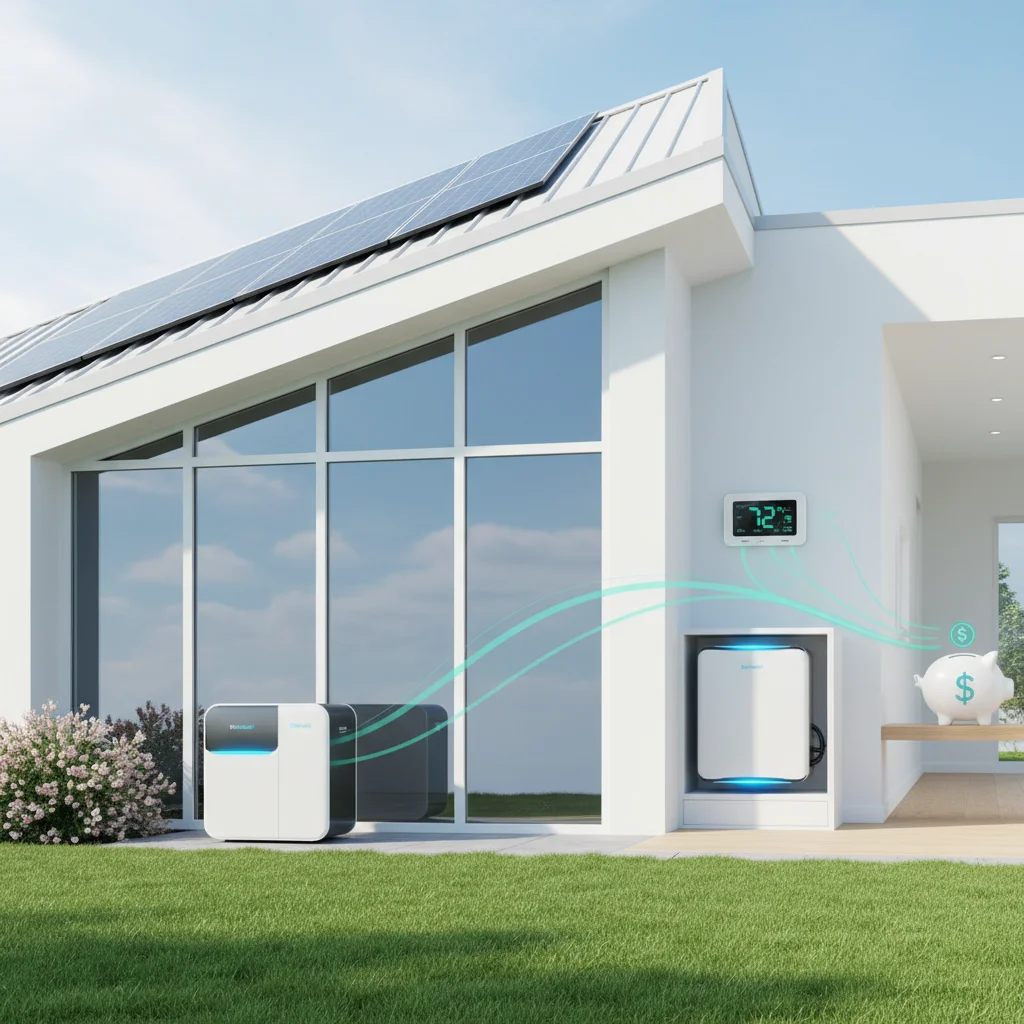
American households waste $29 billion annually on inefficient HVAC systems, according to the Department of Energy. And the typical 15-year-old furnace or air conditioner costs 30-40% more to operate than a modern high-efficiency replacement. Upgrading heating and cooling equipment now delivers immediate energy savings, federal tax credits up to $2,000, and potential utility rebates totaling $500-$5,000 depending on location and system type.
How Much Does an HVAC Upgrade Cost Compared to Repair?
A complete HVAC system replacement costs $5,000-$12,500 for standard efficiency equipment and $8,000-$20,000 for high-efficiency heat pumps or dual-fuel systems in 2026. Single repairs typically run $150-$800 per incident. But systems older than 12 years average 2-3 major repairs annually, pushing total repair costs to $1,500-$2,400 per year. So replacement becomes cost-neutral within 3-4 years when factoring annual energy savings of $400-$900 from modern equipment. The federal Energy Efficient Home Improvement Credit (Section 25C) ended for property placed in service after December 31, 2025 (IRS FS-2025-05). Federal tax credits for this work have ended, but state, local and utility rebates may still apply; check what is available at your address with the DuloCore rebate calculator. The rebate calculator shows personalized payback periods based on current equipment age and local utility rates.
Repair costs escalate sharply after year 10 as compressors, heat exchangers, and control boards fail. Major component replacement often costs 40-60% of new system price but delivers zero efficiency improvement. Refrigerant phase-outs compound the problem since R-22 recharges now cost $150-$200 per pound compared to $50-$80 in 2020. Modern systems use R-410A or R-32 refrigerants with stable pricing and higher efficiency ratings of 16-25 SEER compared to 10-13 SEER for pre-2015 equipment.
What Are the Main Alternatives to a Full HVAC Replacement?
Ductless mini-split heat pumps cost $3,000-$5,000 per indoor unit and eliminate ductwork renovation expenses of $2,500-$6,500 in older homes. These systems deliver 20-30 SEER efficiency and zone-specific temperature control that reduces energy waste in unused rooms by 15-25%. The federal Energy Efficient Home Improvement Credit (Section 25C) ended for property placed in service after December 31, 2025 (IRS FS-2025-05). But multi-room installations require 2-4 indoor units at $12,000-$20,000 total cost, making them competitive with central systems only in homes needing significant duct repair.
Geothermal heat pumps represent the highest-efficiency alternative at 300-400% efficiency compared to 250-350% for air-source heat pumps. Installation costs $15,000-$35,000 including ground loop drilling but qualifies for the full 30% federal credit (this federal credit ended for property placed in service after December 31, 2025) with no dollar cap, reducing net cost to $10,500-$24,500. Annual operating costs run $300-$600 compared to $800-$1,400 for standard gas furnaces, creating payback periods of 5-10 years. The hvac efficiency guide compares efficiency metrics across system types.
Hybrid dual-fuel systems combine electric heat pumps with gas furnace backup for $7,000-$14,000 installed cost. These automatically switch to the most economical fuel source based on outdoor temperature and energy prices, cutting heating costs 20-35% compared to gas-only systems in climates with winter temperatures below 25°F. Federal credits apply only to the heat pump component, typically $1,200-$1,600 of the total installation.
How Do HVAC Upgrades Compare to Other Home Efficiency Improvements?
HVAC system replacement delivers $0.30-$0.75 energy savings per dollar invested over 15-year equipment lifespan, according to Lawrence Berkeley National Laboratory research. Attic insulation returns $0.50-$1.20 per dollar invested through reduced heating and cooling loads, making it the highest-ROI efficiency upgrade. But insulation requires adequate HVAC capacity to maintain comfort, so pairing both investments delivers combined savings of 35-50% on annual energy costs.
Air sealing costs $400-$1,500 for whole-house treatment and reduces HVAC runtime 10-20% by eliminating infiltration losses. This extends equipment lifespan 2-4 years and cuts maintenance costs $150-$300 annually. Window replacement costs $8,000-$20,000 for typical homes but delivers only $200-$400 annual energy savings, creating 20-50 year payback periods without factoring aesthetic and resale value improvements. So windows rank lowest among efficiency investments on pure energy economics.
Smart thermostats cost $120-$250 installed and reduce HVAC energy use 8-15% through automated scheduling and learning algorithms. Annual savings of $100-$180 create payback in 8-18 months. And many utility companies offer $50-$75 rebates on smart thermostat purchases, reducing net cost to $45-$175. The DOE reports homes with programmable thermostats save $180 annually compared to manual thermostat operation.
Solar panel systems cost $15,000-$30,000 after federal tax credits and offset 70-100% of electricity costs including HVAC operation. Combined solar plus heat pump installations qualify for separate 30% tax credit (these federal credits ended for projects completed after December 31, 2025)s on each system, maximizing available incentives. But geographic solar potential varies significantly, with southwestern states averaging 1,800-2,200 annual sun hours compared to 1,200-1,500 in northern regions, affecting system economics.
What Financial Incentives Are Available for HVAC Upgrades in 2026?
The federal home energy tax credits (Sections 25C and 25D) ended for projects completed after December 31, 2025 (IRS FS-2025-05). Equipment must meet ENERGY STAR certification with minimum 16 SEER2 cooling and 9.5 HSPF2 heating efficiency ratings. And the credit applies to both primary residences and second homes but excludes rental properties. Form 5695 only covers qualifying work completed by December 31, 2025 and claimed on a 2025 return; the federal 25C and 25D credits ended after that date (IRS FS-2025-05).
The federal Energy Efficient Home Improvement Credit (Section 25C) ended for property placed in service after December 31, 2025 (IRS FS-2025-05).
State-level incentives vary dramatically by location. California offers $3,000-$6,500 through TECH Clean California for heat pump installations in existing homes. New York provides $1,000-$3,500 via the Clean Heat program with additional $4,000-$6,000 incentives for low-to-moderate income households. Massachusetts delivers $1,500-$10,000 through Mass Save depending on fuel source conversion and income qualification. The DSIRE database tracks all state and utility rebate programs with current 2026 program details.
Utility company rebates add $300-$2,500 for high-efficiency equipment installations. Duke Energy offers $600-$1,200 for heat pumps meeting 16+ SEER ratings. Pacific Gas & Electric provides $1,500-$3,000 for qualifying air-source and ductless systems. And ComEd delivers $350-$850 for ENERGY STAR certified central air conditioners and heat pumps. Most utility rebates combine with federal tax credits but require pre-approval before installation begins.
Manufacturer rebates from Carrier, Trane, Lennox, and other major brands provide additional $200-$800 seasonal discounts. These typically run during spring and fall shoulder seasons when installation demand drops. Some manufacturers offer 0% financing for 36-60 months on complete system purchases, reducing monthly payment burden while capturing immediate energy savings.
What's the ROI Timeline for an HVAC Upgrade Investment?
Heat pump upgrades deliver payback in 4-8 years for gas furnace replacements and 6-12 years for oil furnace conversions based on 2026 energy prices. Annual savings range from $400-$900 for moderate climates to $800-$1,600 in extreme temperature regions with high heating or cooling demands. And federal tax credits reduce effective payback periods by 12-18 months depending on system cost.
Geothermal systems require 8-15 year payback despite higher efficiency due to $15,000-$35,000 upfront costs. But these systems last 20-25 years for indoor components and 50+ years for ground loops, delivering decades of sub-$500 annual energy costs after payback completion. Maintenance expenses run $100-$200 annually compared to $200-$400 for conventional systems.
Energy price volatility significantly impacts ROI calculations. Natural gas prices fluctuated from $3.89 to $8.50 per thousand cubic feet between 2020-2025, creating 35-55% variation in operating cost projections. Electric rates show greater stability with 3-8% annual increases in most markets. So heat pump economics improve as fossil fuel price volatility continues.
Resale value increases of $2,500-$6,000 according to Zillow research for homes with heat pump systems versus standard furnaces. And properties with modern HVAC equipment sell 15-25 days faster than comparable homes needing system replacement. The National Association of Realtors reports 71% of buyers consider energy efficiency "very important" or "extremely important" in home purchase decisions.
Equipment lifespan extension from 12-15 years to 18-22 years through regular maintenance adds $3,000-$5,000 in avoided replacement costs. Annual tune-ups costing $120-$180 prevent 60-85% of major component failures according to HVAC industry data. Filter changes every 90 days and coil cleaning every 2-3 years maintain peak efficiency ratings throughout system life.
How Do You Choose Between Upgrading Now vs. Waiting?
Immediate replacement makes financial sense when current equipment requires repairs exceeding 30% of new system cost or when annual energy bills exceed $1,800 for heating and cooling. The 50% rule applies industry-wide since repair costs compound rapidly after major component failure. And waiting through another season costs $150-$400 in excess energy consumption for systems operating below 65% efficiency.
End-of-season timing captures maximum contractor availability and manufacturer rebates. Installing heat pumps in fall (September-November) or spring (March-May) reduces labor costs 10-20% compared to peak summer air conditioning season. Equipment prices remain stable but installation scheduling flexibility improves significantly.
Emergency replacement during system failure costs 15-30% more than planned installations due to limited contractor competition and rush service premiums. And homeowners lose negotiating leverage on equipment selection, financing terms, and warranty coverage. So monitoring system age and performance indicators prevents costly emergency scenarios.
Pre-failure indicators include increasing repair frequency, rising energy bills without usage changes, uneven heating or cooling, and strange noises during operation. Systems older than 12 years showing any of these symptoms face 60-80% likelihood of major failure within 24 months based on actuarial data from equipment manufacturers.
Utility rate changes affect upgrade economics significantly. Planned natural gas rate increases of 12-18% in northeastern states during 2026-2027 improve heat pump payback periods by 8-14 months. Time-of-use electric rates with 50-70% price differentials between peak and off-peak hours favor heat pump systems with thermal storage capabilities.
Climate patterns influence system sizing and technology selection. Homes in heating-dominated climates (6,000+ heating degree days annually) benefit most from cold-climate heat pumps rated for -15°F operation. Cooling-dominated regions (2,500+ cooling degree days) prioritize high SEER ratings of 20+ for maximum summer savings. The energy tax credits guide explains climate-specific equipment qualifications.
Official Sources
- Energy.gov Home Energy Rebates — Federal IRA tax credit details, eligibility requirements, and state program summaries for HVAC upgrades (note: the federal 25C credit ended for property placed in service after December 31, 2025)
- DSIRE USA Database — Comprehensive state, local, and utility rebate programs with current 2026 incentive amounts and application processes
- ENERGY STAR HVAC Guide — Equipment efficiency ratings, certification requirements, and savings calculators for qualified heat pump and air conditioning systems
Frequently Asked Questions
How much does an HVAC upgrade cost on average?
Complete HVAC system replacement costs $5,000-$12,500 for standard efficiency equipment and $8,000-$20,000 for high-efficiency heat pumps in 2026. Ductless mini-split installations run $3,000-$5,000 per indoor unit. And geothermal systems cost $15,000-$35,000 including ground loop installation. Federal tax credits reduce net costs by 30% up to $2,000 for air-source systems and unlimited amounts for geothermal. Labor represents 35-45% of total project cost.
What rebates are available for HVAC upgrades in 2026?
The federal Energy Efficient Home Improvement Credit (Section 25C) ended for property placed in service after December 31, 2025 (IRS FS-2025-05). State programs vary from $1,000-$6,500 depending on location and equipment type. Utility rebates add $300-$2,500 for high-efficiency installations. And manufacturer promotions deliver seasonal discounts of $200-$800. The heat pump rebates guide details specific program requirements and stacking rules for combining multiple incentives.
Is an HVAC upgrade worth the cost?
HVAC upgrades deliver $400-$1,600 annual energy savings depending on climate zone and replaced equipment type. Payback periods range from 4-8 years for heat pump installations after factoring federal tax credits. And modern systems reduce repair costs $200-$600 annually while improving comfort through better humidity control and temperature consistency. Resale value increases of $2,500-$6,000 and faster home sales add non-energy financial benefits.
How long does it take to recoup the cost of an HVAC upgrade?
Heat pump installations recoup costs in 4-8 years through energy savings and reduced repair expenses. Geothermal systems require 8-15 years due to higher upfront costs but deliver 50+ year ground loop lifespans. And ductless mini-splits pay back in 5-9 years when replacing window units or electric resistance heating. Federal tax credits reduce effective payback by 12-18 months. Energy price increases accelerate returns since newer equipment maintains stable operating costs.
Do I qualify for federal tax credits on HVAC equipment?
Homeowners qualify for 30% federal tax credits up to $2,000 on air-source heat pump (this federal credit ended for property placed in service after December 31, 2025)s and central air conditioners meeting 16 SEER2 and 9.5 HSPF2 efficiency ratings. Geothermal systems receive unlimited 30% credits on total installation costs. Equipment must be installed in primary or second homes (not rentals) between January 1, 2023 and December 31, 2032. Form 5695 only covers qualifying work completed by December 31, 2025 and claimed on a 2025 return; the federal 25C and 25D credits ended after that date (IRS FS-2025-05). No income limits apply. (Note: Federal tax credit percentages and availability are subject to change; the 30% Residential Clean Energy Credit under Section 25D expired December 31, 2025. Verify current incentives at energy.gov.)
Ready to calculate your savings? Use our free rebate calculator to discover available federal tax credits, state rebates, and utility incentives for your specific location and HVAC upgrade project. Get personalized payback estimates and compare system options in under 2 minutes.
Last updated: April 14, 2026. Reviewed by the DuloCore Editorial Team. About our authors.
Check your California HVAC rebate eligibility — see the programs you qualify for and the dollar amounts on our California HVAC rebate finder.