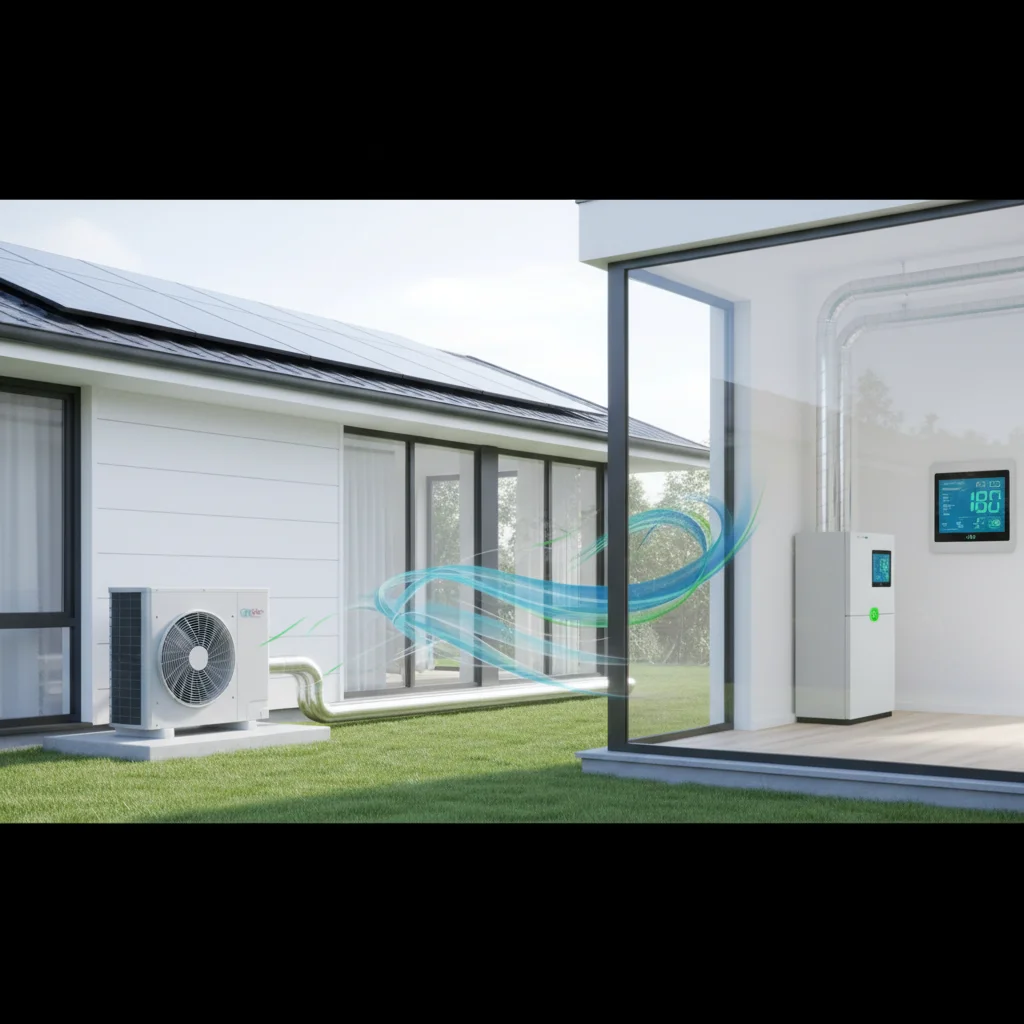
The average American household spends $115 per month on heating and cooling—14% of total energy costs—yet 80% of HVAC systems installed today are oversized by at least one ton, wasting $300-$500 annually. And when the 20-year-old furnace finally dies on the coldest January night, homeowners face sticker shock: $5,000 to $12,000 for a standard replacement, or $15,000 to $30,000 for a high-efficiency heat pump system. But the real financial damage isn't the upfront price—it's the 15-20 years of inflated utility bills from an incorrectly sized or outdated system.
How Much Does an HVAC System Cost in 2026?
Residential HVAC replacement costs range from $5,000 for a basic furnace to $30,000 for a dual-fuel heat pump system with variable-speed components. Central air conditioning units average $5,500-$8,000 installed, gas furnaces run $4,000-$7,500, and whole-home heat pumps cost $8,000-$18,000 before incentives. Equipment accounts for 40-50% of total project cost, while labor, permits, and ductwork modifications make up the remainder.
So why does the same 3-ton heat pump cost $10,000 at one contractor and $16,000 at another? Three factors drive price variation: SEER2 efficiency rating (14 vs. 20+ SEER2), installation complexity (existing ductwork vs. complete replacement), and regional labor rates ($75/hour in rural areas vs. $150/hour in coastal cities). And the brand premium matters—Carrier and Trane command 15-20% higher prices than Goodman or Rheem for functionally identical equipment.
Gas furnace installation in a 1,800-square-foot home with existing ductwork costs $4,500-$6,500 for a single-stage 80% AFUE unit, $6,000-$8,500 for a two-stage 95% AFUE condensing model, and $8,000-$11,000 for a modulating variable-speed system. Heat pump rebates through state and federal programs reduce net costs by $2,000-$8,000 depending on household income and system efficiency.
Central air conditioning replacement averages $5,500-$8,000 for a 14 SEER2 unit, $7,000-$10,000 for 16-18 SEER2, and $9,000-$13,000 for 20+ SEER2 variable-speed systems. But SEER2 ratings only measure cooling efficiency in standardized conditions—actual savings depend on climate zone, duct leakage rates, and thermostat programming habits.
Ductless mini-split systems cost $3,000-$5,000 for a single-zone installation, $8,000-$14,000 for a three-zone setup, and $15,000-$25,000 for whole-home coverage with five or more indoor units. And installation is faster—most single-zone projects complete in 4-6 hours with minimal wall penetration.
Geothermal heat pump systems require $15,000-$25,000 for equipment and $10,000-$30,000 for ground loop installation depending on soil conditions and lot size. Horizontal loops cost less but need 1,500-2,500 square feet of yard space, while vertical loops work on smaller lots but require drilling 150-400 feet deep at $15-$30 per foot.
"Residential geothermal heat pumps can reduce energy consumption by 25-50% compared to conventional heating and cooling systems." — U.S. Department of Energy
What's the Payback Period for a New HVAC System Investment?
Standard efficiency HVAC replacements rarely pay back through energy savings alone—homeowners replace failed equipment to restore comfort, not to profit. A $7,000 furnace upgrade from 70% AFUE to 95% AFUE saves $275 annually in a cold climate with $1,200 heating bills, creating a 25-year payback period that exceeds typical equipment lifespan of 15-20 years.
Heat pump conversions offer faster returns in moderate climates. A $12,000 heat pump replacing electric resistance heat saves $800-$1,400 annually in Pacific Northwest homes, generating a 9-15 year payback before incentives. And federal energy tax credits worth 30% of project costs reduce net investment to $8,400, cutting payback to 6-10 years.
But maintenance costs offset some savings—annual tune-ups cost $150-$300, refrigerant recharges run $200-$600, and capacitor replacements average $150-$400. So the $275 annual furnace savings become $125 net savings after maintenance expenses.
Geothermal systems need 10-15 years to break even despite 50% energy reductions because of $25,000-$55,000 installed costs. A home spending $2,400 annually on heating and cooling saves $1,200 with geothermal, but the $30,000 net cost after 30% federal credit (these federal credits ended for projects completed after December 31, 2025) requires 25 years to recover—and ground loops typically warrant for 50 years while heat pump equipment lasts 20-25 years.
Variable-speed and modulating equipment adds $2,000-$4,000 to project costs but delivers only 5-15% additional savings over two-stage systems. That $3,000 upgrade premium saves $75-$150 annually, creating a 20-40 year payback that doesn't justify the investment on financial grounds alone—homeowners choose these systems for superior comfort and humidity control.
Use our free rebate calculator to model payback periods based on your current utility bills and climate zone.
How Do HVAC Systems Compare to Alternative Heating and Cooling Solutions?
Ductless mini-splits cost 30% more upfront than comparable central systems but eliminate duct losses of 20-30%, making them cheaper to operate in homes with poor duct design. A $10,000 three-zone mini-split system uses 25-40% less energy than an $8,000 central heat pump in older homes with uninsulated attic ducts.
Window air conditioners cost $300-$800 per unit and consume 30-50% more electricity per BTU than central AC, but cooling only occupied rooms reduces total consumption. A 12,000 BTU window unit running 8 hours daily costs $120-$180 per cooling season, while a whole-home 3-ton central system costs $400-$700 despite higher efficiency ratings.
Radiant floor heating delivers superior comfort but costs $10-$20 per square foot installed versus $7-$12 for forced air systems. A 2,000-square-foot installation runs $20,000-$40,000 for hydronic tubing and boiler, compared to $8,000-$14,000 for a high-efficiency furnace and ductwork.
Wood pellet stoves cost $3,000-$5,000 installed and burn fuel at $250-$350 per ton—roughly equivalent to $1.50-$2.00 per gallon heating oil. But pellet stoves heat single zones, require daily ash removal, and need annual chimney cleaning costing $200-$400.
Packaged terminal air conditioners (PTACs) common in hotels cost $800-$1,500 per unit and consume 15-25% more electricity than split systems of equal capacity. But PTAC installation takes 2-4 hours versus 2-3 days for central systems, and individual units can fail without disabling whole-home heating or cooling.
"ENERGY STAR certified heat pumps use about 15% less energy than standard models and can save more than $1,000 over their lifetime." — ENERGY STAR
What Rebates and Tax Credits Can Reduce Your HVAC Costs?
The Inflation Reduction Act's residential clean energy credit covers 30% of heat pump costs through 2032, reducing a $15,000 installation to $10,500 net cost. And the credit has no annual cap—homeowners can claim 30% of a $30,000 geothermal system ($9,000 credit) in the same year as a $10,000 heat pump water heater ($3,000 credit).
California's TECH Clean California offers $3,000-$7,000 for heat pump installations in disadvantaged communities, Oregon's High Efficiency Gas Furnace program rebates $250-$600, and Massachusetts' Mass Save provides $10,000-$15,000 for income-qualified households switching from fossil fuels to cold-climate heat pumps.
Equipment efficiency thresholds determine eligibility. Federal credits require heat pumps to meet 16 SEER2 / 9.5 HSPF2 minimum ratings, central AC needs 16 SEER2, and gas furnaces must achieve 95% AFUE or higher. But state programs often set stricter requirements—New York's Clean Heat program mandates cold-climate ratings of -5°F or lower.
Point-of-sale rebates reduce upfront costs without waiting for tax season. Efficiency Maine's $1,500 heat pump rebate applies at installation, BPA's $1,000 ductless incentive processes in 4-6 weeks, and San Diego Gas & Electric's $3,000 heat pump credit issues within 60 days of project completion.
Low-income households qualify for enhanced benefits—the HOMES rebate program offers $8,000 for projects achieving 35%+ whole-home energy reductions, while the High-Efficiency Electric Home Rebate Act (HEEHRA) provides up to $8,000 for heat pump installations with no out-of-pocket cost for households under 150% of area median income.
Check HVAC efficiency requirements for your state and utility territory before purchasing equipment—rebate-eligible models cost 10-20% more than baseline units, but incentives cover the premium and accelerate payback.
How Do Installation Costs Vary by System Type and Home Size?
Labor accounts for 50-60% of HVAC replacement costs and scales with project complexity, not just equipment size. A straightforward furnace swap in an accessible basement costs $1,500-$2,500 in labor, while the same unit installed in a cramped attic crawlspace runs $3,000-$4,500 due to difficulty accessing connections and venting.
Ductwork modifications add $1,500-$5,000 to project costs. Homes built before 1980 often have undersized return ducts limiting airflow to 300-400 CFM per ton instead of the required 400-450 CFM, forcing contractors to add return plenums and grilles. And converting from AC-only to heat pump requires larger linesets—upgrading from 1/4" liquid line to 3/8" costs $600-$1,200 in materials and labor.
Electrical upgrades consume $500-$2,500 of installation budgets. Heat pumps draw 30-50 amps versus 15-20 amps for AC-only systems, often requiring panel upgrades from 100 to 200 amps at $1,200-$2,000. And adding a second heat pump zone needs a separate 30-40 amp circuit at $300-$600.
Permit and inspection fees range from $150 in rural counties to $800 in major metros. California requires Title 24 energy compliance documentation adding $200-$400 in engineering costs, while Oregon mandates radon-resistant construction techniques in certain zones increasing foundation work by $150-$300.
System sizing directly affects price—each additional ton of capacity adds $800-$1,500 to equipment costs and $300-$600 to installation labor. A 2-ton heat pump for a 1,200-square-foot home costs $8,000-$11,000 installed, a 3-ton unit for 1,800 square feet runs $10,000-$14,000, and a 5-ton system for 3,000 square feet averages $14,000-$19,000.
But bigger isn't better—oversized equipment cycles on and off rapidly, reducing efficiency by 10-20% and cutting equipment lifespan by 3-5 years. Manual J load calculations cost $300-$500 but prevent $2,000-$4,000 in wasted capacity and years of excess utility bills.
What's the True Cost of Ownership Over 15-20 Years?
Total cost of ownership combines purchase price, energy costs, maintenance expenses, and repair frequency over equipment lifespan. A $6,000 furnace consuming $1,200 annually in natural gas plus $200 yearly maintenance costs $30,000 over 15 years, while a $12,000 heat pump using $800 in electricity and requiring $250 annual service totals $27,750—cheaper despite higher upfront cost.
Repair costs escalate after year 10. Compressors fail at $1,500-$3,000, blower motors cost $400-$800, heat exchangers crack at $1,200-$2,500, and refrigerant leaks run $500-$1,500 to locate and repair. And equipment installed before 2023 uses R-410A refrigerant being phased out under EPA regulations—recharge costs will double or triple by 2028 as supplies dwindle.
Extended warranties cost $500-$1,200 and rarely pay off. Manufacturers cover parts for 5-10 years on heat pumps and furnaces, leaving only labor costs of $150-$300 per service call. A $1,000 extended warranty needs 4-7 repair visits to break even—unlikely for properly maintained equipment.
Filter replacement costs $50-$150 annually for disposable pleated filters or $200-$400 every 3-5 years for washable electrostatic models. But skipping filter changes reduces airflow by 15-30%, cutting efficiency by 10-20% and shortening equipment life by 2-4 years.
Duct sealing and insulation pay back in 3-7 years by reducing conditioned air losses. Aeroseal duct sealing costs $1,500-$3,000 and cuts duct leakage from 30% to under 10%, saving $200-$400 annually. And adding R-6 duct insulation for $800-$1,500 prevents another $100-$200 in annual losses.
Smart thermostats cost $150-$300 installed and reduce heating and cooling costs by 10-15% through automated setbacks and learning algorithms. That $200 net investment saves $120-$180 annually for homes spending $1,200 on HVAC, paying back in 13-20 months.
Official Sources
- U.S. Department of Energy - Heat Pump Systems — Federal guidance on heat pump technology, efficiency ratings, and energy savings potential
- ENERGY STAR Heat Pumps — Certification requirements, qualified product lists, and estimated savings for energy-efficient equipment
- DSIRE USA — Comprehensive database of state, local, and utility rebate programs for residential HVAC upgrades
Related Reading: Learn more about Energy Audit Zero Cost Improvements and High Impact Low Cost Energy Fixes.
Frequently Asked Questions
How much does a new HVAC system cost?
New HVAC systems cost $5,000-$30,000 installed depending on equipment type, efficiency rating, and home size. Gas furnaces average $4,000-$7,500, central air conditioning runs $5,500-$8,000, heat pumps cost $8,000-$18,000, and geothermal systems range from $25,000-$55,000. Federal tax credits worth 30% of project costs and state rebates of $1,000-$8,000 reduce net investment significantly.
What factors affect the price of an HVAC system?
Equipment efficiency ratings drive 30-40% of price variation—20+ SEER2 variable-speed heat pumps cost $4,000-$6,000 more than 14 SEER2 single-stage models. Installation complexity adds $1,500-$5,000 for ductwork modifications, electrical upgrades, and difficult equipment access. And regional labor rates range from $75-$150 per hour, creating 30-50% cost differences between rural and urban markets.
Can I get a rebate for replacing my HVAC system?
The federal Energy Efficient Home Improvement Credit (Section 25C) ended for property placed in service after December 31, 2025 (IRS FS-2025-05). State and utility programs add $1,000-$8,000 in rebates—California offers $3,000-$7,000 through TECH Clean California, Massachusetts provides $10,000-$15,000 for income-qualified heat pump conversions, and Oregon rebates $250-$600 for 95%+ AFUE furnaces. Check current 2026 program availability through the rebate calculator.
How long does an HVAC system last before needing replacement?
Gas furnaces last 15-20 years with annual maintenance, central air conditioners average 12-17 years, heat pumps run 15-18 years in moderate climates, and geothermal heat pumps operate 20-25 years while ground loops function for 50+ years. But poor maintenance cuts lifespan by 3-5 years—skipped filter changes, refrigerant leaks, and electrical issues force premature replacement at year 10-12.
What's the difference between HVAC repair and replacement costs?
Single component repairs cost $200-$800 for capacitors, thermostats, or blower motors, while major repairs run $1,500-$3,000 for compressor or heat exchanger replacement. Full system replacement costs $5,000-$18,000 but makes sense when repair exceeds 50% of new equipment cost, the system is over 12 years old, or refrigerant conversion to R-32 is required due to R-410A phase-out.
Ready to find out how much you can save? Use our rebate calculator to discover federal tax credits, state incentives, and utility rebates available for your HVAC upgrade. Get your personalized savings estimate in under 60 seconds.
Last reviewed: April 14, 2026. Reviewed by DuloCore Energy Specialists. About the team.
Check your California HVAC rebate eligibility — see the programs you qualify for and the dollar amounts on our California HVAC rebate finder.