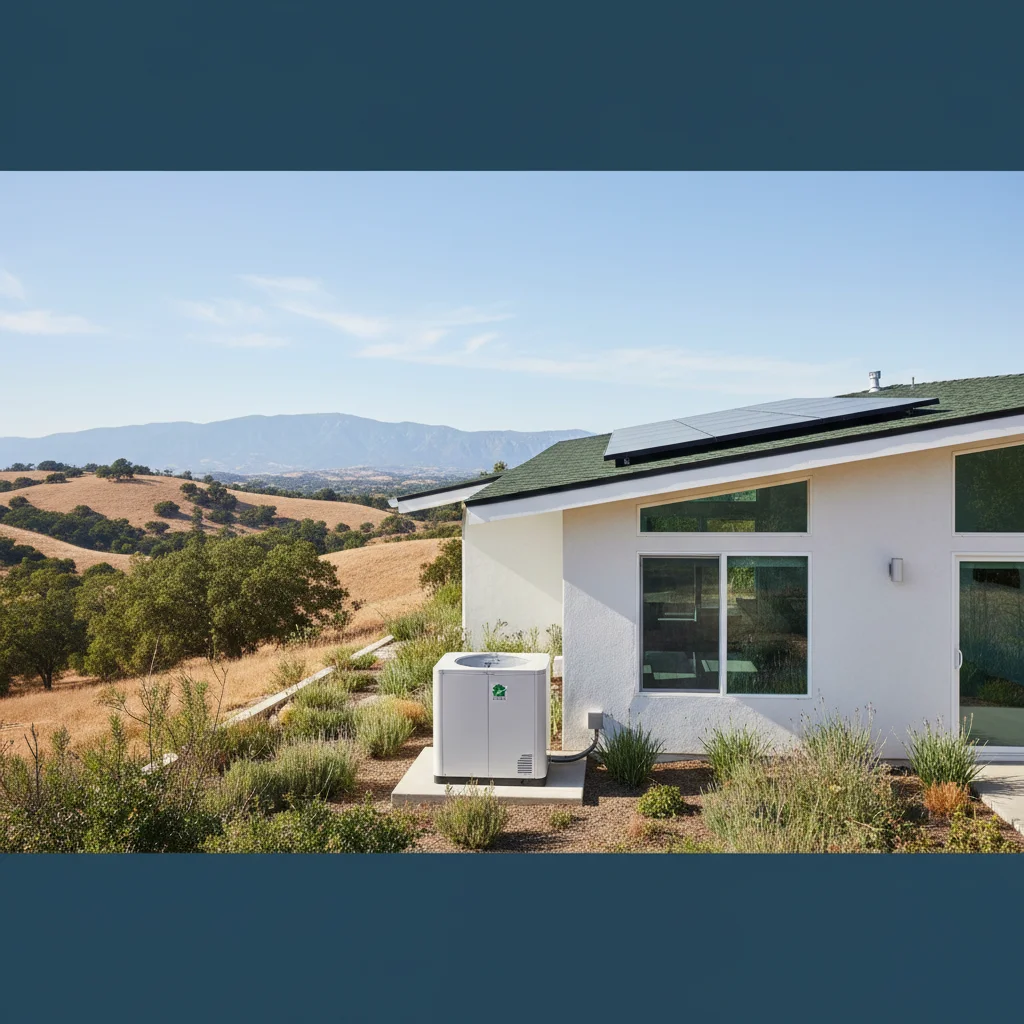
A new HVAC system in California costs between $5,800 and $18,000 installed, but 68% of homeowners who replaced their systems in 2025 didn't know they qualified for rebates that cut those costs by $2,000 to $14,000. And that gap—between sticker price and actual out-of-pocket cost—keeps thousands of California families running inefficient, expensive systems that inflate utility bills by 30% to 50% every summer.
How Much Does an HVAC System Cost in California?
California HVAC system costs in 2026 range from $5,800 for a basic central air conditioner replacement to $18,000 for a premium heat pump installation with ductwork modifications. Equipment accounts for 40% to 50% of total project costs, labor runs $75 to $150 per hour, and permits add $200 to $800 depending on jurisdiction. And installation complexity—duct replacement, electrical panel upgrades, refrigerant line runs—drives the final invoice more than brand name or SEER rating.
But here's the tension: California's 2026 utility rates—averaging $0.37 per kWh, 42% higher than the national average—mean every efficiency point matters. A 16 SEER heat pump running 1,200 hours annually costs $666 in electricity, while an 18 SEER model costs $592, saving $74 yearly. Over a 15-year lifespan, that's $1,110 in energy savings that narrows the price gap between mid-tier and high-efficiency systems.
Equipment type determines base costs. Central air conditioners start at $3,500 for a 2-ton 14 SEER unit plus $2,300 to $4,500 installation. Heat pumps—which both heat and cool—range from $4,200 for a 14 SEER model to $9,000 for a 20+ SEER cold-climate unit. Ductless mini-splits cost $1,800 to $3,500 per indoor head, with most homes needing 2 to 4 zones. And dual-fuel systems pairing a heat pump with a gas furnace run $8,000 to $14,000 installed.
Regional costs vary by 15% to 25% across California. Los Angeles and San Francisco installations run $1,200 to $2,500 higher than Central Valley or Inland Empire projects due to labor rates and permit fees. Coastal cities require corrosion-resistant coatings that add $400 to $900. And mountainous areas above 3,000 feet elevation need cold-climate heat pumps with enhanced vapor injection, adding $1,500 to $2,800 to equipment costs.
Labor components include removal of old equipment ($300 to $800), refrigerant line installation ($12 to $30 per linear foot), electrical work ($400 to $1,200 for 240V circuits or panel upgrades), and duct modifications ($35 to $55 per linear foot). Permits cost $200 in rural counties and up to $800 in cities like San Francisco or Santa Monica. So a straightforward replacement in Fresno might cost $6,800, while the same system in San Jose runs $9,200.
Efficiency tiers impact long-term value more than upfront costs. A $7,200 16 SEER heat pump uses 7,920 kWh annually in Sacramento's climate, costing $2,930 at current rates. An $8,900 20 SEER model uses 6,336 kWh, costing $2,344—saving $586 yearly. The $1,700 price premium pays back in 2.9 years. And over 15 years, the high-efficiency system saves $8,790 in electricity plus qualifies for larger rebates through California utility programs.
What's the Payback Period for Investing in a New HVAC System?
California HVAC replacement payback periods range from 4 to 12 years depending on current system efficiency, climate zone, and utility rates. Homes replacing pre-2006 systems with sub-10 SEER efficiency see 6 to 8 year paybacks through reduced energy bills alone. And combining utility savings with 2026 federal tax credits and state rebates accelerates payback to 3 to 5 years for qualifying heat pump installations.
Climate zone drives usage hours and savings velocity. Coastal homes in CZ3 run HVAC 800 to 1,000 hours yearly, saving $280 to $420 annually by upgrading from 10 SEER to 16 SEER. Inland Empire and Central Valley homes in CZ13-15 run systems 2,000+ hours, saving $840 to $1,260 yearly with the same upgrade. So a $7,500 heat pump replacement in Bakersfield pays back in 6 years through energy savings alone, while the same system in San Diego takes 11 years.
Rebates compress payback dramatically. A homeowner in PG&E territory replacing a gas furnace with an 18 SEER heat pump receives $3,000 from the federal energy tax credits (30% of $10,000 project cost), $2,000 from PG&E's heat pump rebate, and $1,500 from local air quality incentives. That $6,500 in rebates cuts a $10,000 project to $3,500 out-of-pocket. With $950 in annual energy savings, payback drops to 3.7 years.
Maintenance cost reductions add hidden value. New systems eliminate the $150 to $400 annual repair costs common on 12+ year-old equipment. Longer warranties—10 years on parts versus 1 to 5 years on aging systems—prevent $800 to $2,200 compressor or heat exchanger replacements. And modern variable-speed systems reduce wear, extending component lifespan by 20% to 30% compared to single-stage units.
Financing terms affect cash flow payback differently than total cost. A $9,000 heat pump financed at 6.5% over 10 years costs $102 monthly. If the system saves $85 monthly in energy costs, net cash flow impact is just $17 per month. But after year 8.5 when the loan ends, monthly cash flow improves by $102. So payback calculations should separate total economic value from monthly budget impact.
Use our free rebate calculator to model payback for your specific climate zone, current system efficiency, and available incentives. The calculator pulls current 2026 rebate amounts from California utilities and applies your local electricity rates to show month-by-month savings and payback timelines.
What Tax Credits and Rebates Can Reduce Your HVAC Costs?
California HVAC buyers in 2026 access $2,000 to $14,000 in combined federal, state, and utility incentives that cut installation costs by 25% to 60%. Federal tax credits cover 30% of project costs up to $2,000 for heat pumps meeting ENERGY STAR standards, state rebates provide $1,000 to $3,500 for electrification projects, and utility programs offer $500 to $4,500 based on equipment efficiency and income eligibility.
The federal Energy Efficient Home Improvement Credit (Section 25C) ended for property placed in service after December 31, 2025 (IRS FS-2025-05). Federal tax credits for this work have ended, but state, local and utility rebates may still apply; check what is available at your address with the DuloCore rebate calculator. Homeowners claim 30% of equipment and installation costs, capped at $2,000 annually for air-source heat pumps and $2,000 for heat pump water heaters. The credit requires ENERGY STAR Most Efficient certification—typically 18+ SEER for cooling and 9+ HSPF for heating. And the credit applies to both primary residences and second homes, unlike expired 25C/25D programs.
California's TECH Clean California initiative provides $1,000 to $3,500 for heat pump HVAC installations replacing gas furnaces. Single-family homes qualify for $2,000 base rebates, with an additional $1,500 for households earning below 80% Area Median Income. Multifamily properties receive $3,000 per unit. And South Coast and Bay Area air districts add $1,000 to $2,500 for replacing gas appliances to improve air quality.
Utility company programs layer on top of state and federal incentives. PG&E offers $2,000 to $4,500 for qualifying heat pumps through its Energy Upgrade California program. SoCalGas provides $3,000 for heat pump installations in its Building Electrification Program. And SMUD allocates $3,500 for heat pump conversions, plus $500 for smart thermostat integration. Each utility sets income tiers with enhanced rebates for low-to-moderate income households.
Income-qualified programs multiply incentives. The California Alternate Rates for Energy (CARE) program provides $5,000 to $8,000 additional rebates for households earning below 200% of federal poverty guidelines. The Self-Generation Incentive Program (SGIP) adds $1,000 per ton for heat pump systems paired with battery storage. And the California Climate Credit provides $20 to $75 in annual bill credits, partially offsetting financing costs.
Application timing matters. State and utility rebates require pre-approval or post-installation applications within 90 to 180 days. Some programs operate first-come-first-served with funds exhausted by Q3, while others allocate budgets by income tier. So applying for utility rebates within 30 days of project completion maximizes approval likelihood.
"California's TECH Clean California offers rebates up to $3,500 for heat pump HVAC installations, with enhanced incentives for low-income households replacing gas heating systems." — TECH Clean California
How Do HVAC Installation Costs Compare Across California Regions?
California HVAC installation costs vary by 18% to 32% across regions, with Bay Area and coastal metro areas charging $8,200 to $12,500 for systems priced at $6,500 to $9,200 in Central Valley and Inland Empire markets. Labor rates, permit fees, equipment markup, and installation complexity driven by building codes and climate zones explain regional price gaps that exceed $2,000 for identical equipment and scope.
Bay Area installations—San Francisco, Oakland, San Jose—run $9,500 to $14,000 for 3-ton heat pump systems. Labor costs $95 to $150 per hour versus $75 to $100 in inland areas. Permit fees reach $600 to $800 compared to $200 to $350 elsewhere. And seismic bracing, corrosion-resistant materials, and stricter energy codes add $800 to $1,500 to material costs. So a $10,500 installation in Fresno costs $13,200 in San Francisco for the same equipment.
Southern California coastal cities—Los Angeles, San Diego, Santa Barbara—charge $8,800 to $12,000 for similar systems. Coastal corrosion requires specialized coatings and stainless fasteners adding $400 to $700. Title 24 compliance inspections cost $250 to $500. And contractor density drives competitive pricing 10% to 15% below Bay Area rates but 12% to 18% above inland markets. Orange County falls mid-range at $9,200 to $11,500.
Central Valley markets—Fresno, Bakersfield, Modesto, Stockton—offer the state's lowest installation costs at $6,200 to $9,500 for equivalent systems. Labor runs $70 to $95 per hour, permits cost $200 to $350, and lower cost-of-living allows contractor margins at 15% to 20% versus 25% to 35% in metro areas. But extreme summer temperatures require robust equipment sizing, sometimes adding 0.5 to 1 ton of capacity and $600 to $1,200 to equipment costs.
Inland Empire—Riverside, San Bernardino, Ontario—prices fall between coastal and Central Valley at $7,100 to $10,200. And mountain communities—Lake Tahoe, Big Bear, Truckee—face 20% to 35% premiums due to limited contractor availability, cold-climate equipment requirements, and challenging installation conditions. A $7,800 system in Sacramento costs $10,200 to $11,500 in Tahoe due to travel time, cold-weather heat pumps, and backup heating integration.
Climate zone equipment requirements shift costs regionally. Coastal CZ3-6 homes need smaller tonnage—2 to 3 tons for 1,800 sq ft—while CZ13-15 inland homes require 3.5 to 4 tons for the same square footage. Desert areas specify 16+ SEER for Title 24 compliance versus 14 SEER minimums in mild climates. And cold-climate zones above 3,000 feet require enhanced vapor injection heat pumps costing $1,200 to $2,400 more than standard models.
Permitting complexity varies by jurisdiction. Los Angeles requires licensed contractors to pull permits, adding $150 to $300 versus owner-pulled permits in rural counties. San Francisco mandates third-party HERS verification costing $300 to $600. And some cities require separate electrical, mechanical, and building permits totaling $500 to $900 versus single combined permits at $200 to $350. These administrative costs concentrate in metro areas with stricter enforcement.
What Financing Options Are Available for California HVAC Systems?
California HVAC financing in 2026 includes contractor payment plans, utility on-bill financing, home equity products, and government-backed loans with terms from 6 months to 20 years and rates from 0% promotional to 12% unsecured. Payment structures range from $85 to $180 monthly for a $9,000 installation depending on term length, interest rate, and down payment, with some programs offering deferred payments until rebates arrive.
Contractor financing typically offers 6 to 12 month same-as-cash promotions or 5 to 10 year loans at 6.9% to 12.9% APR. A $9,000 heat pump financed at 9.5% over 7 years costs $145 monthly with $3,160 in total interest. Zero-interest promotional terms require payment in full within 6 to 18 months or retroactive interest applies to the original balance—often at 24% to 29% APR. And credit approval requires 640+ FICO scores for promotional rates, 580+ for standard terms.
Utility on-bill financing ties loan repayment to monthly utility bills, with PG&E's GoGreen Financing offering $500 to $15,000 at 0% to 6.99% APR for qualifying efficiency upgrades. Monthly payments appear as a line item on electricity bills, simplifying cash flow tracking. And on-bill programs sometimes waive prepayment penalties and offer forbearance during financial hardship. SMUD provides similar programs at 3.99% to 5.99% for 5 to 10 year terms.
"California utilities offer on-bill financing programs for energy upgrades at below-market rates, with some programs providing 0% interest for income-qualified households replacing gas appliances with heat pumps." — DSIRE USA
Home Equity Lines of Credit (HELOCs) and home equity loans provide lower rates—4.5% to 8.5% in 2026—but require 15% to 20% home equity and appraisal fees of $400 to $650. A $10,000 equity loan at 6.25% over 10 years costs $113 monthly with $3,560 total interest. And interest may qualify as tax-deductible if the improvement adds substantial value, though homeowners should consult tax professionals for specific guidance.
Property Assessed Clean Energy (PACE) financing attaches loans to property tax bills rather than personal credit. Terms run 10 to 20 years at 6% to 9% fixed rates with no down payment required. A $12,000 PACE loan at 7.5% over 15 years costs $111 monthly added to property tax payments. But PACE liens take priority over mortgages, creating complications during refinancing or home sales. And some mortgage servicers prohibit PACE financing in their loan terms.
CaliforniaFIRST and other PACE administrators offer specific heat pump rebates paired with financing, allowing homeowners to deduct rebates from loan principal before first payment. So a $10,000 installation with $4,000 in rebates finances only $6,000, lowering monthly payments from $112 to $67 at 7% over 10 years. This structure prevents cash flow gaps while waiting for tax credits or utility rebate checks.
Deferred payment programs through some contractors allow 90 to 180 day payment delays, giving homeowners time to receive rebate checks before financing begins. And employer-sponsored benefit programs increasingly include home efficiency financing at preferential rates—some offering 3.99% to 5.99% with payroll deduction convenience. These programs typically cap loans at $15,000 to $20,000 with 5 to 7 year maximum terms.
Is Replacing Your HVAC System Worth the Investment?
California HVAC replacement delivers positive ROI when existing systems exceed 12 years old, require annual repairs above $400, or achieve below 10 SEER efficiency in moderate-to-high usage climate zones. Homes running pre-2010 equipment and accessing 2026 rebates see 4 to 7 year payback periods through combined energy savings, avoided repair costs, and incentive capture, while also gaining improved comfort, air quality, and home resale value.
System age determines replacement urgency. Equipment manufactured before 2010 uses R-22 refrigerant now costing $80 to $150 per pound versus $15 to $30 for modern R-410A. A refrigerant leak repair on a 15-year-old system costs $800 to $1,800, while the same repair on a 6-year-old unit costs $300 to $600. And systems over 12 years face 22% annual failure rate increases, driving average repair costs from $180 yearly to $520 yearly between years 10 and 15.
Energy cost impact varies by baseline efficiency and usage. A 1,800 sq ft home in Fresno running a 9 SEER system 1,800 hours annually consumes 12,600 kWh costing $4,662 at $0.37 per kWh. Upgrading to 16 SEER cuts consumption to 7,088 kWh costing $2,623—saving $2,039 yearly. Over 15 years that's $30,585 in energy savings against a $7,800 replacement cost after rebates, delivering 292% total return.
Rebate availability creates timing incentives. California's 2026 programs allocate $240 million to heat pump conversions, with most utility territories exhausting funds by October in 2024 and 2025. Early replacement captures $3,000 to $6,500 in combined incentives that reduce net costs by 40% to 55%. Waiting until system failure forces emergency replacement often means missing rebate windows and paying 20% to 30% premiums for expedited installation.
Comfort improvements add qualitative value. Modern variable-speed systems maintain temperatures within 0.5°F versus 3°F swings from single-stage units. Dehumidification improves by 25% to 40%, reducing mold risk and improving indoor air quality. And sound levels drop from 72-76 decibels on older systems to 56-62 decibels on new equipment—a 50% perceived noise reduction. These factors don't appear in ROI calculations but significantly impact daily living quality.
Home resale value benefits from HVAC updates. California real estate data shows homes with systems under 5 years old sell 8 to 12 days faster and command 2% to 4% price premiums in competitive markets. A $600,000 home gains $12,000 to $24,000 in value from a $9,000 investment, delivering 133% to 267% return. And buyer inspection contingencies fall through 40% less often when major systems show recent replacement dates.
Repair-versus-replace thresholds help decision-making. If repair costs exceed 50% of replacement cost after rebates, replacement delivers better value. A $3,500 compressor repair on a 14-year-old system competes poorly against a $7,200 heat pump replacement with $3,800 in rebates—net cost $3,400 for 15 years of new equipment versus $3,500 for 3 to 5 years of patched-together operation. And the new system captures energy savings the repair doesn't provide.
Official Sources
- IRS Energy Incentives for Individuals — Federal tax credit guidance for residential energy efficiency improvements including heat pumps (note: the federal 25C and 25D credits ended for projects completed after December 31, 2025)
- DOE Energy Saver — Department of Energy resources on HVAC efficiency, rebates, and home energy upgrades
- DSIRE USA California Programs — Database of State Incentives for Renewables & Efficiency tracking all California rebate programs
Related Reading: Learn more about Spray Foam Insulation Cost and Wall Insulation Cost.
Frequently Asked Questions
How much does a new HVAC system cost in California?
New HVAC systems in California cost $5,800 to $18,000 installed depending on equipment type, efficiency rating, and installation complexity. Central air conditioners start at $5,800 for basic 14 SEER units, heat pumps range from $7,200 to $12,000 for 16-20 SEER models, and ductless mini-splits run $6,500 to $14,000 for multi-zone configurations. Labor accounts for 40% to 50% of total costs, with regional variations of 18% to 32% between coastal metro areas and inland markets.
What rebates are available for replacing my HVAC system in California?
California HVAC rebates in 2026 total $2,000 to $14,000 through combined federal, state, and utility programs. The federal Energy Efficient Home Improvement Credit (Section 25C) ended for property placed in service after December 31, 2025 (IRS FS-2025-05). TECH Clean California offers $1,000 to $3,500 for electrification projects, with enhanced amounts for income-qualified households. And utility companies like PG&E, SoCalGas, and SMUD provide $2,000 to $4,500 based on equipment efficiency and household income, with some programs offering $5,000 to $8,000 for CARE-eligible participants.
Am I eligible for HVAC rebates if my system is over 10 years old?
System age doesn't disqualify California homeowners from 2026 HVAC rebates—eligibility depends on new equipment meeting efficiency standards and project type aligning with program goals. Federal tax credits require ENERGY STAR Most Efficient certification, typically 18+ SEER. State and utility rebates focus on fuel-switching from gas to electric heat pumps or installing high-efficiency equipment in specific climate zones. And income-qualified programs prioritize households earning below 80% to 200% Area Median Income regardless of existing system age.
How long does it take to get an HVAC rebate in California?
California HVAC rebate processing times range from 30 days to 120 days depending on program type and application volume. Utility rebates through PG&E, SCE, and SoCalGas typically process in 45 to 90 days after submitting completed applications with invoices and proof of installation. TECH Clean California processes income-qualified applications in 60 to 90 days. And federal tax credits claim immediately on annual tax returns filed in the year equipment was placed in service, with refunds arriving based on IRS processing timelines of 21 to 90 days.
What's the difference between federal and California state HVAC rebates?
Federal HVAC rebates provide tax credits worth 30% of project costs up to $2,000 annually, claimed on IRS Form 5695 when filing taxes, with no income restrictions and availability through 2032. California state rebates offer upfront discounts or post-installation payments ranging from $1,000 to $8,000 based on equipment type, fuel-switching, and household income, with funds allocated annually and sometimes exhausted mid-year. Federal credits apply to efficiency upgrades broadly, while California programs prioritize electrification—replacing gas furnaces with heat pumps—to meet climate goals and air quality standards.
Ready to calculate your total savings? Use our free rebate calculator to see exactly how much you'll save on your California HVAC replacement. Enter your zip code, current system details, and new equipment specs to get personalized estimates of federal tax credits, state rebates, utility incentives, and energy bill reductions. Most homeowners discover $3,000 to $8,000 in available incentives they didn't know existed—finding yours takes 90 seconds.
Last updated April 14, 2026 — reviewed by DuloCore Editorial. About our authors.
Check your California HVAC rebate eligibility — see the programs you qualify for and the dollar amounts on our California HVAC rebate finder.