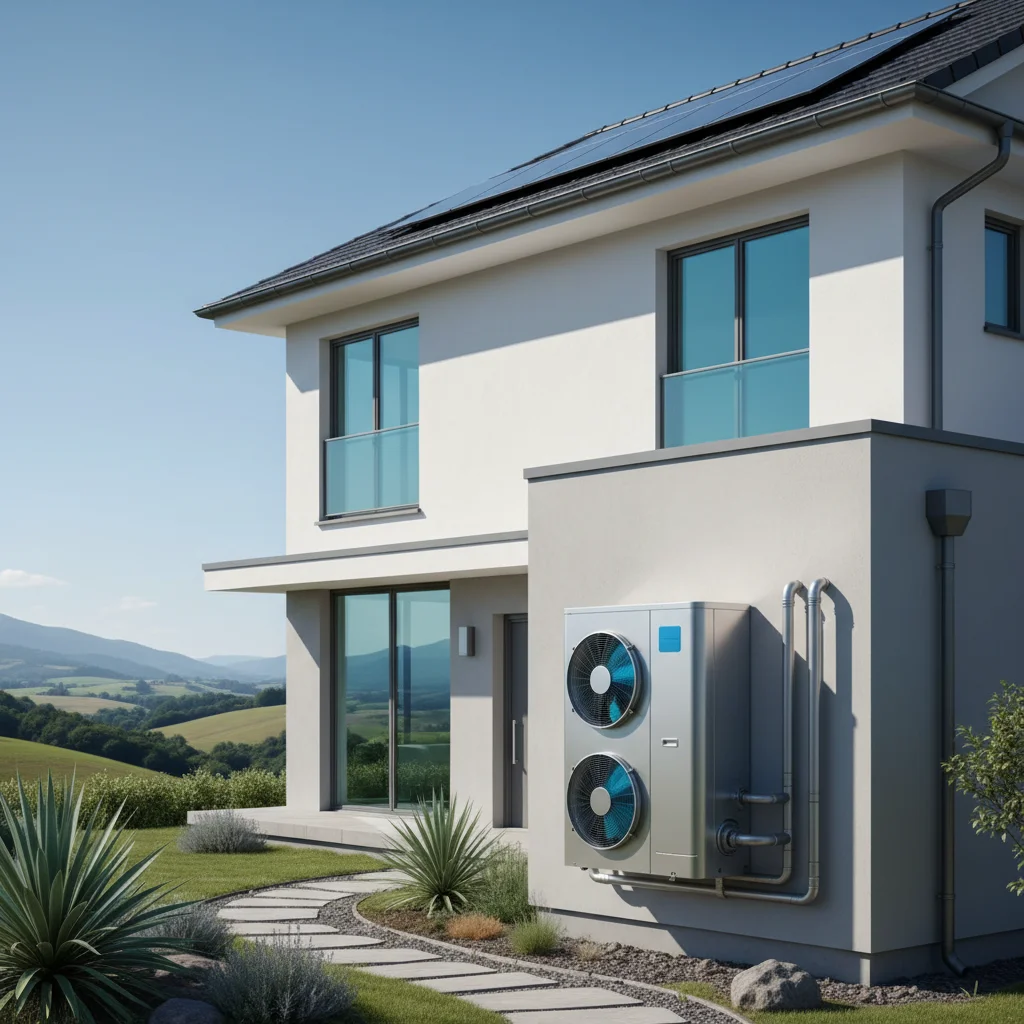
San Jose homeowners paid an average of $12,400 for complete HVAC system replacements in 2025, with costs ranging from $8,200 for basic 2-ton systems to $18,500 for high-efficiency 5-ton units with smart controls. And that's before California's TECH Clean California program and federal IRA tax credits, which together can slash net costs by 30-50% depending on system efficiency and household income.
How Much Does HVAC Installation Cost in San Jose?
HVAC installation costs in San Jose range from $8,200 to $18,500 for complete system replacement in 2026, with the average falling at $12,400 for a 3-ton 16-SEER heat pump system. Equipment accounts for 60% of total cost, labor represents 25%, and permits plus ductwork modifications make up the remaining 15%.
The price breakdown for a typical 1,800-square-foot San Jose home looks like this: $7,440 for the heat pump unit itself, $3,100 for installation labor, $1,200 for electrical upgrades to support the new system, and $660 for city permits and inspections. But system size drives the biggest cost variation. A 2-ton system for a small condo runs $8,200, while a 5-ton system for a 3,000-square-foot home hits $16,800 before incentives.
So why does San Jose's HVAC market sit 18% above California's statewide average of $10,500? Labor rates in Silicon Valley run $125-$165 per hour compared to $95-$120 in Central Valley cities, and Santa Clara County's stricter permitting requirements add $200-$400 to project costs. And the region's mild climate paradoxically increases costs because contractors spec systems for cooling efficiency rather than the simpler heating-only units common in colder regions.
System efficiency rating determines equipment cost more than any other factor. A 14-SEER system costs $6,800, a 16-SEER runs $8,400, and an 18-SEER high-efficiency model jumps to $10,200. But higher SEER ratings unlock bigger rebates through TECH Clean California and the federal IRA tax credit, which covers 30% of total project costs through 2032 for systems meeting Energy Star Most Efficient criteria.
The federal home energy tax credits (Sections 25C and 25D) ended for projects completed after December 31, 2025 (IRS FS-2025-05).
What's the Average Payback Period for Your HVAC Investment?
San Jose homeowners see average payback periods of 6.8 years for heat pump installations when factoring in energy savings and available incentives. Systems replacing gas furnaces pay back faster at 5.2 years, while replacements for existing electric resistance heat extend payback to 9.4 years due to smaller utility bill reductions.
The math works like this for a typical replacement scenario: $12,400 total cost minus $3,720 federal tax credit minus $3,000 TECH Clean California rebate equals $5,680 net investment. And monthly energy savings average $84 when replacing a 15-year-old gas furnace, delivering full payback in 68 months. But PG&E's tiered electricity rates create wild payback variation. Homes in Tier 3 or 4 see payback in 4.8 years, while Tier 1 households stretch to 9.2 years.
Income-qualified programs slash payback dramatically. The IRA's High-Efficiency Electric Home Rebate provides up to $8,000 for heat pump installations to households under 150% of area median income, reducing net costs to $4,400 or less. So lower-income San Jose households qualifying for maximum rebates see payback in just 3.1 years on average.
Equipment lifespan matters as much as payback period. Modern heat pumps last 15-20 years with proper maintenance, meaning a system with 6.8-year payback delivers 8-13 years of pure savings. But skipping annual maintenance cuts lifespan to 10-12 years and increases operating costs by 15-25%, eroding return on investment.
How Does HVAC Installation Compare to Other Cooling Alternatives?
Heat pump systems cost $12,400 installed in San Jose versus $6,800 for central air conditioning or $4,200 for ductless mini-splits, but heat pumps deliver both heating and cooling while qualifying for significantly larger rebates that AC-only systems don't receive.
The total cost of ownership tells a different story than upfront price. Central AC at $6,800 plus an existing gas furnace creates a split system costing $1,680 annually to operate, while a $12,400 heat pump runs just $1,140 per year for the same heating and cooling load. And over a 15-year lifespan, the heat pump saves $8,100 in utility costs while eliminating gas line fees of $11 per month ($1,980 over 15 years), bringing total savings to $10,080.
Ductless mini-splits occupy a middle ground at $4,200-$7,800 for whole-home coverage using 2-4 indoor units. They excel in homes without existing ductwork, avoiding the $4,500-$8,200 cost to install new ducts. But they qualify for smaller rebates than ducted heat pumps—$2,000 versus $3,000 through TECH Clean California—and lack the whole-home comfort and resale value boost that ducted systems provide.
So which system makes sense? Homes with existing ductwork favor ducted heat pumps for maximum rebates and property value increase. Homes without ducts should compare the $12,400-$16,600 cost of ducted heat pump plus ductwork against $4,200-$7,800 for mini-splits. And homes needing cooling only in mild climates might justify AC-only systems, but they forfeit $3,000-$8,000 in heat-pump-specific incentives.
How Long Will Your New HVAC System Last?
Heat pump systems installed in San Jose last 15-20 years with annual professional maintenance, compared to 12-15 years for traditional air conditioners and 15-25 years for gas furnaces. And manufacturers back equipment with 10-year parts warranties, while labor warranties typically run 1-2 years unless extended warranty coverage is purchased.
Maintenance frequency directly impacts lifespan. Systems receiving annual tune-ups ($180-$240 in San Jose) reach the 18-20 year mark consistently, while neglected systems fail at 10-13 years. The annual service includes refrigerant level checks, electrical connection tightening, condensate drain clearing, and airflow measurement—all preventing the gradual efficiency loss that forces early replacement.
Climate conditions affect durability significantly. San Jose's mild winters and moderate summers create ideal operating conditions compared to Phoenix's extreme heat or Minneapolis's brutal cold, both of which stress components harder. And coastal proximity within 15 miles introduces salt air corrosion risk, cutting lifespan by 2-4 years unless systems include coastal-rated coil coatings.
So the all-in lifetime cost calculation shows why efficiency matters: a $12,400 system lasting 18 years costs $689 annually in depreciation plus $1,140 in energy costs, totaling $1,829 per year. But a cheaper $8,200 low-efficiency system lasting only 12 years costs $683 annually in depreciation plus $1,620 in energy costs, totaling $2,303 per year—26% more expensive over its lifetime.
What Financial Incentives and Rebates Are Available in San Jose?
San Jose homeowners access three major incentive programs in 2026: the federal IRA tax credit covering 30% of costs up to $2,000 annually, TECH Clean California rebates of $3,000 for qualifying heat pumps, and income-qualified rebates up to $8,000 through the IRA High-Efficiency Electric Home Rebate program.
The federal Energy Efficient Home Improvement Credit (Section 25C) ended for property placed in service after December 31, 2025 (IRS FS-2025-05). Federal tax credits for this work have ended, but state, local and utility rebates may still apply; check what is available at your address with the DuloCore rebate calculator. And homeowners can claim the credit for multiple clean energy improvements in a single year—heat pump plus insulation plus solar panels—with the $2,000 limit applying to each category separately according to IRS guidelines.
TECH Clean California provides point-of-sale rebates processed through participating contractors, meaning the $3,000 discount applies immediately rather than requiring homeowners to wait for tax season. But the program requires specific efficiency thresholds: 16 SEER2 minimum for ducted systems and 18 SEER2 for ductless units. And installations must be completed by certified contractors registered with the program.
Income-qualified households under 150% of area median income ($165,000 for a family of four in Santa Clara County) access the High-Efficiency Electric Home Rebate program providing $8,000 for heat pump installations. So a household at 140% of AMI installing a $12,400 system receives $8,000 upfront, $3,000 from TECH Clean California, and $2,000 federal tax credit—total incentives of $13,000, creating a net cost of negative $600 before considering the electrical panel upgrade rebate of $4,000.
Bay Area Air Quality Management District offers additional rebates for furnace replacements, though 2026 funding remains unconfirmed. Check DSIRE USA for real-time program availability and energy tax credits for federal credit details.
What's the HVAC Installation Timeline and Process in San Jose?
HVAC installations in San Jose take 6-12 weeks from initial quote to system operation, with 2-4 weeks for contractor selection and quotes, 1-2 weeks for permitting, 2-4 weeks for equipment ordering, and 1-2 days for physical installation once materials arrive.
The process starts with home assessments from 2-3 contractors who calculate heating and cooling loads using Manual J methodology, measuring square footage, insulation levels, window area, and sun exposure. Contractors provide written quotes within 3-5 business days, and homeowners should verify contractor licensing through California's CSLB database and confirm TECH Clean California registration before signing contracts.
Permitting through San Jose's Building Division requires mechanical, electrical, and sometimes structural plans depending on equipment location changes. And contractors typically handle all permitting, but homeowner-direct applications save $200-$400 in markup. Permit review takes 5-10 business days for standard replacements and 15-20 days for complex installations requiring engineered plans.
Installation day involves removing the old system, setting the new outdoor unit on a reinforced pad, mounting the indoor air handler, connecting refrigerant lines, running new electrical circuits if needed, and programming the thermostat. But ductwork modifications add 1-2 days, and electrical panel upgrades add another day. Final inspection occurs 1-3 days after installation, and utility rebate processing takes 4-8 weeks for TECH Clean California funds to reach homeowners' bank accounts.
So the critical path runs: quote collection (weeks 1-2) → contractor selection and contract signing (week 3) → permitting (weeks 4-5) → equipment ordering (weeks 6-8) → installation (weeks 9-10) → inspection and startup (week 11) → rebate processing (weeks 12-20). Use our rebate calculator to estimate total incentives before starting the quote process.
Official Sources
- U.S. Department of Energy Save Energy — Federal guidance on heat pump tax credits and energy efficiency incentives (note: the federal 25C and 25D credits ended for projects completed after December 31, 2025)
- DSIRE USA — Comprehensive database of state and federal renewable energy and efficiency incentives
- ENERGY STAR — Equipment efficiency criteria and Most Efficient product listings
Frequently Asked Questions
How much does HVAC installation cost in San Jose?
Complete HVAC system installation in San Jose costs $8,200 to $18,500 depending on system size, efficiency rating, and home requirements, with the average landing at $12,400 for a 3-ton heat pump. Equipment represents 60% of cost, labor 25%, and permits plus modifications 15%. And net costs drop to $6,400-$9,400 after federal tax credits and TECH Clean California rebates.
What rebates are available for HVAC installation in San Jose?
San Jose homeowners qualify for three 2026 rebate programs: federal IRA tax credit covering 30% of costs up to $2,000, TECH Clean California providing $3,000 point-of-sale rebates for qualifying heat pumps, and income-qualified rebates up to $8,000 for households under 150% area median income. Combined incentives reach $13,000 for eligible households installing high-efficiency systems.
Do I qualify for HVAC rebates in San Jose?
The federal Energy Efficient Home Improvement Credit (Section 25C) ended for property placed in service after December 31, 2025 (IRS FS-2025-05). TECH Clean California requires systems meet 16 SEER2 minimum efficiency and installation by registered contractors. And the $8,000 income-qualified rebate applies to households earning under $165,000 annually for a family of four in Santa Clara County. (Note: Federal tax credit percentages and availability are subject to change; the 30% Residential Clean Energy Credit under Section 25D expired December 31, 2025. Verify current incentives at energy.gov.)
How long does HVAC installation take in San Jose?
Physical installation takes 1-2 days for standard replacements, but the full process from quote to operation spans 6-12 weeks including contractor selection (2-4 weeks), permitting (1-2 weeks), equipment ordering (2-4 weeks), and installation (1-2 days). Ductwork modifications or electrical panel upgrades add 1-2 days to installation time.
What's the difference between HVAC replacement and repair costs in San Jose?
HVAC repairs in San Jose cost $180-$850 for common issues like capacitor replacement ($280), refrigerant recharge ($420), or blower motor replacement ($650), while complete system replacement runs $8,200-$18,500. Systems over 12 years old with repair costs exceeding $2,500 typically justify replacement, especially when factoring in $6,000-$13,000 available rebates that don't apply to repairs.
Ready to calculate your net HVAC installation cost after all available rebates? Use our free rebate calculator to get personalized estimates for federal tax credits, TECH Clean California rebates, and income-qualified programs based on your specific home and income level. Get your total savings estimate in under 2 minutes.
Last updated: April 14, 2026. Reviewed by the DuloCore Editorial Team. About our authors.
Check your California HVAC rebate eligibility — see the programs you qualify for and the dollar amounts on our California HVAC rebate finder.