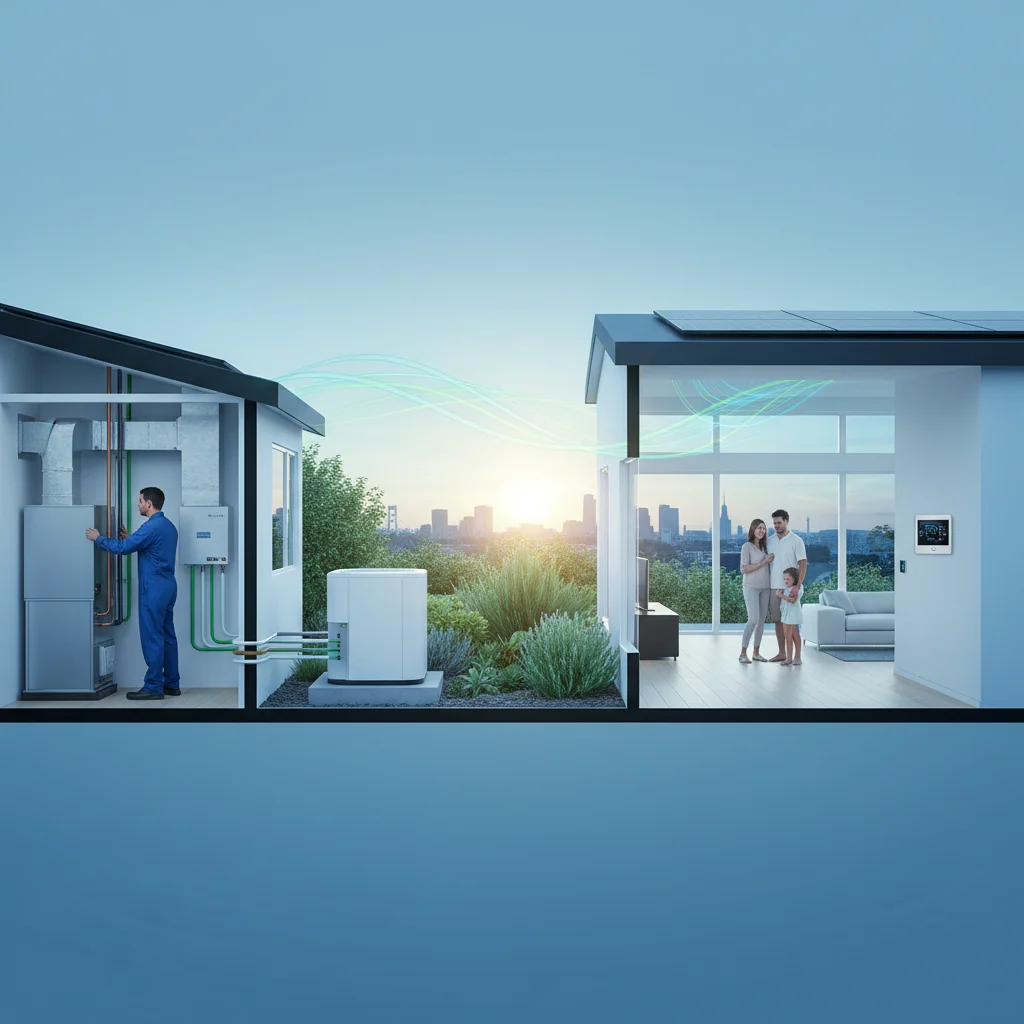
Sacramento homeowners replacing a failing HVAC system in 2026 face a sticker shock that didn't exist three years ago: the average complete system replacement now costs $8,500 to $18,000, up 23% since 2023 due to refrigerant phase-outs and supply chain pressures. And that price doesn't include the ductwork repairs that 40% of older Sacramento homes need before installation can even begin.
How Much Does HVAC Installation Cost in Sacramento?
Sacramento HVAC installation costs in 2026 range from $5,200 for basic single-stage systems to $18,000 for premium variable-speed units with smart controls. Central air conditioning installation averages $6,800 to $12,500, while furnace replacement costs $3,500 to $9,000. Complete system replacements including both heating and cooling equipment typically cost $8,500 to $18,000 installed.
But here's the tension: Sacramento's 100°F+ summer days demand reliable cooling, yet the region's mild winters mean oversized heating systems waste money. The average Sacramento household spends $1,680 annually on energy, with HVAC accounting for 48% of that total. So choosing the right system size and efficiency level determines whether homeowners pay that amount or cut it by 30-40% through strategic equipment selection.
Sacramento's unique climate drives specific cost factors. The dry heat means evaporative coolers work exceptionally well for $2,500 to $4,500 installed—60% less than traditional AC. And because heating degree days (HDD) in Sacramento total only 2,502 annually compared to 5,000+ in colder regions, installing an oversized furnace wastes $300 to $600 yearly on unnecessary capacity.
System type determines the cost range. Single-stage air conditioners cost $5,200 to $7,800 installed for 2.5-ton to 4-ton units suitable for 1,400 to 2,400 square foot homes. Two-stage systems add $1,200 to $2,400 to that baseline. Variable-speed systems with SEER2 ratings above 17 cost $9,500 to $15,000 but reduce summer cooling bills by 35-45% in Sacramento's hot climate.
Installation complexity adds significant cost. Homes built before 1980 often have undersized ductwork that restricts airflow, requiring $2,500 to $6,000 in duct modifications. Attic installations cost $800 to $1,500 less than ground-level installations due to easier access. And homes without existing ductwork face $6,000 to $12,000 in additional costs for complete duct system installation.
Equipment efficiency creates a cost-savings tradeoff. A basic 14 SEER2 system costs $6,200 installed but consumes $1,340 annually in a 1,800 square foot Sacramento home. An 18 SEER2 system costs $10,500 but reduces annual costs to $920—a $420 yearly savings that pays back the $4,300 premium in 10.2 years. But Sacramento's utility rates of $0.28 per kWh accelerate payback compared to the national average of 16 years.
"Residential HVAC systems installed in California must meet minimum efficiency standards of 14 SEER2 for air conditioners and 80% AFUE for furnaces as of 2023." — California Energy Commission
Labor costs in Sacramento run 15-20% above national averages due to California's prevailing wage laws and contractor licensing requirements. Expect to pay $85 to $125 per hour for licensed HVAC contractors, with typical installations requiring 12 to 20 labor hours. So a straightforward system replacement costs $1,020 to $2,500 in labor alone, while complex installations with duct modifications reach $3,000 to $5,000 in labor charges.
Permit costs in Sacramento add $250 to $450 per installation. The city requires permits for all HVAC system replacements, and inspections verify proper refrigerant handling and electrical connections. And because California enforces strict Title 24 energy code compliance, systems must include programmable thermostats and proper duct sealing—adding $300 to $800 to project costs.
What Are the Best HVAC Alternatives to Traditional Systems in Sacramento?
Sacramento homeowners have three primary alternatives to traditional HVAC systems: heat pumps costing $8,000 to $18,000, ductless mini-splits ranging from $3,500 to $12,000, and evaporative coolers priced at $2,500 to $4,500. Heat pumps provide both heating and cooling with 300% efficiency compared to 95% for gas furnaces. Mini-splits eliminate ductwork losses that waste 25-40% of conditioned air in older Sacramento homes.
Heat pumps deliver the strongest value proposition for Sacramento's climate. The region's mild winters with only 12 days below 40°F mean cold-climate performance limitations don't apply. So heat pumps operate at peak efficiency year-round, reducing heating costs by 50-60% compared to natural gas furnaces when electricity rates remain below $0.30 per kWh.
But upfront costs create barriers. Complete heat pump installations cost $11,000 to $18,000 for whole-home systems, versus $8,500 to $14,000 for traditional AC-plus-furnace setups. And Sacramento's natural gas rates of $2.40 per therm make gas heating cheaper than heat pump heating when electricity exceeds $0.35 per kWh—a threshold SMUD customers occasionally breach during peak summer rate periods.
Ductless mini-splits excel in specific applications. Homes without existing ductwork save $6,000 to $12,000 by installing mini-splits instead of adding ductwork. Room additions cost $3,500 to $5,500 for single-zone systems compared to $4,500 to $8,000 for extending central HVAC. And homes with poorly designed duct systems recover 25-40% of lost cooling capacity by switching to ductless systems.
"Ductless heat pump systems can reduce cooling energy use by 30% compared to standard central air conditioners, with the greatest savings in homes with leaky or uninsulated ductwork." — U.S. Department of Energy
Evaporative coolers work exceptionally well in Sacramento's dry climate. With average summer humidity below 25%, evaporative systems cool effectively while consuming 75% less electricity than refrigerated air conditioning. Installation costs of $2,500 to $4,500 compare favorably to $6,800 to $12,500 for central AC. But evaporative systems can't dehumidify, making them unsuitable for the 15-20 days per summer when Sacramento humidity exceeds 50%.
Geothermal heat pumps offer the highest efficiency but carry prohibitive costs for most Sacramento homeowners. Ground-source systems cost $18,000 to $35,000 installed due to excavation requirements. The 400% efficiency rating reduces operating costs by 65-70%, but the 15 to 25-year payback period makes sense only for new construction or homeowners planning to stay 20+ years.
Hybrid systems combine gas furnaces with heat pump technology. The system uses the heat pump for cooling and mild-weather heating, then switches to gas when outdoor temperatures drop below 35-40°F. Sacramento's 2,502 heating degree days mean the heat pump handles 80-85% of heating needs, reducing gas consumption by $400 to $650 annually while adding only $2,000 to $3,500 to installation costs compared to standard AC.
For homes with space constraints, packaged units combine heating and cooling in a single outdoor cabinet. These systems cost $6,500 to $11,000 installed—10-15% more than split systems—but eliminate indoor equipment and save 30-50 square feet of garage or closet space. And because all components sit outdoors, packaged units reduce indoor noise by 15-20 decibels compared to split systems with indoor air handlers.
How Does Sacramento HVAC Installation Compare to Other Cooling Solutions?
Sacramento HVAC installation costs average $8,500 to $18,000 for complete systems, while window air conditioners cost $300 to $800 per unit, portable ACs range $400 to $900, and whole-house fans run $800 to $2,500 installed. Central HVAC delivers 2.5-ton to 5-ton cooling capacity serving entire homes, versus 8,000 to 15,000 BTU for window units cooling single rooms.
Window air conditioners serve as tactical cooling solutions for specific rooms. A 12,000 BTU window unit cooling a 450 square foot bedroom costs $65 to $95 per cooling season in electricity, versus $180 to $240 for central AC cooling the same space. But cooling an entire 1,800 square foot home requires four to six window units costing $1,200 to $4,800 total, plus $260 to $570 in combined operating costs—approaching central AC's $320 to $480 seasonal cost.
Portable air conditioners offer flexibility but sacrifice efficiency. These units consume 30-40% more electricity than comparably sized window units due to single-hose designs that create negative pressure and draw warm air indoors. Sacramento summer cooling with a 14,000 BTU portable costs $110 to $145 per season, versus $75 to $100 for a similar window unit. And the $400 to $900 purchase price buys entry-level central AC installation when spread across a system's 15-year lifespan.
Whole-house fans provide effective cooling during Sacramento's 75-85°F evenings. These systems exhaust hot attic air while drawing cooler outdoor air through open windows, reducing indoor temperatures by 10-15°F in 20-30 minutes. Installation costs of $800 to $2,500 and operating costs under $15 per cooling season make them 95% cheaper than AC. But whole-house fans work only when outdoor temperatures drop below indoor temps—limiting effectiveness during Sacramento's 35-45 days above 95°F.
The lifespan comparison reveals total cost of ownership differences. Central HVAC systems last 15 to 20 years with proper maintenance, window units survive 8 to 12 years, and portable ACs fail after 5 to 8 years. So a $10,000 central system costs $500 to $667 annually over its life, while replacing window units every decade costs $100 to $133 per unit yearly—adding up to $400 to $800 for multi-room cooling.
Energy efficiency gaps widen operating cost differences. Modern central AC systems achieve 16 to 20 SEER2 ratings, delivering 16,000 to 20,000 BTU per kWh consumed. Window units rate 10 to 12 CEER (combined energy efficiency ratio), equivalent to 10 to 12 SEER. So cooling the same space costs 40-60% more with window units than with a high-efficiency central system. And Sacramento's $0.28 per kWh summer rates amplify these differences compared to the national average of $0.18 per kWh.
Comfort and convenience factors justify central HVAC's premium. Central systems maintain consistent temperatures within 2°F across all rooms, while window units create 8-12°F temperature variations between conditioned and unconditioned spaces. Central systems filter air through MERV 8-13 filters removing 85-98% of particles, versus 20-35% removal from basic window unit filters. And whole-home humidity control prevents the 70%+ indoor humidity levels that window AC units often create.
What Factors Affect HVAC Installation Pricing in Sacramento?
Sacramento HVAC installation costs vary by home size, existing ductwork condition, equipment efficiency level, and installation complexity. Homes under 1,500 square feet require 2 to 3-ton systems costing $6,500 to $11,000, while 2,500+ square foot homes need 4 to 5-ton units running $12,000 to $18,000. Ductwork replacement adds $3,500 to $8,000. Premium variable-speed systems cost $4,000 to $7,000 more than single-stage equipment.
Home size determines equipment capacity requirements. Sacramento's cooling load averages 650 to 850 BTU per square foot depending on insulation levels and window area. So a 1,800 square foot home requires 39,000 to 51,000 BTU capacity—typically a 3 to 4-ton system. But oversizing by even half a ton adds $800 to $1,500 to equipment costs while reducing efficiency through short-cycling and poor humidity control.
Ductwork condition creates the largest cost variable beyond equipment selection. Homes built before 1980 often have undersized ducts restricting airflow to 300-350 CFM per ton instead of the required 400 CFM. Duct replacement costs $15 to $25 per linear foot with 100 to 200 feet typical, totaling $1,500 to $5,000. And sealing leaky ducts recovers 15-30% of lost capacity for $800 to $1,500—often eliminating the need for larger equipment.
"Duct losses can account for more than 30% of cooling energy consumption, especially if ducts are in an unconditioned space such as an attic." — U.S. Department of Energy
Equipment efficiency level drives a cost-versus-savings tradeoff. A 14 SEER2 3-ton system costs $6,200 to $7,800 installed, while an 18 SEER2 unit runs $9,500 to $11,500. The higher efficiency system reduces annual cooling costs from $980 to $650 in a typical 1,800 square foot Sacramento home—a $330 yearly savings. So the $2,500 to $3,700 premium pays back in 7.6 to 11.2 years, favorable given 15 to 20-year system lifespans.
Installation complexity multiplies labor costs. Straightforward replacements with accessible equipment locations require 10 to 14 hours of labor at $85 to $125 per hour, totaling $850 to $1,750. But tight attic spaces, difficult electrical runs, or extensive duct modifications push labor to 20 to 30 hours and $1,700 to $3,750. And homes requiring structural modifications to accommodate larger equipment add $2,000 to $5,000 in carpentry and drywall costs.
Refrigerant type affects equipment costs. Older R-410A systems cost $500 to $1,200 less than newer R-32 or R-454B systems, but the phase-out schedule means R-410A refrigerant costs will increase 40-60% by 2028. So choosing equipment using next-generation refrigerants avoids future service cost increases when repairs require refrigerant replacement.
Seasonal timing creates price variations. Sacramento contractors charge 10-15% premiums during peak summer months when demand surges and lead times stretch to 3-5 weeks. Spring and fall installations cost $850 to $2,250 less for identical systems, and contractors offer better equipment selections when they're not racing through backlogged summer work. But waiting carries risk—system failures during 105°F heat waves force emergency replacements at 20-30% price premiums.
Smart controls and zoning add functionality and cost. Basic programmable thermostats cost $150 to $300, smart thermostats run $250 to $400, and multi-zone systems with individual room controls add $1,500 to $3,500. Sacramento homes with temperature variations between sun-exposed and shaded rooms see 18-25% energy savings from zoning, paying back the premium in 6 to 10 years. And smart thermostats reduce consumption by 10-15% through learned scheduling and remote access.
How Long Will Your New HVAC System Last in Sacramento?
Sacramento HVAC systems last 15 to 20 years for air conditioners, 15 to 25 years for furnaces, and 20 to 30 years for heat pumps with proper maintenance. Air conditioner compressors typically fail after 12 to 18 years, while furnace heat exchangers crack after 18 to 25 years. Sacramento's dry climate extends equipment life 15-20% compared to humid regions where condensate accelerates corrosion.
Central air conditioners in Sacramento average 17 years of service life—two years longer than the national average of 15 years. The dry climate prevents the condensate-related corrosion that degrades coils and cabinets in humid regions. But Sacramento's extreme summer heat stresses compressors and capacitors, offsetting some climate benefits. And systems running 1,200 to 1,500 hours annually in Sacramento wear faster than systems in mild climates operating only 800 hours yearly.
Furnace lifespan exceeds air conditioner longevity. Gas furnaces last 20 to 25 years in Sacramento due to low annual usage—the region's 2,502 heating degree days mean furnaces operate only 800 to 1,200 hours yearly compared to 2,000+ hours in cold climates. Heat exchangers crack from thermal cycling stress, but Sacramento's mild winters mean fewer start-stop cycles and longer component life.
Heat pumps face more demanding duty cycles. These systems operate year-round for both heating and cooling, accumulating 2,000 to 2,800 hours annually. But modern cold-climate heat pumps last 20 to 30 years when properly maintained, and Sacramento's mild winters prevent the cold-weather stress that shortens lifespans in northern regions. So heat pump longevity in Sacramento matches or exceeds traditional HVAC system life.
Maintenance frequency determines whether systems reach their full lifespan potential. Annual professional maintenance costs $120 to $180 but extends equipment life by 30-40% by catching issues early. Skipping maintenance reduces lifespan to 10 to 12 years for AC units and 12 to 15 years for furnaces. And unmaintained systems lose 5-10% efficiency yearly, increasing operating costs by $80 to $160 annually on top of shortened replacement cycles.
Component failure patterns follow predictable timelines. Capacitors fail after 8 to 12 years and cost $150 to $300 to replace. Blower motors last 12 to 18 years with replacement costing $400 to $800. Compressors fail after 12 to 18 years, requiring $1,800 to $3,500 for replacement—often making full system replacement more economical. And circuit boards fail after 10 to 15 years at $300 to $600 for replacement.
Sacramento's air quality affects filter and coil maintenance requirements. The region's agricultural surroundings and wildfire smoke create particulate loading that clogs filters in 30 to 60 days instead of the typical 90 days. Dirty filters restrict airflow, causing compressors to work harder and fail earlier. So Sacramento homeowners replacing filters monthly extend system life by 15-20% compared to those following standard 90-day intervals.
Equipment quality creates lifespan tiers. Budget-tier systems from regional brands last 12 to 15 years, mid-tier national brands survive 15 to 18 years, and premium brands with enhanced warranties reach 18 to 22 years. The premium systems cost $2,000 to $4,000 more upfront but save $5,000 to $8,000 in replacement costs over 25 years—a net gain of $1,000 to $4,000 even before accounting for improved efficiency.
Are There Tax Credits or Rebates for HVAC Installation in Sacramento?
The federal Energy Efficient Home Improvement Credit (Section 25C) ended for property placed in service after December 31, 2025 (IRS FS-2025-05). Federal tax credits for this work have ended, but state, local and utility rebates may still apply; check what is available at your address with the DuloCore rebate calculator. SMUD offers rebates from $500 to $3,000 for heat pump installations and $300 to $800 for high-efficiency AC systems. Combined incentives reduce net installation costs by $800 to $5,000 depending on equipment type and efficiency level.
The federal Energy Efficient Home Improvement Credit (Section 25C) ended for property placed in service after December 31, 2025 (IRS FS-2025-05). Heat pump installations qualify for 30% of project costs up to $2,000 for equipment meeting ENERGY STAR efficiency requirements. Central air conditioners qualify for $600 credits when achieving 16 SEER2 or higher ratings. And natural gas furnaces with 95% AFUE or better qualify for $600 credits. But the credits cover equipment and installation costs, excluding ductwork modifications or electrical upgrades.
SMUD administers Sacramento's most generous local incentive programs. The utility offers $3,000 rebates for heat pump installations replacing gas furnaces, $1,500 for heat pump replacements of electric resistance heating, and $500 to $800 for high-efficiency central AC systems rated 16 SEER2 or higher. And ductless mini-split systems qualify for $500 per indoor unit up to $1,500 per home. But SMUD funding runs out by September in most years, making early application critical.
California's TECH Clean California program provides additional heat pump incentives. Single-family homeowners qualify for $1,000 to $3,000 in point-of-sale rebates when replacing gas furnaces with heat pumps. Moderate-income households earning 80-120% of area median income ($74,000 to $111,000 for a family of four in Sacramento) qualify for enhanced incentives of $2,500 to $5,000. And low-income households below 80% AMI access incentives covering 50-100% of installation costs through separate programs.
Low-income Sacramento residents qualify for no-cost HVAC upgrades through the Energy Savings Assistance Program administered by SMUD and PG&E. Households earning below 200% of federal poverty guidelines ($60,000 for a family of four in 2026) qualify for free central AC replacement, furnace upgrades, and weatherization services. The program replaces inefficient systems regardless of condition, eliminating the typical requirement that systems must be broken to qualify for replacement assistance.
Sacramento County offers property tax exemptions for energy efficiency improvements including HVAC systems. The California Active Solar Energy System Exclusion prevents property tax increases from energy-saving upgrades for the life of the equipment. So a $5,000 assessed value increase from heat pump installation saves $50 to $65 annually in property taxes—adding up to $1,000 to $1,300 over a 20-year system lifespan.
Stacking incentives requires strategic application sequencing. Apply for SMUD rebates first since those funds run out fastest. File the federal tax credit when completing the following year's tax return. And apply for TECH Clean California rebates at the point of sale through participating contractors. But check compatibility—some programs prohibit stacking, while others allow combining federal credits with state and utility rebates for maximum savings.
Eligibility requirements vary by program. Federal tax credits require systems meeting ENERGY STAR Most Efficient or Consortium for Energy Efficiency Tier 3 standards. SMUD rebates mandate professional installation by licensed contractors and require permit documentation. And income-qualified programs verify household size and earnings through tax returns or pay stubs. So gathering documentation before starting projects prevents delays in receiving incentive payments.
Use our free rebate calculator to identify all federal, state, and utility incentives available for your specific project and income level.
Official Sources
- U.S. Department of Energy - Energy Saver — Federal guidance on HVAC efficiency, rebates, and home energy improvements
- ENERGY STAR — Equipment efficiency requirements and qualified product listings
- DSIRE - Database of State Incentives for Renewables & Efficiency — Comprehensive database of California and Sacramento-area HVAC incentive programs
Related Reading: Learn more about Hvac Installation Cost Orange County and Old Insulation Removal Cost.
Related Reading: Learn more about Hvac Installation Cost Inland Empire.
Frequently Asked Questions
How much does HVAC installation cost in Sacramento?
Sacramento HVAC installation costs range from $6,500 to $18,000 depending on system type, size, and efficiency level. Basic 14 SEER2 central air conditioning systems cost $6,500 to $9,000 for homes under 1,800 square feet. Complete heating and cooling replacements average $8,500 to $14,000 for mid-efficiency equipment. Premium variable-speed systems with smart controls cost $12,000 to $18,000 installed. Ductwork modifications add $2,500 to $8,000 to baseline costs.
What rebates are available for HVAC installation in Sacramento?
Sacramento homeowners qualify for federal tax credits up to $2,000 for heat pumps and $600 for high-efficiency air conditioners under the 2026 IRA program. SMUD offers rebates from $500 to $3,000 for qualifying equipment. TECH Clean California provides $1,000 to $3,000 point-of-sale rebates for heat pump installations. Combined incentives reduce net costs by $800 to $5,000 depending on equipment selection and household income level. Check current availability since utility funds typically deplete by September annually.
Do I qualify for HVAC rebates in Sacramento?
All Sacramento homeowners qualify for federal tax credits when installing equipment meeting ENERGY STAR efficiency requirements. SMUD rebates require professional installation by licensed contractors and permit documentation. TECH Clean California rebates require heat pump installations replacing gas or electric resistance heating systems. Income-qualified programs serve households earning below 200% of federal poverty guidelines ($60,000 for a family of four) through the Energy Savings Assistance Program, which provides free HVAC replacement and weatherization services.
When is the deadline for HVAC rebate applications?
SMUD rebates require applications within 90 days of installation, with program funding typically exhausted by September each year. TECH Clean California rebates apply at the point of sale through participating contractors with no separate deadline, but annual program funding runs out by October in most years. So scheduling installations early in the calendar year maximizes access to available incentive funds.
How long does HVAC installation take in Sacramento?
Sacramento HVAC installation typically requires 1 to 3 days depending on project complexity. Straightforward system replacements with no ductwork modifications take 8 to 14 hours, completing in a single day. Installations requiring duct sealing or minor modifications span 2 days. Complete duct system replacements or complex zoning installations require 3 to 5 days. And permit acquisition adds 3 to 10 business days before work begins. Summer installation lead times stretch to 3 to 5 weeks due to contractor backlog.
Ready to calculate your potential savings? Use our free rebate calculator to find every federal, state, and local incentive available for your HVAC installation project. Get personalized estimates based on your home size, current equipment, and income level in under 2 minutes.
Last updated April 14, 2026 — reviewed by DuloCore Editorial. About our authors.
Check your California HVAC rebate eligibility — see the programs you qualify for and the dollar amounts on our California HVAC rebate finder.