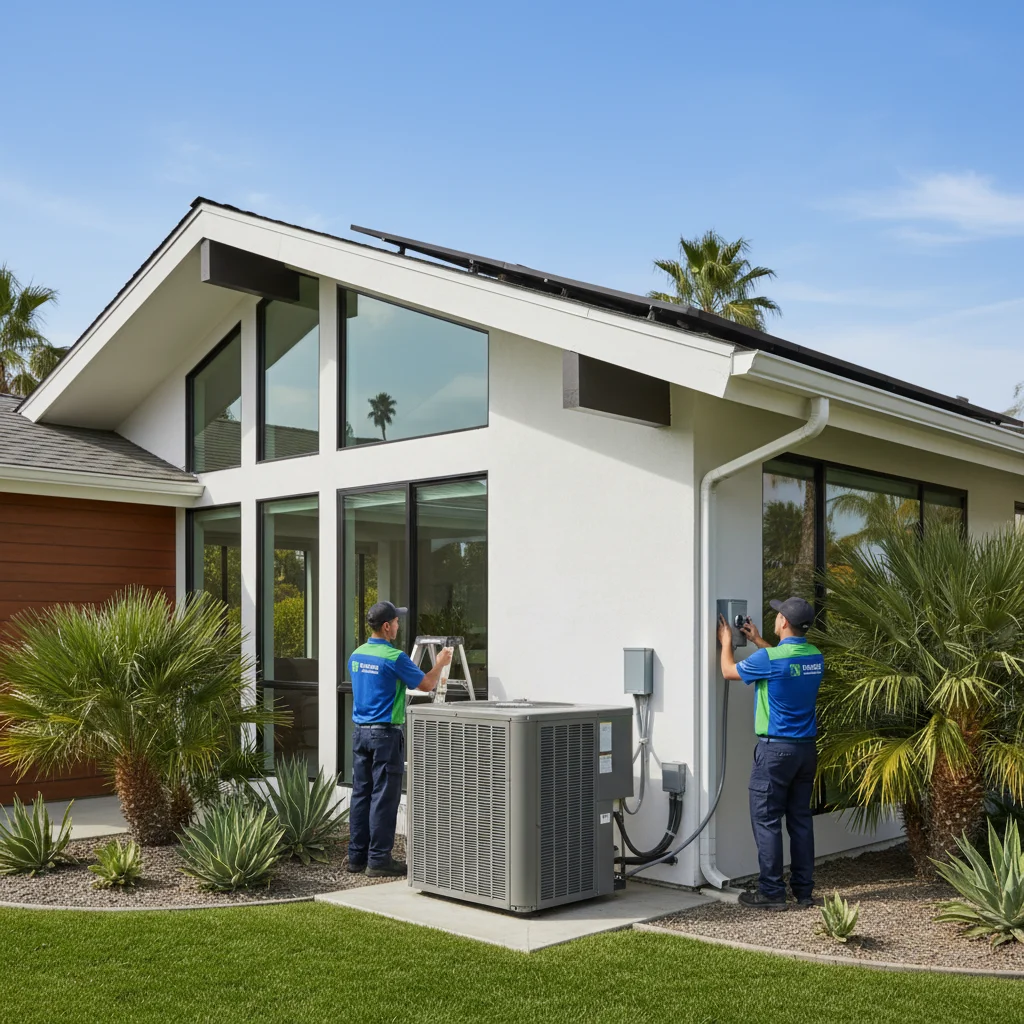
Los Angeles homeowners replaced over 127,000 HVAC systems in 2025, spending an average of $11,847 per installation—nearly $2,300 more than the national average. And rising electricity rates pushed 41% of those buyers toward heat pump systems despite the higher upfront cost.
How Much Does HVAC Installation Cost in Los Angeles?
HVAC installation in Los Angeles ranges from $6,200 for basic central air systems to $28,500 for high-efficiency heat pump installations with ductwork modifications. Central air conditioning replacement averages $8,400-$12,600, while heat pump systems cost $10,800-$18,200. Split systems start at $6,200-$9,400 for single-zone installations. Ductless mini-split heat pumps run $7,800-$14,300 for multi-zone coverage. Geothermal heat pump installations reach $24,000-$38,000 with ground loop installation.
The 2026 federal tax credit covers 30% of qualified heat pump and geothermal system costs through 2032, reducing a $15,000 heat pump installation to $10,500 after the credit. So homeowners installing qualifying systems before December 31, 2026 can claim up to $2,000 for air-source heat pumps or unlimited credit amounts for geothermal installations.
But the real stakes extend beyond installation day. California's Title 24 building codes now require new HVAC systems to meet SEER2 ratings of 14.3 or higher in Los Angeles County, effectively eliminating budget-tier equipment from the market. And the South Coast Air Quality Management District charges $50-$400 in permit fees depending on system size, adding $175 on average to total project costs.
"Heat pumps can reduce energy use for heating by approximately 50% compared to electric resistance heating such as furnaces and baseboard heaters." — U.S. Department of Energy
Labor costs in Los Angeles run $85-$140 per hour for licensed HVAC contractors, compared to $65-$95 in national markets. A standard 2-3 day installation requires 16-24 labor hours, adding $1,360-$3,360 to equipment costs. Permits, inspections, and refrigerant line modifications add another $800-$1,600.
What Factors Affect HVAC Installation Prices in LA?
System capacity drives the largest price variation—Los Angeles homes require 2.5-5 ton units depending on square footage, climate zone, and insulation quality. A 2.5 ton heat pump costs $8,200-$11,400 installed, while a 5 ton system reaches $14,800-$19,600. SEER2 efficiency ratings add $600-$1,200 per efficiency point above the 14.3 minimum, with 18 SEER2 systems commanding $2,400-$4,800 premiums over baseline models.
Ductwork condition determines whether homeowners face simple replacement ($6,200-$9,800) or extensive modification ($12,400-$18,900). Homes built before 1990 often need duct sealing, insulation upgrades, or complete replacement to meet current efficiency standards. And asbestos-wrapped ducts require $3,000-$8,000 in certified abatement before HVAC installation can proceed.
Coastal zones from Malibu to Manhattan Beach require corrosion-resistant equipment with specialized coatings, adding $800-$1,400 to system costs. Inland valleys face extreme temperature swings—Woodland Hills and Northridge installations need oversized condensers and upgraded electrical service, increasing costs by $1,200-$2,600.
Refrigerant type affects long-term costs more than installation price. R-410A systems cost $200-$400 less upfront but face phase-out pressure. R-32 and R-454B systems add $400-$900 to initial costs but offer 30-50% better efficiency and compliance with California's 2025 refrigerant regulations.
Building permits run $175-$650 in Los Angeles County depending on system value and jurisdiction. Electrical upgrades for heat pump installations add $1,200-$3,800 when homes need 200-amp service or dedicated circuits for backup heating elements.
How Long Until an HVAC Investment Pays for Itself?
Heat pump systems in Los Angeles achieve payback in 6-11 years compared to gas furnace alternatives, with coastal and inland valley homes seeing the fastest returns. A $14,200 heat pump installation replacing a 15-year-old gas furnace saves $840-$1,380 annually in combined heating and cooling costs at 2026 electricity rates of $0.31/kWh and gas prices of $2.18/therm.
The federal tax credit accelerates payback by 2-3 years—that same $14,200 system costs $9,940 after the 30% credit, reaching break-even in 7-8 years instead of 10-11. And California's Self-Generation Incentive Program offers $150-$350 per kWh for battery storage paired with heat pumps, adding $3,000-$7,000 in incentives for qualifying installations.
"ENERGY STAR certified central air conditioners have higher seasonal energy efficiency ratio (SEER) and energy efficiency ratio (EER) ratings, using at least 8% less energy than conventional models." — ENERGY STAR
But payback calculations depend on usage patterns and existing equipment efficiency. Homes with working 12-14 SEER air conditioners see 4-6 year payback periods when upgrading to 18 SEER2 heat pumps. Homes replacing failed systems avoid $800-$1,400 in annual efficiency losses from degraded equipment, shortening payback to 5-7 years.
Utility rate structures tilt economics toward heat pumps in Los Angeles Department of Water and Power territory, where tiered pricing pushes summer rates to $0.37/kWh. Southern California Edison customers in inland valleys face time-of-use rates reaching $0.51/kWh during 4-9pm peak periods—heat pumps with smart thermostats shift cooling loads to off-peak hours, saving $340-$620 annually beyond base efficiency gains.
Are You Eligible for LA Rebates and Tax Credits on HVAC Systems?
The federal home energy tax credits (Sections 25C and 25D) ended for projects completed after December 31, 2025 (IRS FS-2025-05). Federal tax credits for this work have ended, but state, local and utility rebates may still apply; check what is available at your address with the DuloCore rebate calculator. Qualifying systems must meet ENERGY STAR Most Efficient criteria—18 SEER2 and 9.5 HSPF2 for ducted heat pumps, 19 SEER2 and 10 HSPF2 for ductless systems. (Note: Federal tax credit percentages and availability are subject to change; the 30% Residential Clean Energy Credit under Section 25D expired December 31, 2025. Verify current incentives at energy.gov.)
California's Tech Clean California program offers point-of-sale rebates of $3,000-$6,500 for income-qualified households replacing gas furnaces with heat pumps. Households earning below 80% of area median income ($83,200 for a family of four in Los Angeles County) qualify for maximum rebates, while those at 80-150% AMI receive $2,000-$4,000.
The Los Angeles Department of Water and Power provides $4,000 rebates for ducted heat pump installations and $3,000 for ductless systems when replacing electric resistance heating. Southern California Edison customers access $3,000-$5,500 through the Energy Savings Assistance Program for income-qualified households, with an additional $1,000 for homes in disadvantaged communities.
And the South Coast Air Quality Management District offers up to $3,000 for zero-emission HVAC systems in Rule 1111 areas, targeting replacement of high-NOx equipment in pollution-impacted neighborhoods. So a household stacking federal, state, and local incentives can reduce a $16,000 heat pump installation to $6,500-$9,000 in net costs.
Gas Company customers qualify for $5,250 rebates when bundling heat pump installation with attic insulation and air sealing through the California Energy Upgrade Program. The program requires certified contractors and pre-installation energy audits but delivers combined savings of 25-40% on heating and cooling costs. Use our free rebate calculator to find your exact savings across all available programs.
HVAC Installation Process: What to Expect in Los Angeles
Licensed contractors perform load calculations using Manual J methodology to determine proper system sizing—90% of Los Angeles installations require 3-4 ton systems for 1,400-2,200 square foot homes. The calculation accounts for ceiling height, insulation levels, window area, and orientation to prevent oversizing that causes short-cycling and humidity problems.
Permit applications take 3-7 business days for approval in most Los Angeles jurisdictions, though some cities like Beverly Hills and Santa Monica require 10-14 days. Contractors submit equipment specifications, load calculations, and duct modification plans to building departments. And inspections occur after installation but before final system startup.
Installation spans 1-3 days depending on ductwork scope and electrical requirements. Day one includes old equipment removal, refrigerant recovery, and electrical disconnection—2-4 hours for straightforward replacements. Duct modifications, air sealing, and insulation upgrades add 4-8 hours. Day two covers new equipment installation, refrigerant line runs, condensate drain connection, and electrical hookup requiring 6-10 hours.
But heat pump installations requiring electrical panel upgrades extend timelines to 3-4 days. Electricians install 40-60 amp circuits for heat pump air handlers and outdoor units, upgrading panels from 100-amp to 200-amp service when necessary. Inspections occur after electrical work completion, adding 1-2 days before HVAC installation proceeds.
Final startup includes refrigerant charge verification, airflow testing at each register, thermostat programming, and homeowner operation training. Contractors provide air filter schedules, maintenance requirements, and smart thermostat optimization tips. And warranty registration requires equipment serial numbers, installation dates, and homeowner contact information submitted within 60 days.
How Do HVAC Installation Costs Compare Across LA Neighborhoods?
Coastal communities from Pacific Palisades to Palos Verdes pay 8-12% premiums for corrosion-resistant equipment and specialized installation techniques. Salt air exposure requires epoxy-coated condenser coils, stainless steel fasteners, and protective cabinet treatments adding $950-$1,680 to standard system costs. And proximity to ocean winds demands reinforced mounting brackets and upgraded electrical connections, increasing labor by 3-5 hours.
San Fernando Valley installations in Encino, Sherman Oaks, and Studio City cost 5-9% more than county averages due to extreme summer temperatures requiring oversized equipment. Homes regularly exceeding 105°F need 20-30% larger condensers than coastal equivalents, adding $1,200-$2,400 to equipment costs. But valley homeowners see faster payback through higher cooling season savings—$180-$280 annually compared to coastal zones.
Downtown and central Los Angeles neighborhoods face permit complexity that adds $200-$600 to project costs. Historic preservation districts require design review for outdoor equipment placement, extending permit timelines by 2-4 weeks. And multi-unit buildings in Koreatown, Echo Park, and Silver Lake need additional mechanical permits when upgrading shared ventilation systems.
South LA communities qualify for enhanced rebates through California's disadvantaged communities designation—an additional $1,000-$2,000 in incentives through Tech Clean California and AQMD programs. So a $13,500 heat pump installation costs $7,000-$9,000 after stacking federal, state, and local incentives in these zip codes.
Foothill communities like La Cañada Flintridge and Altadena require wildfire-resistant equipment placement—outdoor units installed in ember-resistant enclosures or located away from vegetation. These modifications add $400-$900 but satisfy building codes in Very High Fire Hazard Severity Zones.
Official Sources
- U.S. Department of Energy - Heat Pump Systems — Federal guidance on heat pump technology, efficiency ratings, and performance expectations
- ENERGY STAR - Central Air Conditioning — Certification criteria and energy savings data for qualifying HVAC systems
- Database of State Incentives for Renewables & Efficiency — Comprehensive database of federal, state, and local rebate programs
Frequently Asked Questions
How much does HVAC installation cost in Los Angeles?
HVAC installation in Los Angeles costs $6,200-$28,500 depending on system type and home requirements. Standard central air conditioning replacement runs $8,400-$12,600, while heat pump installations range from $10,800-$18,200 for ducted systems. Ductless mini-splits cost $7,800-$14,300 for multi-zone coverage. Geothermal systems reach $24,000-$38,000 with ground loop installation. Labor accounts for $1,360-$3,360 of total costs, with permits adding $175-$650.
What rebates are available for HVAC installation in Los Angeles?
The federal Energy Efficient Home Improvement Credit (Section 25C) ended for property placed in service after December 31, 2025 (IRS FS-2025-05). California's Tech Clean California program offers $3,000-$6,500 for income-qualified households. LADWP provides $4,000 for ducted heat pump installations, while Southern California Edison offers $3,000-$5,500 through the Energy Savings Assistance Program. The South Coast AQMD adds up to $3,000 for zero-emission systems in targeted areas. Check our rebate calculator for your specific eligibility.
Is HVAC installation covered by California rebate programs?
California rebate programs cover heat pump installations but not traditional air conditioning systems. Tech Clean California provides $3,000-$6,500 for income-qualified households replacing gas furnaces with heat pumps. The California Energy Upgrade Program offers $5,250 when bundling heat pump installation with insulation upgrades. And California's Self-Generation Incentive Program provides $150-$350 per kWh for battery storage paired with heat pumps, adding $3,000-$7,000 in potential incentives.
How long does HVAC installation take in Los Angeles?
Standard HVAC replacement takes 1-2 days in Los Angeles for straightforward installations. Equipment removal, new system installation, and startup require 8-14 labor hours total. But duct modifications extend timelines to 2-3 days, adding 4-8 hours for sealing and insulation work. Heat pump installations requiring electrical panel upgrades need 3-4 days, including separate electrical and HVAC inspections. Permit approval adds 3-7 business days before installation begins.
What is the average lifespan of a new HVAC system?
New HVAC systems installed in Los Angeles last 12-18 years depending on equipment quality and maintenance frequency. Heat pumps average 14-16 years with annual professional servicing, while traditional air conditioners reach 12-15 years. Geothermal systems last 20-25 years for indoor components and 40-50 years for ground loops. Coastal installations face 10-15% shorter lifespans due to salt air corrosion unless equipped with protective coatings. Regular filter changes and biannual maintenance extend equipment life by 2-4 years.
Ready to calculate your HVAC installation savings? Use our free rebate calculator to discover exactly how much you'll save with federal tax credits, California rebates, and utility incentives. Get your personalized estimate in under 2 minutes—no email required.
Updated on April 14, 2026. Fact-checked by DuloCore Editors. About our research team.
Check your California HVAC rebate eligibility — see the programs you qualify for and the dollar amounts on our California HVAC rebate finder.