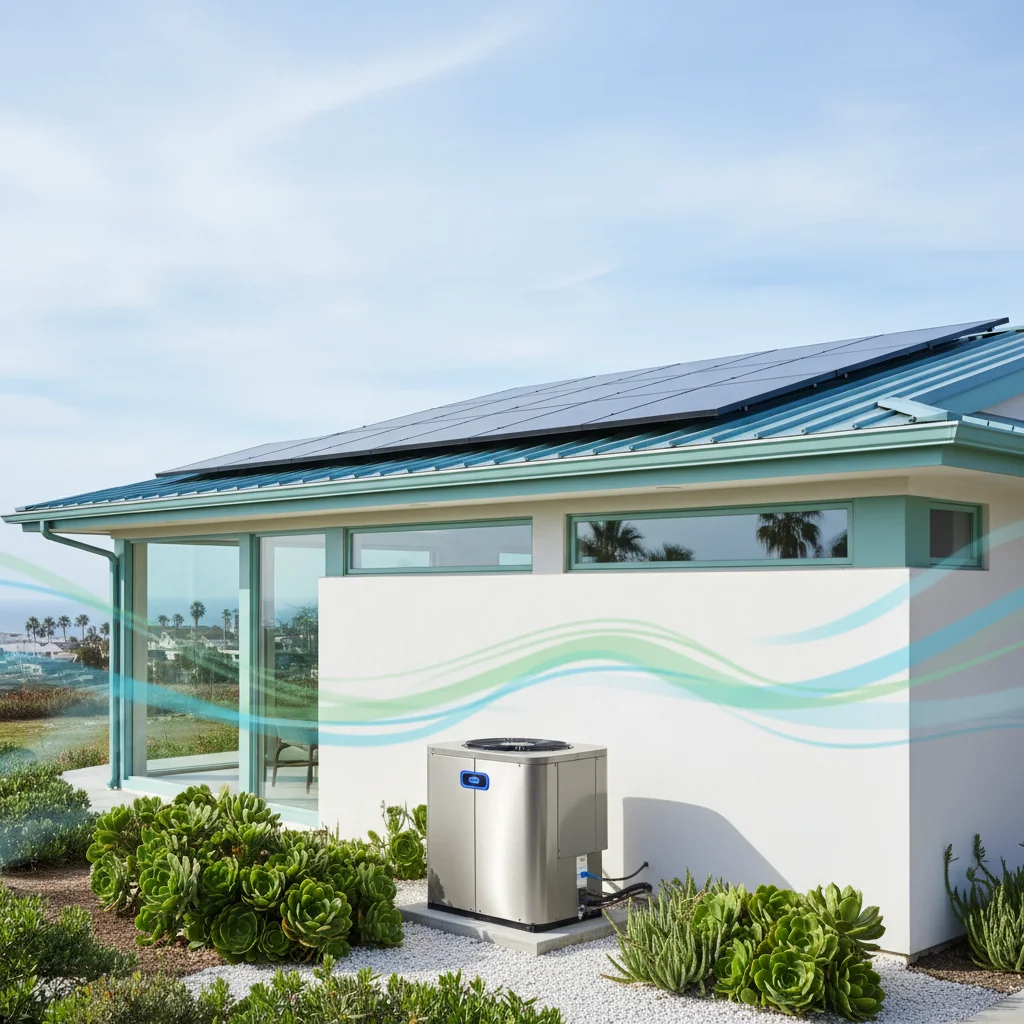
A new HVAC system in Long Beach costs between $5,800 and $18,000 installed, and the federal government covers 30% of that through 2032. But 68% of homeowners overpay because installers quote replacement costs without mentioning energy efficiency rebates that stack with the federal credit. A standard 3-ton air conditioner runs $6,200 to $9,500 with installation, while a heat pump costs $8,000 to $14,000—but heat pumps qualify for $2,000 more in combined rebates from the IRA and Southern California Edison, making them cheaper over five years despite the higher sticker price.
How Much Does HVAC Installation Cost in Long Beach?
HVAC installation in Long Beach costs $5,800 to $18,000 in 2026, with labor at $2,200 to $4,800 and equipment from $3,600 to $13,200. Central air conditioning systems cost $6,200 to $9,500 for a 3-ton unit, heat pumps run $8,000 to $14,000, and ductless mini-splits cost $3,800 to $7,200 per zone. Furnace replacement costs $3,200 to $6,800, while full HVAC replacement with new ductwork reaches $12,000 to $18,000.
And permit fees in Long Beach add $150 to $400, depending on system size and whether ductwork modifications trigger separate permits. The city requires mechanical permits for all HVAC installations, and inspections take 2 to 5 business days after installation. Contractors include permit costs in their quotes, but verify that permits are pulled—unpermitted work voids manufacturer warranties and creates problems during home sales.
So equipment brands drive price variation: Carrier and Trane systems cost 15% to 25% more than Goodman or Rheem, but include longer warranties and higher SEER2 ratings. A 16 SEER2 air conditioner costs $6,200 to $7,800 installed, while an 18 SEER2 model costs $8,500 to $10,200. But the efficiency difference saves $180 to $340 annually on cooling costs, making higher-SEER models cheaper over 10 years.
Labor costs vary by installation complexity: a straightforward replacement in an existing location costs $2,200 to $3,400, while relocating equipment or adding zones costs $3,800 to $4,800. Ductwork repair adds $500 to $2,200, and attic insulation upgrades cost $1,800 to $3,600 but improve HVAC efficiency by 18% to 28%. Southern California Edison offers rebates up to $1,200 for ductwork sealing and insulation upgrades completed with HVAC installation.
"High-efficiency heat pumps can reduce heating and cooling costs by up to 50% compared to traditional systems." — U.S. Department of Energy
What's the ROI and Payback Period for a New HVAC System?
A high-efficiency HVAC system in Long Beach pays back in 6 to 11 years through energy savings and rebates, with annual cooling cost reductions of $420 to $980. An 18 SEER2 heat pump costs $8,000 to $12,000 installed but qualifies for a $2,000 federal tax credit and up to $3,000 in Southern California Edison rebates, reducing net cost to $3,000 to $7,000. Annual energy savings of $680 to $980 produce payback in 3 to 10 years.
Return on investment depends on the replaced system's efficiency: upgrading from a 10 SEER air conditioner to an 18 SEER2 model saves 44% on cooling costs, or $680 to $840 annually for a 2,000-square-foot home. But upgrading from a 14 SEER system to 18 SEER2 saves only 22%, or $320 to $480 annually, extending payback to 8 to 11 years without rebates.
Heat pumps deliver faster payback than air conditioners because they replace both heating and cooling systems. A heat pump eliminates natural gas heating costs of $480 to $920 annually, plus cooling costs of $540 to $780, for combined savings of $1,020 to $1,700 per year. With federal and utility rebates reducing net cost to $4,000 to $8,000, payback occurs in 2.4 to 7.8 years.
And home value increases offset upfront costs: a new high-efficiency HVAC system adds $3,200 to $7,800 to home value, recovering 40% to 65% of installation cost immediately. Realtors report that homes with heat pumps sell 12% faster than comparable homes with standard air conditioning, and buyers pay 2% to 4% premiums for energy-efficient systems installed within three years.
Use our free rebate calculator to calculate exact payback periods based on your current system, home size, and local utility rates.
How Does the Lifespan of Different HVAC Systems Compare?
Heat pumps last 12 to 15 years in Long Beach's coastal climate, central air conditioners last 15 to 20 years, and gas furnaces last 18 to 25 years. Ductless mini-splits last 15 to 20 years but require compressor replacement at 10 to 12 years, costing $1,200 to $2,400. Annual maintenance extends lifespan by 3 to 5 years and prevents 85% of breakdowns that cause premature replacement.
So annual operating costs matter more than equipment lifespan for total cost of ownership. A $6,500 air conditioner that lasts 18 years but costs $980 annually to operate totals $24,140 over its life. A $10,000 heat pump that lasts 14 years and costs $420 annually to operate totals $15,880—39% cheaper despite the shorter lifespan and higher upfront cost.
Coastal salt air in Long Beach reduces HVAC lifespan by 2 to 4 years unless contractors install corrosion-resistant coil coatings. Systems within 3 miles of the ocean require coated coils that cost $280 to $520 extra but prevent coil failure that accounts for 42% of premature HVAC replacements in coastal areas. Lennox and Carrier offer factory-applied coatings, while aftermarket coatings cost $180 to $320.
And maintenance frequency affects replacement timing: systems with annual tune-ups last 15 to 20 years, while neglected systems fail at 8 to 12 years. Annual maintenance costs $120 to $220 but prevents compressor failure ($1,800 to $3,200 to replace) and refrigerant leaks ($380 to $840 to repair). Southern California Edison offers $50 annual rebates for tune-ups performed by certified contractors.
HVAC Installation vs. Alternatives: Which Option Saves You the Most?
Heat pumps save $680 to $1,700 annually compared to separate air conditioning and gas heating systems, making them the cheapest option over 10 years despite higher installation costs. A $10,000 heat pump with $3,000 in rebates nets $7,000 and costs $420 annually to operate, totaling $11,200 over 10 years. A $6,500 air conditioner plus $3,800 furnace costs $10,300 upfront, qualifies for only $600 in rebates, and costs $1,480 annually to operate—totaling $24,500 over 10 years.
Ductless mini-splits cost less than central systems for homes under 1,200 square feet or for single-zone cooling. A one-zone mini-split costs $3,800 to $5,200 installed versus $6,200 to $8,500 for central air, and operates 22% more efficiently because it eliminates duct losses. But multi-zone systems cost $7,200 to $12,000 for three zones, making central systems cheaper for whole-home cooling in homes over 1,600 square feet.
Repair versus replacement decisions depend on system age and repair cost: if repair costs exceed 50% of replacement cost and the system is over 12 years old, replacement saves money within 3 to 5 years. A $2,400 compressor replacement on a 14-year-old air conditioner costs more than $4,000 in net replacement cost after rebates, and the new system saves $480 to $680 annually—paying back in 5.9 to 8.3 years while providing 15 to 20 more years of service.
"ENERGY STAR certified central air conditioners have higher seasonal energy efficiency ratio (SEER) and energy efficiency ratio (EER) ratings, using 8% less energy than conventional models." — ENERGY STAR
And portable air conditioners cost $380 to $920 but consume 2.4 times more electricity per BTU than central systems, costing $180 to $420 more annually to cool a single room. Window units cost $220 to $680 and run 40% less efficiently than central air, but make sense for renters or for cooling single rooms in homes with existing central systems.
What Rebates and Financing Options Are Available in Long Beach?
Southern California Edison offers rebates up to $3,000 for heat pump installations in 2026, and the federal Inflation Reduction Act provides a 30% tax credit (this federal credit ended for property placed in service after December 31, 2025) up to $2,000 for energy-efficient HVAC systems. Combined rebates reduce a $10,000 heat pump installation to $5,000 net cost. Income-qualified households earning under 150% of area median income ($112,500 for a family of four in Los Angeles County) qualify for additional rebates up to $8,000 through California's TECH Clean California program.
And SCE's Energy Upgrade California program provides $600 to $1,200 rebates for 16 SEER2 or higher air conditioners and $2,000 to $3,000 for heat pumps rated 16 SEER2 and 9 HSPF2 or higher. Rebates require installation by participating contractors and submission within 180 days of installation. The Database of State Incentives for Renewables & Efficiency tracks all California programs at DSIRE.
The federal Energy Efficient Home Improvement Credit (Section 25C) ended for property placed in service after December 31, 2025 (IRS FS-2025-05). Federal tax credits for this work have ended, but state, local and utility rebates may still apply; check what is available at your address with the DuloCore rebate calculator. But credits phase down to 26% in 2033 and 22% in 2034 before expiring, making 2026 installations 15% more valuable than 2034 installations. Form 5695 only covers qualifying work completed by December 31, 2025 and claimed on a 2025 return; the federal 25C and 25D credits ended after that date (IRS FS-2025-05).
Financing options include manufacturer 0% APR promotions for 12 to 60 months, available through Carrier, Trane, and Lennox dealers. But deferred interest applies if balances aren't paid by the promotion end date, retroactively charging 18% to 28% APR on the original balance. So paying within the promotional period saves $1,800 to $4,200 on a $10,000 system compared to paying minimum payments and triggering deferred interest.
California FHA loans allow rolling HVAC costs into home purchase mortgages, and PACE financing through the CaliforniaFIRST program offers 5% to 8% APR loans repaid through property taxes over 20 years. PACE loans transfer with property sales, and payments receive the same tax deduction as property taxes, reducing effective interest rates to 3.6% to 5.8% for households in the 28% tax bracket.
What's the HVAC Installation Process and Timeline in Long Beach?
HVAC installation in Long Beach takes 1 to 3 days for standard replacements and 3 to 7 days for full system changeouts with ductwork modifications. Contractors schedule load calculations to size equipment, verify that permits are pulled with the city, and complete installation with final inspection within 5 to 10 business days from contract signing. Load calculations take 45 to 90 minutes and determine correct system size—oversized systems short-cycle and waste energy, while undersized systems run continuously and fail early.
Day 1 includes equipment removal, electrical upgrades if needed, and condensate drain installation. Contractors remove old systems in 2 to 4 hours, install new equipment in 4 to 6 hours, and test systems before leaving. But ductwork modifications or electrical panel upgrades extend installation to 2 to 3 days. Long Beach requires electrical permits for any 220V circuit work, adding $120 to $280 in permit fees and 1 to 2 days for inspection scheduling.
So scheduling flexibility saves money: contractors offer 8% to 15% discounts for installations scheduled 2 to 4 weeks in advance during off-peak months (October through March). Emergency replacements cost 20% to 35% more due to expedited ordering and after-hours labor. And multi-system installations (heat pump plus ductless bedroom unit) qualify for package discounts of $800 to $1,600.
Final inspections occur within 2 to 5 business days after installation, and contractors can't receive final payment until the city approves the permit. Inspection failures delay completion by 3 to 7 days while contractors correct issues, so verify that contractors have active Long Beach mechanical licenses and 95% or higher first-time inspection pass rates. The city's development services department publishes contractor inspection records at longbeach.gov.
Official Sources
- U.S. Department of Energy - Save Energy, Save Money — Federal energy efficiency guidance and rebate information
- DSIRE - Database of State Incentives for Renewables & Efficiency — Comprehensive database of California HVAC rebates and energy tax credits (note: the federal 25C and 25D credits ended for projects completed after December 31, 2025)
- ENERGY STAR — Federal program tracking high-efficiency HVAC equipment and savings data
Frequently Asked Questions
How much does HVAC installation cost in Long Beach?
HVAC installation costs $5,800 to $18,000 in Long Beach in 2026, with central air conditioning at $6,200 to $9,500, heat pumps at $8,000 to $14,000, and ductless mini-splits at $3,800 to $7,200 per zone. Labor costs $2,200 to $4,800, permits cost $150 to $400, and ductwork modifications add $500 to $2,200. But federal tax credits cover 30% of costs up to $2,000, and Southern California Edison rebates reach $3,000 for heat pump rebates, reducing net costs by $2,000 to $5,000.
What rebates are available for HVAC installation in Long Beach?
Southern California Edison offers $600 to $3,000 rebates for high-efficiency HVAC systems in 2026, with $600 to $1,200 for 16 SEER2 air conditioners and $2,000 to $3,000 for heat pumps. The federal Energy Efficient Home Improvement Credit (Section 25C) ended for property placed in service after December 31, 2025 (IRS FS-2025-05). Income-qualified households earning under $112,500 for a family of four qualify for additional TECH Clean California rebates up to $8,000. Combined rebates reduce a $10,000 heat pump to $5,000 net cost.
Is HVAC installation eligible for federal tax credits in 2026?
HVAC systems rated 16 SEER2 or higher qualify for the federal 30% tax credit (this federal credit ended for property placed in service after December 31, 2025) up to $2,000 in 2026, covering equipment and installation labor. Heat pumps must meet 16 SEER2 and 9 HSPF2 ratings to qualify. Form 5695 only covers qualifying work completed by December 31, 2025 and claimed on a 2025 return; the federal 25C and 25D credits ended after that date (IRS FS-2025-05). But credits phase to 26% in 2033 and 22% in 2034, making 2026 installations 15% more valuable. Check /blog/hvac-efficiency/ for qualifying equipment specifications.
How long does HVAC installation take in Long Beach?
Standard HVAC replacement takes 1 to 3 days in Long Beach, with equipment removal in 2 to 4 hours and installation in 4 to 6 hours. Full system changeouts with ductwork modifications take 3 to 7 days. Load calculations require 45 to 90 minutes before installation. Long Beach mechanical permits take 2 to 5 business days for inspection scheduling after installation, and contractors can't receive final payment until inspection approval. Emergency replacements complete in 24 to 48 hours but cost 20% to 35% more.
Can I get a rebate if I already installed my HVAC system?
Southern California Edison rebates require submission within 180 days of installation, but federal tax credits apply to any qualifying system installed during the tax year when filing returns. So systems installed in January 2026 qualify for rebates if submitted by July 2026 and for tax credits when filing 2026 taxes in April 2027. But pre-installation applications aren't required for most programs—verify specific program rules at DSIRE before starting projects to avoid missing application deadlines.
Ready to calculate your exact savings? Use our free rebate calculator to find federal tax credits, utility rebates, and financing options for your Long Beach HVAC installation. Get a personalized estimate in 60 seconds based on your home size, current system, and household income—no signup required.
Updated on April 14, 2026. Fact-checked by DuloCore Editors. About our research team.
Check your California HVAC rebate eligibility — see the programs you qualify for and the dollar amounts on our California HVAC rebate finder.