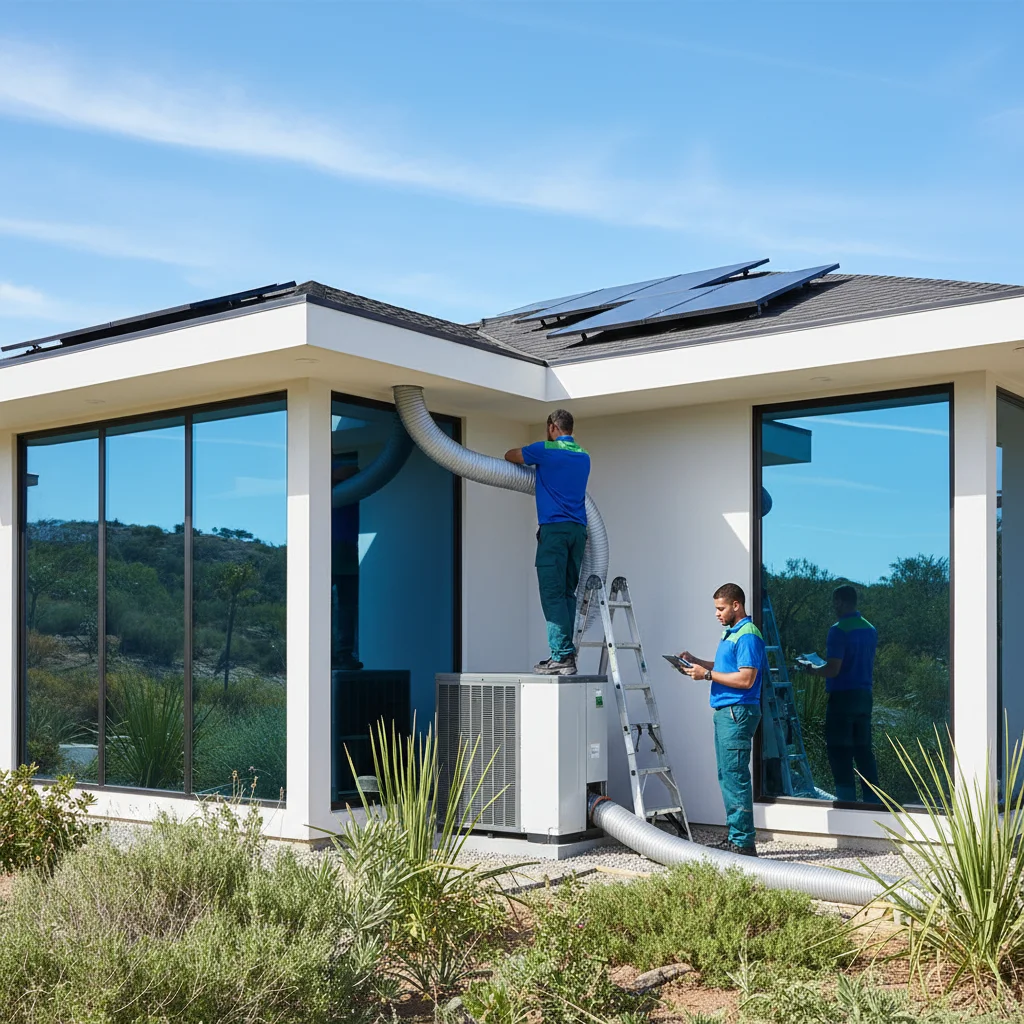
Fresno homeowners paid between $7,800 and $15,200 for complete HVAC system replacements in 2026, with the median install hitting $10,400—roughly $2,100 above California's statewide average. And those numbers exclude federal tax credits and utility rebates that can slash final costs by 30-50%. The federal Energy Efficient Home Improvement Credit (Section 25C) ended for property placed in service after December 31, 2025 (IRS FS-2025-05). Federal tax credits for this work have ended, but state, local and utility rebates may still apply; check what is available at your address with the DuloCore rebate calculator.
How Much Does HVAC Installation Cost in Fresno? (2026 Pricing Guide)
Complete HVAC system installation in Fresno ranges from $7,800 for basic 2-ton split systems to $15,200 for high-efficiency 5-ton heat pump setups with advanced zoning controls in 2026. Labor accounts for $2,400 to $4,800 of total project costs, while equipment makes up the remaining $5,400 to $10,400. Permit fees add another $150-$350. Three-ton systems serving typical 1,600-2,000 square-foot homes average $9,800-$11,600 installed.
So what drives Fresno's above-average pricing? The city's extreme summer heat—averaging 97°F in July—pushes contractors toward oversized equipment and reinforced ductwork. The federal Energy Efficient Home Improvement Credit (Section 25C) ended for property placed in service after December 31, 2025 (IRS FS-2025-05). And California's TECH Clean California program adds up to $3,000 in point-of-sale rebates for income-qualified households replacing gas furnaces with electric heat pumps.
Equipment Cost Breakdown by System Type
| System Type | Equipment Cost | Labor + Permits | Total Before Incentives | After 30% Federal Credit |
|---|---|---|---|---|
| 14 SEER Central AC (3-ton) | $3,200-$4,100 | $2,600-$3,400 | $5,800-$7,500 | $4,060-$5,250 (AC not eligible) |
| 16 SEER Heat Pump (3-ton) | $5,400-$6,800 | $2,800-$3,600 | $8,200-$10,400 | $5,740-$7,280 |
| 20 SEER Heat Pump (3-ton) | $7,200-$9,100 | $3,000-$3,800 | $10,200-$12,900 | $7,140-$9,030 |
| Dual-Fuel System (3-ton) | $6,900-$8,400 | $3,200-$4,200 | $10,100-$12,600 | $7,070-$8,820 |
Traditional air conditioners don't qualify for federal tax credits because they provide cooling only. The federal Residential Clean Energy Credit (Section 25D) ended for expenditures made after December 31, 2025, and the IRS treats an expenditure as made when installation is completed (IRS FS-2025-05). So a $10,400 heat pump (this federal credit ended for property placed in service after December 31, 2025) install drops to $7,280 after federal incentives—before adding California utility rebates. (Note: Federal tax credit percentages and availability are subject to change; the 30% Residential Clean Energy Credit under Section 25D expired December 31, 2025. Verify current incentives at energy.gov.)
What Factors Affect HVAC Installation Costs in Your Area?
Seven variables determine final HVAC installation costs in Fresno: home square footage, existing ductwork condition, equipment efficiency rating, refrigerant type, electrical service capacity, permit requirements, and seasonal demand. Homes requiring duct replacement or modification add $1,800-$4,200 to base costs. Systems using newer R-410A refrigerant cost $300-$600 less than legacy R-22 conversions.
Electrical panel upgrades for heat pump installations run $1,200-$2,400 when existing 100-amp service can't support new equipment loads. And Fresno's permit process adds 3-5 business days and $180-$320 in fees, though some contractors bundle permits into quoted labor rates. Spring and fall installations typically cost 8-12% less than peak summer demand pricing from June through August.
Efficiency ratings create the steepest cost variations. A 14 SEER system costs $5,800-$7,500 installed, while a 20 SEER model runs $10,200-$12,900 for identical tonnage. But higher-SEER units cut annual cooling costs by $240-$380 in Fresno's climate, according to ENERGY STAR calculations. So the $4,400 premium pays back in 11-18 years through utility savings alone—before accounting for improved comfort and resale value.
"Heat pumps can reduce electricity use for heating by approximately 50% compared to electric resistance heating such as furnaces and baseboard heaters." — U.S. Department of Energy
How Long Will Your New HVAC System Last and What's the ROI Payback Period?
Central air conditioners and heat pumps installed in Fresno last 14-18 years with proper maintenance, while gas furnaces reach 18-22 years before requiring replacement. High-efficiency systems (18+ SEER) typically deliver full payback within 7-11 years through combined utility savings and federal tax credits. Standard 14-16 SEER equipment takes 12-16 years to recoup costs through energy savings alone.
Return on investment calculations shift dramatically when factoring current incentives. A $10,400 heat pump installation in Fresno qualifies for $3,120 in federal tax credits (30%) and up to $3,000 in California utility rebates for eligible households. So the effective $4,280 net cost pays back in just 4-6 years against a $900 annual utility bill reduction compared to older 10 SEER equipment. And the system delivers another 8-14 years of continued savings after hitting breakeven.
Maintenance directly impacts lifespan and efficiency retention. Annual tune-ups cost $120-$180 but preserve 95-98% of original efficiency ratings through year 10. Neglected systems lose 5-8% efficiency annually after year 5, turning a 16 SEER unit into effective 13 SEER performance by year 8. So $1,680 in maintenance over 14 years protects $3,360-$5,320 in avoided efficiency losses—a 200-315% maintenance ROI.
HVAC Installation vs. Other Cooling Alternatives: Which Option Saves You Money?
Heat pumps cost $8,200-$12,900 installed but provide both heating and cooling year-round, while traditional AC-plus-furnace systems run $7,800-$11,400 but operate less efficiently. Ductless mini-splits range from $3,200-$8,400 for single-zone to whole-home configurations. Evaporative coolers cost just $1,800-$3,400 installed but only work effectively in Fresno's low-humidity climate during 6-7 months annually.
Annual operating costs reveal the real savings picture. A 16 SEER heat pump costs $840-$1,020 yearly to cool and heat a typical 1,800-square-foot Fresno home. Traditional 80% AFUE gas furnace plus 14 SEER AC combinations run $960-$1,180 annually. But ductless mini-splits operating at 20+ SEER cost just $640-$780 yearly for identical loads—saving $180-$400 compared to conventional systems.
Federal incentives flip the equation. The federal Energy Efficient Home Improvement Credit (Section 25C) ended for property placed in service after December 31, 2025 (IRS FS-2025-05). A $10,400 heat pump drops to $7,280 after credits, undercutting the $7,800 baseline cost of AC-plus-furnace systems. And California's TECH rebates add another $3,000 for income-qualified heat pump installations, pushing net costs below $4,300—less than half the price of comparable gas systems.
Check your specific savings using our free rebate calculator to compare exact costs with current 2026 incentives.
What Federal and State Tax Credits and Rebates Can You Claim in California?
The federal Residential Clean Energy Credit (Section 25D) ended for expenditures made after December 31, 2025, and the IRS treats an expenditure as made when installation is completed (IRS FS-2025-05). California's TECH Clean California program offers $2,000-$3,000 point-of-sale rebates for moderate-income households switching from gas heating to electric heat pumps. And Pacific Gas & Electric customers qualify for additional $500-$2,000 efficiency rebates through the Energy Upgrade California program.
2026 HVAC Rebate Comparison Table
| Program | Maximum Amount | Income Limits | Equipment Requirements | Application Deadline |
|---|---|---|---|---|
| Federal Clean Energy Credit (IRA) | Ended Dec 31, 2025 | — | — | Ended Dec 31, 2025 |
| TECH Clean California | $3,000 | 80-150% AMI | Gas-to-electric conversion | December 31, 2026 |
| PG&E Energy Upgrade | $2,000 | None | 16+ SEER equipment | Ongoing (budget-limited) |
| BayREN Heat Pump Incentive | $3,000 | 80% AMI or below | Ducted heat pump only | June 30, 2027 |
Form 5695 only covers qualifying work completed by December 31, 2025 and claimed on a 2025 return; the federal 25C and 25D credits ended after that date (IRS FS-2025-05). But state and utility rebates demand upfront applications through program portals before installation begins. TECH rebates get applied at point of sale through participating contractors, reducing immediate out-of-pocket costs. PG&E rebates arrive 6-10 weeks after submitting post-installation paperwork with receipts and equipment spec sheets.
Income qualification for California programs uses Area Median Income benchmarks. For Fresno County in 2026, 80% AMI equals $54,400 for single-person households and $77,600 for four-person households. And households between 80-150% AMI qualify for reduced TECH rebates of $2,000 instead of $3,000. You can stack federal tax credits with all state and utility rebates—they don't reduce each other's values.
What's the HVAC Installation Timeline and Process in Fresno?
Complete HVAC installations in Fresno take 6-12 hours for straightforward replacements and 2-4 days for systems requiring ductwork modifications or electrical upgrades. The process starts with in-home assessments where contractors calculate Manual J load requirements—a critical step that determines proper system sizing. Permit applications add 3-5 business days before work begins. Final inspections typically occur 1-2 days after installation completion.
Pre-installation steps determine project success. Contractors measure existing ductwork for leaks and sizing adequacy—roughly 30% of Fresno homes have undersized return air ducts that reduce system efficiency by 15-25%. Electrical service assessments identify panel capacity issues before equipment arrives. And rebate pre-approvals through TECH Clean California or utility programs lock in funding 2-4 weeks before installation dates.
Installation day follows a standard sequence: old equipment removal (2-3 hours), new outdoor condenser placement and pad leveling (1-2 hours), indoor air handler mounting and refrigerant line connection (2-4 hours), electrical hookup and thermostat wiring (1-2 hours), system startup and refrigerant charge verification (1 hour). Duct modifications or attic air handler relocations add 4-8 hours. Fresno Building Division inspectors verify refrigerant handling, electrical connections, and combustion venting within 48 hours of project completion.
Official Sources
- U.S. Department of Energy - Heat Pump Systems — Comprehensive federal guidance on heat pump technology, efficiency ratings, and cost savings
- IRS Energy Incentives for Individuals — Official federal tax credit details for residential clean energy equipment (note: the federal 25D credit ended for expenditures made after December 31, 2025)
- ENERGY STAR Heat Pump Rebates — Equipment qualification criteria and efficiency specifications for federal tax credit eligibility (note: the federal 25C and 25D credits ended for projects completed after December 31, 2025)
Related Reading: Learn more about Hvac Installation Cost Orange County.
Related Reading: Learn more about Hvac Installation Cost Inland Empire.
Frequently Asked Questions
How much does HVAC installation cost in Fresno?
Complete HVAC system installations in Fresno range from $7,800 to $15,200 in 2026, with most 3-ton systems averaging $9,800-$11,600. Labor and permits account for $2,750-$4,150 of total costs. But federal tax credits reduce net costs by 30% for qualifying heat pumps, dropping effective prices to $5,460-$10,640 before adding state and utility rebates.
What rebates are available for HVAC installation in Fresno?
Three major rebate programs serve Fresno in 2026: the federal Clean Energy Credit (30% of costs, no cap), TECH Clean California ($2,000-$3,000 for income-qualified households), and PG&E Energy Upgrade incentives ($500-$2,000). Combined incentives can reduce a $10,400 heat pump installation to $4,280 net cost. Learn more about heat pump rebates and eligibility requirements.
Do I qualify for HVAC rebates in Fresno?
The federal Energy Efficient Home Improvement Credit (Section 25C) ended for property placed in service after December 31, 2025 (IRS FS-2025-05). California's TECH program requires household income between 80-150% of Area Median Income ($54,400-$102,000 for single-person households in Fresno County). PG&E rebates have no income restrictions but require 16+ SEER equipment ratings.
How long does it take to get an HVAC rebate in Fresno?
Federal tax credits arrive with your annual tax refund 4-12 weeks after filing—typically April through June for calendar year installations. TECH rebates apply instantly at point of sale through participating contractors, reducing upfront costs. PG&E utility rebates process in 6-10 weeks after submitting post-installation paperwork with equipment receipts and AHRI certificates.
What's the difference between HVAC rebates and tax credits?
Rebates provide immediate cash-back payments or point-of-sale discounts that reduce upfront installation costs—TECH's $3,000 comes off your contractor invoice immediately. Tax credits reduce federal income tax liability when filing annual returns but require full payment at installation—you recoup the 30% federal credit (this federal credit ended for property placed in service after December 31, 2025) months later. Both can be stacked without reducing each other's values. For detailed calculations, explore all available energy tax credits.
Ready to Calculate Your HVAC Savings?
Get personalized rebate estimates for your Fresno home in under 60 seconds. Our rebate calculator combines federal tax credits, state incentives, and utility programs to show your exact net costs—no email required.
Last updated April 14, 2026 — reviewed by DuloCore Editorial. About our authors.
Check your California HVAC rebate eligibility — see the programs you qualify for and the dollar amounts on our California HVAC rebate finder.