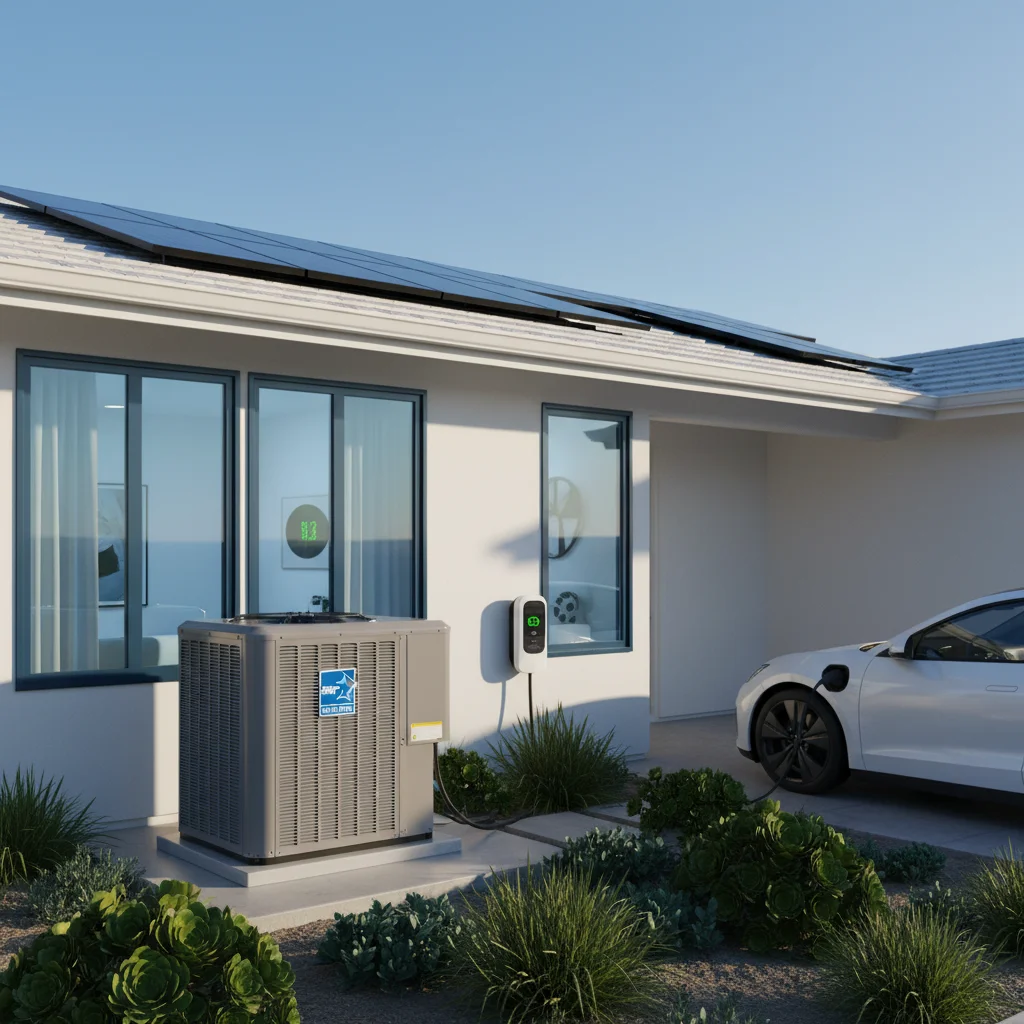
California homeowners spent an average of $18,243 on HVAC replacements in 2025—a 14% increase from 2023—driven by stricter efficiency mandates and supply chain recovery following pandemic-era shortages. And that figure doesn't account for the 2026 Title 24 updates requiring higher SEER2 ratings for all new installations, which add another $1,200-$2,400 to baseline costs depending on system size and regional climate zones.
How Much Does HVAC Installation Cost in California in 2026?
HVAC installation costs in California range from $6,800 to $28,000 in 2026, with median costs at $14,500 for a 3-ton central air system and $19,200 for a heat pump replacement. Coastal regions pay 12-18% more than inland areas due to labor rates and permitting costs. Title 24 compliance adds $1,200-$2,400 for systems meeting SEER2 16 minimums.
So what drives California's 22% premium over the national average? The answer lies in a perfect storm of regulatory requirements, regional labor shortages, and climate zone variability that creates a fragmented pricing landscape across the state's 16 distinct climate zones.
Cost Breakdown by System Type
Central air conditioning systems with gas furnaces cost $6,800-$14,000 for 2-3 ton units in moderate climates like San Francisco, while 4-5 ton systems for Sacramento's hotter summers reach $11,000-$18,500. Heat pump installations start at $9,200 for basic single-stage units and climb to $22,000 for inverter-driven models with HSPF2 ratings above 10. Ductless mini-splits range from $3,400 for single-zone bedroom units to $14,800 for whole-home systems with 4-5 heads.
"California's Title 24 energy standards require all new HVAC installations to meet minimum SEER2 16 for air conditioning and HSPF2 8.8 for heat pumps, effective January 1, 2026." — California Energy Commission
And packaged systems—combining heating and cooling in a single outdoor unit—cost $8,900-$16,200 installed, popular in homes with limited indoor space for furnace installations. Geothermal heat pumps represent the premium tier at $24,000-$45,000 for residential installations, but qualify for the largest rebate stack available in California.
Regional Price Variations
Bay Area installations average $16,800 due to $95-$135/hour labor rates and stringent local permitting that adds $800-$1,400 in fees. Los Angeles County costs run 8% lower at $15,500 median, while Inland Empire and Central Valley installations drop to $12,200-$13,800 thanks to lower labor costs of $75-$95/hour. But Riverside and San Bernardino counties require larger tonnage systems to handle triple-digit summers, offsetting some labor savings.
Coastal premium pricing extends beyond labor—salt air corrosion requires upgraded coil coatings and fasteners that add $600-$900 per system. Mountain communities like Lake Tahoe face $2,200-$3,800 surcharges for equipment rated to operate at -15°F and snow-load reinforced installations.
What Factors Affect HVAC Installation Prices Across Different California Regions?
Five primary factors determine HVAC installation costs in California: equipment efficiency ratings mandated by Title 24, ductwork condition requiring $2,400-$8,200 in repairs, permitting complexity ranging from $180 to $1,400, regional labor rates varying $75-$135/hour, and climate zone requirements dictating system sizing. Coastal and mountain regions add 15-28% premiums for specialized equipment and installation challenges.
Equipment efficiency drives baseline costs. SEER2 16 systems cost $1,200-$1,800 more than discontinued SEER 14 models, while SEER2 20+ inverter units command $3,400-$5,200 premiums. And California's Title 24 prohibits installation of systems below minimum thresholds, eliminating budget options available in other states.
Ductwork and Infrastructure Costs
Ductwork condition determines whether installations stay on budget or explode into $15,000+ projects. Homes built before 1990 typically need $2,400-$5,800 in duct sealing, insulation upgrades, and asbestos abatement. Complete duct replacement runs $4,200-$8,200 for 1,500-2,000 square foot homes. But building officials require duct testing to verify less than 6% total leakage, adding $280-$420 in mandatory testing fees.
Electrical panel upgrades hit 38% of installations when existing 100-amp service can't support modern high-efficiency equipment. Panel upgrades cost $1,800-$3,400, while full service upgrades to 200 amps reach $4,200-$6,800. So older homes in established neighborhoods face compounding infrastructure costs that double total project expenses.
Permitting and Compliance Costs
California cities charge $180-$1,400 for HVAC permits based on project value, with Los Angeles at $420 base, San Francisco at $680, and smaller cities at $180-$280. Title 24 compliance documentation adds $320-$580 in energy consultant fees for systems requiring HERS testing verification. And some jurisdictions mandate home performance testing revealing additional weatherization requirements costing $1,200-$4,800 before HVAC permits finalize.
"The 2025 HERS Registry processed 47,800 HVAC installations requiring Title 24 compliance verification, with average documentation costs of $485 per project." — California HERS Registry
So permitting timelines stretch 3-8 weeks in major metro areas, compounding costs when emergency replacements force homeowners into temporary solutions or premium rush fees of $800-$1,500 for expedited processing.
How Long Does It Take to Recoup Your HVAC Installation Investment Through Energy Savings?
California homeowners recoup HVAC installation costs in 7-14 years through energy savings, with heat pump installations achieving 6-9 year payback periods when replacing electric resistance or propane heating. Systems qualifying for utility rebates and federal tax credits reduce payback to 4-7 years. Coastal climate zones show slower returns of 11-14 years, while inland regions with extreme temperatures see 6-8 year payback from higher usage rates.
Payback calculations depend on replaced equipment age and efficiency. Upgrading from a 25-year-old SEER 10 system to SEER2 18 saves $840-$1,260 annually in cooling costs for Sacramento homes running 1,800+ cooling hours per year. But temperate coastal homes with 400 cooling hours annually save only $180-$290, extending payback beyond system lifespan.
Energy Cost Savings by Region
Inland Empire homeowners replacing gas furnaces with heat pumps save $720-$1,140 annually on heating costs when natural gas prices exceed $2.40/therm. Bay Area installations show smaller heating savings of $380-$580 due to milder winters, but cooling savings reach $460-$720 in areas like Walnut Creek and Concord with summer heat waves. So climate zone 12-16 installations (desert and inland valleys) deliver the fastest returns.
Utility rate structures amplify savings for time-of-use customers. PG&E's peak summer rates of $0.58/kWh make high-efficiency cooling extremely valuable, with annual savings reaching $1,400-$2,200 for large homes running AC during 4-9pm peak periods. But baseline tier customers in moderate climates save only $240-$380 annually, making economics less compelling.
Check your potential savings with our rebate calculator to see specific payback periods based on your climate zone and current equipment.
Maintenance Cost Reductions
New HVAC systems reduce maintenance costs by $280-$620 annually compared to aging equipment requiring frequent repairs. Heat pumps eliminate separate furnace maintenance, saving $140-$220 per year in service contracts. And modern systems with diagnostic capabilities alert homeowners to minor issues before failures occur, preventing $1,200-$3,800 emergency repairs common with older systems.
But extended warranties costing $480-$920 increase upfront expenses while providing protection against compressor failures that cost $2,400-$4,200 to repair out of warranty. So warranty economics favor homeowners planning 12+ year ownership over those expecting to move within 5-7 years.
Are You Eligible for California Rebates and Tax Credits to Reduce HVAC Installation Costs?
California homeowners qualify for combined incentives totaling $4,200-$14,000 through utility rebates, federal tax credits, and state programs in 2026. Tech Clean California offers $3,000-$8,000 for heat pump installations for income-qualified households, while utility rebates provide $800-$3,500 for high-efficiency systems. Federal IRA credits cover 30% of installation costs up to annual limits, stackable with state incentives.
The federal Energy Efficient Home Improvement Credit (Section 25C) ended for property placed in service after December 31, 2025 (IRS FS-2025-05). Federal tax credits for this work have ended, but state, local and utility rebates may still apply; check what is available at your address with the DuloCore rebate calculator. But geothermal systems qualify for uncapped 30% credits, making $30,000 installations effectively $21,000 after credits.
Tech Clean California Incentives
Tech Clean California replaced the TECH Initiative in 2024, expanding heat pump rebates to all residential customers with enhanced amounts for income-qualified households. Standard rebates range $800-$2,200 for ducted heat pumps, while moderate-income households (earning 80-120% of area median income) receive $3,000-$5,000. Low-income households under 80% AMI qualify for $5,000-$8,000 rebates covering 60-85% of total installation costs.
Applications require HERS verification confirming minimum HSPF2 ratings and proper installation. Processing takes 6-10 weeks after project completion, with rebates paid directly to homeowners or assigned to contractors as point-of-sale discounts. So working with participating contractors eliminates upfront cost barriers for income-qualified households.
For detailed eligibility and application steps, see our guide on heat pump rebates available in California.
Utility Company Rebates
Major California utilities offer tiered rebates for HVAC efficiency upgrades. PG&E provides $800-$2,000 for SEER2 17+ systems and $1,200-$3,500 for heat pumps with HSPF2 9.5+. SCE offers $1,000-$2,500 for qualifying heat pumps, while SoCal Gas provides $1,200-$2,000 for high-efficiency furnaces paired with smart thermostats. And municipal utilities like SMUD and LADWP offer enhanced rebates of $2,200-$4,000 for electrification projects replacing gas equipment.
"SMUD's 2026 heat pump rebates cover up to $4,000 per system for residential customers switching from gas heating, part of a broader electrification initiative targeting 50,000 conversions by 2030." — SMUD
But rebates require pre-approval or specific contractor participation in some programs. LADWP's incentives mandate enrollment before installation begins, while PG&E accepts post-installation applications within 90 days of completion. So confirming program requirements prevents lost incentives from procedural mistakes.
Learn more about available programs in our energy tax credits overview.
How Does California HVAC Installation Cost Compare to National Averages?
California HVAC installations cost 22-34% more than the $12,200 national average in 2026, with state median costs at $14,500 for standard systems and $19,200 for heat pumps. Regulatory compliance adds $1,200-$2,400 through Title 24 requirements, while coastal region labor rates 30-45% above national averages drive further premiums. But rebate availability offsets 18-35% of costs, bringing net expenses closer to national parity.
National median costs for 3-ton central air installations sit at $6,800-$11,200, while California's equivalent systems cost $8,400-$14,000. Heat pump price gaps widen further, with national averages at $12,400 versus California's $16,800-$22,000 for comparable equipment. And ductless mini-split premiums reach 28% over national averages due to higher labor costs for multi-zone installations.
Why California Costs More
Three structural factors drive California's premium pricing. Title 24 compliance eliminates budget equipment options, forcing minimum SEER2 16 standards when other states allow SEER2 14 systems costing $1,200-$1,800 less. Permitting requirements add $320-$1,400 in fees and documentation costs rarely seen in states with simpler building codes. And skilled HVAC technician shortages in high-demand markets push labor rates to $95-$135/hour versus $65-$85/hour nationally.
But California's rebate infrastructure partially compensates. The national average rebate for heat pumps sits at $400-$800, while California programs deliver $3,000-$8,000 for income-qualified households. So net-of-incentive costs for low-income California homeowners often undercut national averages despite higher gross prices.
Regional Exceptions
Central Valley cities like Fresno and Bakersfield show pricing closer to national averages, with median installations at $11,800-$13,200. Lower labor costs and simpler permitting create competitive markets where national HVAC chains compete aggressively. But these regions lack the robust utility rebate programs available in IOU territories, reducing net savings opportunities.
Mountain and rural areas face opposite dynamics—lower labor rates offset by higher equipment transport costs, limited contractor competition, and challenging installations. Lake County and Shasta region installations average $16,200-$18,800, on par with Bay Area costs despite $30-40/hour lower labor rates.
What's the Complete Process and Timeline for Installing HVAC in California?
California HVAC installations require 4-12 weeks from initial consultation to final inspection, spanning equipment selection (1-2 weeks), permitting (2-6 weeks), physical installation (1-3 days), and Title 24 compliance verification (1-2 weeks). Emergency replacements compress timelines to 3-10 days through expedited permits costing $800-$1,500, but sacrifice rebate eligibility and competitive bidding. Standard installations following full rebate application processes extend to 10-16 weeks.
Process begins with load calculations determining proper system sizing based on home square footage, insulation levels, window area, and climate zone. Manual J calculations take 2-4 hours on-site, revealing whether existing ductwork supports new equipment or requires $2,400-$8,200 in upgrades. So accurate sizing prevents the 28% of California installations that use oversized equipment wasting energy through short-cycling.
Pre-Installation Steps
Contractors provide written quotes itemizing equipment models, labor costs, permit fees, and compliance testing. California law requires contractors to carry active C-20 HVAC licenses and $15,000 contractor bonds. And homeowners benefit from collecting 3-5 quotes revealing typical 18-25% price variations for identical equipment and scope.
Rebate applications typically require pre-approval or contractor enrollment verification. Tech Clean California applications take 2-3 weeks for approval, while utility rebates process in 1-2 weeks. But some programs allow post-installation applications, reducing upfront delays. So coordinating rebate timing with contractor schedules prevents installation delays and lost incentives.
Installation Timeline
Physical installation takes 1-3 days for standard replacements, with single-day completions common for direct equipment swaps without ductwork modifications. Multi-zone ductless systems require 2-4 days for line set running and head mounting. And geothermal installations span 3-7 days including ground loop drilling or trenching.
Building inspections occur 1-3 days after installation in most jurisdictions, with inspectors verifying proper refrigerant charges, ductwork sealing, electrical connections, and combustion venting for gas furnaces. Title 24 compliance testing happens concurrently, measuring system airflow and duct leakage to confirm regulatory thresholds. So final approval requires passing both building and energy code inspections before systems legally operate.
Post-Installation Verification
HERS raters conduct final verification testing for rebate-eligible installations, documenting installed equipment efficiency ratings and performance metrics. Testing costs $280-$420 but satisfies both Title 24 requirements and rebate program verification. Reports process through California's HERS Registry within 5-10 business days, triggering rebate payment processing.
But homeowners should document baseline energy usage before installation to measure actual savings against projections. Smart thermostats track runtime hours and energy consumption, revealing whether installations deliver promised efficiency gains. And first-year savings below projections indicate potential installation issues like inadequate refrigerant charge or duct leakage requiring contractor correction under warranty.
Official Sources
- California Energy Commission Title 24 — Building energy efficiency standards and compliance requirements
- ENERGY STAR HVAC Guide — Federal efficiency standards and certified equipment database
- DSIRE California — Comprehensive database of state and utility rebate programs
Related Reading: Learn more about Hvac Installation Cost Orange County.
Frequently Asked Questions
How much does HVAC installation cost in California?
HVAC installation costs range from $6,800 to $28,000 in California in 2026, with median costs at $14,500 for central air conditioning and $19,200 for heat pump systems. Coastal regions pay 12-18% more than inland areas, while Title 24 compliance adds $1,200-$2,400 to all installations. Ductwork repairs or replacements increase total costs by $2,400-$8,200 depending on home age and existing duct condition.
What rebates are available for HVAC installation in California?
California homeowners qualify for $4,200-$14,000 in combined rebates and tax credits through Tech Clean California ($3,000-$8,000 for income-qualified households), utility rebates ($800-$3,500), and federal IRA tax credits (30% of costs up to $2,000 annually for heat pumps). Incentive stacking reduces net installation costs by 25-55% depending on household income and equipment choices. Applications require HERS verification and often pre-approval before installation begins.
How long does HVAC installation take in California?
Standard HVAC installations take 4-12 weeks in California including equipment selection (1-2 weeks), permitting (2-6 weeks), physical installation (1-3 days), and compliance verification (1-2 weeks). Emergency replacements compress timelines to 3-10 days through expedited permits costing $800-$1,500 additional. Multi-zone ductless systems require 2-4 days installation, while geothermal systems take 3-7 days including ground loop installation.
Are there tax credits for HVAC installation in California?
The federal Energy Efficient Home Improvement Credit (Section 25C) ended for property placed in service after December 31, 2025 (IRS FS-2025-05). Geothermal systems qualify for uncapped 30% credits, potentially saving $7,000-$13,000 on installations costing $24,000-$45,000. Credits apply to equipment and installation labor, stackable with state and utility rebates. Form 5695 only covers qualifying work completed by December 31, 2025 and claimed on a 2025 return; the federal 25C and 25D credits ended after that date (IRS FS-2025-05).
Can I get a rebate if I already installed HVAC?
Most California utility rebates accept post-installation applications within 90 days of project completion, while Tech Clean California requires pre-approval before installation begins. But maximizing rebate stacking requires coordinating program requirements before installation, as some utilities mandate contractor participation or specific application timing that can't be satisfied retroactively.
Ready to calculate your potential HVAC rebates and tax credits? Use our free rebate calculator to get personalized estimates based on your location, income, and system type. Get instant results showing total incentives available and estimated payback periods for your installation.
Last reviewed: April 14, 2026. Reviewed by DuloCore Energy Specialists. About the team.
Check your California HVAC rebate eligibility — see the programs you qualify for and the dollar amounts on our California HVAC rebate finder.