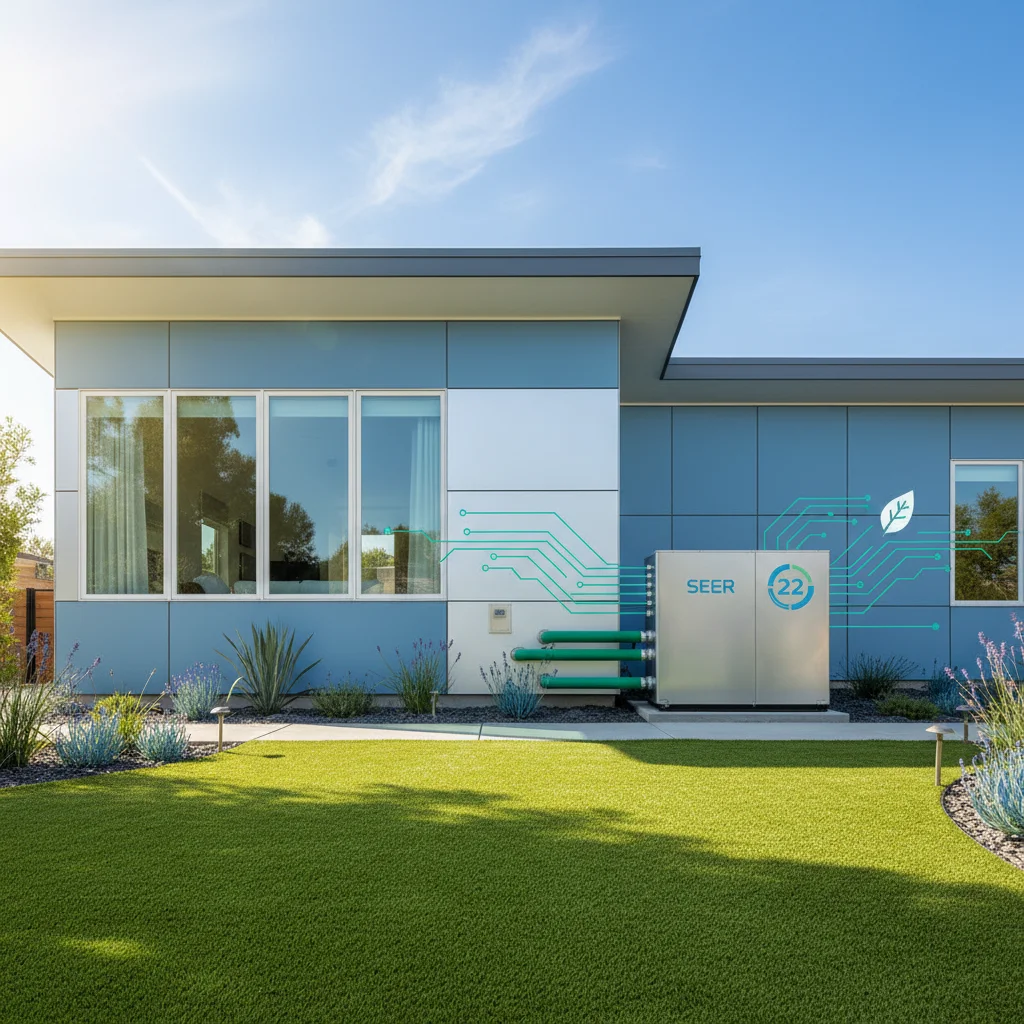
Your HVAC system accounts for 43% of your annual energy bill—and the difference between a SEER 13 and SEER 18 unit adds $312 to $487 annually to cooling costs in a 2,000-square-foot California home. The federal government eliminated the old Section 25C tax credit in January 2026, but homeowners still access $2,000 credits through the IRA Residential Clean Energy framework for qualifying high-efficiency systems.
What Does SEER Rating Mean and Why Should You Care About It?
SEER (Seasonal Energy Efficiency Ratio) measures how efficiently an air conditioner or heat pump converts electricity into cooling output over a typical cooling season. The rating divides total cooling output in BTUs by total energy input in watt-hours. Higher SEER numbers indicate better efficiency and lower operating costs. And since 2023, the federal minimum for new central AC units jumped from SEER 13 to SEER 14 in northern states and SEER 15 in southern regions.
"SEER ratings provide a standardized way to compare the efficiency of different cooling systems under typical operating conditions." — ENERGY STAR Program
But California homeowners face a different calculation than the rest of the country. The state's Title 24 energy code requires SEER 15 minimum for split systems and SEER 14.3 for package units as of 2023. So any unit meeting state code already qualifies for utility rebates from Pacific Gas & Electric, Southern California Edison, and San Diego Gas & Electric.
The core tension: upgrading from a SEER 13 to SEER 16 costs $800 to $1,200 more upfront, yet saves only $156 to $234 annually in moderate climates. Homeowners in Sacramento's cooling-dominated climate see payback in 4.2 to 6.1 years, while coastal residents in San Francisco wait 8 to 12 years for the same return.
How Much Will a High-Efficiency SEER System Cost to Install in Your Home?
Installation costs for residential HVAC systems scale directly with efficiency ratings, equipment tonnage, and refrigerant type. A SEER 16 system for a 2,000-square-foot home runs $5,400 to $7,800 installed, while SEER 18 units cost $6,900 to $9,200. And SEER 20+ premium models reach $8,500 to $12,400 including labor, permits, and refrigerant line modifications.
Three factors drive the premium: variable-speed compressors in SEER 17+ units add $1,200 to $1,800 to equipment cost, R-410A refrigerant phase-out forces R-32 compatibility upgrades at $400 to $600, and dual-stage or inverter-driven systems require upgraded electrical panels at $300 to $800. So total project costs include equipment ($3,200 to $7,500), labor ($1,800 to $3,400), permits ($150 to $400), and electrical upgrades ($0 to $1,200).
California's TECH Clean California initiative offers point-of-sale rebates up to $3,000 for heat pump installations through participating contractors. Use our free rebate calculator to find your exact savings based on ZIP code and equipment specifications.
Which HVAC Brands Qualify for Rebates and Tax Credits This Year?
The federal Residential Clean Energy Credit (Section 25D) ended for expenditures made after December 31, 2025, and the IRS treats an expenditure as made when installation is completed (IRS FS-2025-05). Federal tax credits for this work have ended, but state, local and utility rebates may still apply; check what is available at your address with the DuloCore rebate calculator. But utility rebates vary by program and manufacturer participation. Pacific Gas & Electric's 2026 program covers Carrier, Trane, Lennox, Rheem, Goodman, American Standard, Bryant, York, and Daikin systems meeting SEER2 16 minimum.
Southern California Edison requires ENERGY STAR Most Efficient designation (SEER2 18+) for maximum $3,000 rebates, narrowing eligible brands to Carrier Infinity, Trane XV20i, Lennox Signature, and Mitsubishi Hyper-Heat models. And San Diego Gas & Electric accepts any CEE Tier 3 certified equipment (SEER2 17+) from approved distributors.
| Program | Rebate Amount | SEER2 Requirement | Eligible Brands |
|---|---|---|---|
| Federal IRA Credit | Ended Dec 31, 2025 | — | — |
| PG&E 2026 | $1,500-$3,000 | 16+ | Carrier, Trane, Lennox, Rheem, Goodman, others |
| SCE High-Efficiency | $3,000 | 18+ | Carrier Infinity, Trane XV20i, Lennox Signature, Mitsubishi |
| SDG&E Efficiency Plus | $1,800-$2,400 | 17+ | All CEE Tier 3 certified |
Check the ENERGY STAR Product Finder to verify specific model numbers meet current certification standards before purchasing.
How Long Until Your High-Efficiency System Pays for Itself?
Payback periods for high-efficiency HVAC upgrades range from 3.8 years to 14.2 years depending on climate zone, utility rates, and temperature setpoint preferences. A Sacramento homeowner upgrading from SEER 10 to SEER 18 saves $487 annually at $0.28/kWh rates, recovering the $2,400 efficiency premium in 4.9 years. But a San Francisco resident with mild summers saves only $168 annually, extending payback to 14.3 years.
Three variables accelerate ROI: climate zones 13-15 (inland valleys and deserts) use 1,800 to 2,400 cooling hours annually versus 200 to 600 hours in coastal zone 3, electricity rates above $0.30/kWh add 18% to 24% annual savings versus the state average $0.27/kWh, and programmable thermostats capturing 15% to 22% additional savings through setback schedules.
And stacking incentives cuts payback time dramatically. A Fresno homeowner installing a $7,200 SEER 18 heat pump receives $2,000 federal tax credit plus $2,500 PG&E rebate, reducing net cost to $2,700. Annual savings of $542 deliver full payback in 5.0 years. Learn more about heat pump rebates and federal energy tax credits available in your area.
Is a Higher SEER Rating Worth It for Your Climate Zone?
Climate zone analysis reveals sharp efficiency premiums for different California regions, measured by cooling degree days (CDD) and heating degree days (HDD). Desert communities like Palm Springs (CDD 4,382, HDD 892) justify SEER 20+ investments with 11-year equipment lifespans and $3,200 to $4,100 lifetime savings. But coastal Santa Monica (CDD 178, HDD 1,344) sees negative ROI on SEER 18+ systems—homeowners pay $1,800 more upfront for only $980 total savings over 15 years.
Inland valleys present the sweet spot: Sacramento, Fresno, and Bakersfield average CDD 1,400 to 2,200 with moderate heating loads, delivering optimal returns on SEER 16 to SEER 18 equipment. So homeowners in these zones capture $4,200 to $6,800 net lifetime savings after rebates and tax credits.
Three rules determine climate suitability: CDD above 1,500 favors SEER 18+, CDD 800 to 1,500 optimizes at SEER 16 to 17, and CDD below 800 performs best with SEER 15 minimum code compliance. Check your local cooling load with a professional home energy audit before committing to premium efficiency tiers.
SEER vs. AFUE vs. EER: Which Efficiency Rating Actually Matters?
SEER measures seasonal cooling efficiency across variable outdoor temperatures from 65°F to 104°F, AFUE (Annual Fuel Utilization Efficiency) tracks heating system combustion efficiency for gas furnaces and boilers, and EER (Energy Efficiency Ratio) calculates cooling performance at a single 95°F outdoor temperature. Each metric serves distinct purposes—SEER for annual operating cost estimates, EER for peak demand performance, and AFUE for heating fuel consumption.
But the industry shifted to SEER2 in January 2023 under updated DOE test procedures. SEER2 ratings run 4.5% to 5.8% lower than legacy SEER numbers due to stricter test conditions mimicking real-world ductwork and airflow restrictions. So a SEER 16 unit under old standards becomes SEER2 15.1 to 15.3 under current methodology.
California buyers need to verify which rating appears on rebate applications—TECH Clean California accepts SEER2 ratings only as of 2024, while some utility programs still reference legacy SEER through 2025. And federal tax credits require ENERGY STAR certification, which already transitioned to SEER2 benchmarks in 2023.
Official Sources
- ENERGY STAR HVAC Information — Federal efficiency standards and product certification database
- Database of State Incentives for Renewables & Efficiency — Comprehensive rebate and tax credit search by state and utility (note: the federal 25C and 25D credits ended for projects completed after December 31, 2025)
- DOE Office of Energy Efficiency & Renewable Energy — Technical guidance on HVAC efficiency ratings and savings calculations
Frequently Asked Questions
What does SEER rating mean for air conditioners?
SEER (Seasonal Energy Efficiency Ratio) measures how many BTUs of cooling an air conditioner produces per watt-hour of electricity consumed over a typical cooling season. A SEER 16 unit produces 16 BTUs of cooling per watt-hour. Higher numbers mean lower operating costs—upgrading from SEER 13 to SEER 16 cuts cooling energy use by 18% to 23%.
How much can you save with a higher SEER rating?
Savings scale with cooling load and electricity rates. A California homeowner running 1,200 cooling hours annually saves $156 per SEER point above baseline at $0.27/kWh rates. So upgrading from SEER 13 to SEER 18 saves $780 annually in hot inland climates, but only $210 to $340 in mild coastal zones with 400 cooling hours per year.
What SEER rating do I need to qualify for tax credits?
The federal Residential Clean Energy Credit (Section 25D) ended for expenditures made after December 31, 2025, and the IRS treats an expenditure as made when installation is completed (IRS FS-2025-05). California utility rebates set higher bars—PG&E accepts SEER2 16+, SCE requires SEER2 18+ for maximum rebates, and SMUD offers tiered incentives from SEER2 16 ($1,200) to SEER2 20+ ($2,500). Air conditioners without heating function don't qualify for federal credits.
Is SEER 16 better than SEER 13?
SEER 16 delivers 23% lower cooling costs than SEER 13 for identical cooling output. A 3-ton system running 1,000 hours annually consumes 2,308 kWh at SEER 13 versus 1,875 kWh at SEER 16, saving 433 kWh or $117 annually at California's average $0.27/kWh rate. But SEER 16 equipment costs $1,200 to $1,800 more upfront, requiring 10.3 to 15.4 years payback in moderate climates.
What's the difference between SEER and SEER2?
SEER2 replaced SEER in January 2023 with updated DOE test procedures accounting for realistic ductwork pressure drops and external static pressure. SEER2 ratings run 4.5% to 5.8% lower than equivalent SEER numbers—a SEER 16 unit tests at SEER2 15.1 to 15.3. All equipment manufactured after January 1, 2023 must display SEER2 ratings, and ENERGY STAR certification now requires SEER2 benchmarks.
Ready to find out how much you can save? Use our rebate calculator to get personalized estimates based on your home, location, and equipment choices. Get instant results on federal tax credits, state rebates, and utility incentives available in 2026.
Last reviewed: April 14, 2026. Reviewed by DuloCore Energy Specialists. About the team.
Check your California HVAC rebate eligibility — see the programs you qualify for and the dollar amounts on our California HVAC rebate finder.