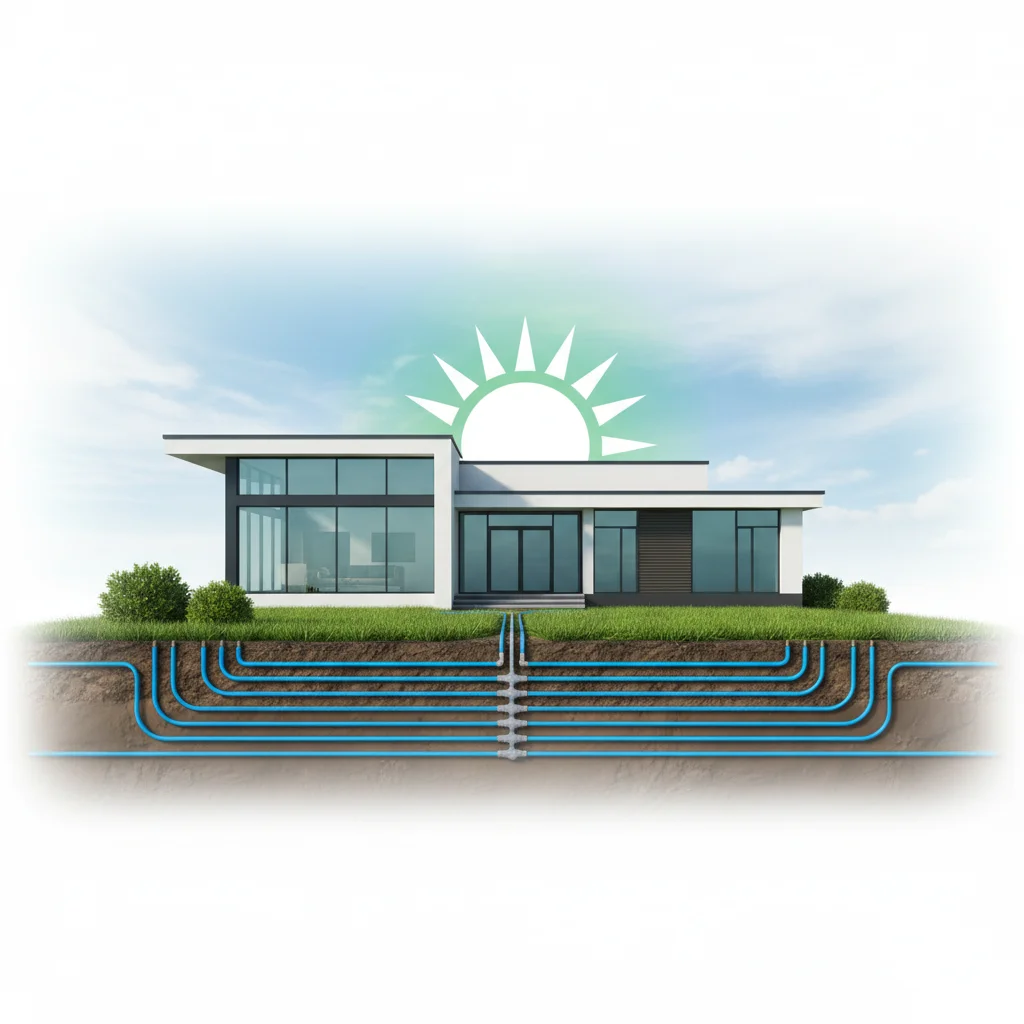
A homeowner in Sacramento who installed a horizontal loop geothermal system in 2025 saw their annual heating and cooling costs drop from $2,400 to $720—a 70% reduction that paid back the $18,000 installation in just 8 years. And with 2026 federal tax credits covering 30% of equipment and labor costs, that same system now costs $12,600 out of pocket, cutting the payback period to 5.4 years.
What is the ROI and payback period for a horizontal loop geothermal system?
Horizontal loop geothermal systems deliver an average return on investment of 10-15% annually through energy savings. Installation costs range from $15,000 to $25,000 for a 2,000-square-foot home, with annual operating costs of $600 to $900—compared to $1,800 to $3,000 for traditional HVAC systems. The typical payback period spans 5 to 10 years, depending on climate zone and local utility rates.
So what makes this payback timeframe compelling? Homeowners who finance through an energy-efficient mortgage pay $125 monthly for the system while saving $150 monthly on utilities—creating immediate positive cash flow of $25 per month from day one.
The federal Residential Clean Energy Credit (Section 25D) ended for expenditures made after December 31, 2025, and the IRS treats an expenditure as made when installation is completed (IRS FS-2025-05). Federal tax credits for this work have ended, but state, local and utility rebates may still apply; check what is available at your address with the DuloCore rebate calculator. For a $20,000 system, that's a $6,000 credit, reducing the net cost to $14,000. California's TECH Clean California initiative adds rebates of $3,000 to $8,000 for qualifying installations, further shortening the payback period to 3 to 6 years in eligible counties.
But payback calculations vary by soil type and property size. Clay and loam soils transfer heat more efficiently than sandy or rocky ground, reducing the length of pipe needed and cutting installation costs by 15-20%. Properties with sufficient horizontal space (at least 2,000 square feet of yard area) avoid the premium costs of vertical loop systems, which run $25,000 to $35,000 for comparable capacity.
Utility rate structures affect ROI timing. Homeowners in PG&E territory with tiered electric rates see faster payback than those with flat-rate billing. And time-of-use plans that charge premium rates during peak hours amplify savings, since geothermal systems shift most energy consumption to off-peak periods through thermal storage in the ground loop.
"Geothermal heat pumps are the most energy-efficient, environmentally clean, and cost-effective systems for heating and cooling buildings." — U.S. Department of Energy
Use our free rebate calculator to estimate your exact payback period based on your zip code, home size, and current energy bills.
How long do horizontal loop geothermal systems last compared to other heating solutions?
Horizontal loop geothermal systems operate for 20 to 25 years for the indoor heat pump unit and 50+ years for the buried ground loop piping. That's 2 to 3 times longer than conventional furnaces (15-20 years) and central air conditioners (12-15 years). The polyethylene pipe in the ground loop carries a 50-year warranty from most manufacturers and often outlasts the buildings they serve.
The extended lifespan creates cumulative savings beyond the initial payback period. A homeowner who installs a system at age 45 saves $1,800 annually on energy costs for 25 years—totaling $45,000 in lifetime savings, even before accounting for avoided replacement costs of conventional systems.
But component lifespan varies within the system. The compressor and heat exchanger inside the heat pump require replacement every 15 to 20 years, costing $3,000 to $5,000. The circulating pump that moves fluid through the ground loop lasts 10 to 15 years and costs $800 to $1,200 to replace. Total maintenance costs over 25 years average $6,000 to $8,000—still 60% less than maintaining a furnace and air conditioner over the same period.
Environmental conditions affect longevity. Systems in coastal regions with salt air exposure require corrosion-resistant materials for above-ground components, while systems in areas with high water tables benefit from sealed loop designs that prevent groundwater infiltration. And properties with mature tree root systems need root barriers installed during excavation to prevent pipe damage over decades of operation.
Compare that to air-source heat pumps, which last 15 to 18 years but lose 30% of their heating capacity after 10 years in cold climates. Geothermal systems maintain 95% of their rated capacity for their entire operational life because underground temperatures remain constant year-round, eliminating the freeze-thaw stress that degrades outdoor equipment.
What are the installation costs and available tax incentives for horizontal loop systems?
Installation costs for horizontal loop geothermal systems range from $15,000 to $25,000 for a typical 2,000-square-foot home in California. That breaks down to $10,000 to $15,000 for equipment (heat pump, controls, and loop piping) and $5,000 to $10,000 for excavation and installation labor. Properties requiring extensive landscaping restoration or rock excavation face costs toward the upper end.
The federal Residential Clean Energy Credit (Section 25D) ended for expenditures made after December 31, 2025, and the IRS treats an expenditure as made when installation is completed (IRS FS-2025-05). Check current state, local and utility incentives for your address with the DuloCore rebate calculator.
| Program | Amount | Eligibility | Deadline |
|---|---|---|---|
| Federal IRA Tax Credit | Ended Dec 31, 2025 | — | Ended Dec 31, 2025 |
| TECH Clean California | $3,000-$8,000 | Low-to-moderate income households in participating counties | Funding dependent |
| SMUD Residential Heat Pump Rebate | $3,500 | SMUD electric customers | Ongoing while funds last |
California's TECH Clean California program provides point-of-sale rebates ranging from $3,000 for moderate-income households to $8,000 for low-income households. These rebates apply at the time of purchase, reducing upfront costs without waiting for tax season. And Sacramento Municipal Utility District (SMUD) customers receive an additional $3,500 rebate for qualifying geothermal installations, stackable with federal and state incentives.
But timing matters for maximizing incentives. The federal tax credit applies to systems placed in service during the tax year, so installations completed in December 2026 qualify for the 2026 tax year. State rebate programs often exhaust funding mid-year, making early application critical. Check the California energy tax credits page for current program availability.
Local utility districts offer additional rebates. PG&E's Energy Efficiency Rebate Program provides up to $2,000 for ENERGY STAR-certified geothermal systems. Southern California Edison offers custom rebates for installations that exceed minimum efficiency standards by 15% or more. These vary by territory and change annually.
How do horizontal loop systems compare to vertical loop and air-source heat pumps in performance and lifespan?
Horizontal loop geothermal systems achieve heating efficiencies of 300-400% (COP of 3.0-4.0), meaning they produce 3 to 4 units of heat for every unit of electricity consumed. That's 50% more efficient than air-source heat pumps in winter (COP of 2.0-2.5) and 200% more efficient than resistance electric heating (COP of 1.0). Cooling efficiency ranges from 15 to 25 EER (Energy Efficiency Ratio), compared to 12 to 18 EER for conventional central air conditioning.
Performance remains constant regardless of outdoor temperature because ground temperature at 6-foot depth stays between 50°F and 60°F year-round in California. Air-source heat pumps lose 30-50% of their heating capacity when outdoor temperatures drop below 32°F, requiring backup resistance heating that triples operating costs. And horizontal loops avoid the defrost cycles that reduce air-source efficiency by 10-15% in humid climates.
But installation constraints favor different technologies for different properties. Horizontal loops require 1,500 to 2,500 square feet of yard space for trenching, making them impractical for urban lots smaller than 5,000 square feet. Vertical loops drill 150 to 400 feet deep and need just 200 square feet of drilling access, fitting constrained sites at a 40-50% cost premium. Air-source systems require zero excavation and install in 1 to 2 days compared to 3 to 5 days for horizontal geothermal.
Lifespan differences compound over decades. A horizontal loop system operating 25 years with a $1,800 annual savings generates $45,000 in lifetime value. An air-source heat pump lasting 15 years with a $1,200 annual savings produces $18,000 in value, requiring one replacement during the horizontal system's operational life. The second air-source unit costs $12,000 to $18,000, reducing net savings to $6,000 over 25 years.
Noise levels differ substantially. Horizontal geothermal systems produce 40-50 decibels of sound from indoor equipment—quieter than a refrigerator. Air-source outdoor units generate 60-70 decibels, comparable to normal conversation, and create neighborhood complaints when installed near property lines. And geothermal systems eliminate the outdoor condenser entirely, preserving aesthetic appeal and reducing maintenance exposure to weather.
Compare performance across California climate zones. Homes in Redding (hot summers, cold winters) see 35% greater savings with geothermal over air-source systems. Coastal properties in San Diego (mild year-round) see just 15% savings advantage, making air-source heat pumps more cost-effective given the $10,000 lower installation cost. Check our heat pump rebates page for climate-specific recommendations.
What maintenance requirements affect the long-term cost and lifespan of horizontal loop geothermal systems?
Horizontal loop geothermal systems require annual maintenance costs of $150 to $300, covering filter replacement, refrigerant pressure checks, and circulating pump inspection. That's 40% less than the $250 to $500 annual maintenance for furnaces and air conditioners, which need burner cleaning, flame sensor replacement, and refrigerant leak repairs. The buried ground loop requires zero maintenance after installation.
But filter maintenance directly impacts efficiency and longevity. Clogged filters reduce airflow by 30%, forcing the compressor to work harder and cutting system lifespan by 5 to 7 years. Homeowners replace pleated filters every 3 months at $15 per filter—$60 annually. High-efficiency MERV 13 filters cost $25 each but improve indoor air quality and protect heat exchanger coils from dust buildup that degrades heat transfer.
The circulating pump that moves antifreeze solution through the ground loop operates continuously, consuming 80 to 120 watts. Pump bearings wear after 40,000 to 50,000 hours of operation—roughly 10 to 15 years. Replacement costs $800 to $1,200 including labor. And variable-speed pumps that adjust flow based on heating demand last 20-25% longer than single-speed models while reducing electricity consumption by 30%.
So what monitoring prevents expensive failures? Annual professional inspections verify refrigerant charge (should be within 5% of factory spec), check electrical connections for corrosion, and measure temperature differential across the heat exchanger (should be 15-25°F in heating mode). These inspections cost $150 to $200 and catch problems before they cascade into $2,000+ compressor replacements.
Antifreeze concentration in the ground loop requires testing every 5 years. Concentrations below 20% allow freezing in cold soil, while concentrations above 30% reduce heat transfer efficiency. Testing costs $75, and antifreeze replacement runs $200 to $400 for a typical residential system. Propylene glycol antifreeze lasts 10 to 15 years before degrading, while methanol-based solutions need replacement every 5 to 7 years.
Hard water regions require additional maintenance. Mineral deposits accumulate in heat exchangers, reducing efficiency by 10-15% over 5 years. Annual descaling treatments cost $100 to $150 and restore performance. And homes with water-source heat pumps (using well water instead of closed loops) need annual well pump inspections costing $200 to $300 to prevent sediment damage.
"Routine maintenance of geothermal systems costs less than half that of conventional heating and cooling systems and can extend equipment life by 30-50%." — International Ground Source Heat Pump Association
Are you eligible for federal or state rebates on horizontal loop geothermal installation?
Federal eligibility for the 30% tax credit (this federal credit ended for expenditures made after December 31, 2025) under the Inflation Reduction Act requires the geothermal heat pump to meet ENERGY STAR certification or Consortium for Energy Efficiency (CEE) Tier 2 standards. Equipment must achieve minimum efficiency ratings of 3.5 COP for heating and 17.1 EER for cooling in closed-loop configurations. And the system must be installed in the taxpayer's primary or secondary residence—rental properties don't qualify unless owner-occupied.
California's TECH Clean California rebates target households earning up to 80% of area median income (AMI), which ranges from $78,000 for a family of four in Fresno County to $142,000 in San Francisco County. Moderate-income households (60-80% AMI) receive $3,000 rebates, while low-income households (below 60% AMI) qualify for $8,000. And disadvantaged communities identified by CalEnviroScreen receive priority processing and higher rebate amounts.
But documentation requirements vary by program. Form 5695 only covers qualifying work completed by December 31, 2025 and claimed on a 2025 return; the federal 25C and 25D credits ended after that date (IRS FS-2025-05). State rebate programs need proof of income (tax returns or pay stubs), contractor licenses (TECH Clean California requires BPI or NATE certification), and final inspection reports confirming proper installation.
Geographic restrictions limit some incentives. SMUD rebates apply only to customers within Sacramento County service territory. PG&E's program excludes properties already receiving TECH Clean California funding—rebates don't stack within the same utility incentive category. And some rural electric cooperatives offer custom geothermal rebates ranging from $1,500 to $5,000 that aren't widely advertised.
Timeline matters for claiming incentives. Federal tax credits apply to the year the system is placed in service, not the year of purchase or payment. A system installed in December 2026 qualifies for the 2026 tax year even if paid in 2027. State rebates typically require pre-approval before installation begins, with applications processed 4 to 8 weeks before work starts. Missing the pre-approval step disqualifies most state programs.
Combining incentives maximizes savings. A $20,000 horizontal loop system with a $6,000 federal credit (30%), $5,000 TECH Clean California rebate, and $3,500 SMUD rebate reduces net cost to $5,500—a 72% discount. Calculate your specific savings with our rebate calculator using your zip code and income level.
Official Sources
- U.S. Department of Energy Geothermal Heat Pumps — Technical performance data and federal efficiency standards for ground-source systems
- ENERGY STAR Geothermal Heat Pump Requirements — Certification criteria and qualified product lists for federal tax credit eligibility (note: the federal 25C and 25D credits ended for projects completed after December 31, 2025)
- DSIRE California Incentive Database — Comprehensive listing of state, utility, and local rebate programs updated quarterly
Related Reading: Learn more about Vertical Vs Horizontal Geothermal.
Frequently Asked Questions
How much does a horizontal loop geothermal system cost?
Horizontal loop geothermal systems cost $15,000 to $25,000 installed for a 2,000-square-foot home in California. Equipment accounts for $10,000 to $15,000, while excavation and labor add $5,000 to $10,000. Properties with rocky soil or complex landscaping face costs toward the upper range. After applying the 30% federal tax credit, net costs drop to $10,500 to $17,500. California rebates reduce costs by an additional $3,000 to $8,000 for eligible households.
What are the eligibility requirements for geothermal system rebates?
Federal tax credits require ENERGY STAR-certified equipment installed in a primary or secondary residence, with no income restrictions. California's TECH Clean California rebates limit eligibility to households earning below 80% of area median income, ranging from $78,000 in rural counties to $142,000 in high-cost regions. Utility rebates like SMUD's $3,500 program require active customer status in the service territory. All programs mandate licensed contractor installation with BPI or NATE certification.
How long does it take to install a horizontal loop geothermal system?
Installation takes 3 to 5 days for a typical horizontal loop system. Excavation and loop installation require 1 to 2 days, depending on soil conditions and trench length (400-600 feet for a 3-ton system). Heat pump installation and connection to existing ductwork add 1 to 2 days. System startup, testing, and commissioning take 4 to 6 hours. Properties requiring landscaping restoration or rock excavation extend timelines by 1 to 3 days.
What is the difference between horizontal and vertical loop geothermal systems?
Horizontal loop systems bury polyethylene pipe in 4-to-6-foot-deep trenches spanning 1,500 to 2,500 square feet of yard space, costing $15,000 to $25,000. Vertical loops drill 150-to-400-foot boreholes requiring just 200 square feet of surface area, costing $25,000 to $35,000. Both achieve identical efficiency (COP 3.5-4.5), but horizontal installations need sufficient land while vertical systems fit constrained urban lots. Lifespan exceeds 50 years for both loop types.
What rebates are available for geothermal heating and cooling systems?
The federal Residential Clean Energy Credit (Section 25D) ended for expenditures made after December 31, 2025, and the IRS treats an expenditure as made when installation is completed (IRS FS-2025-05). California's TECH Clean California offers $3,000 to $8,000 for income-qualified households. SMUD customers receive $3,500 for geothermal installations. PG&E provides up to $2,000 through its Energy Efficiency Program. These rebates stack, reducing a $20,000 system to $5,500 net cost when combined. Verify current program availability annually—funding exhausts mid-year for popular incentives.
Ready to calculate your exact savings? Use our free rebate calculator to see how much you can save on a horizontal loop geothermal system based on your zip code, home size, and income level. Get personalized rebate amounts from federal, state, and utility programs in under 60 seconds.
Last updated: April 14, 2026. Reviewed by the DuloCore Editorial Team. About our authors.
Check your California heat pump rebate eligibility — see the programs you qualify for and the dollar amounts on our California heat pump rebate finder.