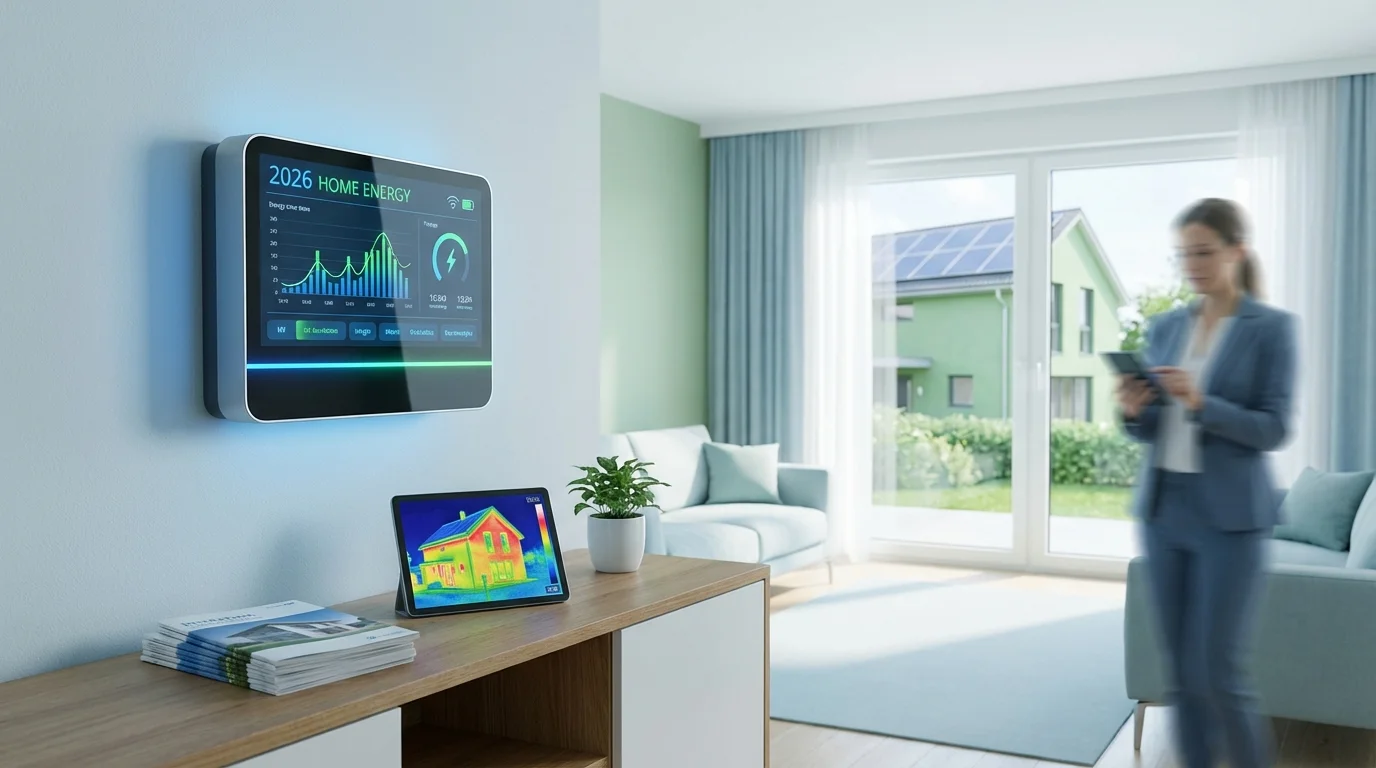
The average U.S. household has 25 connected devices, many of which draw "vampire power" even when turned off, accounting for up to 10% of a home's total electricity use. This silent drain on your wallet is exactly what a home energy monitor is designed to expose and eliminate. So gaining real-time visibility into your consumption isn't just a novelty; it's a direct path to cutting utility bills by identifying and managing these hidden energy hogs.
What Home Energy Monitor Rebates Are Available in My State and Utility for 2026, and How Much Can I Save?
State and utility rebates for home energy monitors provide direct financial incentives for homeowners in 2026. These programs offer point-of-sale discounts or mail-in rebates, with savings ranging from $25 to $150 per qualifying device, depending on the specific utility provider and state-level clean energy goals.
In 2026, dozens of state and local utility programs offer rebates for installing smart home energy monitors. For instance, California's Self-Generation Incentive Program (SGIP) and various utility-specific programs in states like Massachusetts and New York provide direct financial incentives. So savings often range from $50 to $100 per device. But these amounts are tied to program funding, which fluctuates annually. Homeowners must verify the current status of their local utility's program, as funds are often allocated on a first-come, first-served basis. And the goal of these programs is to reduce peak grid demand by giving consumers the data to shift their energy usage. You can find detailed, up-to-date information on programs in your area by using DuloCore’s free rebate calculator. Many of these programs are designed to complement broader efficiency upgrades, like those detailed in a home energy audit.
Which Specific Home Energy Monitor Devices Qualify for 2026 Rebate Programs?
Qualifying home energy monitor devices for 2026 rebates typically must be ENERGY STAR® certified and provide circuit-level monitoring. Models from brands like Sense, Emporia, and Span often meet these criteria, which are required by utility programs to ensure data accuracy and effectiveness for grid management.
Not every device on the market qualifies for a 2026 rebate. Utility companies maintain specific lists of eligible products, often referred to as a Qualified Products List (QPL). So to be eligible, a monitor generally must connect to your home's electrical panel and provide real-time, circuit-level data. And models like the Sense Home Energy Monitor and the Emporia Vue Gen 2 are frequently listed due to their advanced monitoring capabilities. But simpler plug-in style monitors that only track a single appliance rarely qualify for these utility-scale programs. The key requirement is the ability to provide whole-home insights that empower homeowners to make meaningful changes to their consumption patterns. Always check your utility’s QPL before purchasing a device to ensure it meets the 2026 program specifications.
"Many utilities offer rebates or other incentives for energy-efficient products. Search the DSIRE database for a comprehensive list of incentives in your area." — U.S. Department of Energy
Do I Meet the Income and Contractor Requirements for Home Energy Monitor Rebates in 2026?
Eligibility for 2026 home energy monitor rebates is primarily based on residency within a participating utility's service area. While most programs don't have income caps, some state-funded initiatives reserve enhanced rebates of up to 100% for low-to-moderate income (LMI) households, defined as below 80% of area median income.
Most 2026 utility rebates for home energy monitors are available to all residential customers, regardless of income. So the primary requirement is being a customer of the sponsoring utility. But some state-level programs, funded through federal grants, do have income restrictions to target assistance to LMI households. For example, a program may offer a standard $50 rebate to all customers but increase it to $150 for households earning less than 80% of the Area Median Income (AMI). And unlike larger installations like heat pumps, most home energy monitors don't have strict contractor requirements. Homeowners can often install the devices themselves. However, for panel-installed monitors, using a licensed electrician is always a safe practice and may be required by certain programs to validate the rebate claim.
What's the Application Process, Deadline, and Current Funding Status for 2026 Rebate Programs?
The 2026 application process for home energy monitor rebates typically involves an online form submitted through a utility portal post-purchase. Deadlines are often set for December 31, 2026, or when program funds, which are allocated annually and can be depleted by Q3, are exhausted.
Applying for a home energy monitor rebate in 2026 is a straightforward process, but it requires attention to detail. So homeowners typically purchase a qualifying device first, then submit an online application through their utility's website. And this application requires a copy of the sales receipt and the device's model or serial number. But it's critical to act quickly. Most programs have a fixed annual budget and operate on a first-come, first-served basis. Funding status is often updated on the utility's rebate webpage, and popular programs can run out of money by the third or fourth quarter. The typical deadline for submission is within 90 days of purchase or by the end of the calendar year, whichever comes first. So don't wait until December to apply.
2026 Home Energy Monitor Rebate Program Comparison
| Program / State Example | Rebate Amount | Key Eligibility | Application Deadline |
|---|---|---|---|
| Con Edison (NY) | Up to $75 | Must be a Con Edison electric customer, purchase a qualifying monitor. | December 31, 2026 or until funds are depleted. |
| PG&E (CA) | $50 - $100 | Must be a PG&E customer, device must be on QPL. | Rolling, but funds are limited annually. |
| Austin Energy (TX) | Up to $25 | Must reside in Austin Energy service area. | September 30, 2026 or when funds are exhausted. |
Can I Combine (Stack) Multiple Rebates or Incentives for Home Energy Monitor Devices?
Stacking a utility rebate with a manufacturer's discount for a home energy monitor is generally permitted in 2026. However, combining two separate utility rebates for the same device is prohibited. The total incentive cannot exceed the purchase price of the monitor, which is typically between $150 and $400.
Stacking incentives is a smart way to maximize savings, but rules apply. So homeowners can almost always combine a utility rebate with a temporary discount from the device manufacturer or a retailer. For example, you can use a $50 utility rebate on a monitor that is also on sale for 20% off at a big-box store. But you can't claim a rebate from both your electric utility and a separate state-level energy agency for the same device. Program terms and conditions explicitly forbid this "double-dipping" to ensure funds are distributed broadly. And while there aren't direct federal energy tax credits for standalone monitors in 2026, installing one as part of a larger project, like a solar installation, may have different financial implications. Always read the fine print of each program.
"The Database of State Incentives for Renewables & Efficiency (DSIRE) is the most comprehensive source of information on incentives and policies that support renewables and energy efficiency in the United States." — DSIRE
What Are the Best Home Energy Monitor Devices to Consider in 2026 for Maximum Savings?
The best home energy monitors for maximizing savings in 2026 are those that provide real-time, circuit-level data and are eligible for local rebates. Models like the Emporia Vue Gen 2, Sense Monitor, and Span Smart Panel are top contenders, enabling savings of 15-20% on annual electricity costs.
Choosing the right device in 2026 depends on your goals and rebate eligibility. For granular data, the Emporia Vue Gen 2 is a strong choice, offering monitoring for up to 16 individual circuits, which helps pinpoint exactly where energy is being wasted. And the Sense monitor uses AI to identify individual appliances by their unique electrical signature from a single point of connection. So it offers a more automated, user-friendly experience. For homeowners planning a full electrical system overhaul, the Span Smart Panel replaces the entire breaker box with a smart, controllable interface. But its cost is much higher. The best device is one that qualifies for a local rebate, provides actionable data you'll use, and helps you save on bigger ticket items like heat pump rebates.
Official Sources
- ENERGY STAR Rebate Finder — A tool from the U.S. Environmental Protection Agency to find local rebates on certified products.
- Database of State Incentives for Renewables & Efficiency (DSIRE) — A comprehensive database of state, local, utility, and federal incentives for energy efficiency.
Related Reading: Learn more about Iot Energy Monitoring Devices.
Frequently Asked Questions
What home energy monitor devices qualify for rebates in 2026?
Qualifying devices for 2026 rebates are typically those that connect directly to your home's electrical panel and offer whole-home or circuit-level monitoring. Brands like Sense, Emporia, and Span are frequently included on utility Qualified Products Lists (QPLs). So simple, single-outlet smart plugs generally don't qualify. You must check your specific utility's QPL before purchase to ensure eligibility.
How much can I save with rebates on home energy monitors in 2026?
In 2026, rebates on home energy monitors typically range from $25 to $150. The exact amount depends entirely on your state and local utility provider. For example, a municipal utility in Texas may offer a $25 credit, while a larger investor-owned utility in California may offer a $100 rebate. These amounts are subject to change based on annual program funding.
What is the application process for home energy monitor rebates in 2026?
The 2026 process usually involves purchasing an eligible device, then submitting an online application via your utility’s portal. You will need to upload a digital copy of your receipt and provide the product's model number. The review process takes approximately 4-8 weeks, after which a check or bill credit is issued.
Are there specific deadlines to claim 2026 rebates for home energy monitor devices?
Yes, deadlines are critical. Most 2026 programs either have a hard deadline of December 31, 2026, or they close once the allocated program funds are exhausted, which can happen as early as Q3. A common rule is that applications must be submitted within 90 days of the purchase date, so prompt action is required.
Ready to Find Your Savings?
Don't guess how much you can save on home energy upgrades. Use the DuloCore Rebate Calculator to see a personalized list of 2026 rebates and tax credits available for your home in under two minutes.
Updated: April 14, 2026 — fact-checked by DuloCore Research. About our editorial process.