Update (2026): The federal Energy Efficient Home Improvement Credit (Section 25C) expired December 31, 2025, following the passage of the OBBBA. Check state and local programs for current incentives.
The average U.S. home has enough air leaks to equal leaving a window open every day of the year. So this drafts and wasted energy directly inflate your monthly utility bills by up to 30%. But a professional home energy audit pinpoints these hidden energy drains, from attics to basements, creating a roadmap for targeted, cost-effective upgrades.
What Happens During a Professional Home Energy Audit?
A professional home energy audit is a comprehensive diagnostic assessment of a building's energy consumption. Technicians perform tests like a blower door test to measure air leakage and use infrared cameras to detect insulation gaps. This 2026 assessment provides a prioritized list of upgrades, projecting energy savings of 5-30%.
So what does this mean for your wallet? A home energy audit isn't just a check-up; it's the first step to unlocking thousands in savings. The Department of Energy estimates that sealing air leaks and adding insulation, two common audit recommendations, reduces annual heating and cooling costs by an average of 15%. And for a typical household spending $2,000 annually on energy, that's a direct saving of $300 each year, year after year. This audit unlocks access to federal and state rebates that often cover 50-100% of the project cost.
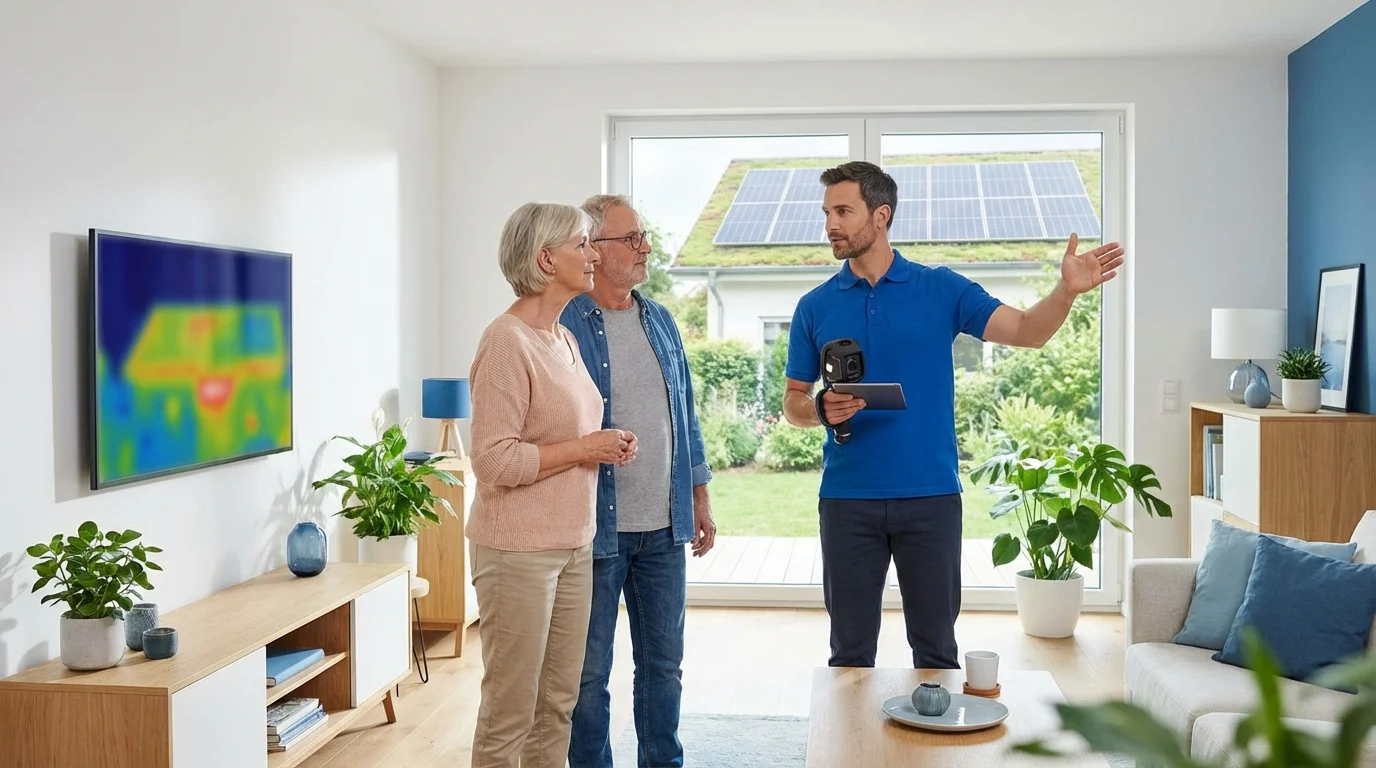
The audit process is a top-to-bottom inspection. So an auditor will first interview the homeowner about energy use patterns and any comfort issues. Then, they conduct a visual inspection of the home's exterior, insulation levels in the attic and walls, and the condition of HVAC systems and ductwork. Specialized equipment is then used for diagnostic testing. And a blower door test depressurizes the home to precisely measure air leakage rates, while thermographic scans reveal hidden thermal defects. The final report details these findings and recommends specific improvements, like air sealing or upgrading to a new system with available heat pump rebates.
What State and Utility Rebates Are Available for Energy Efficiency Upgrades?
State and utility energy rebates are financial incentives designed to lower the upfront cost of efficiency upgrades for homeowners in 2026. These programs offer point-of-sale discounts or mail-in rebates for equipment like heat pumps and insulation, often covering up to $8,000 per project, depending on location and household income.
In 2026, dozens of state and local utility programs offer rebates for upgrades identified in a home energy audit. For example, California’s TECH Clean California program provides incentives up to $3,000 for heat pump installations. And New York's NYSERDA offers similar rebates, which can be combined with utility-specific programs for an additional $1,000 or more in savings. But these programs are funded with specific annual budgets and often operate on a first-come, first-served basis. Homeowners must check their local utility provider's website or a state database like DSIRE to find currently available 2026 incentives, as funding levels and eligibility requirements change frequently.
How Do Income Limits and Location Affect My Eligibility for Energy Grants?
Income limits and geographic location are primary determinants for eligibility in 2026 energy grant programs. Federal programs, such as the Home Electrification and Appliance Rebate (HEAR), offer up to $14,000 for low-to-moderate-income households, defined as those earning less than 150% of the Area Median Income (AMI).
Your eligibility for the most valuable energy grants is directly tied to your household income and zip code. The federal HEAR program, for instance, provides rebates covering 100% of project costs (up to $14,000) for households earning below 80% of AMI. So those earning between 80-150% of AMI qualify for rebates covering 50% of the cost.
But state-level programs have their own unique income thresholds. So it's critical to verify your local AMI and check the specific requirements for state energy offices. These grants often stack with non-income-based energy tax credits, maximizing total savings.
What is the Application Process, Key Deadlines, and Funding Status for Energy Incentives?
The application process for 2026 energy incentives involves pre-approval, installation by a certified contractor, and submission of itemized invoices. Key deadlines are typically December 31, 2026, for tax credits, while rebate programs often close once annual funding is depleted, which can happen as early as Q3.
Navigating the application process requires careful attention to detail. So most utility rebates require pre-approval before any work begins. And this involves submitting a project proposal and your recent energy audit report. Once approved, the installation must be completed. After installation, homeowners submit final invoices and proof of payment to the program administrator. Federal tax credits, on the other hand, are claimed when filing your annual taxes for the 2026 tax year. But funding for state rebate programs is finite. Homeowners can use our free rebate calculator to check the current funding status of local programs, as popular incentives often run out of money before the end of the calendar year.
Do Specific Contractor Requirements Impact My Ability to Receive Rebates?
Specific contractor requirements directly impact a homeowner's ability to receive 2026 energy rebates. Most state and utility programs mandate that all work must be performed by a licensed, insured, and program-approved contractor to qualify for incentives. Using an uncertified installer will result in application denial.
You can't just hire any contractor to qualify for these valuable rebates. And state energy offices and utility companies maintain a list of approved or certified contractors who have met specific training and insurance standards. So this ensures that the work is performed correctly and will deliver the projected energy savings.
"Many state and utility programs require you to work with one of their certified or approved contractors to be eligible for rebates and other incentives." — U.S. Department of Energy (energy.gov)
Before signing a contract, homeowners must verify the contractor’s status on their local utility or state rebate program's online portal. Or they risk forfeiting rebates that amount to thousands of dollars. So this step protects the consumer and ensures the integrity of the incentive program.
2026 Home Energy Rebate Program Comparison
| Program Name | Max Rebate Amount | Income Eligibility | 2026 Deadline |
|---|---|---|---|
| HEAR Program (Federal) | $14,000 | <150% Area Median Income | Varies by State |
| IRA Tax Credits | Ended Dec 31, 2025 | — | December 31, 2025 |
| NYSERDA (NY State) | $4,000 | Varies by program | Program funding-based |
| Mass Save (MA Utility) | 75-100% of cost | None for basic rebates | Program funding-based |
Official Sources
- ENERGY STAR — Federal guidance on what to expect during a home energy assessment.
- DSIRE — A comprehensive database of state and local energy incentives and policies.
Frequently Asked Questions
What happens during a home energy audit?
During a home energy audit, a certified technician inspects your home from attic to basement to identify sources of energy loss. They perform diagnostic tests like a blower door test to measure air leakage and use an infrared camera to find insulation gaps. The audit concludes with a detailed report outlining prioritized energy-saving improvements, typically taking 2-4 hours to complete for an average-sized home.
How long does a typical home energy audit take?
A typical professional home energy audit takes between 2 to 4 hours to complete for a home of up to 3,000 square feet. The duration depends on the size and complexity of the house. So larger homes or those with more complex HVAC systems will take longer. The auditor needs this time for a thorough visual inspection and to set up and run diagnostic equipment like the blower door.
How much does a professional home energy audit cost?
The cost of a professional home energy audit typically ranges from $300 to $600 in 2026. But many local utility companies offer subsidized or even free audits to their customers. These programs aim to encourage energy efficiency, so it's always worth checking with your electric or gas provider first. The cost often pays for itself within 1-2 years through energy savings.
What should I do to prepare for a home energy audit?
To prepare for a home energy audit, gather at least 12 months of your past utility bills for the auditor to review. Make a list of any known problems, such as drafty rooms or high energy bills. And ensure the auditor has clear access to all areas, including the attic, crawl spaces, and mechanical closets where the furnace and water heater are located.
What kind of report or recommendations will I receive after an energy audit?
After the audit, you will receive a comprehensive written report, typically within 5-10 business days. This report details the findings, including photos from the infrared camera and the results of the blower door test. It provides a prioritized list of recommended upgrades, from simple DIY air sealing to larger projects like insulation, along with their estimated costs and projected annual energy savings.
Unlock Your Home's Savings Potential
An energy audit is your first step. Now, find out exactly how much you can save on upgrades.
Calculate Your Rebates NowUpdated on April 14, 2026. Fact-checked by DuloCore Editors. About our research team.