Update (2026): The federal Energy Efficient Home Improvement Credit (Section 25C) expired December 31, 2025, following the passage of the OBBBA. Check state and local programs for current incentives.
Phantom energy loads and hidden air leaks account for up to 30% of the average American's monthly utility bill, silently draining hundreds of dollars from household budgets each year. Identifying these invisible energy vampires isn't a guessing game; it requires specific diagnostic equipment. So homeowners are now leveraging advanced tools, often subsidized by rebates, to pinpoint exactly where their energy dollars are escaping and to unlock thousands in savings on efficiency upgrades.
What Essential Tools and Equipment Are Needed for a Comprehensive Home Energy Audit?
Professional home energy audit equipment includes diagnostic instruments used in 2026 to quantify energy loss with precision. And these tools, like blower doors and infrared cameras, identify specific air leakage rates and thermal boundary failures, providing the data needed for targeted, cost-effective home improvements.
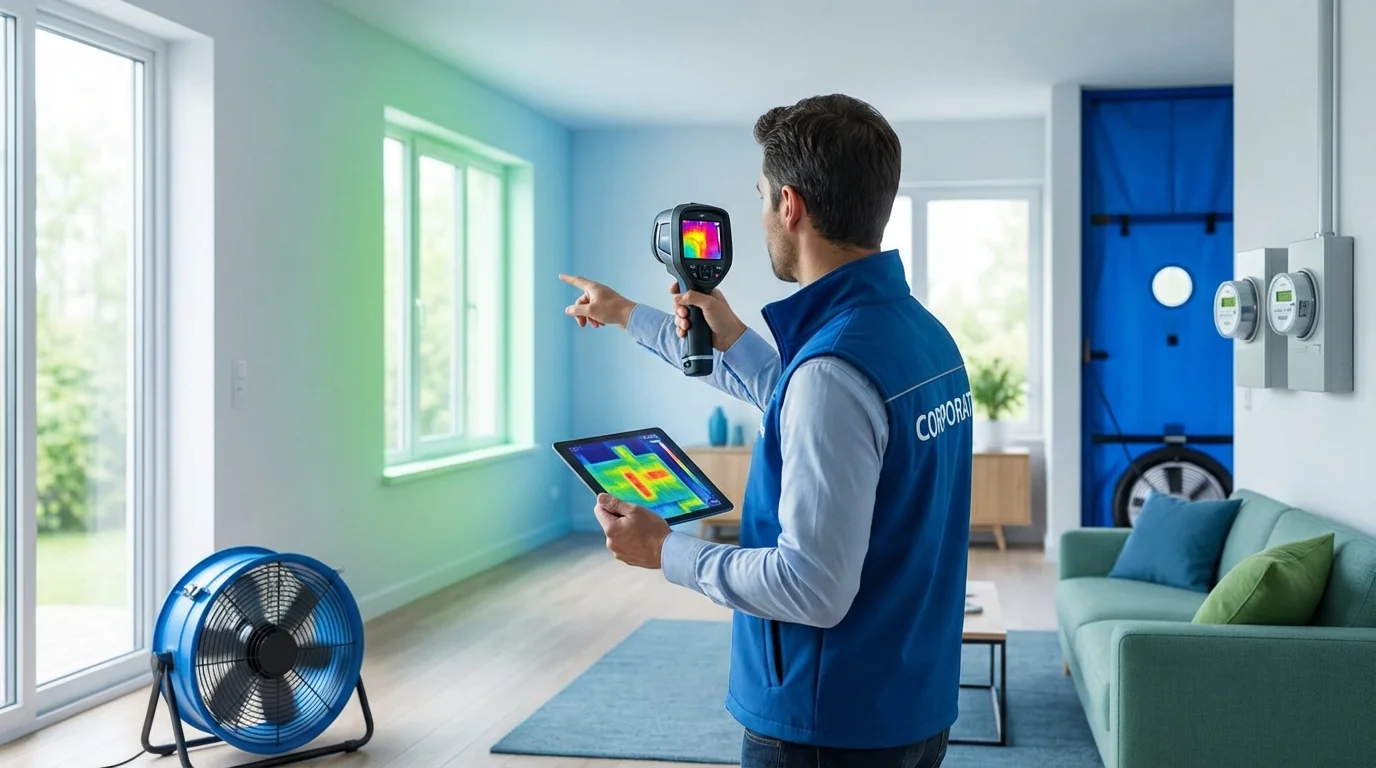
A comprehensive home energy audit relies on a suite of specialized tools, not just a simple checklist. The cornerstone is the blower door test, which uses a powerful fan mounted in an exterior doorway to depressurize the house, making it easy to detect air leaks with a smoke pencil or by hand. And an infrared camera complements this by creating a thermographic image of the home, visually revealing areas of heat loss or missing insulation in walls and ceilings that are invisible to the naked eye. For homes with combustion appliances like furnaces or water heaters, a combustion analyzer is critical. So this tool measures the efficiency and safety of these units, checking for dangerous carbon monoxide leaks. Other essential equipment includes manometers to measure pressure differences, moisture meters to find potential mold sources, and kill-a-watt meters to measure the energy consumption of individual appliances.
The core tension for homeowners is the disconnect between high energy bills and the unknown sources of that waste. The U.S. Department of Energy reports that air leaks alone can waste 10-20% of a home's heating and cooling costs. So without the diagnostic data from professional audit equipment, any attempt to improve efficiency is just guesswork. But investing in a professional audit, which uses this equipment, provides a prioritized roadmap for improvements, ensuring that every dollar spent on upgrades delivers a measurable return by targeting the most critical energy loss points first.
How Can State and Utility Programs Offer Rebates for Energy Audit Tools and Services?
State and utility programs in 2026 provide point-of-sale discounts or mail-in rebates for professional energy audits, often covering 50-75% of the service cost up to $300. So these incentives directly reduce the upfront expense, encouraging homeowners to identify energy inefficiencies and qualify for further upgrade rebates.
Rebates for home energy audits almost exclusively cover the cost of the professional service, not the direct purchase of the equipment by a homeowner. And utilities and state energy offices offer these incentives because a professional audit is the gateway to deeper energy savings. For example, a utility provider may offer a $150 rebate for an audit that costs $400, effectively reducing the homeowner's out-of-pocket cost to $250. This audit then generates a report that qualifies the homeowner for thousands more in heat pump rebates or insulation incentives. These programs are funded by small surcharges on customer utility bills or state-level clean energy funds. So the goal is to lower the barrier to entry for a data-driven approach to home performance, which benefits both the consumer and the grid by reducing overall energy demand.
What Are the Eligibility Criteria, Application Process, and Stacking Rules for Home Energy Audit Financial Incentives?
Eligibility for 2026 home energy audit rebates typically requires using a certified auditor and meeting homeownership criteria for the property. And the application process involves submitting an invoice post-audit. So stacking is often allowed, combining a $150 utility rebate with state incentives for a combined discount.
To qualify for an energy audit rebate, homeowners must typically hire an auditor certified by an organization like the Building Performance Institute (BPI). And the property must be a primary residence serviced by the sponsoring utility. The application process is straightforward: schedule the audit, pay the contractor in full, and then submit the paid invoice along with a completed rebate form to the utility or state program administrator. Some programs have income-based tiers, offering a 100% free audit for households below 80% of the area median income. Stacking rules permit combining multiple offers; for instance, a homeowner can combine a $150 utility rebate with a $100 state rebate, totaling $250 in savings. Use our free rebate calculator to see what incentives you qualify for.
What Are the Current Deadlines and Funding Status for Home Energy Audit Rebate Programs?
Most 2026 state and utility energy audit rebate programs operate on an annual funding cycle, resetting on January 1st. And funding is typically allocated on a first-come, first-served basis. So homeowners must apply early in the calendar year before the program's $10-50 million budgets are exhausted.
The availability of home energy audit rebates is finite and time-sensitive. Utility programs receive a set budget each year, and once those funds are depleted—often by the third or fourth quarter—the program closes to new applicants until the next calendar year. And some popular programs have seen their entire annual budget claimed within six to nine months. The funding status is usually available on the program's official website. So it is critical for homeowners to verify that a program is still accepting applications before scheduling an audit. While federal energy tax credits under the IRA have a longer-term horizon through December 31, 2025, local utility rebates operate on this much shorter, "use-it-or-lose-it" annual cycle. Waiting until the end of the year to act often means missing out entirely.
How Do DIY Energy Audit Tools Compare to Professional Equipment and Services, Considering Available Rebates?
DIY tools like thermal leak detectors and outlet sealers cost under $100 and identify basic issues. But professional equipment, such as a $5,000 blower door, provides quantifiable data required for most 2026 utility rebates. So professional audits unlock access to thousands in upgrade incentives.
A DIY energy audit is a valuable first step, using simple tools like caulk, weatherstripping, and handheld infrared thermometers to find obvious drafts and cold spots. These actions provide immediate, albeit small, improvements. But professional equipment provides quantitative analysis. A blower door doesn't just show there's a leak; it measures the home's total air leakage in Cubic Feet per Minute (CFM), a metric that is often required to qualify for insulation and air sealing rebates. An auditor's report serves as official documentation for rebate programs. So while a DIY approach saves the upfront cost of an audit, it simultaneously forfeits access to upgrade rebates that often exceed $2,000-$5,000, making the professional audit a necessary and high-ROI investment.
Home Energy Audit Incentive Comparison (2026)
| Program / Incentive Type | Typical Rebate Amount (2026) | Key Eligibility Requirement |
|---|---|---|
| Utility Rebate | $100 - $300 | Must be a customer of the sponsoring utility. |
| State Energy Program | $150 - $500 | Must use a state-certified energy auditor. |
| Federal IRA Tax Credit | Ended Dec 31, 2025 | — |
Official Sources
- DSIRE (Database of State Incentives for Renewables & Efficiency) — A comprehensive database of state, local, utility, and federal incentives that promote renewable energy and energy efficiency.
- ENERGY STAR Rebate Finder — A tool from the U.S. EPA to find local rebates and special offers for ENERGY STAR certified products.
"A home energy assessment, also known as a home energy audit, is the first step to assess how much energy your home consumes and to evaluate what measures you can take to make your home more energy efficient." — U.S. Department of Energy
Frequently Asked Questions
What equipment is typically used during a professional home energy audit?
A professional home energy audit uses several key pieces of equipment. The most common are a blower door to measure airtightness, an infrared camera to detect heat loss and insulation gaps, and a combustion analyzer to ensure furnace and water heater safety and efficiency. Auditors also use manometers and smoke pencils.
Are there rebates available for purchasing home energy audit tools?
No, rebates are generally not available for homeowners to purchase professional-grade audit equipment like a blower door, which can cost over $5,000. Instead, state and utility rebates in 2026 subsidize the cost of the professional audit service, often covering $150 to $300 of the total fee.
What is the difference between DIY and professional home energy audit equipment?
DIY equipment, like caulk or a $50 thermal leak detector, identifies obvious qualitative issues. Professional equipment, such as a $5,000 infrared camera and a blower door, provides quantitative data, like a home's exact air leakage rate. This professional data is required to qualify for most major upgrade rebates.
Updated on April 14, 2026. Fact-checked by DuloCore Editors. About our research team.