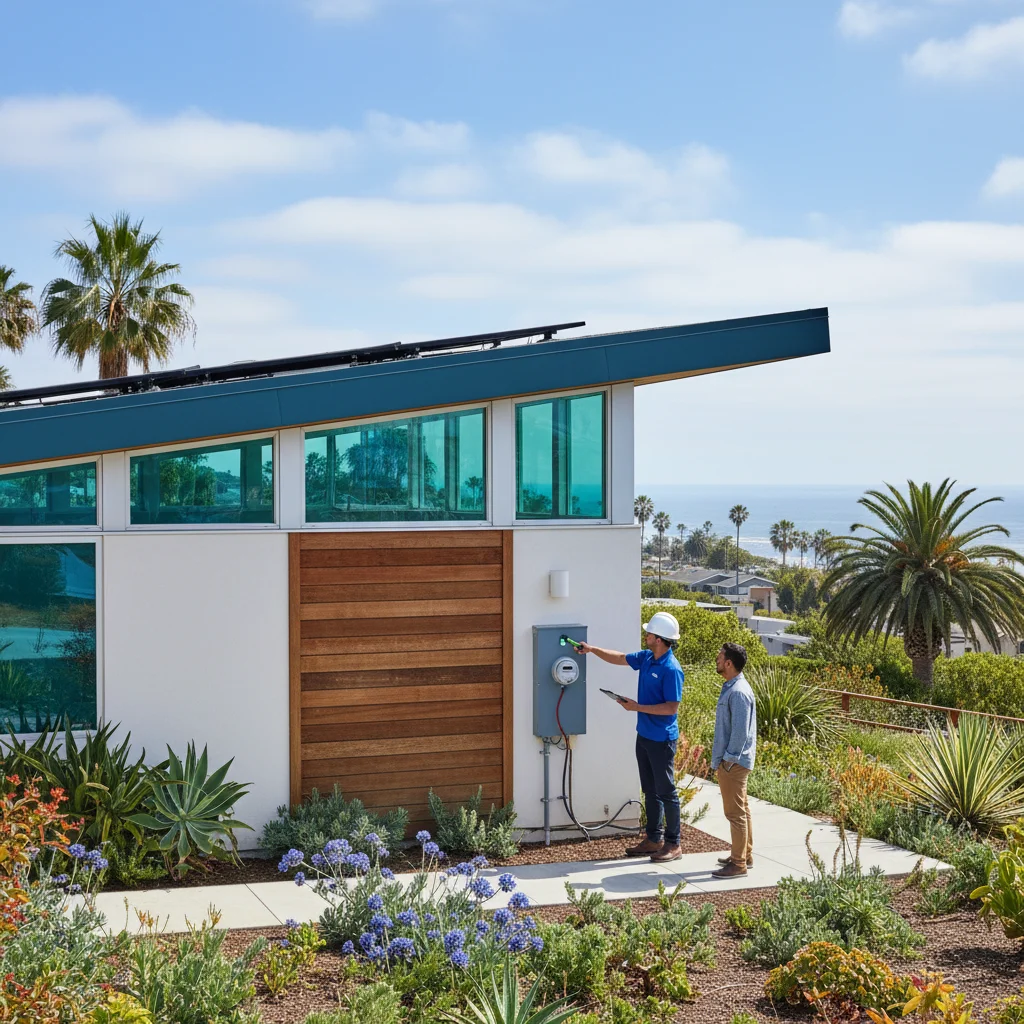
Long Beach homeowners spend an average of $1,900 annually on wasted energy through air leaks, outdated HVAC systems, and poor insulation. And the typical household could cut that waste by 25-35% through targeted upgrades identified in a professional energy audit. But most residents don't know that utility rebates and federal incentives can reduce the audit cost to zero in 2026.
How Much Does a Home Energy Audit Cost in Long Beach?
Professional home energy audits in Long Beach range from $300 to $600 for comprehensive assessments in 2026, though Southern California Edison (SCE) provides free audits to qualifying residential customers through the Energy Advisor program, which includes blower door testing, infrared imaging, and personalized upgrade recommendations with estimated savings calculations.
The cost breakdown depends on audit scope. Basic walk-through assessments start at $150-$200 and cover visual inspections of insulation, HVAC systems, and major appliances. Comprehensive audits with diagnostic testing cost $400-$600 and include thermal imaging to detect air leaks, blower door tests measuring home pressurization at 0.50 ACH50 or higher, and combustion safety testing for gas appliances. So homeowners planning major renovations should invest in comprehensive audits to maximize energy tax credits and rebate eligibility.
And SCE's no-cost Energy Advisor program eliminates upfront expenses entirely. The utility-sponsored audit includes all diagnostic equipment, a detailed report ranking upgrades by payback period, and direct connections to approved contractors. But availability depends on income qualification and program funding, which resets annually each January.
What Documentation Do You Need for a Long Beach Energy Audit?
Required documentation for Long Beach energy audits includes 12 months of utility bills showing baseline energy consumption, homeowner identification matching the property address, and proof of residence through mortgage statements or lease agreements for rental properties where landlords authorize tenant-initiated audits.
Utility bills provide the consumption baseline auditors use to calculate projected savings. SCE customers access 12-month usage data through the online account portal at sce.com, which displays kilowatt-hour consumption by billing period and calculates average daily use. And gas customers need corresponding SoCalGas bills showing therm consumption for heating and hot water systems.
Homeowners claiming rebates through California's TECH Clean California program need pre-approval documentation before scheduling audits. The program requires income verification through tax returns for moderate-income tiers, though standard-tier rebates skip income checks entirely. But all applicants must complete the online pre-qualification form at techcleanca.com and receive a confirmation number before booking contractor visits. Property documentation includes the assessor's parcel number (APN) found on property tax bills, which auditors use to verify square footage and building age against county records.
Are There State-Specific Deadlines for Energy Audit Programs in California?
California's 2026 energy audit rebate programs operate on fiscal year funding cycles with most application windows closing September 30, 2026, though individual utility territories including SCE's Long Beach service area may exhaust allocated budgets earlier, triggering waitlists or program suspensions until the next fiscal year beginning October 1.
TECH Clean California processes rebate applications on a first-come, first-served basis within each funding cycle. The program allocated $120 million for the 2025-2026 fiscal year, with 40% reserved for moderate-income applicants earning 80-120% of area median income ($83,200-$124,800 for Los Angeles County households). And the program paused new applications twice in the 2024-2025 cycle after hitting enrollment caps, leaving thousands of homeowners on waitlists for 3-5 months.
SCE's Energy Advisor program runs year-round but prioritizes scheduling based on customer tier. Income-qualified customers earning below 80% AMI receive priority booking within 2-3 weeks, while standard-tier customers face 4-8 week wait times during peak demand periods from June through September. So homeowners should schedule audits in January through March to avoid summer backlogs and secure faster appointment slots. The federal Energy Efficient Home Improvement Credit (Section 25C) ended for property placed in service after December 31, 2025 (IRS FS-2025-05). Federal tax credits for this work have ended, but state, local and utility rebates may still apply; check what is available at your address with the DuloCore rebate calculator.
How Do Energy Audit Rebates Stack with Other California Incentives?
Energy audit rebates stack with California's TECH Clean California heat pump incentives up to $8,000, federal IRA tax credits covering 30% of equipment costs through 2032, and utility-specific rebates from SCE totaling $3,000-$6,500 for qualified HVAC upgrades, creating combined savings packages of $15,000-$25,000 for comprehensive home electrification projects.
Stacking rules vary by program administrator. TECH Clean California allows full rebate amounts regardless of other incentive claims, meaning a homeowner receiving the maximum $8,000 heat pump rebates can still claim the 30% federal tax credit on remaining equipment costs. And SCE adds $3,000 for central heat pump (this federal credit ended for property placed in service after December 31, 2025) installations plus $1,000 for smart thermostats, which don't reduce TECH or IRA amounts. (Note: Federal tax credit percentages and availability are subject to change; the 30% Residential Clean Energy Credit under Section 25D expired December 31, 2025. Verify current incentives at energy.gov.)
The calculation order matters for maximum savings. Apply utility rebates first, then state rebates, then calculate the federal tax credit on remaining costs. For a $20,000 heat pump installation: subtract $8,000 TECH rebate and $4,000 SCE rebate, leaving $8,000 in eligible costs for the 30% IRA credit worth $2,400, bringing total incentives to $14,400. But homeowners must verify current program rules through the rebate calculator since stacking allowances change annually based on state budget allocations and federal guidance updates.
Do You Need Pre-Approval Before Scheduling a Home Energy Audit in Long Beach?
Pre-approval requirements depend on the audit sponsor. SCE's free Energy Advisor program requires online enrollment through sce.com/energyadvisor before scheduling but provides instant confirmation numbers for qualifying residential customers, while private audits booked directly with certified professionals need no advance authorization unless homeowners plan to claim rebates through programs like TECH Clean California that mandate pre-qualification.
The SCE enrollment process takes 5-10 minutes and requests basic property information including address, account number, and preferred contact method. And the system automatically verifies active service and residential classification, rejecting commercial or multi-family properties with shared meters. Customers receive confirmation emails within 24 hours containing scheduling links and assigned auditor contact information.
TECH Clean California enforces strict pre-approval rules for all rebate-eligible projects. Homeowners must create accounts at techcleanca.com, complete income documentation uploads for moderate-income tiers, and receive application approval before initiating any contractor work including preliminary audits. The pre-approval review takes 3-5 business days for standard applications and 7-10 days for income-verified applications requiring manual document review. So homeowners should start the pre-qualification process 2-3 weeks before planned audit dates to avoid scheduling delays. And applications submitted without pre-approval face automatic rejection with no appeals process, requiring complete resubmission and forfeiting time-sensitive contractor quotes.
Which Utility Company Offers Energy Audits in Long Beach, and What's Included?
Southern California Edison provides comprehensive home energy audits to Long Beach residential customers through the Energy Advisor program, which includes blower door testing measuring air infiltration rates, thermal imaging identifying insulation gaps and air leaks, HVAC system efficiency analysis, and a prioritized upgrade roadmap projecting annual savings from recommended improvements.
The SCE audit covers major energy systems across 4 assessment categories. Envelope testing uses calibrated blower door fans to measure air changes per hour (ACH), with typical Long Beach homes showing 0.35-0.65 ACH50 compared to the recommended 0.25 ACH50 for optimal efficiency. Thermal cameras detect temperature differentials exceeding 5°F that indicate missing insulation in attics, walls, and crawl spaces. And HVAC diagnostics measure duct leakage, refrigerant charge, and airflow rates against manufacturer specifications.
Auditors deliver detailed reports within 5-7 business days containing 15-25 specific recommendations ranked by payback period. High-priority items typically include attic insulation upgrades from R-19 to R-38 ($1,200-$1,800 cost, 3-4 year payback), air sealing reducing infiltration by 15-25% ($800-$1,500 cost, 2-3 year payback), and heat pump replacements for homes with furnaces over 15 years old ($8,000-$15,000 cost after rebates, 7-10 year payback). So homeowners receive actionable data for sequencing upgrades based on available capital and maximum energy savings per dollar invested.
Official Sources
- Energy.gov Home Energy Audits — Federal guidance on professional audit standards and DIY assessment tools
- DSIRE California Programs — Database of state incentives for renewables and efficiency including audit rebates
- Southern California Edison Energy Advisor — Utility program details and enrollment portal
Related Reading: Learn more about Energy Audit Condo Apartment and Energy Audit Cost.
Related Reading: Learn more about Energy Audit Coastal Homes and Energy Audit Cold Climate Homes.
Related Reading: Learn more about Energy Audit Cost Long Beach.
Frequently Asked Questions
How much does a home energy audit cost in Long Beach?
Professional home energy audits cost $300-$600 in Long Beach for comprehensive assessments with diagnostic testing, though Southern California Edison offers free audits through the Energy Advisor program to qualifying residential customers. Basic visual inspections start at $150-$200. And costs vary based on home size, with properties over 2,500 square feet typically adding $100-$150 to base rates.
What rebates are available for home energy audits in Long Beach?
Long Beach homeowners access free audits through SCE's Energy Advisor program, eliminating the typical $400-$600 cost entirely. And qualifying for TECH Clean California rebates requires completed audits showing baseline energy use, which then unlock up to $8,000 in heat pump rebates and $3,000-$6,500 in SCE equipment incentives based on audit recommendations.
Are home energy audits free in Long Beach?
Yes, SCE provides no-cost comprehensive home energy audits to Long Beach residential customers through the Energy Advisor program, which includes blower door testing, thermal imaging, and personalized upgrade reports. Income-qualified customers earning below 80% area median income receive priority scheduling within 2-3 weeks. And standard-tier customers face 4-8 week wait times during peak summer months.
How long does a home energy audit take in Long Beach?
Comprehensive home energy audits take 2-4 hours for typical Long Beach single-family homes under 2,500 square feet, with larger properties or complex systems requiring up to 5-6 hours for complete assessment. Auditors spend 45-60 minutes on blower door testing and thermal imaging, 30-45 minutes evaluating HVAC systems, and 60-90 minutes inspecting insulation, appliances, and building envelope details. So homeowners should plan for half-day availability and ensure access to attics, crawl spaces, and utility areas.
Do I qualify for energy audit rebates in California?
California residents with active residential utility accounts qualify for SCE's free Energy Advisor audits regardless of income, while TECH Clean California rebates based on audit findings require California residency, single-family or duplex property classification, and existing natural gas service for electrification projects. Moderate-income tiers offering higher rebates require household income between 80-120% area median income ($83,200-$124,800 for Los Angeles County). And all programs require homeowners to live in the property being audited, excluding investment properties and rental units where tenants occupy the residence.
Ready to maximize your energy savings? Use our free rebate calculator to estimate your total available incentives based on your home's energy audit results and planned upgrades. Get your personalized savings estimate in under 3 minutes.
Updated: April 14, 2026 — fact-checked by DuloCore Research. About our editorial process.