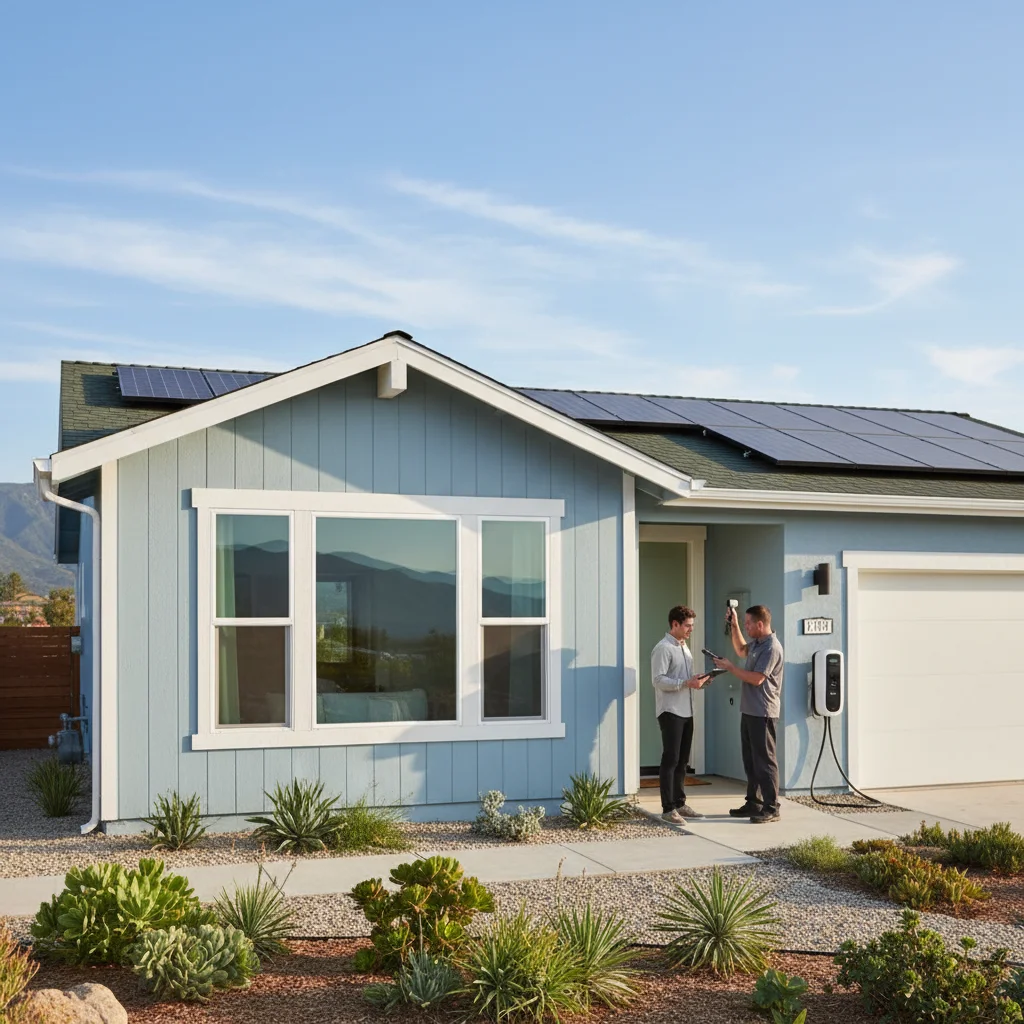
Inland Empire homeowners spend an average of $400-$600 on professional energy audits, but federal and utility rebates now cover up to 100% of that cost for income-qualified households in Riverside and San Bernardino counties. And the audit itself identifies an average of $2,200 in annual energy waste across homes built before 2000, making the upfront cost negligible compared to the savings potential.
How Much Does a Home Energy Audit Cost in the Inland Empire?
Professional home energy audits in the Inland Empire range from $300 to $600 for comprehensive assessments, with basic walk-through audits starting at $150. Certified RESNET HERS raters charge $400-$550 for blower door tests, thermal imaging, and detailed reports required for federal tax credit documentation. So the investment pays for itself within 6-12 months through identified savings averaging $183 monthly for pre-1990 homes.
Southern California Edison offers no-cost audits for residential customers through its Energy Advisor program, including remote virtual assessments and in-person visits. But these utility audits typically exclude the HERS rating documentation needed for energy tax credits and rebate pre-approval. And third-party certified auditors provide the comprehensive analysis required for stacking multiple incentive programs.
Audit costs vary by home size, with properties under 2,000 square feet averaging $325, while homes exceeding 3,500 square feet run $575-$650. Thermal imaging adds $75-$150 to base pricing, but reveals insulation gaps and air leaks invisible to standard inspections. Or homeowners can opt for DIY audit kits priced at $30-$50, though these lack the certified documentation required for rebate applications.
The comprehensive audit includes blower door testing to measure air infiltration rates, infrared thermography to detect thermal bridging, appliance efficiency analysis, and duct leakage testing. RESNET-certified auditors deliver a detailed report with prioritized recommendations and projected ROI for each upgrade. So the $400-$600 investment generates a roadmap to $15,000-$25,000 in potential heat pump rebates and efficiency improvements.
What Financial Incentives and Rebates Can Help Cover Audit Costs?
The Inflation Reduction Act's Home Energy Rebate programs allocate $4.5 billion nationally for energy audits and efficiency upgrades through 2031, with California receiving $537 million for the Home Efficiency Rebates (HER) program. Income-qualified households earning up to 150% of area median income ($112,500 for a family of four in Riverside County) receive 100% reimbursement for audit costs up to $500. And moderate-income households at 80-150% AMI qualify for 50% reimbursement.
Southern California Edison's Home Upgrade Program provides $200-$400 rebates for completed energy assessments when paired with qualifying efficiency improvements. But homeowners must complete recommended upgrades within 12 months to claim the audit rebate. Or participants can combine SCE incentives with federal tax credits for a total potential offset of $900 on a $500 audit.
"The Home Efficiency Rebates program covers 100% of energy audit costs for households earning up to 80% of area median income, and 50% for households earning 80-150% AMI." — U.S. Department of Energy
California's TECH Clean California initiative offers $250 heat pump installation rebates that stack with federal credits, but require pre-installation energy modeling performed during certified audits. So the audit becomes a prerequisite for accessing $14,000 in combined incentives for whole-home electrification projects. And the modeling documentation prevents costly compliance issues that delay rebate processing by 60-90 days.
SoCalGas customers access the Energy Savings Assistance Program providing free comprehensive audits plus immediate installation of no-cost efficiency measures valued at $3,000-$5,000. The program targets households at or below 200% of federal poverty level ($60,000 for a family of four). But participants forfeit eligibility for certain rebate programs that require pre-installation baseline documentation.
Are There Eligibility Requirements or Income Limits for Energy Audits?
Federal Home Efficiency Rebate programs set income thresholds at 150% of area median income, translating to $112,500 for a four-person household in Riverside County and $105,750 in San Bernardino County as of 2026. Households earning below 80% AMI ($60,000) qualify for 100% rebate coverage, while the 80-150% AMI bracket receives 50% reimbursement. And participants must provide tax returns or pay stubs from the most recent calendar year to verify income status.
Property eligibility requires single-family homes, multifamily buildings with four units or fewer, or individually-metered condominium units. Mobile homes and manufactured housing qualify when permanently affixed to foundations. But new construction completed after January 1, 2024 is excluded from the Home Efficiency Rebates program, which targets existing housing stock.
Auditors must hold current RESNET HERS Rater certification or Building Performance Institute (BPI) Building Analyst credentials to perform rebate-qualifying assessments. California requires additional state certification through the Home Energy Rating System (HERS) Registry. So homeowners should verify auditor credentials through the RESNET Registry database before scheduling appointments.
Primary residence requirement applies to all federal rebate programs, excluding investment properties, vacation homes, and rental units where the owner doesn't occupy the dwelling. And homeowners must retain ownership for three years post-rebate or face repayment obligations. Or the rebate transfers to new owners if documented during property sale.
The Home Upgrade Program from Southern California Edison removes income restrictions but requires active residential electric service and participation in time-of-use rate plans. Audit participants must complete at least $1,000 in qualifying efficiency upgrades within 12 months. But the program stacks with income-qualified federal rebates for maximum savings potential.
What's the Timeline and Deadline for Claiming Energy Audit Incentives?
California's Home Efficiency Rebates program accepts applications through December 31, 2031, but operates on a first-come, first-served basis with annual funding caps. The California Energy Commission allocated $180 million for fiscal year 2026, projected to serve 28,000-35,000 households statewide. And Riverside and San Bernardino counties combined represent 12% of the state's allocation, suggesting local funding depletion by Q3 2026 at current application rates.
Applications require submission within 180 days of audit completion, with rebate processing taking 45-90 days from approved submission. So homeowners scheduling audits in April 2026 face an August deadline for application submittal. But incomplete documentation extends processing to 120+ days, pushing payment into late fall.
Southern California Edison's Home Upgrade Program operates on rolling enrollment with quarterly funding allocations. Current waitlists in Riverside County average 6-8 weeks for initial audit scheduling. And rebate claims must be submitted within 365 days of audit date, creating a hard deadline for completing recommended upgrades.
"California's HER program funding is allocated annually and available on a first-come, first-served basis until depleted." — Database of State Incentives for Renewables & Efficiency
The federal Energy Efficient Home Improvement Credit (Section 25C) ended for property placed in service after December 31, 2025 (IRS FS-2025-05). Federal tax credits for this work have ended, but state, local and utility rebates may still apply; check what is available at your address with the DuloCore rebate calculator. But the credit requires filing with annual tax returns, creating an April 15 deadline for the tax year in which expenses occurred. Or homeowners can amend returns up to three years retroactively to claim missed credits, though amended returns face heightened IRS scrutiny.
Pre-approval processes for combined federal and utility rebates add 15-30 days to project timelines. Applications submitted without required energy modeling documentation face automatic rejection, restarting the 180-day clock. So scheduling audits in early Q2 2026 maximizes the window for completing upgrades and securing rebates before year-end funding depletion.
How Do Stacking Rules Affect Your Total Savings and Rebate Eligibility?
Federal Home Efficiency Rebates and IRA tax credits stack for combined savings up to $16,500 on whole-home efficiency projects, but specific calculation sequencing prevents double-dipping. Homeowners must first subtract rebates from project costs before calculating the 30% federal tax credit. So a $20,000 heat pump (this federal credit ended for property placed in service after December 31, 2025) installation with an $8,000 HER rebate generates a $3,600 tax credit (30% of $12,000 remaining cost), not $6,000. (Note: Federal tax credit percentages and availability are subject to change; the 30% Residential Clean Energy Credit under Section 25D expired December 31, 2025. Verify current incentives at energy.gov.)
California prohibits stacking state-funded rebates with federal HER program dollars for the same equipment or measure. But utility company incentives from Southern California Edison and SoCalGas stack with both federal rebates and tax credits. And the rebate calculator helps homeowners model optimal incentive combinations for their specific upgrade scenarios.
Energy audit costs qualify for separate reimbursement streams that don't reduce equipment rebate eligibility. So homeowners can claim the $500 HER audit rebate, $400 from SCE's Home Upgrade Program, and deduct remaining costs through itemized tax returns for a total recovery of $1,100 on a $600 audit. But the Energy Savings Assistance Program's free audit disqualifies participants from claiming the HER audit rebate for the same assessment.
Income-qualified households stacking 100% HER audit coverage with SCE's $400 upgrade incentive create a net $400 payment to the homeowner. But program rules require returning excess rebates or applying the surplus to qualifying efficiency improvements. And documentation must clearly delineate which incentive reimburses which cost component to prevent audit flags during program review.
Local utility demand response programs and time-of-use rates create additional stacking opportunities worth $200-$400 annually. Southern California Edison's Summer Discount Plan pays $50-$200 per season for allowing brief air conditioning cycling during peak events. But enrollment requires smart thermostat installation, which qualifies for $50-$75 rebates from both federal and utility programs.
Audit recommendations prioritize measures with the highest stacking potential, typically air sealing and insulation upgrades qualifying for both HER rebates ($1,600-$8,000) and 30% tax credit (this federal credit ended for property placed in service after December 31, 2025)s. Certified auditors calculate net costs after all incentives, revealing that comprehensive weatherization projects often generate positive cash flow for income-qualified households through combined rebates exceeding project costs.
Do You Need Pre-Approval Before Getting a Home Energy Audit?
Southern California Edison's Home Upgrade Program requires pre-enrollment through the online portal or customer service before scheduling audits. The enrollment process takes 5-10 minutes and generates a confirmation number needed for contractor verification. But skipping pre-enrollment invalidates rebate eligibility, forcing homeowners to pay full audit costs without reimbursement.
Federal Home Efficiency Rebates operate on a post-completion reimbursement model without pre-approval requirements. Homeowners select certified auditors, complete assessments, and submit documentation with proof of payment for processing. And the system reduces administrative barriers but shifts financial risk to homeowners who must cover upfront costs and wait 45-90 days for reimbursement.
Income verification occurs during application submission rather than pre-approval, using tax transcripts or employer income documentation from the most recent calendar year. California's HER program cross-references submitted income against IRS records through the federal Data Services Hub. So discrepancies between reported and verified income trigger automatic application holds pending additional documentation.
Auditor certification verification happens automatically when homeowners hire RESNET or BPI credentialed professionals listed in state registries. But hiring uncertified auditors results in rebate denial regardless of audit quality. And homeowners should request proof of current certification before signing audit contracts to avoid $400-$600 in non-recoverable costs.
Pre-installation energy modeling requirements for heat pump rebates and electrification incentives effectively mandate audit completion before equipment purchases. Contractors cannot submit rebate applications without HERS ratings and energy modeling reports generated during certified audits. So the audit becomes a de facto pre-approval step for accessing $8,000-$14,000 in equipment incentives.
Early enrollment in utility programs locks in current rebate amounts even if funding levels decrease mid-year. Southern California Edison guarantees enrolled participants receive published incentive amounts for 180 days post-enrollment. But programs reserve the right to reduce rebates for new enrollees once annual allocations reach 75% depletion.
Official Sources
- DOE Home Energy Rebates — Federal guidance on IRA rebate programs, income limits, and eligible improvements
- DSIRE California — Comprehensive database of state, local, and utility energy efficiency incentives
- Southern California Edison Rebates — Current utility rebate programs and application requirements
Related Reading: Learn more about Energy Audit Company Comparison Guide and Energy Audit Condo Apartment.
Related Reading: Learn more about Energy Audit Cost and Energy Audit For Home.
Frequently Asked Questions
How much does a home energy audit cost in the Inland Empire?
Professional RESNET-certified home energy audits cost $400-$600 in Riverside and San Bernardino counties, with basic assessments starting at $300. Comprehensive audits include blower door testing, thermal imaging, and detailed HERS rating documentation required for federal rebate applications. And income-qualified households receive 100% reimbursement up to $500 through California's Home Efficiency Rebates program.
Can I get a free energy audit in the Inland Empire?
Southern California Edison provides no-cost virtual and in-person audits through the Energy Advisor program for all residential customers. SoCalGas offers free comprehensive audits plus immediate installation of efficiency measures valued at $3,000-$5,000 for households at or below 200% federal poverty level ($60,000 for a family of four). But free utility audits typically lack the HERS certification documentation required for federal tax credits and certain rebate programs.
What rebates are available for home energy audits in Riverside County?
California's Home Efficiency Rebates program covers 100% of audit costs up to $500 for households earning below 80% area median income ($60,000 for a family of four), and 50% for incomes at 80-150% AMI. Southern California Edison's Home Upgrade Program provides $200-$400 audit rebates when paired with qualifying efficiency improvements completed within 12 months. And these incentives stack for potential total reimbursement of $900 on a $500 audit for income-qualified households.
How long does a home energy audit take?
Comprehensive certified audits require 2-4 hours for homes under 2,500 square feet, with larger properties taking 4-6 hours including blower door testing, duct leakage assessment, and thermal imaging. RESNET HERS raters deliver detailed reports within 5-7 business days including prioritized recommendations and energy modeling for rebate applications. And Southern California Edison's virtual audits take 45-60 minutes through remote video consultation with follow-up reports in 3-5 days.
Do I need a professional energy audit to qualify for rebates?
Federal Home Efficiency Rebates and California utility programs require audits performed by RESNET HERS Raters or BPI Building Analyst certified professionals. DIY assessments and non-certified audits don't generate the documentation needed for rebate applications or tax credit verification. And hiring uncertified auditors results in automatic rebate denial, making the $400-$600 audit cost non-recoverable. So verification of current auditor credentials through the RESNET Registry prevents costly eligibility mistakes.
Ready to maximize your savings? Use our free rebate calculator to discover your exact eligibility for federal and local energy efficiency incentives. Calculate your potential rebates in under 2 minutes and get a personalized roadmap to lower energy bills.
Last updated: April 14, 2026. Reviewed by the DuloCore Editorial Team. About our authors.