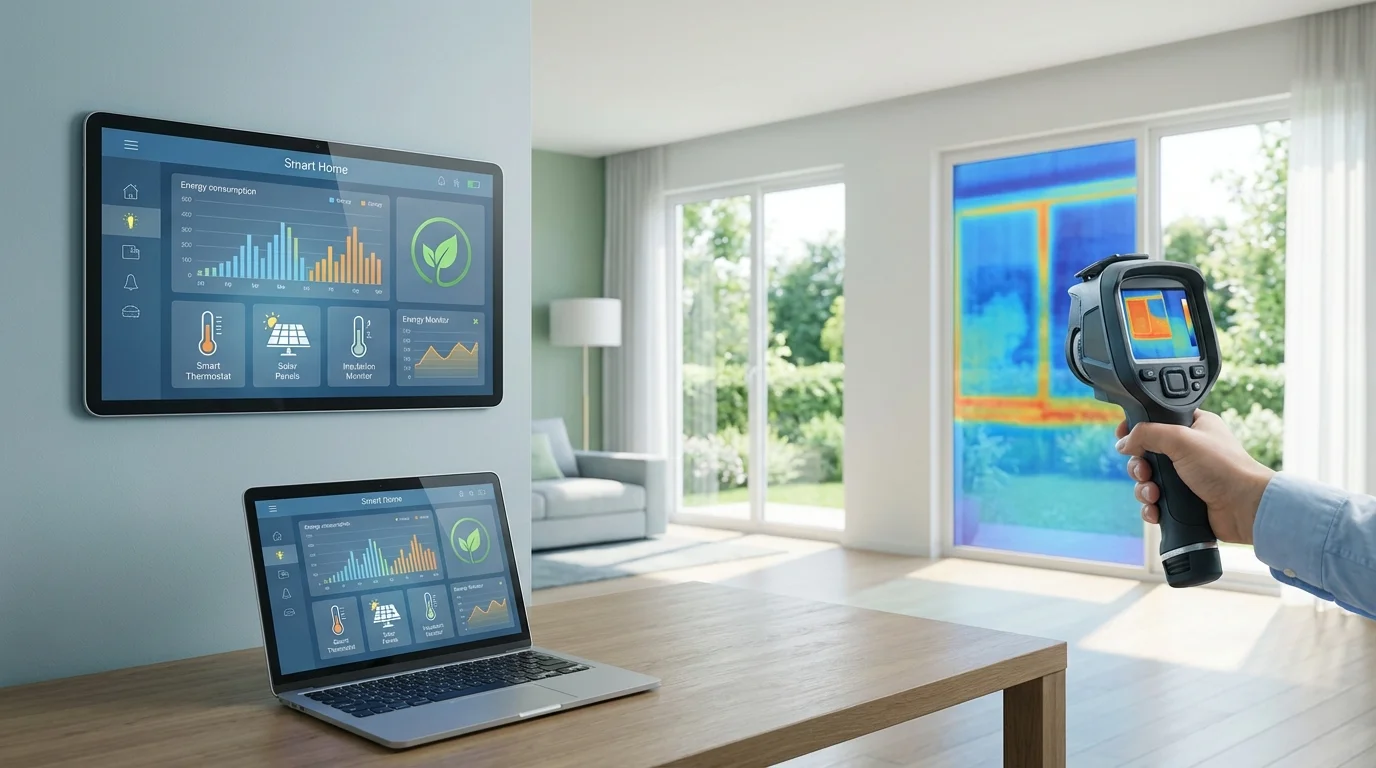
Up to 20% of a home's annual energy bill is wasted by inefficient climate control and phantom power drain from electronics. This isn't a minor leak; it's a constant drain on household finances, equivalent to throwing away hundreds of dollars each year. So with energy costs continuing to rise in 2026, homeowners are using automation not just for convenience, but as a primary tool for financial defense against escalating utility bills.
How Much Can Smart Home Automation Really Save on My Energy Bills?
Smart home automation systems reduce annual energy bills by 10-25% through optimized HVAC, lighting, and appliance management. For 2026, this translates to $200-$500 in direct energy cost reductions, excluding additional savings from available state and utility rebates of up to $1,500 for qualifying equipment.
So what does this mean for your wallet? For the average American household spending over $2,000 annually on energy, a 15% reduction from a smart thermostat alone saves $300 per year. But the real power comes from integrating multiple systems. Smart lighting adds another 5-10% savings, while smart plugs eliminate phantom loads from electronics, which account for nearly 10% of residential energy use. And these savings compound over time, turning a one-time upgrade into a recurring annual dividend. The first step is often a professional home energy audit to identify the biggest sources of waste. So the total savings potential from a fully integrated system often exceeds initial projections, paying back the investment in under three years.
What State and Utility Rebates Are Available for Home Automation Energy Upgrades?
State and utility home automation rebates for 2026 offer point-of-sale discounts and mail-in refunds from $50 to $1,500. These programs, often funded by state energy offices, cover ENERGY STAR certified smart thermostats, lighting controls, and energy management systems, with specific availability and amounts varying by zip code.
These incentives are designed to lower the barrier to entry for energy-saving technology. And programs typically focus on specific devices. For example, a utility provider offers a $75 instant rebate on a qualifying smart thermostat purchased through its online marketplace. But a state-level program provides a $250 mail-in rebate for a comprehensive system including smart lighting and plugs. The Database of State Incentives for Renewables & Efficiency (DSIRE) is a primary resource for locating these local programs.
"Many states and utilities offer rebates or other incentives for purchasing ENERGY STAR certified products. Some also have recycling incentives for old appliances." — ENERGY STAR
So homeowners must verify the specific offers in their service area, as funding is often limited and operates on a first-come, first-served basis. Use our free rebate calculator to find your savings.
Am I Eligible? Understanding Income Limits and Equipment Requirements for Smart Home Rebates.
Eligibility for 2026 smart home rebates depends on two primary factors: household income and equipment specifications. Many state programs reserve enhanced rebates, covering up to 100% of costs, for households earning less than 80% of their Area Median Income (AMI), while standard rebates have no income cap.
Equipment must almost always be ENERGY STAR certified to qualify. And this ensures the device meets strict energy efficiency criteria set by the EPA. For instance, a smart thermostat rebate requires the model to be on the program’s Qualified Products List (QPL). So installing a non-listed model, even if it's a "smart" device, results in a denied application. But income verification for enhanced rebates typically involves submitting a recent tax return or proof of enrollment in other income-based assistance programs. For homeowners looking at broader upgrades, it's important to understand how these rebates interact with federal energy tax credits to maximize total financial benefits.
What's the Application Process, and Do I Need a Specific Contractor for Rebates?
The 2026 application process for home automation rebates is typically a digital-first procedure, completed through a utility or state program web portal. For simpler device rebates, homeowners can often self-install and submit receipts, but comprehensive system rebates frequently require installation by a program-approved contractor.
The process for a simple smart thermostat rebate involves purchasing a qualifying model, installing it, and uploading a photo of the installed device and the purchase receipt to the utility’s online portal. And reimbursement arrives as a bill credit or check within 6-8 weeks. But for larger projects, like integrated lighting and HVAC controls, the workflow changes. A certified contractor must perform the installation. So that contractor often submits the rebate application on the homeowner's behalf, providing a point-of-sale discount that removes the upfront cost burden. This is common for incentives tied to larger projects like new heat pump rebates.
"The Database of State Incentives for Renewables & Efficiency (DSIRE) is the most comprehensive source of information on incentives and policies that support renewables and energy efficiency in the United States." — DSIRE
How Can I Maximize My Savings: Stacking Rules, Deadlines, and Funding Status?
Maximizing savings in 2026 requires understanding rebate stacking rules, application deadlines, and program funding status. Homeowners can often stack a manufacturer's discount with a utility rebate, but stacking two different government-funded rebates for the same device is generally prohibited.
For example, you can use a $50 manufacturer coupon on a smart thermostat and still claim a $75 utility rebate. But you can't claim both a state and a local utility rebate for that same thermostat. And deadlines are critical; most 2026 programs have a hard deadline of December 31, 2026, or when program funds are exhausted, whichever comes first. So checking the program’s website for the funding status before purchase is essential. Many programs run out of money by the third quarter. Or, in some cases, the rules of the federal Inflation Reduction Act (IRA) credits dictate how they interact with local incentives, making it crucial to plan all energy upgrades holistically.
| Program Example (2026) | Rebate Amount | Key Eligibility Requirements | Application Deadline |
|---|---|---|---|
| CA Utility (PG&E) | $75 for Smart Thermostat | Must be ENERGY STAR certified, installed in service area | December 31, 2026 |
| TX State Program | Up to $250 for Lighting/Controls | <120% Area Median Income, certified contractor install | October 31, 2026 |
| NYSERDA Comfort Home | Up to $1,000 for Controls | Bundled with insulation/air sealing, income-based | Funds are limited |
Official Sources
- ENERGY STAR — A federal tool to find local rebates and special offers for ENERGY STAR certified products.
- DSIRE — The most comprehensive database of state and local incentives for renewable energy and energy efficiency.
- Department of Energy — Federal guidance on home energy savings, including information on IRA tax credits and rebates. (note: the federal 25C and 25D credits ended for projects completed after December 31, 2025)
Frequently Asked Questions
Do all smart home devices qualify for energy saving rebates?
No, not all smart devices qualify. Rebate programs in 2026 almost exclusively require products to be ENERGY STAR certified. And they must appear on the specific program's Qualified Products List (QPL). So a generic smart plug or non-certified thermostat won't be eligible for the typical $50 to $150 rebate, making it critical to check the QPL before purchasing any equipment.
How much can home automation reduce my monthly energy bill?
Home automation typically reduces monthly energy bills by 10-25%. A smart thermostat alone can save 10-15% on heating and cooling costs, which is the largest portion of a utility bill. So for a home with a $200 monthly energy bill, this translates to $20-$50 in savings every month. And adding smart lighting and plugs increases that savings total further.
What is the process for claiming rebates on home automation energy upgrades?
The process varies by program. For single devices like a thermostat, homeowners often apply online after purchase by uploading a receipt and proof of installation. But for larger, integrated systems, a program-approved contractor is often required to install the equipment and submit the rebate paperwork on the homeowner's behalf, sometimes providing an instant discount of up to $1,500.
Ready to Automate Your Savings?
Don't guess how much you can get back. Our tool instantly finds every home automation rebate and tax credit you qualify for based on your zip code.
Updated on April 14, 2026. Fact-checked by DuloCore Editors. About our research team.