Update (2026): The federal Energy Efficient Home Improvement Credit (Section 25C) expired December 31, 2025, following the passage of the OBBBA. Check state and local programs for current incentives.
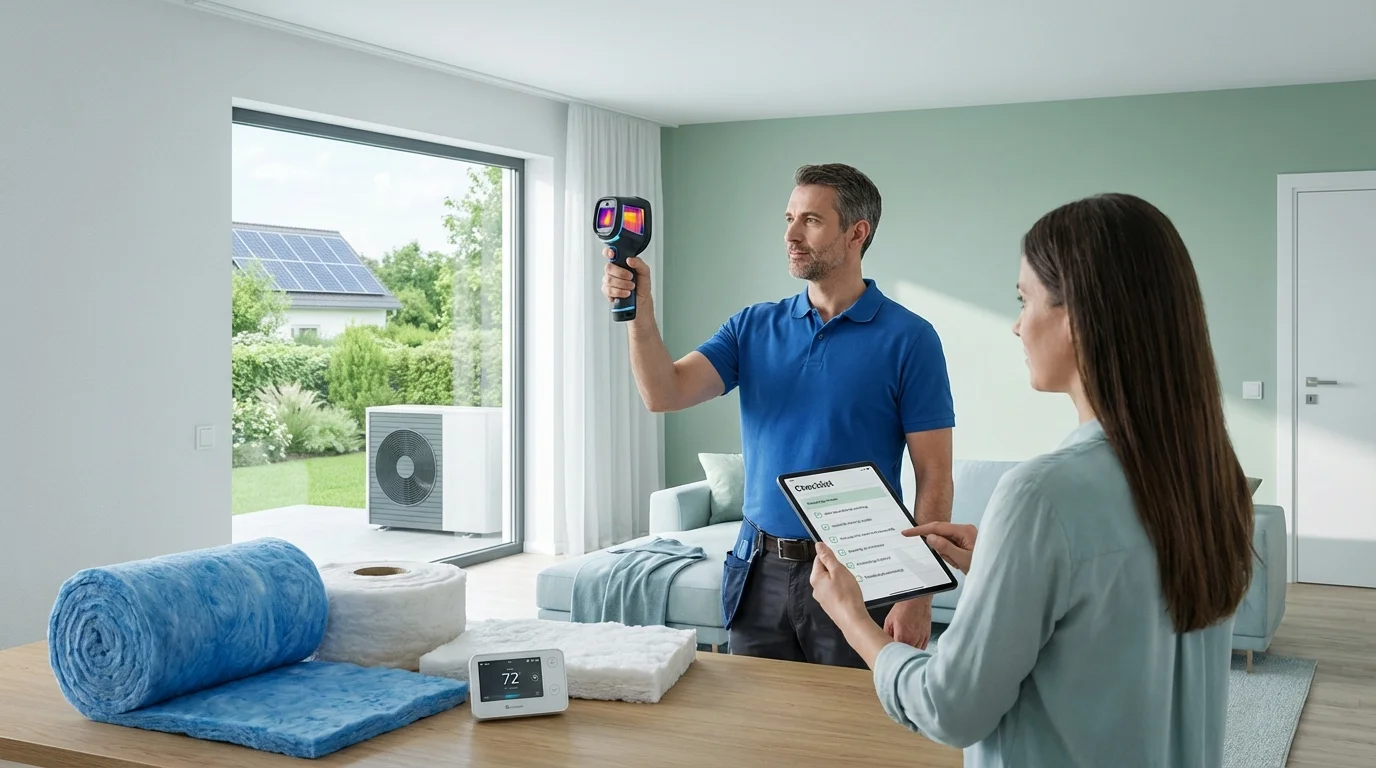
Up to 30% of a home's heating energy is lost through air leaks around windows, doors, and foundations. As temperatures drop for the 2026 heating season, every draft and uninsulated space directly inflates utility bills. A professional energy audit pinpoints these invisible leaks, turning a vague checklist into a targeted plan for immediate savings.
So why does this checklist matter? The average American household spends over $2,000 annually on energy bills, with nearly half of that dedicated to heating and cooling. A comprehensive home energy audit identifies specific upgrades that reduce energy consumption by 5% to 30%. But without a structured audit, homeowners often guess at solutions, wasting money on ineffective fixes while leaving the primary sources of energy loss unaddressed.
What Government and Utility Rebates Are Available for Heating Season Energy Audits and Upgrades?
Government and utility rebates for 2026 heating season audits offer between $150 and $500 to cover the initial assessment cost. Subsequent upgrade rebates, like those for insulation or heat pumps, reach up to $8,000 through federal Inflation Reduction Act (IRA) programs and state-level incentives.
Federal programs provide a foundation for savings through direct energy tax credits, which cover 30% of the cost for qualifying improvements up to an annual cap of $3,200. And state energy offices and local utilities offer direct cash rebates that further reduce upfront costs. For example, a state program may offer a $1,000 rebate for attic insulation, while the local gas company provides an additional $250 for the same project. So combining these incentives maximizes the financial return on energy-efficient upgrades. The U.S. Department of Energy states that these programs are designed to accelerate the adoption of cleaner, more efficient home energy systems.
Am I Eligible for Income-Based Energy Audit Assistance, and What Equipment Qualifies?
Income-based energy audit assistance, such as the Weatherization Assistance Program (WAP), is available to households earning at or below 200% of the federal poverty level. Qualifying equipment for rebates includes ENERGY STAR certified heat pumps, insulation, air sealing, and high-efficiency windows and doors.
These programs ensure that energy savings are accessible to all households, regardless of income. For 2026, a family of four qualifies for WAP with an annual income at or below approximately $60,000. And eligible equipment extends beyond basic weatherization. Rebates cover high-efficiency furnaces, smart thermostats, and even duct sealing, which can improve heating system efficiency by over 20%. So homeowners can access a full suite of upgrades, from a simple audit to a complete system overhaul. Many states also offer enhanced heat pump rebates for low-to-moderate income (LMI) households, sometimes covering up to 100% of the installation cost.
"The Weatherization Assistance Program (WAP) reduces energy costs for low-income households by increasing the energy efficiency of their homes, while ensuring their health and safety." — U.S. Department of Energy
How Do I Find Approved Contractors and Navigate the Application Process for Rebates?
Homeowners find approved contractors through state energy office databases or utility provider lists, ensuring technicians are certified by bodies like the Building Performance Institute (BPI). The application process typically involves a pre-approval, the audit, the upgrade installation, and a final submission with invoices by December 31, 2026.
First, a homeowner must confirm their eligibility and reserve funds through the program's online portal. But the next step is hiring a certified professional; uncertified work is often ineligible for rebates. After the BPI-certified contractor completes the energy audit and recommended upgrades, they provide detailed invoices. So the homeowner then submits these documents, along with the completed application form, before the program's deadline. The entire process, from application to receiving a check, typically takes 6-8 weeks. Use our free rebate calculator to see what incentives you qualify for before starting the process.
Heating Season Upgrade Rebate Comparison
| Program Feature | Federal IRA Tax Credit | State Clean Heat Program | Utility Weatherization Rebate |
|---|---|---|---|
| Max Amount | 30% of cost, up to $3,200/year | Up to $4,000 for heat pumps | $500 for insulation |
| Eligibility | All taxpayers; income limits for some | Varies by state; some income-based | Must be a utility customer |
| 2026 Deadline | File with 2026 taxes (April 2027) | December 31, 2026 | November 30, 2026 |
When Are the Deadlines, and Can I Combine Multiple Rebates for My Heating Season Upgrades?
Most 2026 state and utility rebate programs have a submission deadline of December 31, 2026, while federal IRA tax credits run through December 31, 2025. Homeowners can stack multiple incentives, combining a federal tax credit of 30% with a state rebate of $1,500 for the same project.
Stacking rebates is a key strategy for reducing project costs. For instance, a $10,000 heat pump installation is eligible for a $2,000 federal tax credit. And if the state offers a $1,500 rebate and the utility provides another $500, the total out-of-pocket cost drops to just $6,000—a 40% reduction. But homeowners must verify that programs allow stacking, as some utility rebates cannot be combined with state incentives for the same piece of equipment. So always check the terms and conditions for each program. Deadlines are strict; work must usually be completed and paperwork submitted by the end of the calendar year.
How Can I Check the Funding Status of Energy Programs in My State and Utility Area?
Homeowners check the funding status of 2026 energy programs by visiting their state's Department of Energy website or the DSIRE database, which tracks real-time availability. Utility programs often list remaining funds on their customer portals, as many are allocated on a first-come, first-served basis.
State and utility energy rebate programs operate with fixed annual budgets, and popular incentives can be exhausted before the year ends. So checking the funding status before committing to a project is critical. The Database of State Incentives for Renewables & Efficiency (DSIRE) is a comprehensive resource maintained by North Carolina State University and funded by the DOE. And it provides up-to-date information on program availability, funding levels, and application deadlines for every state. But for the most current information, a direct call to the utility or state program administrator is the most reliable method.
"DSIRE is the most comprehensive source of information on incentives and policies that support renewables and energy efficiency in the United States." — DSIRE
Official Sources
- ENERGY STAR Rebate Finder — A tool from the U.S. Environmental Protection Agency to find local rebates and special offers for ENERGY STAR certified products.
- Database of State Incentives for Renewables & Efficiency (DSIRE) — The most comprehensive national database of state-level energy efficiency incentives and policies.
- IRS Credits and Deductions Under the IRA — Official guidance from the Internal Revenue Service on federal energy tax credits available for homeowners. (note: the federal 25C and 25D credits ended for projects completed after December 31, 2025)
Related Reading: Learn more about Radiant Floor Heating Energy Audit.
Frequently Asked Questions
What are the eligibility requirements for a heating season energy audit rebate?
Eligibility for a 2026 energy audit rebate typically requires the home to be a primary residence and a customer of the sponsoring utility or state program. Some programs have income-based requirements, while others are open to all residents. The audit must be performed by a BPI-certified professional. For upgrade rebates, the installed equipment, such as insulation or a furnace, must meet specific ENERGY STAR efficiency ratings.
How do I complete a heating season energy audit checklist to qualify for rebates?
To qualify for rebates, a homeowner hires a certified energy auditor who completes the checklist. This professional process involves a blower door test to measure air leakage, thermographic imaging to find insulation gaps, and a combustion safety test. The auditor provides a detailed report with a prioritized list of recommended upgrades. Homeowners then use this official report and contractor invoices to apply for rebates, as self-audits don't qualify for financial incentives.
What kind of energy savings can I expect after implementing a heating season audit checklist?
Implementing the recommendations from a professional energy audit checklist reduces annual energy bills
Updated on April 14, 2026. Fact-checked by DuloCore Editors. About our research team.