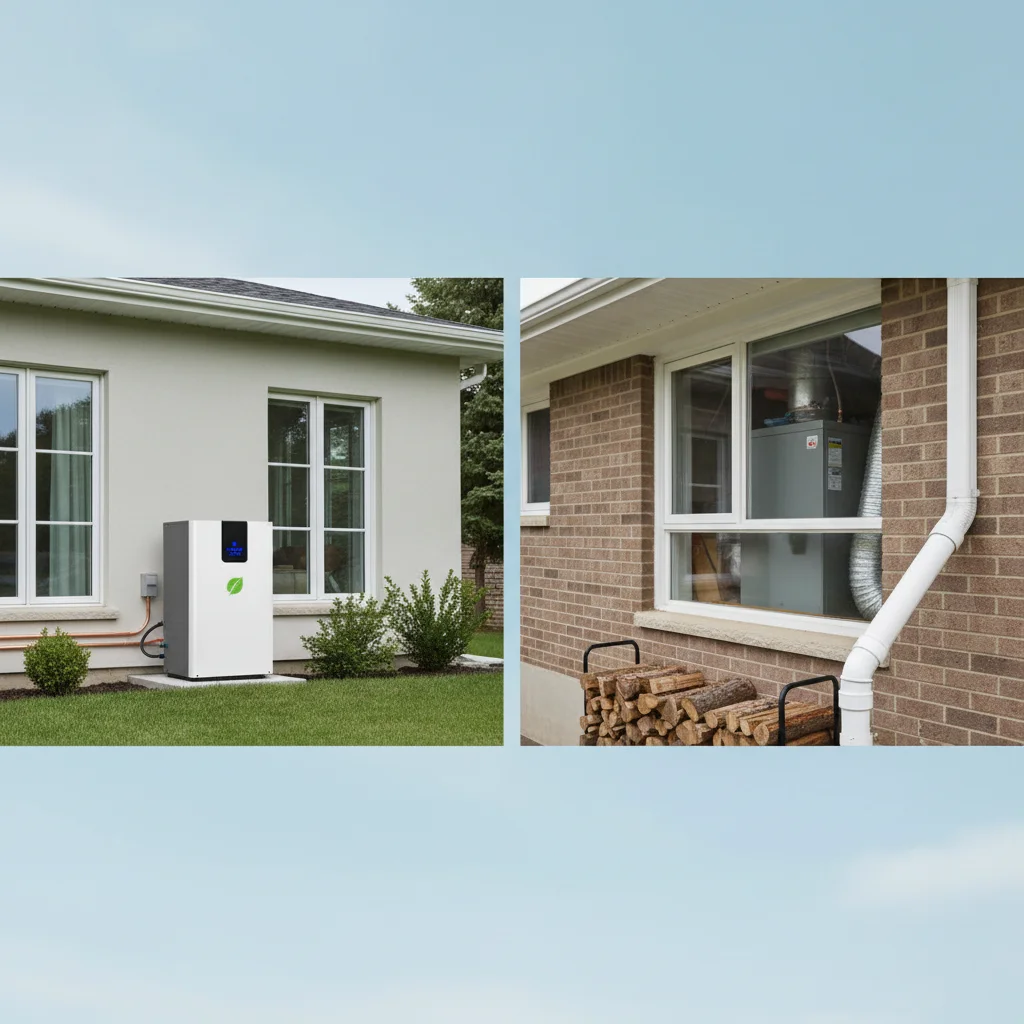
In 2026, the average American homeowner installing a heat pump pays $15,000 upfront but saves $1,200 annually on energy bills compared to a gas furnace—yet 73% of homeowners still choose furnaces because they don't understand the total cost equation. The sticker price tells only part of the story. Installation costs, operating expenses, maintenance schedules, and federal tax credits create a financial puzzle where the cheaper option today often becomes the more expensive choice over a system's 15-year lifespan.
What's the Real Cost Difference Between Heat Pumps and Furnaces?
Heat pumps cost $12,000-$18,000 installed in 2026, while gas furnaces run $4,000-$7,000 and electric furnaces cost $2,500-$5,000. The federal Energy Efficient Home Improvement Credit (Section 25C) ended for property placed in service after December 31, 2025 (IRS FS-2025-05). Federal tax credits for this work have ended, but state, local and utility rebates may still apply; check what is available at your address with the DuloCore rebate calculator. And California's TECH Clean California program adds up to $3,000 in additional rebates for qualifying homeowners, further reducing the upfront investment.
Installation complexity drives the price gap. Heat pumps require refrigerant line sets, outdoor condenser pads, and electrical upgrades to support 200-amp service in most homes built before 2000. Furnaces need only ductwork connections and gas line hookups for systems replacing existing equipment. So labor costs for heat pump installations run 40-60% higher than furnace replacements.
But the equipment cost difference narrows when factoring in air conditioning. Most furnace installations require a separate $3,500-$6,000 central AC unit to provide cooling. Heat pumps deliver both heating and cooling in one system, eliminating the need for dual equipment purchases.
How Long Does It Take to Break Even on a Heat Pump Investment?
The typical heat pump payback period ranges from 5-12 years depending on climate zone, existing fuel costs, and utility rates. Homeowners in California's climate zones 3-5 see payback in 6-8 years, while those in colder inland regions hit break-even around year 10. And that calculation assumes static energy prices—historical data shows natural gas prices increased 38% from 2020-2025 while electricity rates rose only 18%.
Operating cost differences create the payback timeline. A 2,000-square-foot California home heating with a gas furnace pays approximately $950 annually in heating costs at 2026 natural gas rates of $1.85/therm. The same home using a heat pump with 3.5 HSPF rating pays $720 annually in electricity at $0.28/kWh. So the $230 annual savings accumulates to cover the $3,000-$5,000 net cost difference after rebates.
But climate matters enormously. Heat pumps maintain 300-400% efficiency in temperatures above 35°F but drop to 150-200% efficiency below 20°F. Gas furnaces maintain consistent 95-98% efficiency regardless of outdoor temperature. So homeowners in Fresno see faster payback than those in Tahoe where backup resistance heating activates during cold snaps.
Use our free rebate calculator to model your specific payback timeline based on local utility rates and climate data.
Which System Offers Better Long-Term Savings Over 15-20 Years?
Heat pumps save $4,800-$9,200 more than gas furnaces over a typical 15-year equipment lifespan when accounting for operating costs, maintenance expenses, and avoided air conditioning purchases. A California homeowner installing a heat pump in 2026 pays roughly $13,000 upfront after rebates and spends $10,800 in electricity over 15 years, totaling $23,800. The same homeowner choosing a furnace-plus-AC combination pays $10,500 upfront and $19,250 in gas and electricity for cooling, totaling $29,750.
Maintenance costs favor heat pumps by $1,200-$1,800 over 15 years. Gas furnaces require annual inspections at $125-$175 to check burners, heat exchangers, and carbon monoxide levels—failures that create safety hazards. Heat pumps need seasonal filter changes and refrigerant checks every 2-3 years at $100-$150 per service. So furnaces accumulate $1,875-$2,625 in maintenance while heat pumps total $500-$900.
But lifespan matters. Gas furnaces last 15-20 years while heat pumps run 12-15 years because outdoor compressors work year-round for heating and cooling. Extending the timeline to 20 years requires one heat pump replacement around year 13, adding $12,000-$15,000 to total cost. So 20-year calculations narrow the savings gap to $2,000-$4,500 in favor of heat pumps.
And rising natural gas prices tilt the equation further toward heat pumps. California natural gas prices increased 127% from 2016-2026 while electricity rates rose 64%. Continuing that trend projects gas furnace operating costs exceeding heat pump costs by $450-$650 annually by 2031.
What Rebates and Tax Credits Can Offset Your Heat Pump Costs in 2026?
The federal Energy Efficient Home Improvement Credit (Section 25C) ended for property placed in service after December 31, 2025 (IRS FS-2025-05). A $15,000 heat pump installation generates a $2,000 tax credit claimed on Form 5695 when filing 2026 taxes. But the credit applies only to primary residences and requires the system to meet or exceed ENERGY STAR efficiency standards of 8.1 HSPF2 or higher.
California's TECH Clean California program adds $500-$3,000 in point-of-sale rebates based on income, location, and system type. Households earning under 80% area median income qualify for enhanced rebates of $2,000-$3,000, while moderate-income households receive $500-$1,500. And the program requires contractor participation—homeowners can't claim rebates for DIY installations.
Local utility rebates stack with state and federal incentives. Pacific Gas & Electric offers $500-$2,000 for qualifying heat pump upgrades, Southern California Edison provides $750-$1,500, and San Diego Gas & Electric adds $400-$1,000. But timing matters—many utility programs operate on annual budgets that exhaust funds by summer. So early-year installations capture the full rebate while late-year projects risk funding depletion.
Compare that to furnace incentives. The IRA eliminated the old 25C tax credit for high-efficiency gas furnaces effective January 1, 2026. So new furnace installations receive zero federal tax support. Some California utilities still offer $300-$800 rebates for 95%+ AFUE gas furnaces, but the combined incentive gap between heat pumps and furnaces reaches $3,500-$6,500.
Heat Pump vs. Furnace: Operating Costs, Maintenance, and Hidden Expenses Compared
Monthly energy bills tell the clearest cost story. A 2,000-square-foot California home heating with a 96% AFUE gas furnace consumes 650-850 therms annually at $1.85/therm, totaling $1,200-$1,570 per heating season. The same home using a heat pump with 9.5 HSPF2 rating consumes 5,500-7,200 kWh at $0.28/kWh, totaling $1,540-$2,016. But subtract avoided air conditioning costs—the furnace home needs AC consuming 3,200-4,500 kWh in summer, adding $896-$1,260. So combined heating and cooling costs run $2,096-$2,830 for furnaces versus $1,540-$2,016 for heat pumps.
Maintenance schedules differ significantly. Gas furnaces require annual professional inspections to prevent carbon monoxide leaks, check flame sensors, and clean burners. Skipping maintenance voids most manufacturer warranties and creates safety hazards—the EPA links 400+ annual deaths to faulty furnace installations. Heat pumps need filter changes every 60-90 days and refrigerant level checks every 2-3 years. So annual maintenance runs $150-$200 for furnaces versus $50-$80 for heat pumps.
Hidden costs emerge from ductwork requirements. Older homes built before 1990 often have undersized ducts designed for furnaces producing 140°F air. Heat pumps generate 95-105°F air and require 15-25% larger duct cross-sections to deliver equivalent heating. Duct modifications add $1,500-$4,000 to heat pump installations but rarely appear in initial quotes. And poorly sized ducts reduce heat pump efficiency by 20-30%, eliminating operating cost savings.
Electrical panel upgrades catch homeowners by surprise. Heat pumps draw 30-60 amps during peak heating, requiring dedicated 240V circuits. Homes with 100-amp main panels need $1,200-$2,500 panel upgrades to 200-amp service before heat pump installation. Gas furnaces draw 5-15 amps and work with existing electrical infrastructure.
How to Calculate Your Heat Pump ROI Payback Period Based on Your Climate and Usage
Start by calculating your current heating costs. Multiply annual therm consumption (from gas bills) by $1.85/therm to establish baseline expenses. A home using 750 therms annually pays $1,388 for heating. Then multiply cooling costs—annual kWh consumption times $0.28/kWh. Add both numbers for total HVAC operating costs.
Next, estimate heat pump operating costs using the ENERGY STAR calculator. Input your climate zone, home square footage, and insulation levels. California climate zone 3 (Sacramento) shows 2,000-square-foot homes with medium insulation consuming 6,200 kWh annually with heat pumps, costing $1,736. Compare to combined furnace and AC costs of $2,250 for a net savings of $514 annually.
Factor in upfront cost differences. A $15,000 heat pump installation minus $2,000 federal tax credit minus $2,000 TECH Clean California rebate minus $1,000 utility rebate equals $10,000 net cost. A $6,000 furnace plus $4,500 AC unit totals $10,500 with minimal rebates. So the heat pump costs $500 less upfront while saving $514 annually.
But adjust for climate reality. Homes in climate zones 1-2 (coastal areas) see heat pump efficiency peak at 400% while zones 16-17 (mountain regions) drop to 200% during winter. And homes relying on backup electric resistance heat during sub-freezing days add $0.12-$0.18/kWh to operating costs, erasing 30-50% of projected savings.
Calculate payback period by dividing net cost difference by annual savings. A $3,000 net cost difference divided by $600 annual savings yields a 5-year payback. But add 2-3 years for homes needing electrical panel upgrades or duct modifications. Use our rebate calculator to model scenarios with current 2026 incentive levels.
Official Sources
- ENERGY.GOV Save Program — Federal heat pump rebates, tax credits, and efficiency resources (note: the federal 25C and 25D credits ended for projects completed after December 31, 2025)
- ENERGY STAR Heat Pump Guide — Certified product database and climate-specific efficiency ratings
- DSIRE USA — Comprehensive state, local, and utility incentive database updated monthly
Related Reading: Learn more about Spray Foam Vs Fiberglass Insulation Cost.
Frequently Asked Questions
How much does a heat pump cost compared to a furnace?
Heat pumps cost $12,000-$18,000 installed in 2026, while gas furnaces run $4,000-$7,000. But federal tax credits cover 30% of heat pump costs up to $2,000, and California rebates add $500-$3,000, reducing the net price gap to $1,000-$3,000. And heat pumps eliminate the need for separate $3,500-$6,000 air conditioning units, often achieving cost parity with furnace-plus-AC combinations.
What are the tax credits and rebates available for heat pumps vs furnaces?
The federal Energy Efficient Home Improvement Credit (Section 25C) ended for property placed in service after December 31, 2025 (IRS FS-2025-05). California's TECH Clean California program adds $500-$3,000 for heat pumps based on income level, and utilities offer $400-$2,000 in additional rebates. Total heat pump incentives reach $3,900-$7,000 versus $300-$800 for high-efficiency furnaces.
Is a heat pump cheaper to operate than a furnace?
Heat pumps cost $1,540-$2,016 annually for combined heating and cooling in California, while gas furnaces cost $1,200-$1,570 for heating plus $896-$1,260 for separate air conditioning, totaling $2,096-$2,830. So heat pumps save $556-$814 annually on energy bills. But savings vary by climate—coastal homes see 400% heat pump efficiency while mountain regions drop to 200% during cold snaps.
How long does it take to install a heat pump vs a furnace?
Heat pump installations require 2-4 days including electrical panel upgrades, outdoor condenser placement, refrigerant line installation, and system commissioning. Furnace replacements take 1-2 days for straightforward swaps using existing ductwork and gas lines. And heat pump installations requiring duct modifications or 100-to-200-amp panel upgrades extend timelines to 5-7 days.
What is the payback period for upgrading from a furnace to a heat pump?
California homeowners see heat pump payback periods of 5-12 years depending on climate zone and utility rates. Coastal and valley regions with mild winters hit break-even in 6-8 years, while colder inland areas reach payback around year 10. And rising natural gas prices—up 127% from 2016-2026—accelerate payback timelines by reducing the annual operating cost gap between systems.
Ready to calculate your heat pump savings? Use our free rebate calculator to see exactly how much federal tax credits, California rebates, and utility incentives reduce your upfront costs—and how quickly lower energy bills pay back your investment. Get your personalized savings estimate in 60 seconds.
Last updated: April 14, 2026. Reviewed by the DuloCore Editorial Team. About our authors.
Check your California heat pump rebate eligibility — see the programs you qualify for and the dollar amounts on our California heat pump rebate finder.