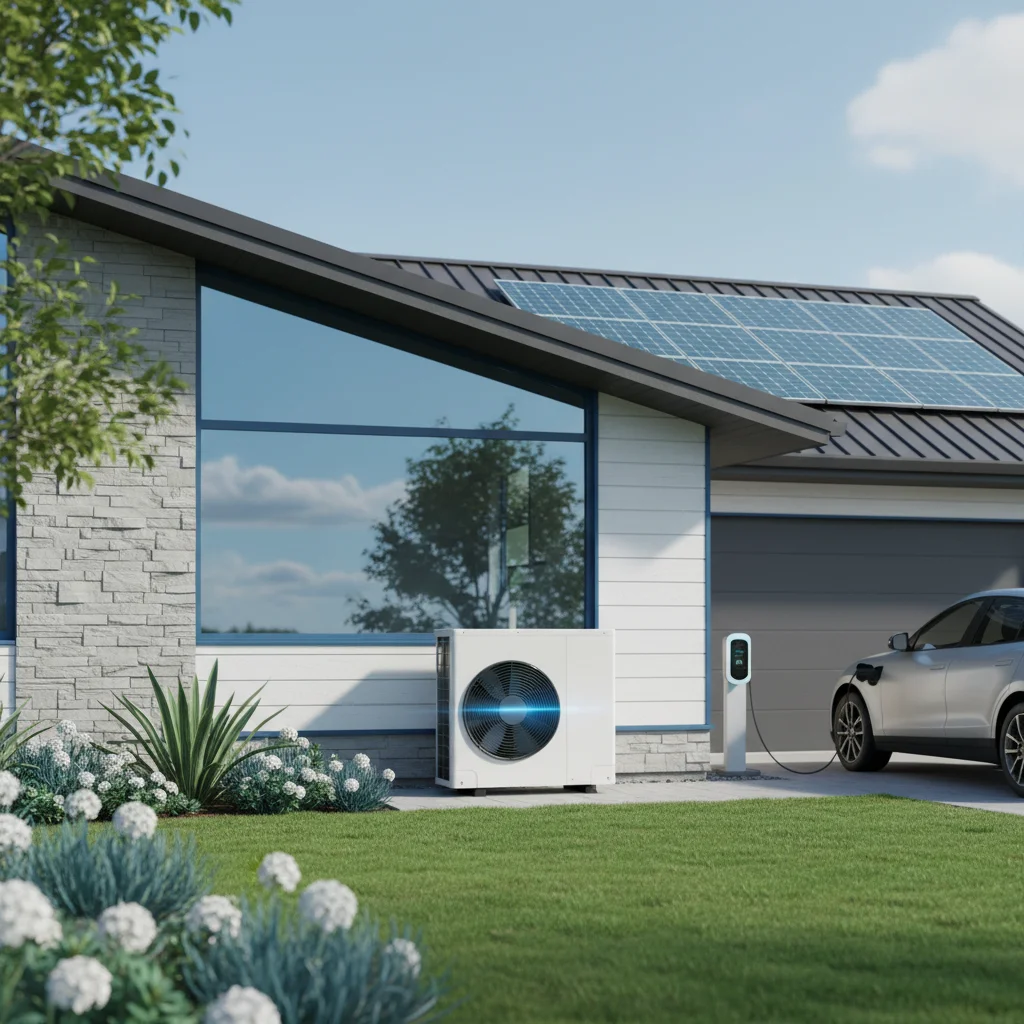
The federal Energy Efficient Home Improvement Credit (Section 25C) ended for property placed in service after December 31, 2025 (IRS FS-2025-05). Federal tax credits for this work have ended, but state, local and utility rebates may still apply; check what is available at your address with the DuloCore rebate calculator. And homeowners who installed systems in 2025 but missed the filing deadline can still claim retroactive credits in 2026. But state rebates and utility incentives stack on top, creating total savings packages worth $5,000 to $14,000 depending on location and household income. (Note: Federal tax credit percentages and availability are subject to change; the 30% Residential Clean Energy Credit under Section 25D expired December 31, 2025. Verify current incentives at energy.gov.)
What Is the Heat Pump Tax Credit and How Much Money Can You Get?
The federal Energy Efficient Home Improvement Credit (Section 25C) ended for property placed in service after December 31, 2025 (IRS FS-2025-05). Homeowners who spend $6,667 or more on qualifying heat pump systems receive the maximum benefit. And the credit applies to air-source heat pumps, geothermal systems, and heat pump water heaters that meet ENERGY STAR efficiency standards. But the 30% rate drops to 26% in 2033 and 22% in 2034 before expiring completely. So installing before 2033 maximizes savings.
California homeowners combine this federal credit with state heat pump rebates worth $3,000 to $8,000 for low-to-moderate income households. And utility companies add another $500 to $2,000 in incentives. The federal credit reduces tax liability dollar-for-dollar—a $2,000 credit cuts your tax bill by $2,000. But if you owe less than $2,000 in federal taxes, the unused portion doesn't roll forward or convert to a refund.
Geothermal heat pumps qualify for a separate uncapped 30% credit through 2032, making $25,000 installations worth $7,500 in federal savings. And that's on top of local utility rebates averaging $1,200 for geothermal systems. So total combined incentives reach $14,000 for households installing geothermal systems in 2026. But ground-source systems require upfront investment of $15,000 to $30,000 compared to $8,000 to $15,000 for air-source heat pumps.
Who Is Eligible for the Heat Pump Tax Credit in 2024 and 2025?
The 2026 heat pump tax credit applies to primary residences owned by taxpayers who owe federal income tax. And the system must be installed between January 1, 2023 and December 31, 2032 in an existing home. But new construction doesn't qualify—the credit targets energy efficiency upgrades for existing structures. So second homes and rental properties are excluded from the program.
Form 5695 only covers qualifying work completed by December 31, 2025 and claimed on a 2025 return; the federal 25C and 25D credits ended after that date (IRS FS-2025-05). And the heat pump must meet ENERGY STAR Most Efficient certification or equivalent performance standards. But there's no income limit for the federal tax credit—a household earning $40,000 or $400,000 qualifies equally. So the credit functions as a flat-rate incentive based on purchase price rather than financial need.
California state programs layer income restrictions on top of federal eligibility. And the TECH Clean California initiative provides $3,000 rebates for households earning up to 80% of area median income ($93,000 for a family of four in Los Angeles County). But households above that threshold still receive the 30% federal credit (this federal credit ended for property placed in service after December 31, 2025) with no state rebate. So combined benefits range from $2,000 for high earners to $11,000 for low-income households installing the same $10,000 system.
"ENERGY STAR certified air source heat pumps have higher seasonal energy efficiency ratio (SEER) and higher heating seasonal performance factor (HSPF) ratings, which means energy savings and increased comfort." — ENERGY STAR Heat Pumps
Can You Stack Heat Pump Tax Credits With Other Energy Incentives?
Yes. And households routinely combine 3 to 5 separate incentive programs on a single installation. But each program has distinct eligibility rules and application processes. So claiming all available benefits requires coordinating federal, state, and utility paperwork within specific deadlines.
A Los Angeles homeowner installing a $12,000 heat pump system in 2026 receives $2,000 from the federal tax credit plus $3,000 from TECH Clean California plus $800 from SoCalGas. And the total $5,800 in incentives reduces net cost to $6,200—a 48% discount. But the federal credit only applies to the original purchase price before rebates, not the net cost after other incentives reduce the bill.
Stacking rules vary by program type. And the federal credit doesn't interact with state or utility rebates—IRS calculates the 30% based on gross installation costs. But some utility programs reduce rebate amounts if households claim state incentives first. So application sequence matters for maximizing total benefits. Check program documentation or use a rebate calculator to model optimal claiming order for your ZIP code and income bracket.
Homeowners also stack heat pump credits with separate IRS incentives for insulation, windows, and electrical panel upgrades completed in the same year. The federal Residential Clean Energy Credit (Section 25D) ended for expenditures made after December 31, 2025, and the IRS treats an expenditure as made when installation is completed (IRS FS-2025-05). So coordinating multiple upgrades in a single tax year maximizes federal savings before the 30% rate drops to 26% in 2033.
Is the Heat Pump Tax Credit Refundable or Will It Just Reduce Your Tax Liability?
The heat pump (this federal credit ended for property placed in service after December 31, 2025) tax credit is non-refundable. And it only reduces federal tax liability—if you owe $1,200 in taxes but qualify for a $2,000 credit, the IRS doesn't send you $800. But the credit doesn't carry forward either. So households with low tax liability lose unused credit value permanently.
A retired couple owing $900 in federal taxes receives $900 in benefit from their $10,000 heat pump installation. And the remaining $1,100 credit evaporates. But working households with $5,000+ in annual tax liability capture the full $2,000 credit. So the program delivers maximum value to middle- and upper-income taxpayers with substantial federal tax bills.
This differs from refundable credits like the Earned Income Tax Credit, where the IRS issues checks for amounts exceeding tax owed. And it creates a planning opportunity for households with variable income. So retirees or self-employed workers can time heat pump installations for years when taxable income—and tax liability—peaks. But most households install based on equipment failure timelines rather than tax optimization.
State rebates function as point-of-sale discounts or post-installation checks rather than tax credits. And those payments don't depend on state income tax liability. So low-income households often benefit more from state rebate programs than federal tax credits. But combining both programs when available maximizes total savings regardless of income level.
What Documentation Do You Need to Claim the Heat Pump Tax Credit?
Form 5695 only covers qualifying work completed by December 31, 2025 and claimed on a 2025 return; the federal 25C and 25D credits ended after that date (IRS FS-2025-05). And homeowners must provide the Manufacturer's Certification Statement confirming the heat pump meets ENERGY STAR Most Efficient criteria. But the IRS doesn't require submitting receipts or invoices unless audited. So keep itemized installation invoices showing equipment costs, labor, and the contractor's business information for at least 3 years.
Required documentation includes the heat pump's make, model number, and BTU capacity. And the contractor's certification that the system was installed according to manufacturer specifications. But most ENERGY STAR certified equipment comes with a pre-filled certification form. So homeowners typically receive this documentation automatically at project completion.
Invoice itemization matters for maximizing the credit. And the 30% applies to equipment costs plus installation labor including electrical work, ductwork modifications, and refrigerant line sets. But expenses for unrelated repairs or cosmetic improvements don't qualify. So contractors should separate heat pump costs from other home improvement charges on the final invoice.
California state rebate programs require proof of income through tax returns or pay stubs. And applications must include photos of the installed equipment showing model number plates. But utility rebates typically need only the contractor's invoice and a completed application form. So documentation requirements vary by program—federal claims are simpler than state or utility applications.
What's the Deadline to Claim Your Heat Pump Tax Credit?
Homeowners claim the credit on the tax return for the year the heat pump was installed and operational. And the deadline matches the standard federal tax filing date—April 15 for most taxpayers. But extensions to October 15 apply if you file Form 4868. So a heat pump installed in December 2025 must be claimed on the 2025 tax return filed by April 15, 2026 (or October 15 with extension).
The federal Energy Efficient Home Improvement Credit (Section 25C) ended for property placed in service after December 31, 2025 (IRS FS-2025-05). And the 30% credit rate holds through that date before stepping down. But amended returns allow retroactive claims for up to 3 years. So homeowners who installed qualifying systems in 2023-2025 but didn't claim the credit can file Form 1040-X to recover the benefit. And the IRS processes amended returns within 16 weeks on average.
There's no application deadline for state or utility rebates beyond the installation must occur during the program year. And California's TECH Clean California program operates on a first-come, first-served basis until annual funding is exhausted—typically by September or October. So early-year installations have higher rebate claim success rates than late-year projects. But reserved funds guarantee payment if you prequalify before installation begins.
Contractors often coordinate rebate applications as part of their service package. And submitting state and utility paperwork within 30 days of project completion prevents documentation delays or expired program windows. So treat rebate applications with the same urgency as contractor payment—late claims risk losing thousands in available incentives. Calculate your combined federal, state, and utility savings with a rebate calculator before scheduling installation.
Official Sources
- Energy Saver — U.S. Department of Energy — Federal energy efficiency guidance, rebate information, and heat pump performance data
- IRS Energy Efficient Home Improvement Credit — Official tax credit rules, Form 5695 instructions, and qualified equipment lists (note: the federal 25C and 25D credits ended for projects completed after December 31, 2025)
- ENERGY STAR Heat Pumps — Certified product directory and efficiency specifications for federal tax credit eligibility (note: the federal 25C and 25D credits ended for projects completed after December 31, 2025)
Related Reading: Learn more about Solar Rebate Vs Tax Credit Difference and Solar Tax Credit 30 Percent.
Frequently Asked Questions
Are you eligible for the heat pump tax credit?
Homeowners who own their primary residence and install a qualifying heat pump between 2023 and 2032 are eligible. And the system must meet ENERGY STAR Most Efficient certification in an existing home—new construction doesn't qualify. But there's no income limit, so households at any earning level can claim the credit if they owe federal income tax.
How much is the heat pump tax credit worth?
The federal Energy Efficient Home Improvement Credit (Section 25C) ended for property placed in service after December 31, 2025 (IRS FS-2025-05). And a household spending $6,667 or more receives the maximum benefit. But the credit is non-refundable and only reduces tax liability—unused amounts don't carry forward or convert to refunds.
What is the deadline to claim the heat pump tax credit?
The credit must be claimed on the federal tax return for the installation year, filed by April 15 (or October 15 with extension). The federal Energy Efficient Home Improvement Credit (Section 25C) ended for property placed in service after December 31, 2025 (IRS FS-2025-05). But amended returns allow retroactive claims for systems installed up to 3 years prior, so 2023-2025 installations remain claimable through 2028.
Do heat pumps qualify for the federal tax credit in 2026?
Yes. The federal Energy Efficient Home Improvement Credit (Section 25C) ended for property placed in service after December 31, 2025 (IRS FS-2025-05). And both air-source and geothermal heat pumps qualify if they meet ENERGY STAR efficiency standards. But the rate drops to 26% in 2033 and 22% in 2034, so installing before 2033 maximizes federal savings.
What's the difference between the heat pump tax credit and rebates?
The federal tax credit reduces income tax liability on your annual IRS return, while state and utility rebates provide direct payment or point-of-sale discounts. And the tax credit is non-refundable—you can't get more back than you owe. But rebates function as cash payments regardless of tax situation, making them more valuable for low-income households or retirees with minimal tax liability.
Ready to find every incentive you qualify for? Use our free rebate calculator to discover your combined federal, state, and utility savings based on your ZIP code, income, and project details. Calculate your total heat pump incentives in under 60 seconds.
Updated on April 14, 2026. Fact-checked by DuloCore Editors. About our research team.
Check your California heat pump rebate eligibility — see the programs you qualify for and the dollar amounts on our California heat pump rebate finder.