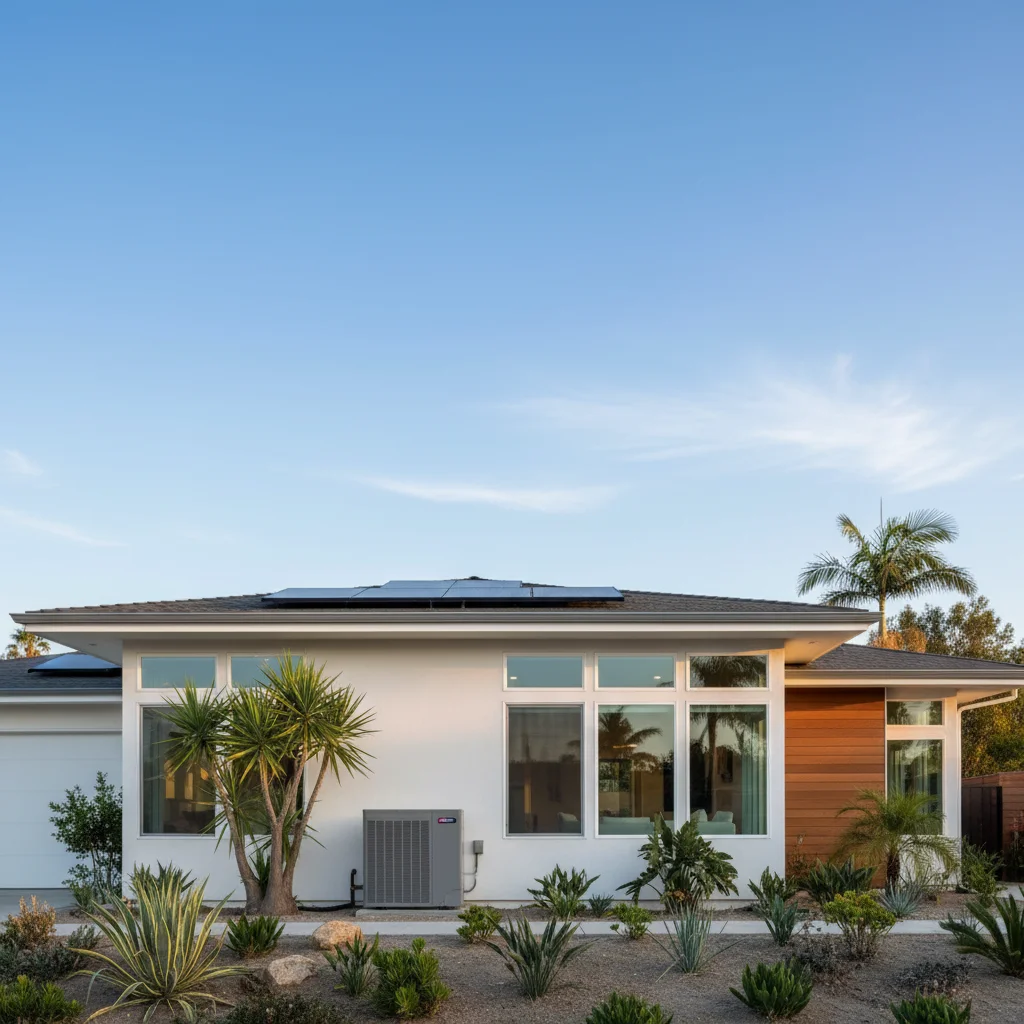
San Diego homeowners replaced over 12,000 gas furnaces with electric heat pumps in 2025—a 340% jump from 2023—driven by stacked state and utility rebates that can cover up to $14,000 of installation costs. And with California's building decarbonization mandates accelerating and natural gas rates climbing 18% year-over-year, the financial case for switching has never been stronger.
What Heat Pump Rebates Are Available in San Diego Right Now?
San Diego homeowners in 2026 qualify for up to $14,000 in combined incentives through three primary programs: the federal IRA High-Efficiency Electric Home Rebate (up to $8,000), the California Tech Clean California initiative (up to $3,000), and San Diego Gas & Electric's Heat Pump Water Heater Rebate program (up to $3,000 for whole-home conversions). These programs stack—homeowners can claim all three simultaneously if they meet income and equipment requirements. But each program operates on a first-come, first-served basis with finite annual budgets that typically deplete by Q3.
The federal IRA rebate covers air-source and ground-source heat pumps with SEER2 ratings of 16 or higher. California's Tech Clean California program prioritizes low-to-moderate income households earning up to 150% of area median income. SDG&E's program requires contractor pre-approval and equipment from their qualified product list. And the application windows don't align—federal applications opened March 1, 2026, while SDG&E's program runs on rolling quarterly cycles.
"The High-Efficiency Electric Home Rebate Program provides up to $8,000 for heat pump installations in households earning less than 150% of area median income." — U.S. Department of Energy
How Much Can You Save With San Diego Heat Pump Rebates?
A typical 3-ton air-source heat pump installation costs $12,000-$18,000 in San Diego County before incentives. After applying all available 2026 rebates, net costs drop to $4,000-$6,000 for qualifying households—a 67-75% reduction. So a moderate-income family (120% AMI) installing a $15,000 system receives $8,000 federal + $3,000 state + $2,000 utility rebates, paying just $2,000 out of pocket. And annual cooling and heating costs drop by an average of $840 per year compared to legacy gas furnace and central AC systems, delivering a 2.4-year payback on the remaining investment.
Ground-source (geothermal) heat pumps qualify for higher rebates but carry steeper upfront costs of $25,000-$35,000. The federal 30% energy tax credits program covers these systems through 2032, offering up to $10,500 in tax credits for a $35,000 installation. But geothermal rebates don't stack with the IRA point-of-sale rebate—homeowners must choose one program. So air-source systems deliver faster ROI for most San Diego properties, while geothermal makes sense for larger homes with high cooling loads above 5 tons.
Calculate your exact savings with our free rebate calculator by entering your zip code, household income, and current HVAC system details.
What Documentation Do You Need to Claim Your Heat Pump Rebate?
Federal IRA rebates require three core documents: a completed DOE Form 50121, proof of household income (recent tax return or three months of pay stubs), and contractor certification of equipment specifications. California Tech Clean California adds a fourth requirement—a pre-installation energy assessment from a BPI-certified auditor. SDG&E's program requires pre-approval through their online portal with uploaded photos of existing equipment and a contractor's bid. And all three programs mandate final inspection reports with photos, invoices, and serial numbers before releasing funds.
Income documentation determines rebate tiers. Households below 80% AMI ($72,000 for a family of four in San Diego County) qualify for 100% of the federal rebate. Households between 80-150% AMI ($72,000-$135,000) receive 50%. So a family earning $85,000 gets $4,000 federal instead of $8,000. But state and utility rebates don't tier—they're all-or-nothing based on binary income thresholds.
Missing documents cause 42% of rebate application rejections, according to California Energy Commission data. The most common error: submitting invoices before final inspection. Most programs require sequential submission—pre-approval first, then installation, then inspection, then payment request. And federal rebates process through state-administered portals with 60-90 day processing times once complete applications arrive.
What's the Deadline for Applying for Heat Pump Rebates in San Diego?
The federal IRA High-Efficiency Electric Home Rebate program runs through December 31, 2031, with annual state-level funding allocations. California received $306 million for 2026, enough for approximately 38,000 whole-home heat pump installations statewide. But funding operates on a first-filed, first-approved basis—California's 2025 allocation depleted by September 18. So experts recommend submitting applications in Q1 or Q2 to avoid year-end shortfalls.
SDG&E's rebate program resets quarterly with $4.2 million per quarter for residential heat pump conversions. Q1 2026 funds exhausted by February 28, pushing 3,200 applications to Q2. And the utility doesn't allow retroactive applications—homeowners must pre-register before signing installation contracts. Applications submitted post-installation are automatically denied, even if funds remain available.
California's Tech Clean California program runs through June 30, 2027, with no annual resets. But the $500 million budget supports an estimated 166,000 projects, and the program has already processed 89,000 applications as of March 2026. So the window narrows monthly. Pre-approved contractors can reserve rebate funds for up to 120 days, locking in availability during permitting and installation.
Are You Eligible for San Diego Heat Pump Rebates?
Federal IRA rebates require household income below 150% area median income—$135,000 for a four-person household in San Diego County as of 2026. California Tech Clean California uses the same threshold but adds a geographic qualifier: properties must be owner-occupied primary residences, not rental units or second homes. SDG&E's program has no income restriction but requires active SDG&E electric service and replacement of a functional gas furnace or electric resistance heating system.
Equipment eligibility varies by program. Federal rebates mandate ENERGY STAR Most Efficient certification or SEER2 ≥16 for air-source systems and EER ≥14 for ground-source. California adds a refrigerant requirement—systems using R-410A refrigerant don't qualify after January 1, 2026, only R-32 or R-454B low-GWP alternatives. And SDG&E maintains a qualified products list with 47 approved models as of April 2026—installers must use listed equipment or applications get rejected.
Multi-family properties face different rules. Buildings with 1-4 units qualify for single-family rebates if each unit has separate HVAC systems. Properties with 5+ units fall under commercial programs with different incentive structures—typically $500-$1,500 per ton rather than per-household flat rates. So a 12-unit building installing individual heat pumps in each apartment uses the commercial pathway, not residential.
How Does the Heat Pump Rebate Process Work in San Diego?
The application process requires five sequential steps. First, schedule a pre-installation energy assessment with a BPI-certified auditor if claiming state rebates—this costs $200-$400 but is required for Tech Clean California eligibility. Second, obtain contractor bids and submit pre-approval applications to SDG&E's portal—this reserves rebate funds for 120 days. Third, file federal pre-approval through California's IRA rebate portal at CalIRA.energy.gov—processing takes 10-15 business days.
Fourth, complete installation with a licensed HVAC contractor (California C-20 or C-10 license required). Contractors must submit pre-installation and post-installation photos showing equipment model numbers, serial numbers, and installation quality. And installations must pass city or county building department inspection—the inspection certificate is mandatory for all three rebate programs. Fifth, submit final payment requests with uploaded invoices, inspection reports, and contractor certifications. Federal rebates arrive as direct deposits 60-90 days after approval. State rebates process in 30-45 days. SDG&E credits appear on utility bills within two billing cycles.
Pro tip: Work with an SDG&E Energy Solutions contractor—they handle all paperwork and application submissions as part of installation service, reducing homeowner administrative burden to near zero. And these contractors pre-negotiate equipment costs with rebates already factored into quotes.
Official Sources
- U.S. Department of Energy - Home Energy Rebates — Federal IRA rebate program details and state administrator contacts
- ENERGY STAR Heat Pumps — Equipment efficiency requirements and qualified product lists
- DSIRE - California Incentives — Comprehensive database of state and utility rebate programs
Related Reading: Learn more about Heat Pump Rebates San Francisco and Heat Pump Rebates San Jose.
Frequently Asked Questions
What are the eligibility requirements for heat pump rebates in San Diego?
Federal rebates require household income below 150% area median income ($135,000 for a family of four in San Diego County as of 2026) and replacement of existing fossil fuel heating systems. California Tech Clean California requires owner-occupied primary residences and BPI-certified energy assessments. SDG&E's program requires active electric service accounts and pre-approval before installation. All programs mandate ENERGY STAR certified equipment with SEER2 ratings of 16 or higher.
How much money can I get back from a heat pump rebate in San Diego?
Combined federal, state, and utility rebates total up to $14,000 for qualifying San Diego homeowners in 2026. The federal IRA program provides up to $8,000, California Tech Clean California offers up to $3,000, and SDG&E contributes up to $3,000 for whole-home conversions. Actual amounts depend on household income tier and equipment specifications. Moderate-income households earning 80-150% AMI receive 50% of federal rebates ($4,000 instead of $8,000).
What is the application process for San Diego heat pump rebates?
Applications require five sequential steps: pre-installation energy assessment, contractor bid and SDG&E pre-approval, federal pre-approval through California's IRA portal, installation with building department inspection, and final payment request with uploaded documentation. Processing times range from 30-90 days depending on program. SDG&E Energy Solutions contractors handle all paperwork as part of installation service, eliminating most homeowner administrative tasks.
When is the deadline to apply for heat pump rebates in San Diego?
Federal IRA rebates run through December 31, 2031, but California's $306 million annual allocation typically depletes by Q3 each year. SDG&E's quarterly funding resets January 1, April 1, July 1, and October 1 with $4.2 million per quarter—Q1 2026 funds exhausted by February 28. California Tech Clean California runs through June 30, 2027, with no annual resets but finite $500 million total budget. Applications operate first-come, first-served within each program.
How do heat pump rebates compare to other HVAC incentives in San Diego?
Heat pump rebates deliver 67-75% cost reductions versus 15-30% for traditional HVAC upgrades like high-efficiency furnaces or AC units. So a $15,000 heat pump installation nets $4,000-$6,000 after rebates, while a $10,000 gas furnace replacement receives only $1,500-$2,000. And heat pump rebates stack with federal tax credits—homeowners can claim both the IRA point-of-sale rebate and the 30% tax credit (these federal credits ended for projects completed after December 31, 2025) on geothermal systems installed before 2033.
Ready to find out exactly how much you can save? Use our rebate calculator to get a personalized estimate based on your home, income, and current HVAC system. Enter your San Diego zip code to see all available federal, state, and utility incentives in under 60 seconds.
Last updated April 14, 2026 — reviewed by DuloCore Editorial. About our authors.
Check your California heat pump rebate eligibility — see the programs you qualify for and the dollar amounts on our California heat pump rebate finder.