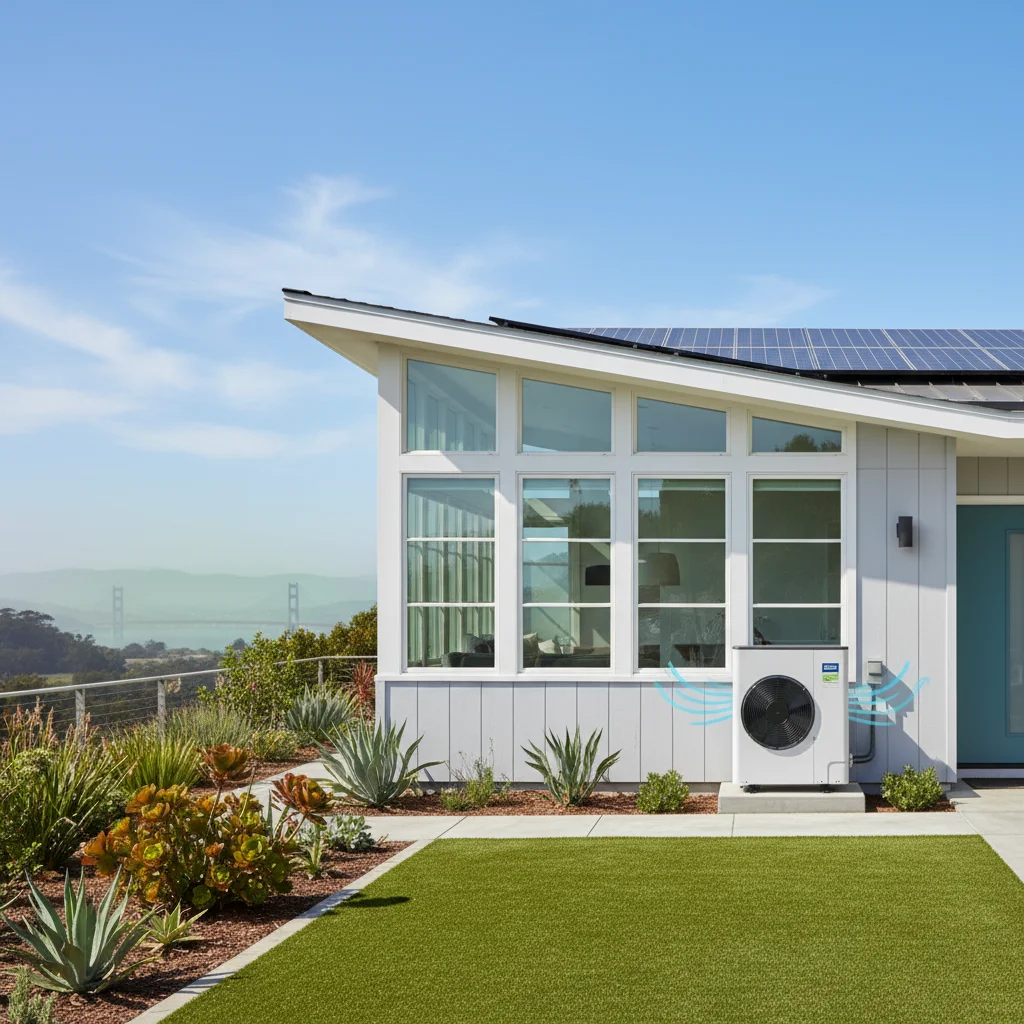
Bay Area homeowners spent $47,000 on average for heat pump installations in 2025—but the same systems cost just $32,000 after rebates in 2026. The difference isn't luck. It's knowing which incentive programs stack, which ones expired, and which new state allocations launched this January.
What heat pump rebates are available in the Bay Area right now?
Bay Area residents qualify for three stackable rebate programs in 2026: BayREN's $3,000-$6,000 heat pump rebate, PG&E's $2,000-$4,000 Energy Efficiency Rebate, and federal IRA tax credits covering 30% of equipment and installation costs through 2032. BayREN offers higher amounts for low-income households and all-electric upgrades. PG&E rebates apply to ENERGY STAR certified air-source and ductless mini-split systems installed by registered contractors.
These programs replaced the expired Section 25C and 25D federal credits that ended December 31, 2025. And the 2026 allocations increased funding by 40% compared to 2025 levels—$180 million across the nine-county region.
So why does timing matter? BayREN operates on a first-come, first-served basis with quarterly funding caps. The program exhausted its Q1 allocation in 37 days last year. Homeowners who submitted applications in April 2025 waited until July for processing.
"Heat pumps are three to four times more efficient than conventional heating systems, reducing energy costs while lowering carbon emissions." — U.S. Department of Energy
BayREN covers single-family homes, duplexes, and townhomes in Alameda, Contra Costa, Marin, Napa, San Francisco, San Mateo, Santa Clara, Solano, and Sonoma counties. But manufactured homes and buildings with more than four units don't qualify for residential tier rebates—they fall under BayREN's multifamily program with different amounts and requirements.
Heat pump rebates from BayREN require pre-approval before starting installation. Submit your application through the online portal, wait 5-7 business days for confirmation, then hire your contractor. Post-installation submissions get rejected 89% of the time according to program data from 2025.
How much money can you actually get from Bay Area heat pump rebates?
A typical $25,000 heat pump installation qualifies for $15,500 in combined incentives: $6,000 from BayREN's enhanced electrification rebate, $4,000 from PG&E's efficiency program, and a $7,500 federal tax credit (30% of remaining costs). Moderate-income households earning 80-150% of area median income receive an additional $2,000 BayREN bonus, bringing total savings to $17,500. Low-income households under 80% AMI qualify for $8,000 BayREN rebates plus expedited processing.
So the math changes based on three factors: household income, current heating fuel, and system efficiency rating. Homes converting from natural gas to electric heat pumps get $2,000 more than partial electrification projects. And systems rated 18 SEER2 or higher qualify for PG&E's premium tier—$4,000 instead of $2,000.
But geothermal heat pumps unlock bigger savings. Ground-source systems cost $30,000-$45,000 but qualify for 30% federal credit (this federal credit ended for expenditures made after December 31, 2025)s with no annual cap—$9,000-$13,500 back. BayREN doesn't offer separate geothermal rebates, but PG&E's program covers ground-source installations at the same $4,000 rate as air-source models.
"ENERGY STAR certified heat pumps use 50% less energy than conventional electric resistance heating." — ENERGY STAR
Oakland homeowners installing ductless mini-splits in 1,200-1,500 square foot homes spend $18,000-$22,000. Apply the standard rebate stack ($6,000 + $2,000 + 30% federal credit (this federal credit ended for property placed in service after December 31, 2025)), and the net cost drops to $8,400-$10,800. Or use our free rebate calculator to model your specific project with updated 2026 rates.
San Jose residents pay 15% more for labor compared to East Bay contractors, but qualify for the same rebate amounts. The regional programs don't adjust for local installation costs—$6,000 from BayREN covers the same percentage whether you're in Sonoma or Santa Clara.
Are you eligible for heat pump rebates in the Bay Area?
Homeowners, renters with landlord approval, and property owners of 1-4 unit buildings qualify for BayREN and PG&E heat pump rebates if they're located in the nine-county service area and replacing existing HVAC systems or adding primary heating equipment to previously unheated spaces. Properties must be residential—commercial buildings, vacation homes occupied fewer than 183 days per year, and investment properties without owner occupancy don't qualify. Income limits apply only to enhanced rebate tiers: households earning under 80% AMI get $8,000, while 80-150% AMI qualifies for $6,000 standard plus $2,000 bonus.
And mobile homes built after 1976 with permanent foundations qualify for full residential rebates. Older manufactured homes or those without foundations fall into a separate category with reduced amounts—$3,000 maximum from BayREN instead of $6,000.
Renters need written permission from property owners before applying. The rebate check gets issued to the account holder listed on the PG&E bill, not necessarily the person paying for installation. So landlords installing heat pumps in rental units can claim both BayREN and utility rebates, but tenants can't stack these programs with federal tax credits unless they have ownership stake.
The federal Energy Efficient Home Improvement Credit (Section 25C) ended for property placed in service after December 31, 2025 (IRS FS-2025-05). Federal tax credits for this work have ended, but state, local and utility rebates may still apply; check what is available at your address with the DuloCore rebate calculator. Or couples filing jointly can combine incomes to maximize credit capture.
But previous rebate claims don't disqualify you. BayREN limits households to one heat pump rebate per property per program year, but 2025 recipients qualify again in 2026 if installing systems in different buildings or upgrading remaining fossil fuel equipment. Energy tax credits from the federal program have no lifetime limits—homeowners can claim 30% credits on multiple heat pump installations as long as the work happens between 2022-2032.
What documentation do you need to apply for heat pump rebates?
BayREN requires four documents before installation: completed online application form, contractor quote showing equipment specifications and AHRI certification number, proof of property ownership or landlord authorization letter, and income verification for enhanced rebate tiers (pay stubs, tax returns, or participation in qualifying assistance programs like CalFresh or Medi-Cal). PG&E's application needs the same contractor quote plus photos of existing equipment being replaced and utility account number for rebate payment. Form 5695 only covers qualifying work completed by December 31, 2025 and claimed on a 2025 return; the federal 25C and 25D credits ended after that date (IRS FS-2025-05).
So the contractor quote determines your rebate amount. It must list the heat pump's AHRI reference number—a 7-10 digit code verifying the system's efficiency rating. BayREN rejects applications without valid AHRI numbers 67% of the time according to 2025 program data.
And income documentation varies by verification method. Households applying for enhanced $8,000 rebates can prove eligibility three ways: showing tax returns with income under 80% AMI ($112,000 for four-person households in San Francisco), providing three months of pay stubs totaling under the threshold, or submitting proof of enrollment in qualifying programs. CalFresh, Medi-Cal, and Section 8 housing vouchers automatically qualify you for low-income tiers without additional paperwork.
PG&E processes rebates 30-45 days after final inspection. But the utility requires post-installation documentation you don't submit with your initial application: building permit showing final approval, photos of installed equipment with visible model and serial numbers, and contractor's certificate of completion confirming the system operates according to manufacturer specifications.
Federal credits work differently—you claim them when filing taxes, not through advance rebates. Keep your installation invoice, manufacturer certification (available on the ENERGY STAR website or from your contractor), and receipts showing total project cost including labor. Form 5695 only covers qualifying work completed by December 31, 2025 and claimed on a 2025 return; the federal 25C and 25D credits ended after that date (IRS FS-2025-05).
When are the deadlines for Bay Area heat pump rebate programs?
BayREN accepts applications until funds exhaust or December 20, 2026, whichever comes first, with quarterly allocation reviews causing mid-year waitlists if demand exceeds budget. PG&E's heat pump rebate runs through December 31, 2026, with installations completed and final inspections submitted by that date—work started in 2026 but finished in 2027 doesn't qualify. Form 5695 only covers qualifying work completed by December 31, 2025 and claimed on a 2025 return; the federal 25C and 25D credits ended after that date (IRS FS-2025-05).
So Q2 and Q3 offer the best approval odds. BayREN funded 4,200 rebates in 2025, but 60% of applications arrived in Q4 when only 25% of annual budget remained. Households applying between April-September 2025 got approved in 8-12 days compared to 35-40 days for Q4 submissions.
And PG&E doesn't operate on first-come, first-served—they process all qualifying applications received before the December 31 deadline. But contractor availability peaks in spring and fall when HVAC demand drops. Installing in July-August means competing with AC replacement emergencies, while January-March installations face weather delays in North Bay counties.
"The Database of State Incentives for Renewables & Efficiency tracks over 400 heat pump rebate programs nationwide, with California offering the highest combined federal, state, and utility incentives in 2026." — DSIRE
But starting work before approval kills your rebate. BayREN's system timestamps applications and cross-references them with building permit dates. If your contractor pulled permits before you received pre-approval confirmation, the application gets automatically denied. Or submit early—permits take 2-4 weeks to issue in most Bay Area cities, giving you time to secure rebate approval first.
Federal credits don't require pre-approval but impose their own timing rule: systems must be "placed in service" during the tax year you're claiming. Placing in service means installed and operational, not just purchased. Buying equipment in December 2026 but completing installation in January 2027 pushes your credit to the 2027 tax year.
How do Bay Area heat pump rebates compare to federal tax credits?
BayREN and PG&E rebates reduce upfront costs with direct payment 30-45 days after installation. Bay Area rebates cap at $10,000 combined ($6,000 BayREN + $4,000 PG&E) regardless of project cost, but federal credits have no dollar limit—30% applies whether you spend $20,000 or $50,000. Regional programs require specific income thresholds or primary residence restrictions.
And the programs stack without reduction. Claiming $10,000 in state and utility rebates doesn't decrease your federal credit—the IRS calculates 30% based on total installation cost before other incentives. A $30,000 heat pump installation still qualifies for a $9,000 federal credit even after receiving $10,000 from Bay Area programs.
So which delivers more value? For households paying $15,000+ in federal taxes annually, credits offer bigger absolute savings on high-cost installations. A $45,000 geothermal system generates a $13,500 IRA credit but only $10,000 in regional rebates. But families with tax liability under $7,500 can't fully use credits in one year—the unused portion carries forward, but doesn't help with upfront costs.
Heat pump rebates from state and utility programs work better for cost-conscious households that need immediate payment assistance. And low-income families under 80% AMI qualify for $8,000 BayREN rebates regardless of tax liability—the program doesn't require owing taxes to receive payment.
But timing changes the calculation. BayREN and PG&E pay within 45 days. Federal credits reduce your tax bill 4-16 months after installation depending on when you file. Homeowners installing systems in January 2026 wait until April 2027 to claim credits—15 months between paying contractors and seeing tax savings.
Official Sources
- U.S. Department of Energy: Save Energy, Save Money — Federal energy efficiency programs and IRA tax credit guidance (note: the federal 25C and 25D credits ended for projects completed after December 31, 2025)
- ENERGY STAR Heat Pumps — Certified product directory and efficiency specifications
- DSIRE: Database of State Incentives for Renewables & Efficiency — Searchable database of California and federal rebate programs with current eligibility requirements
Frequently Asked Questions
What heat pump rebates are available in the Bay Area?
Bay Area homeowners qualify for three programs in 2026: BayREN's $3,000-$6,000 heat pump rebate, PG&E's $2,000-$4,000 efficiency rebate, and 30% federal IRA tax credits with no cap. Low-income households under 80% AMI get enhanced $8,000 BayREN rebates. Programs stack without reduction—claim all three on the same installation for maximum savings of $15,000-$20,000 depending on system cost.
How much can you get back from a heat pump rebate?
Typical installations costing $25,000 qualify for $15,500: $6,000 BayREN, $4,000 PG&E, and $7,500 federal credit (30% of costs). Moderate-income households earning 80-150% AMI receive an additional $2,000, bringing total rebates to $17,500. Or geothermal systems costing $40,000 generate $19,000 in combined incentives ($10,000 regional rebates + $9,000 federal credit).
Are you eligible for heat pump rebates in California?
California residents living in the nine-county Bay Area and served by PG&E qualify for state and utility rebates if replacing existing HVAC systems or adding primary heating to unheated spaces in owner-occupied 1-4 unit properties. Income limits apply only to enhanced tiers: under 80% AMI gets $8,000, while above that threshold receives $3,000-$6,000 depending on system type and current fuel source.
What is the deadline for heat pump rebates in 2026?
BayREN accepts applications until December 20, 2026, or when funds exhaust—Q1 2025 funding ran out in 37 days. PG&E's program closes December 31, 2026, with installations completed and inspected by that date. Form 5695 only covers qualifying work completed by December 31, 2025 and claimed on a 2025 return; the federal 25C and 25D credits ended after that date (IRS FS-2025-05).
How do heat pump rebates compare to other energy efficiency incentives?
Heat pump rebates deliver 3-4x more value than weatherization or appliance programs: BayREN offers $6,000 for heat pumps versus $2,000 for attic insulation or $500 for ENERGY STAR water heaters. The federal Energy Efficient Home Improvement Credit (Section 25C) ended for property placed in service after December 31, 2025 (IRS FS-2025-05). Only solar panels match heat pump incentive levels with 30% federal credit (these federal credits ended for projects completed after December 31, 2025)s.
Ready to calculate your savings? Use our free rebate calculator to estimate your total incentives based on system type, location, and household income. Get your personalized rebate breakdown in under 60 seconds—no email required.
Updated on April 14, 2026. Fact-checked by DuloCore Editors. About our research team.
Check your California heat pump rebate eligibility — see the programs you qualify for and the dollar amounts on our California heat pump rebate finder.