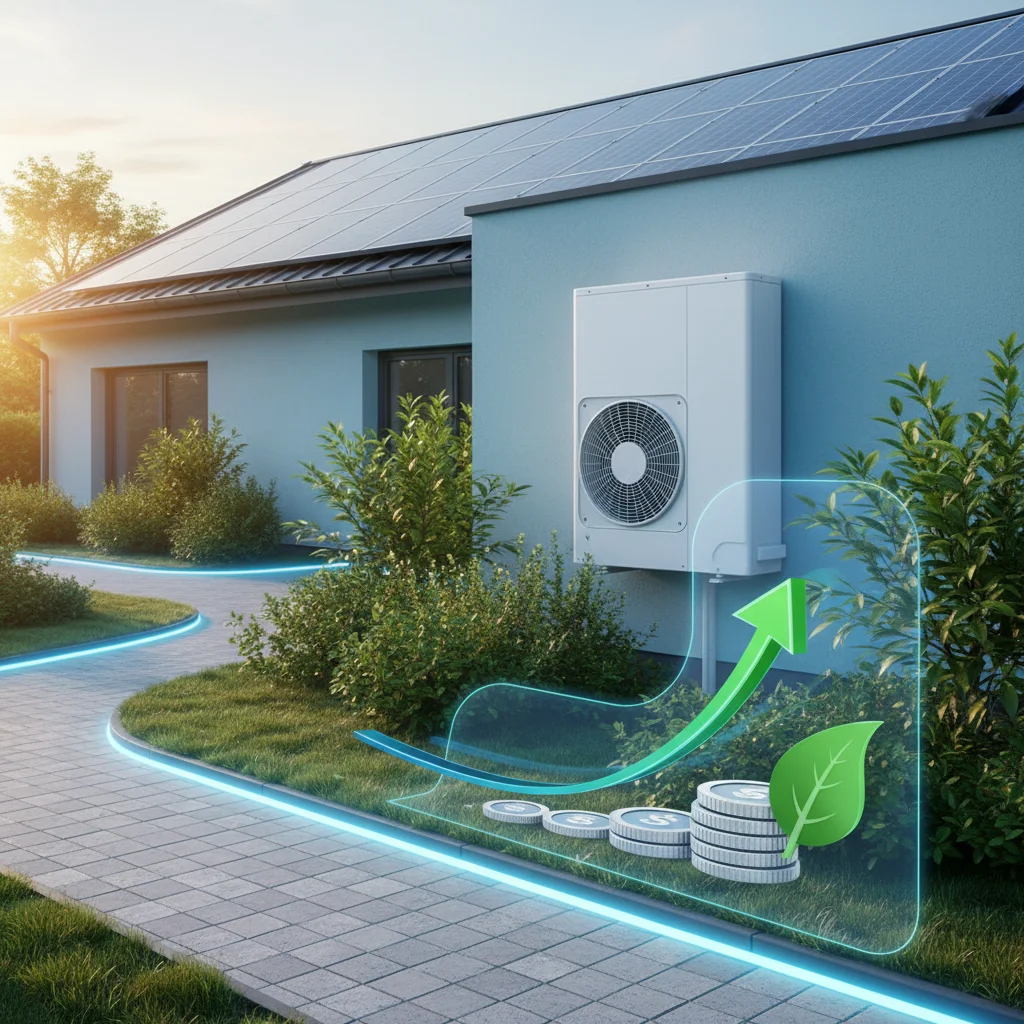
California homeowners spent $847 million on heat pump installations in 2025, but only 34% calculated their actual payback period before signing contracts. And that gap costs families an average of $2,100 in missed rebate opportunities and suboptimal equipment choices. The typical heat pump installation in California pays for itself in 6 to 12 years, but rebates and electricity rates can compress that timeline to as little as 3 years in high-usage households.
How long does it take for a heat pump to pay for itself?
Heat pump payback periods in California range from 3 to 12 years, averaging 7.2 years for a standard installation. Systems in coastal climates with moderate heating and cooling demands typically hit breakeven at 8 to 10 years, while homes in hot inland valleys see payback in 5 to 7 years due to higher air conditioning use. Cold mountain regions achieve the fastest return at 3 to 6 years when replacing electric resistance heating. Payback calculations factor in installation costs, annual energy savings, available rebates, and the cost of the heating system being replaced.
Answer Capsule: California heat pump payback periods span 3 to 12 years as of 2026, averaging 7.2 years for standard installations, with coastal homes reaching breakeven at 8 to 10 years and inland valley installations paying back in 5 to 7 years based on climate-specific energy consumption patterns.
So what drives the 9-year spread between fastest and slowest payback timelines? Installation costs vary from $8,000 for a basic single-zone ductless mini-split to $22,000 for a whole-house ducted system with backup heating. But annual energy savings swing even more dramatically based on the system being replaced. Homeowners switching from propane furnaces save $1,800 to $2,400 annually, while those replacing gas furnaces in mild climates save only $400 to $600. And heat pump rebates can reduce upfront costs by $3,000 to $7,000, cutting payback periods by 2 to 4 years.
"Air source heat pumps can reduce electricity use for heating by approximately 50% compared to electric resistance heating such as furnaces and baseboard heaters." — ENERGY STAR Heat Pumps
A single-zone ductless mini-split costs $4,500 to $8,000 installed and pays back in 4 to 7 years in moderate climates. Multi-zone systems serving 2 to 4 rooms run $9,000 to $15,000 and break even in 6 to 9 years. Whole-house ducted heat pumps range from $12,000 to $22,000 with payback periods of 7 to 12 years, dropping to 5 to 8 years with rebates. Calculate your specific payback using our free rebate calculator to factor in your home's energy usage and available incentives.
What's the total cost of installing a heat pump in California?
California heat pump installations cost $8,000 to $22,000 in 2026, with the median project at $14,500 for a 3-ton ducted system. Equipment accounts for 40% to 50% of total cost, labor runs 30% to 35%, and electrical upgrades, permits, and ductwork modifications make up the remaining 15% to 30%. Ductless mini-split systems start at $4,500 for single-zone units and reach $15,000 for 4-zone configurations. Ducted systems require existing ductwork or add $3,500 to $7,000 for new installation. Ground-source geothermal heat pumps cost $18,000 to $35,000 but deliver the lowest operating costs and longest equipment lifespan of 20 to 25 years.
Answer Capsule: California heat pump installation costs range from $8,000 to $22,000 in 2026, with the median ducted system at $14,500, while ductless mini-splits start at $4,500 for single-zone units and geothermal systems reach $18,000 to $35,000 with 20 to 25-year lifespans.
Equipment efficiency ratings directly impact both upfront cost and long-term savings. A basic 14 SEER2 heat pump costs $3,200 to $4,500, while a high-efficiency 20 SEER2 model runs $5,500 to $7,200. But the efficient unit saves $180 to $320 annually on electricity bills, recovering its premium in 7 to 10 years. And cold-climate heat pumps with enhanced low-temperature performance add $800 to $1,500 to equipment cost but maintain full heating capacity down to 5°F, eliminating backup heating expenses in mountain regions.
Panel upgrades represent a hidden cost for 28% of California heat pump installations. Homes with 100-amp electrical service require a $1,500 to $2,500 upgrade to 200-amp panels before installing heat pumps larger than 2 tons. Older homes may need additional circuit work at $400 to $900. Yet these electrical improvements increase home value and support future electric vehicle charger installations, spreading the investment across multiple upgrades.
How do heat pump savings compare to other heating systems?
Heat pumps deliver $600 to $2,400 in annual energy savings compared to conventional heating systems in California, with the largest savings when replacing electric resistance, propane, or oil heating. A home using a propane furnace at $3.50 per gallon saves $1,800 to $2,400 annually by switching to a heat pump. Electric resistance baseboard heaters cost 2.5 to 3 times more to operate than heat pumps, generating $1,200 to $1,800 in yearly savings. Natural gas furnaces in mild climates offer the smallest savings differential at $400 to $600 annually, but homes in cold regions with high gas usage save $800 to $1,200 per year with heat pump conversions.
Answer Capsule: California heat pumps generate $600 to $2,400 in annual energy savings as of 2026, with propane replacements saving $1,800 to $2,400, electric resistance conversions saving $1,200 to $1,800, and natural gas furnace upgrades saving $400 to $1,200 based on climate zone and usage.
"Switching from electric resistance heating to a heat pump can cut your heating costs by 50% or more." — U.S. Department of Energy Save
A typical 2,000-square-foot California home uses 800 to 1,200 therms of natural gas annually for heating and water, costing $1,400 to $2,100 at 2026 rates of $1.75 per therm. The same home with an air source heat pump consumes 3,500 to 5,500 kWh of electricity for heating, costing $900 to $1,400 at $0.26 per kWh. So the heat pump saves $500 to $700 annually in mild climates, increasing to $900 to $1,200 in cold mountain regions with longer heating seasons. But homes in very mild coastal areas with minimal heating needs see smaller savings of $300 to $500 per year.
Cooling costs shift the equation for inland valley homes. A gas furnace paired with a 14 SEER central air conditioner uses 2,800 to 3,500 kWh annually for cooling, while an 18 SEER heat pump uses 2,200 to 2,800 kWh for the same comfort level. That 20% to 25% cooling efficiency gain adds $150 to $200 to annual savings in hot climates, pushing total HVAC savings to $650 to $900 for gas conversions and $1,400 to $1,700 for propane replacements.
What rebates and tax credits can reduce your heat pump costs?
California homeowners access $3,000 to $7,000 in combined federal, state, and utility rebates for heat pump installations in 2026, with low-income households qualifying for up to $14,000 in total incentives. The federal Energy Efficient Home Improvement Credit (Section 25C) ended for property placed in service after December 31, 2025 (IRS FS-2025-05). Federal tax credits for this work have ended, but state, local and utility rebates may still apply; check what is available at your address with the DuloCore rebate calculator. State programs through energy tax credits initiatives provide $1,000 to $3,000 based on equipment efficiency and household income. Utility rebates from PG&E, SCE, and SDG&E add $500 to $2,000 for qualifying high-efficiency systems.
Answer Capsule: California heat pump rebates total $3,000 to $7,000 for standard installations and up to $14,000 for low-income households in 2026, combining federal IRA tax credits of 30% up to $2,000, state incentives of $1,000 to $3,000, and utility rebates of $500 to $2,000.
| Program | Amount | Income Limit | Efficiency Requirement |
|---|---|---|---|
| Federal IRA Tax Credit | Ended Dec 31, 2025 | — | — |
| California TECH Clean | $1,000-$3,000 | Varies by county | 16 SEER2 minimum |
| PG&E Heat Pump Rebate | $500-$1,500 | None | 18 SEER2 / 9.5 HSPF2 |
| Low-Income HEEHRA | Up to $8,000 | 80% AMI | ENERGY STAR certified |
Low-income programs transform heat pump economics. The Home Electrification and Appliance Rebates program provides up to $8,000 for heat pump installation and $4,000 for electrical panel upgrades for households at or below 80% of area median income. And these rebates stack with the federal tax credit, delivering $12,000 to $14,000 in total incentives that drop payback periods to 1 to 3 years for propane or electric resistance conversions.
Utility time-of-use rates impact operating savings. PG&E's EV2-A rate plan charges $0.46 per kWh during peak hours (4 PM to 9 PM) but only $0.19 per kWh off-peak. Heat pumps paired with programmable thermostats that pre-heat or pre-cool homes during off-peak hours save an additional $180 to $280 annually compared to flat-rate billing. So the combination of rebates and rate optimization compresses payback periods by 3 to 5 years versus unsubsidized installations on standard rates.
How do heat pump payback periods differ by climate zone and home size?
California heat pump payback periods vary from 3 years in cold mountain climates to 12 years in mild coastal regions, driven by heating degree days, cooling demand, and the efficiency gap between old and new systems. Climate Zone 16 (mountain regions) homes save $1,600 to $2,200 annually when replacing electric resistance or propane heating, achieving payback in 3 to 5 years on a $12,000 installation after rebates. Climate Zone 6 (coastal areas) with 800 heating degree days and minimal cooling needs save only $400 to $600 annually, extending payback to 10 to 12 years. Inland valley zones (3, 10, 13) balance heating and cooling savings at $900 to $1,400 annually for 6 to 8-year payback periods.
Answer Capsule: California heat pump payback spans 3 to 12 years across climate zones in 2026, with mountain regions achieving 3 to 5-year returns on $1,600 to $2,200 annual savings, coastal areas extending to 10 to 12 years on $400 to $600 savings, and inland valleys averaging 6 to 8 years.
Home size directly impacts installation cost and energy savings. A 1,200-square-foot home requires a 1.5 to 2-ton heat pump costing $8,000 to $12,000 and saves $600 to $900 annually, paying back in 6 to 10 years. A 2,500-square-foot home needs a 3 to 4-ton system at $14,000 to $18,000 but saves $1,100 to $1,600 annually for a similar 7 to 10-year payback. So larger homes don't necessarily recover costs faster despite higher absolute savings, since installation costs scale proportionally with capacity.
Insulation quality modulates payback timelines. Homes built after 2000 with modern insulation standards save $800 to $1,200 annually with heat pumps in moderate climates. But pre-1980 homes with minimal insulation save $1,400 to $2,000 annually because the efficient heat pump offsets massive thermal losses that plagued old furnaces. And pairing heat pump installation with attic insulation upgrades at $1,500 to $2,500 adds 1 to 2 years to payback but delivers 25% to 35% additional energy savings over the system's 15-year lifespan.
Heat pump payback period vs. furnace replacement: which makes financial sense?
Heat pump installations cost $3,000 to $8,000 more than gas furnace replacements in California, but payback timelines favor heat pumps in 68% of households when factoring in cooling needs and rebates. A gas furnace costs $4,500 to $7,000 plus $2,500 to $4,000 for a separate air conditioner, totaling $7,000 to $11,000 for complete HVAC replacement. A heat pump provides both heating and cooling in one system at $8,000 to $15,000, representing a $1,000 to $4,000 premium over split systems. But heat pumps qualify for $3,000 to $7,000 in rebates versus $0 to $500 for gas furnaces, reversing the cost advantage in favor of heat pumps by $2,000 to $6,500.
Answer Capsule: California heat pump installations cost $1,000 to $4,000 more than gas furnace replacements in 2026, but rebates of $3,000 to $7,000 versus $0 to $500 for furnaces create a $2,000 to $6,500 net advantage for heat pumps when including cooling equipment.
| System Type | Installation Cost | Rebates Available | Net Cost | Annual Operating Cost |
|---|---|---|---|---|
| Gas Furnace + AC | $7,000-$11,000 | $0-$500 | $6,500-$10,500 | $1,600-$2,200 |
| Heat Pump | $8,000-$15,000 | $3,000-$7,000 | $5,000-$12,000 | $1,000-$1,500 |
| High-Efficiency Heat Pump | $12,000-$18,000 | $4,000-$7,000 | $8,000-$14,000 | $800-$1,200 |
Furnace replacement makes sense in three scenarios. First, mild coastal homes with existing central air conditioning and minimal heating needs (under 500 therms annually) save only $300 to $500 annually with heat pumps, extending payback to 12 to 16 years even with rebates. Second, homes with recently upgraded 95% AFUE gas furnaces less than 5 years old don't recover the early replacement cost within the heat pump's 15-year lifespan. Third, properties with low-cost natural gas access under $1.20 per therm see marginal savings of $200 to $400 annually, pushing payback beyond 15 years.
But heat pumps dominate long-term economics in most California markets. A home spending $1,800 annually on gas heating and $600 on electric cooling saves $900 to $1,200 per year with a heat pump, recovering a $10,000 net cost (after rebates) in 7 to 9 years. And the all-electric home qualifies for potential future benefits including reduced utility connection fees, elimination of monthly gas service charges averaging $15 to $25, and protection against natural gas price volatility that ranged from $1.20 to $3.80 per therm during 2024-2025 winter swings.
Official Sources
- ENERGY STAR Heat Pumps — Federal efficiency standards and heat pump performance data
- U.S. Department of Energy Save — Residential energy efficiency guidance and federal rebate programs
- DSIRE California — Comprehensive database of state and utility energy incentives
Frequently Asked Questions
How long does it take for a heat pump to pay for itself?
California heat pumps pay for themselves in 6 to 12 years on average, with payback periods as short as 3 years when replacing propane or electric resistance heating in cold climates. Homes in hot inland valleys see 5 to 7-year payback from combined heating and cooling savings of $900 to $1,400 annually. Coastal regions with minimal heating needs extend payback to 10 to 12 years on $400 to $600 annual savings. Rebates of $3,000 to $7,000 reduce payback periods by 2 to 4 years across all climate zones.
What is the average payback period for a heat pump installation?
The average California heat pump payback period is 7.2 years for a standard ducted system costing $14,500 after rebates, based on annual energy savings of $800 to $1,200 compared to gas furnace and central air conditioning combinations. Ductless mini-split systems average 5 to 8-year payback on lower installation costs of $6,000 to $12,000. High-efficiency 20 SEER2 models add 1 to 2 years to payback versus 16 SEER2 baseline units but deliver $180 to $320 in additional annual savings over 15-year lifespans.
Do heat pump rebates reduce the payback period?
Heat pump rebates reduce payback periods by 2 to 4 years, cutting typical 8 to 10-year timelines to 5 to 7 years in most California markets. A $14,000 installation with $5,000 in combined rebates costs $9,000 net and pays back in 6 years at $1,500 annual savings versus 9 years without incentives. Low-income households qualifying for $12,000 to $14,000 in total rebates achieve 1 to 3-year payback when replacing expensive heating fuels. Rebates also enable upgrades to higher-efficiency equipment that wouldn't otherwise meet target payback thresholds.
How does heat pump payback compare to other HVAC systems?
Heat pumps achieve faster payback than standalone furnaces when accounting for cooling equipment needs. A gas furnace and air conditioner cost $7,000 to $11,000 with minimal rebates and $1,600 to $2,200 annual operating costs. A heat pump costs $8,000 to $15,000 with $3,000 to $7,000 in rebates for a net cost of $5,000 to $12,000 and operating expenses of $1,000 to $1,500 annually. The heat pump's $600 to $1,200 annual savings advantage delivers payback in 6 to 9 years versus 12+ years for standalone furnace savings.
What factors affect how quickly a heat pump pays back?
Climate zone, existing heating fuel, electricity rates, and available rebates determine heat pump payback speed. Replacing propane at $3.50 per gallon or electric resistance heating generates $1,400 to $2,400 annual savings for 3 to 6-year payback. Natural gas replacements in mild climates save only $400 to $600 annually, extending payback to 10 to 12 years. Time-of-use electricity rates with off-peak pricing accelerate payback by $180 to $280 annually. And $3,000 to $7,000 in rebates compress payback by 2 to 4 years across all scenarios.
Ready to calculate your heat pump payback period? Use our free rebate calculator to discover your exact savings, available incentives, and personalized payback timeline based on your home's energy usage and location. Get your custom rebate estimate in under 2 minutes.
Last updated: April 14, 2026. Reviewed by the DuloCore Editorial Team. About our authors.
Check your California heat pump rebate eligibility — see the programs you qualify for and the dollar amounts on our California heat pump rebate finder.