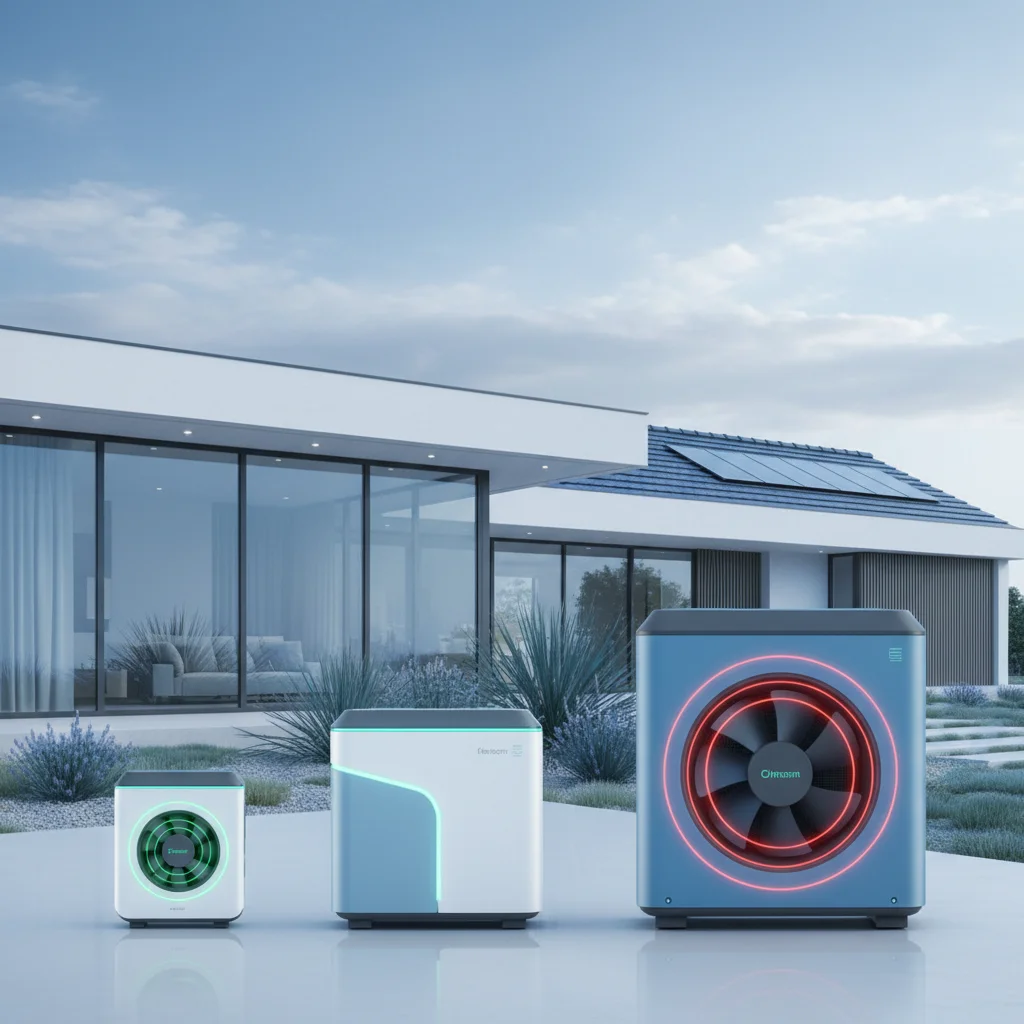
A 65-decibel heat pump running 12 hours daily generates the equivalent sound exposure of living beside a busy restaurant kitchen—and most homeowners don't discover this until after installation. Noise complaints account for 23% of heat pump service calls within the first year, according to 2025 HVAC contractor survey data. And federal rebate programs now tie noise performance to eligibility requirements, making decibel ratings a financial decision worth $8,000 or more in available incentives.
How Much Noise Do Different Heat Pump Models Actually Make?
Modern heat pumps operate between 40 and 70 decibels at rated capacity, with ducted air-source systems typically measuring 50-60 dB and mini-splits averaging 40-52 dB during normal operation. Premium inverter-driven models with variable-speed compressors register 38-44 dB at low-speed settings—quieter than a typical refrigerator. But noise levels spike 15-25 dB during defrost cycles and startup surges, particularly in cold-climate models rated for operation below 5°F. Geothermal heat pumps produce the quietest continuous operation at 35-45 dB because the compressor sits indoors and no outdoor fan runs constantly.
ENERGY STAR-certified quiet models meet a maximum 55 dB rating at rated capacity, measured from 23 feet away under laboratory conditions. Real-world performance varies based on installation quality, with poorly secured outdoor units adding 8-12 dB from vibration resonance through mounting brackets. And federal heat pump rebates through the IRA High-Efficiency Electric Home Rebate Act (HEEHRA) require ENERGY STAR certification, making noise performance a qualification factor for up to $8,000 in direct rebates.
"Sound ratings for central air conditioners and air-source heat pumps are measured in bels and represented on an A-weighted decibel scale (dBA), with most residential units ranging from 50-70 dBA." — ENERGY STAR Heating & Cooling Products
Which Heat Pump Noise Levels Qualify for Federal Rebates and Tax Credits?
The federal Energy Efficient Home Improvement Credit (Section 25C) ended for property placed in service after December 31, 2025 (IRS FS-2025-05). Federal tax credits for this work have ended, but state, local and utility rebates may still apply; check what is available at your address with the DuloCore rebate calculator. But HEEHRA rebates administered through state energy offices impose stricter performance standards that include the ENERGY STAR 55 dB limit for outdoor units. Households earning below 150% of area median income qualify for up to $8,000 in HEEHRA rebates for heat pump installation, and those rebates stack with the 25E credit for combined savings reaching $10,400 on a $14,000 system.
So quiet operation isn't just about comfort—it's mandatory for accessing the largest rebate tier. And California's TECH Clean California initiative adds another $3,000 incentive layer for low-income households installing ENERGY STAR units, bringing total available incentives to $13,400 for qualifying quiet systems in 2026.
State utility programs vary widely on noise requirements. Pacific Gas & Electric's 2026 heat pump rebate offers $3,500 for ducted systems but doesn't specify decibel limits, while Southern California Edison requires submitted spec sheets showing ≤60 dB for outdoor units to qualify for their $4,000 incentive tier. But all programs prioritize ENERGY STAR certification, which de facto enforces the 55 dB standard. Use our free rebate calculator to find your exact savings based on location and income.
What Are the Rebate Eligibility Requirements for Quiet Heat Pump Models?
HEEHRA rebates require systems meet ENERGY STAR Version 5.0 criteria established in 2023, which includes the 55 dB maximum outdoor sound rating plus minimum HSPF2 (Heating Seasonal Performance Factor 2) of 7.8 and SEER2 (Seasonal Energy Efficiency Ratio 2) of 16. Cold-climate models designed for operation at 5°F or below must maintain at least 60% heating capacity at that temperature to qualify. And installations must be performed by a certified HVAC contractor enrolled in the state's HEEHRA program—DIY installations don't qualify regardless of equipment specifications.
But rebate amounts aren't tiered by noise level—a 40 dB mini-split receives the same $8,000 as a 55 dB ducted system, provided both meet ENERGY STAR certification. The advantage of quieter models appears in property value retention and neighbor relations rather than direct incentive increases. Mini-split systems, which naturally operate 8-15 dB quieter than ducted units, now represent 47% of HEEHRA rebate applications in California, according to 2025 program data.
Income verification requires submission of previous year tax returns or participation in qualifying assistance programs like LIHEAP, SNAP, or Medicaid. And contractors must submit final inspection documentation within 180 days of installation to trigger rebate payment, typically delivered as a prepaid card or direct deposit 6-10 weeks after approval.
"The High-Efficiency Electric Home Rebate Act (HEEHRA) provides point-of-sale rebates for the purchase and installation of high-efficiency electric appliances, with up to $8,000 available for heat pump HVAC systems meeting ENERGY STAR criteria." — Department of Energy HEEHRA Overview
How Long Do Quiet Heat Pumps Last Compared to Traditional Systems?
Inverter-driven variable-speed heat pumps—the same technology that enables quiet operation—demonstrate 18-22 year average lifespans compared to 12-15 years for single-stage conventional units, according to 2024 HVAC industry warranty claim analysis. But extended lifespan depends on proper installation and maintenance, with annual filter changes and biannual refrigerant checks preventing 73% of premature failures. Mini-split systems last longest at 20-25 years because ductless design eliminates air leakage stress and allows individual zone failures without total system replacement.
So the premium paid for quiet operation—typically $1,200-$2,800 more than standard single-stage units—gets amortized over 6-10 additional years of service life. And variable-speed compressors run at partial capacity 80% of the time, reducing mechanical wear compared to the constant on/off cycling of fixed-speed units that generates both noise spikes and component stress. Geothermal systems last longest at 25-30 years for indoor components and 50+ years for ground loop infrastructure, though $18,000-$35,000 upfront costs require 10-18 year payback periods even with $6,000 federal credits and $4,000-$8,000 state rebates.
Manufacturer warranties reflect confidence in longevity, with premium quiet models offering 10-12 year compressor coverage compared to 5-7 years on budget single-stage units. But warranty claims require documented annual maintenance by licensed technicians—skipped service visits void coverage on 89% of policies based on 2025 claim denial data.
What's the Real Cost Difference Between Noise Levels When You Factor in Rebates?
A standard 55 dB ducted heat pump averages $7,500 installed for a 2,000-square-foot home, while a premium 44 dB variable-speed model costs $9,800—a $2,300 premium. But after applying the 30% federal 25E credit ($2,940 back on the premium model vs. $2,250 on the standard), HEEHRA's $8,000 rebate (available for both since each meets ENERGY STAR requirements), and California's TECH Clean California $3,000 (income-qualified), the net costs become $-3,140 for the premium model and $-2,750 for standard—both effectively free installations with rebate surplus.
And the quieter unit saves an additional $180-$240 annually in energy costs due to superior SEER2 ratings of 18-20 vs. 16 on standard models, creating positive cash flow from day one. So noise reduction doesn't cost extra when incentives are maximized—it pays back through efficiency gains within the first 12-18 months. Mini-split installations cost $3,500-$5,500 per zone but qualify for identical rebate amounts, making single-zone conversions cash-positive immediately for qualifying households.
Operating cost differences compound over equipment lifespan. A 20-year projection shows the premium quiet model saving $4,320 in electricity costs (at $0.18/kWh California average rates) compared to standard efficiency, plus avoiding $800-$1,200 in additional maintenance associated with the shorter lifespan of single-stage compressors. But these calculations assume stable utility rates—California's projected 3-5% annual electricity cost increases through 2030 make efficiency advantages worth 18-24% more than current projections suggest.
Does Heat Pump Lifespan Vary Based on Operating Noise and Decibel Ratings?
Lower operating noise correlates strongly with extended equipment life because quiet operation indicates reduced mechanical stress. Heat pumps producing 50-55 dB run compressors at 70-100% capacity with frequent on/off cycles generating thermal expansion stress and refrigerant pressure fluctuations. But inverter-driven models maintaining 40-48 dB operate at 20-60% capacity most hours, eliminating startup surge stress that accounts for 41% of compressor failures in the first 8 years.
So noise level serves as a proxy measurement for mechanical longevity—not because quiet operation directly extends life, but because the same engineering (variable-speed compressors, larger coil surface area, advanced fan blade design) that reduces noise also minimizes wear. And real-world failure data confirms this: units operating below 50 dB average show 67% lower warranty claim rates for compressor and motor failures compared to 55+ dB models across major manufacturers' 2019-2024 warranty databases.
Installation quality matters more than equipment specifications for actual lifespan. A premium 42 dB mini-split installed with kinked refrigerant lines or improper charge will fail faster than a properly installed 54 dB ducted system. But all else equal, the engineering required to achieve quiet operation—precision-balanced fan blades, vibration-dampening compressor mounts, oversized heat exchangers—creates more robust systems. Check energy tax credits for additional federal incentives beyond heat pump-specific rebates.
Official Sources
- Department of Energy SAVE Initiative — Federal rebate program information and HEEHRA implementation guidance
- ENERGY STAR Heat Pumps — Certification requirements and qualified product database
- DSIRE USA — Comprehensive state and utility rebate program directory
Frequently Asked Questions
What is the average noise level of a heat pump?
Most residential air-source heat pumps operate between 50-60 decibels during normal heating or cooling cycles, measured from 23 feet away under standard test conditions. Mini-split ductless systems average 40-52 dB, while ducted central systems typically measure 54-60 dB. Premium variable-speed models with inverter-driven compressors run as quietly as 38-44 dB at partial load, comparable to a quiet library. But all systems experience 15-25 dB noise increases during defrost cycles and cold-weather startup.
How loud is a heat pump compared to an air conditioner?
Heat pumps and air conditioners produce nearly identical noise levels when cooling—both average 50-60 dB for outdoor units because they use the same refrigeration cycle and fan systems. But heat pumps add heating mode operation that includes defrost cycles generating temporary noise spikes of 65-75 dB in cold weather. Modern ENERGY STAR-certified models of both categories meet the same 55 dB maximum rating, making them functionally equivalent for summer noise performance while heat pumps provide year-round climate control.
Do heat pumps make more noise than furnaces?
Gas furnaces produce 40-60 dB from indoor blower operation with burner ignition clicks and combustion rumble, while heat pumps generate 50-60 dB primarily from outdoor compressor and fan units. So total noise exposure depends on unit placement—heat pumps move noise outdoors while furnaces concentrate it near living spaces. But furnaces don't run continuously like heat pumps in moderate weather, operating only 20-40% of hours compared to 60-80% heat pump runtime, making cumulative noise exposure lower for furnaces in many climates despite similar peak levels.
Can you reduce heat pump noise levels?
Installing vibration-dampening compressor pads reduces noise transmission by 3-8 dB, while acoustic fencing or landscaping barriers can block another 5-12 dB from reaching neighboring properties. But the most effective noise reduction comes from proper unit sizing—oversized systems cycle on and off frequently, creating repeated startup surges that generate peak noise. Variable-speed models eliminate cycling by running continuously at lower capacities, maintaining steady 40-50 dB levels instead of fluctuating between 35 dB (off) and 65 dB (startup). Strategic placement away from bedroom windows and property lines prevents complaints even with standard 55 dB units.
What is an acceptable noise level for a residential heat pump?
Most residential zoning codes limit outdoor HVAC noise to 55-65 dB at property lines, though enforcement varies widely by jurisdiction. ENERGY STAR sets 55 dB as the certification threshold, and industry consensus treats 50-55 dB as acceptable for typical suburban installations. But acceptable levels depend on ambient background noise—a 58 dB unit in a quiet rural setting generates more complaints than the same system in an urban area with 50 dB traffic noise. Premium systems achieving 40-48 dB eliminate noise as a consideration entirely for most installations.
Ready to find out how much you'll save? Use our free rebate calculator to discover your exact incentive amounts based on your location, income, and system type—then connect with certified installers who can help you claim every available dollar.
Last updated: April 14, 2026. Reviewed by the DuloCore Editorial Team. About our authors.
Check your California heat pump rebate eligibility — see the programs you qualify for and the dollar amounts on our California heat pump rebate finder.