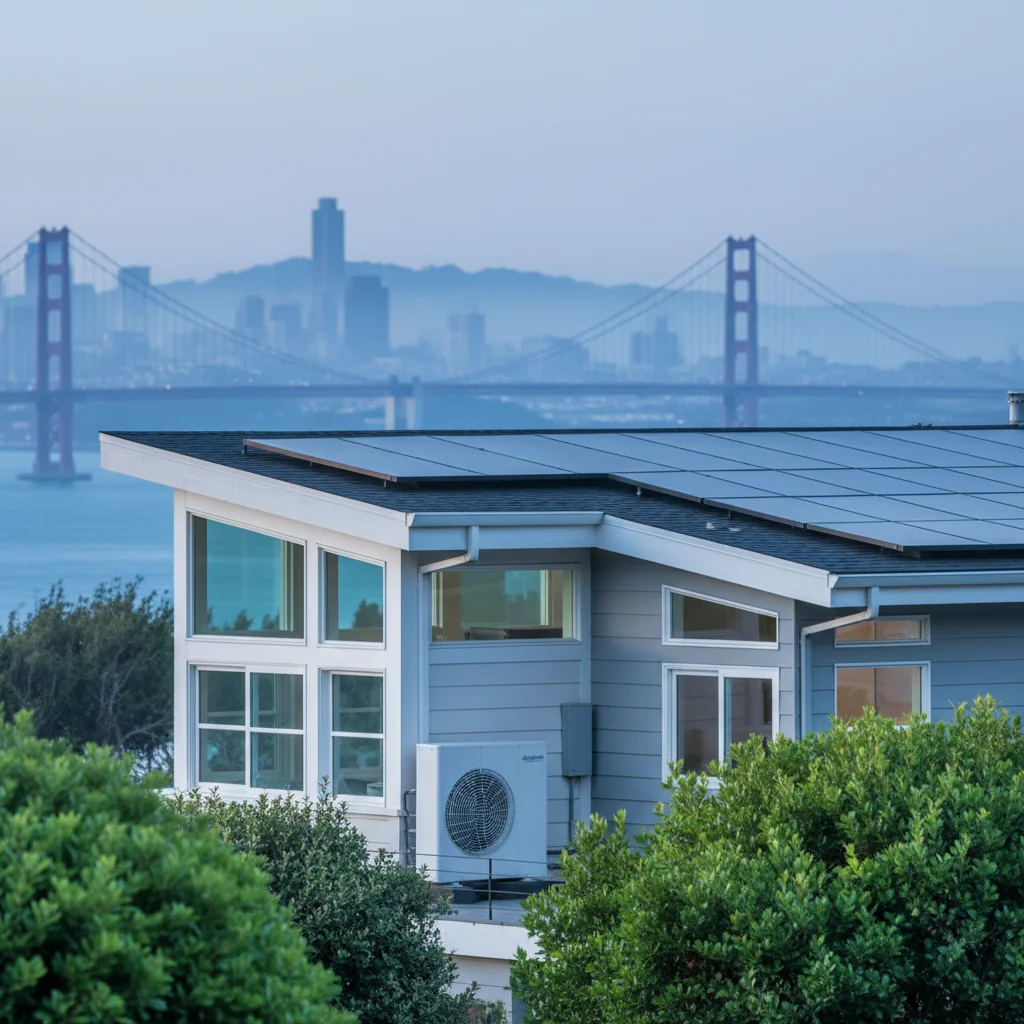
San Francisco homeowners spent an average of $18,400 on heat pump installations in 2025 — but federal and state rebates can slash that figure by 50% or more in 2026. With Pacific Gas & Electric's updated incentive structure, the upfront cost barrier that once kept heat pump adoption below 8% in Bay Area single-family homes is collapsing fast.
How Much Does Heat Pump Installation Cost in San Francisco?
Heat pump installation costs in San Francisco range from $12,000 to $28,000 depending on system size, home configuration, and existing HVAC infrastructure. Air-source heat pumps average $15,000-$22,000 for a 2,000-square-foot home, while ground-source (geothermal) systems cost $20,000-$35,000. Ducted systems cost $3,000-$7,000 more than ductless mini-splits due to ductwork modification or installation.
So what drives the $16,000 price gap between low and high-end installations? Three factors dominate: equipment tier (SEER2 rating), labor complexity (electrical panel upgrades, gas line capping), and permit costs that now include San Francisco's mandatory electric readiness inspection at $450. And the city's seismic retrofitting requirements add $1,200-$2,800 to projects in pre-1973 buildings.
PG&E data shows 63% of San Francisco heat pump installations in 2025 cost between $16,500 and $21,000 after contractor quotes. But those figures don't account for the 2026 incentive landscape that can deliver $8,500-$14,000 in combined federal, state, and utility rebates. Homeowners earning below 150% of area median income qualify for the highest rebate tiers through California's TECH Clean California program.
Ductless mini-split systems cost $12,000-$18,000 for a three-zone configuration covering 1,800-2,400 square feet. Ducted central heat pumps range from $18,000-$28,000 depending on tonnage (2-5 tons) and whether existing ductwork meets the 15% leakage threshold required for heat pump rebates. And homes built before 1980 typically need $2,500-$4,500 in electrical upgrades to support 200-amp service.
What's the Payback Period for Heat Pump Installation in San Francisco?
Heat pump installations in San Francisco deliver payback periods of 4-8 years when replacing natural gas furnaces and 6-11 years when replacing electric resistance heating. The median payback sits at 5.7 years for households using PG&E's E-TOU-C rate plan, which offers lower electricity rates during off-peak hours when heat pumps operate most efficiently.
The federal Energy Efficient Home Improvement Credit (Section 25C) ended for property placed in service after December 31, 2025 (IRS FS-2025-05). California's TECH Clean California program adds $3,000-$7,000 depending on income qualification. Combined with PG&E's Technology and Equipment for Clean Heating (TECH) rebates of $2,500-$6,500, total incentives reach $8,500-$14,000 for income-qualified households. Use our free rebate calculator to determine your exact savings potential based on system type and household income.
San Francisco's mild climate accelerates payback compared to extreme-weather regions. Heat pumps maintain 300%-400% efficiency (COP 3-4) even when outdoor temperatures drop to 40°F, which represents the city's typical winter low. So while a Minneapolis homeowner faces 9-12 year payback due to supplemental heating needs below 0°F, San Francisco installations hit break-even faster due to year-round efficiency.
"Heat pumps can reduce electricity use for heating by approximately 50% compared to electric resistance heating such as furnaces and baseboard heaters." — U.S. Department of Energy
But payback calculations hinge on natural gas price trajectories. PG&E residential gas rates rose 34% between January 2024 and January 2026, from $2.67 to $3.58 per therm. And California's cap-and-trade program projects continued 3-5% annual increases through 2030, improving heat pump economics each year.
How Long Do Heat Pumps Last and What's the Lifespan in San Francisco's Climate?
Heat pumps in San Francisco last 15-20 years for air-source systems and 20-25 years for ground-source installations, with the city's mild coastal climate extending equipment lifespan 2-3 years beyond national averages. The absence of extreme temperature swings reduces compressor stress and thermal cycling that degrades components in hot desert or sub-zero climates.
Air-source heat pump compressors operate for 40,000-70,000 hours before requiring replacement, translating to 18-22 years at San Francisco's average 2,400 annual heating hours. But indoor air handlers and coils often last 25-30 years with proper maintenance. So homeowners typically replace outdoor units once while keeping ductwork and distribution infrastructure intact.
Ground-source (geothermal) heat pumps deliver 25-year equipment lifespans, while the underground loop system lasts 50+ years. The stable 55-60°F ground temperature 6 feet below San Francisco eliminates freeze-thaw cycles that crack pipes in colder regions. And the Bay Area's low seismic activity reduces ground loop disruption compared to fault-adjacent locations.
Annual maintenance costs average $180-$280 for professional filter replacement, refrigerant checks, and coil cleaning. So over a 20-year lifespan, total maintenance expenses reach $3,600-$5,600 — far below the $12,000-$18,000 for furnace and air conditioner replacement cycles every 12-15 years. The federal energy tax credits that once reduced upfront costs ended for projects completed after December 31, 2025 (IRS FS-2025-05).
What Rebates and Incentives Are Available for Heat Pump Installation in San Francisco?
San Francisco homeowners qualify for $8,500-$14,000 in combined heat pump rebates through California state programs and PG&E utility incentives in 2026. The federal High-Efficiency Electric Home Rebate Act (HEEHRA) provides up to $8,000 for air-source heat pumps and $8,000 for electrical upgrades, while the Energy Efficient Home Improvement Credit delivers a 30% tax credit (this federal credit ended for property placed in service after December 31, 2025) up to $2,000 annually.
California's TECH Clean California program offers $3,000-$7,000 based on household income and system type. Households earning below 80% of area median income ($104,400 for a family of four in San Francisco) receive the maximum $7,000 rebate, while those earning 80-150% AMI qualify for $3,500. And PG&E's TECH initiative adds $2,500-$6,500 for qualifying heat pump installations that meet ENERGY STAR Most Efficient 2026 criteria.
Bay Area Air Quality Management District (BAAQMD) provides $3,000 rebates for replacing natural gas furnaces with electric heat pumps, stackable with other programs. But the program caps at 3,000 rebates annually and typically reaches capacity by March. So early application in January-February maximizes approval odds.
"ENERGY STAR certified heat pumps have higher seasonal energy efficiency ratio (SEER) and heating seasonal performance factor (HSPF) ratings, which translates to high-efficiency operation and lower energy costs." — ENERGY STAR
Income-qualified households can stack these programs to reach $14,000+ in total incentives on an $18,000 installation, reducing net cost to $4,000. Non-income-qualified households still access $6,500-$8,500 in combined rebates, cutting a typical $18,000 project to $9,500-$11,500 out-of-pocket.
Heat Pump Installation Cost vs. Traditional HVAC Systems: Which Is More Affordable?
Heat pump installations cost $12,000-$22,000 compared to $8,000-$15,000 for traditional furnace-plus-air-conditioner systems in San Francisco, creating a $4,000-$7,000 upfront premium. But annual operating costs flip the equation: heat pumps cost $800-$1,400 annually to run versus $1,600-$2,400 for natural gas furnaces paired with central AC.
Natural gas furnace installations average $5,500-$9,000, while central air conditioning adds $5,500-$8,000, totaling $11,000-$17,000 for separate heating and cooling. So upfront costs overlap with heat pump pricing, but traditional HVAC delivers lower equipment complexity and faster installation timelines of 2-3 days versus 3-5 days for heat pumps requiring electrical upgrades.
Operating cost differences accumulate fast. San Francisco households heating with PG&E natural gas at $3.58 per therm spend $1,200-$1,800 annually on a 90% AFUE furnace, plus $400-$600 for summer AC electricity. Heat pumps running on E-TOU-C electricity rates (26¢/kWh average) cost $900-$1,500 annually for combined heating and cooling.
And heat pumps eliminate the $45 monthly PG&E natural gas customer charge that persists even during zero-usage months, saving $540 annually. So the $600-$1,000 annual operating cost advantage delivers payback on the $5,000 upfront premium within 5-7 years. Calculate your specific savings with our rebate calculator.
Maintenance costs favor heat pumps at $180-$280 annually compared to $320-$480 for dual furnace-AC systems requiring separate service contracts. But heat pump longevity of 18-22 years exceeds traditional furnaces (15-18 years) and AC units (12-15 years), extending replacement cycles and reducing lifetime costs.
What's the Installation Process and Timeline for Heat Pumps in San Francisco?
Heat pump installation in San Francisco takes 3-7 days from permit application to final inspection, with the city's electric-readiness review adding 2-4 business days to traditional 1-3 day mechanical permits. The process begins with a Manual J load calculation to size equipment correctly — oversized systems cost 15-25% more and cycle inefficiently, while undersized units fail to maintain comfort during the city's 90°F heat waves.
Day 1 involves electrical panel assessment and upgrades if needed. 68% of San Francisco homes built before 1985 require 100-amp to 200-amp panel upgrades costing $2,500-$4,500 to support heat pump loads of 30-60 amps. And homes with knob-and-tube wiring need full rewiring at $8,000-$15,000 before heat pump installation proceeds.
Day 2-3 covers outdoor unit placement, refrigerant line installation, and air handler or ductwork modifications. Ductless mini-splits require 3-inch conduit penetrations through exterior walls, patched and sealed per San Francisco building code Section 1203.3. Ducted systems need duct sealing to achieve <10% leakage measured by Duct Blaster testing — a prerequisite for PG&E TECH rebate approval.
Day 4 includes electrical connections, thermostat installation, and system commissioning with airflow verification at each register. Contractors measure supply air temperature rise (30-50°F in heating mode) and refrigerant charge via superheat/subcooling to ensure 95%+ rated efficiency. And final city inspection verifies permit compliance, with inspectors confirming proper condensate drainage and seismic restraints on units over 400 pounds.
Permit costs total $450-$850: $280 for mechanical, $320 for electrical (if panel upgraded), and $250 for San Francisco's electric-readiness inspection. BAAQMD air quality permits add $75 when retiring natural gas furnaces. The city's online permit portal shows 14-business-day average approval for standard installations without structural modifications.
Official Sources
- U.S. Department of Energy - Heat Pump Systems — Federal guidance on heat pump technology, efficiency ratings, and savings potential
- ENERGY STAR Heat Pumps — Certification requirements and product directory for qualifying equipment
- DSIRE - California Incentives — Comprehensive database of state, utility, and local clean energy rebates and tax credits (note: the federal 25C and 25D credits ended for projects completed after December 31, 2025)
Frequently Asked Questions
How much does a heat pump installation cost in San Francisco?
Heat pump installation costs in San Francisco range from $12,000 to $28,000 depending on system type and home configuration. Air-source heat pumps average $15,000-$22,000, while ductless mini-splits cost $12,000-$18,000. But California TECH Clean California rebates and PG&E incentives deliver $8,500-$14,000 in combined savings for income-qualified households, reducing net costs to $4,000-$10,000.
What rebates are available for heat pump installation in San Francisco?
San Francisco homeowners access three rebate programs in 2026: federal HEEHRA rebates up to $8,000, California TECH Clean California offering $3,000-$7,000 based on income, and PG&E TECH rebates of $2,500-$6,500. The federal Energy Efficient Home Improvement Credit (Section 25C) ended for property placed in service after December 31, 2025 (IRS FS-2025-05). BAAQMD adds $3,000 for natural gas furnace replacements. Combined incentives reach $14,000+ for income-qualified installations.
Am I eligible for heat pump installation rebates in San Francisco?
Eligibility depends on household income and system specifications. California TECH Clean California serves households earning up to 150% of area median income ($195,750 for a family of four in San Francisco), with higher rebates below 80% AMI. PG&E TECH requires ENERGY STAR Most Efficient certification and <10% duct leakage. Federal HEEHRA targets households under 150% AMI with priority for those below 80%.
How long does the heat pump rebate process take in San Francisco?
PG&E TECH rebates process in 6-10 weeks after installation and documentation submission. California TECH Clean California approvals take 8-12 weeks, while BAAQMD rebates arrive within 45-60 days of furnace retirement verification. But BAAQMD's limited annual funding creates first-come urgency for January-March applications.
What is the difference between a heat pump and an air conditioner for home cooling?
Heat pumps provide both heating and cooling through reversible refrigerant flow, while air conditioners only cool. Both achieve identical cooling efficiency (14-20 SEER2), but heat pumps eliminate separate furnace costs and natural gas service. San Francisco's mild winters allow heat pumps to maintain 300%-400% heating efficiency year-round, unlike cold-climate regions requiring backup systems below 20°F.
Ready to find your heat pump savings? Use our free rebate calculator to discover exactly how much you'll save with federal, state, and utility rebates. Get your personalized estimate in under 60 seconds — no installation required.
Updated on April 14, 2026. Fact-checked by DuloCore Editors. About our research team.
Check your California heat pump rebate eligibility — see the programs you qualify for and the dollar amounts on our California heat pump rebate finder.