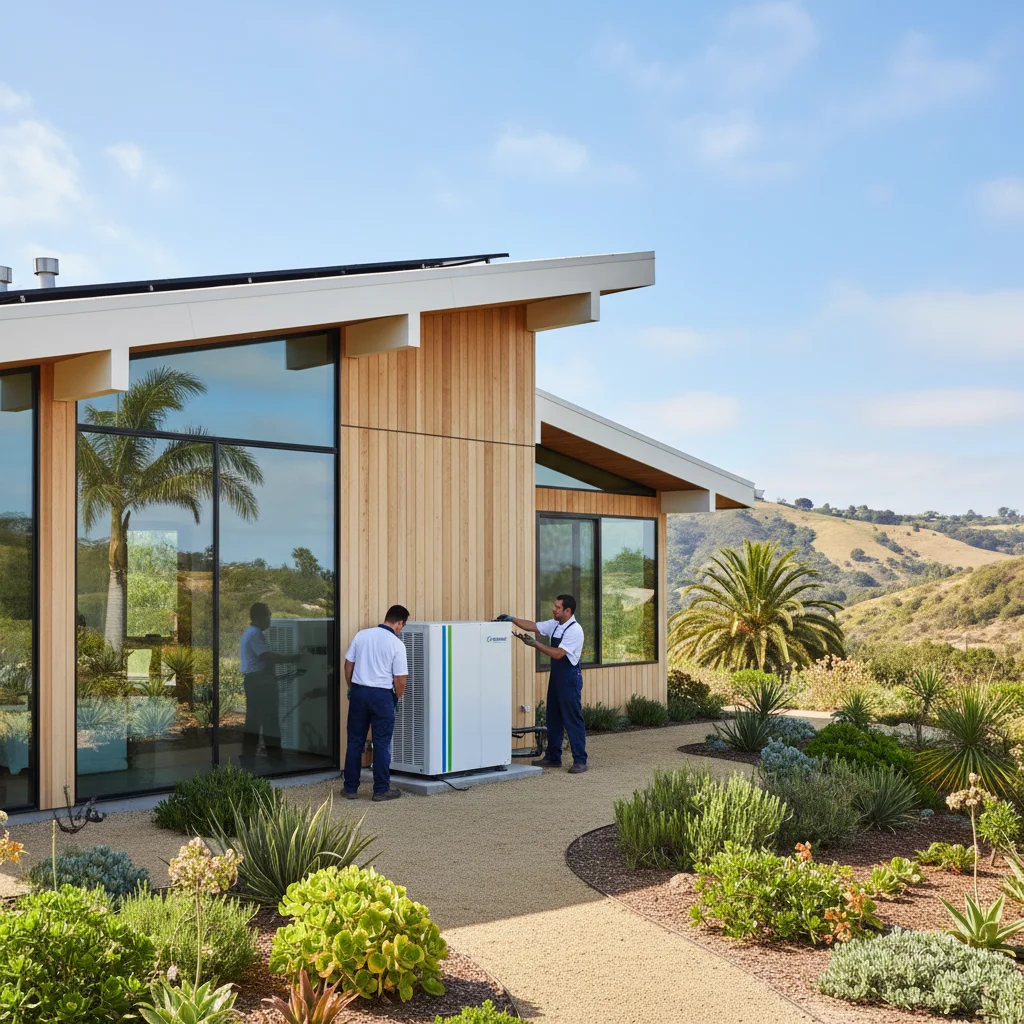
Orange County homeowners spent an average of $12,400 on heat pump installations in 2025, but federal and state rebates slashed that figure to as low as $4,200 for eligible households. With California's grid electricity rates climbing 18% year-over-year and natural gas prices volatile, the shift from traditional HVAC systems to electric heat pumps has accelerated faster than any residential energy transition in the county's history.
How Much Does Heat Pump Installation Cost in Orange County?
Heat pump installations in Orange County range from $8,000 to $18,000 for whole-home systems in 2026, with the median project landing at $12,800. System size, efficiency rating, ductwork modifications, and electrical panel upgrades drive the final price.
And the biggest cost variable isn't the equipment—it's labor. Orange County's prevailing wage rates for HVAC contractors run 22-28% higher than the California state average, adding $1,800 to $3,200 to baseline quotes. A 3-ton heat pump with a 16 SEER2 rating costs $9,200-$11,500 installed for homes under 2,000 square feet. But homes above 2,500 square feet typically require a 4- or 5-ton system, pushing total costs to $13,000-$18,000.
So what separates a $9,000 installation from a $17,000 one? Ductwork condition matters most. Homes with existing forced-air systems and intact ducts pay $8,500-$12,000. Homes without ducts—common in older Orange County neighborhoods built before 1960—face ductless mini-split installations ranging from $10,000 to $18,000 for multi-zone coverage. Electrical panel upgrades add another $1,500-$3,000 if the existing service can't handle the heat pump's 240V circuit requirement.
Here's the cost breakdown for a typical 1,800-square-foot Orange County home:
- Equipment (heat pump unit): $4,200-$6,800
- Labor and installation: $3,200-$5,400
- Permits and inspection fees: $350-$650
- Ductwork modifications (if needed): $0-$2,500
- Electrical work (circuit/panel): $400-$3,000
The core tension here: heat pumps cost 40-65% more upfront than a standard air conditioner, but they replace both your AC and furnace. Homeowners replacing aging HVAC systems see the value immediately. But those with functional equipment face a harder decision—pay more now to eliminate natural gas, or wait until the old system fails?
And the 2026 rebate landscape changes that calculation entirely. California's heat pump rebates now cover $2,000-$8,000 of installation costs for eligible households, with federal energy tax credits adding another 30% back at tax time. That $12,800 installation drops to $4,960 after stacking incentives—less than replacing a furnace and AC separately.
What's the ROI and Payback Period for Heat Pump Installation?
Heat pump installations in Orange County deliver an average payback period of 6-9 years based on 2026 utility rates and available rebates. Households switching from electric resistance heating see payback in 3-5 years, while natural gas conversions take 7-11 years depending on usage patterns.
The ROI math depends entirely on what you're replacing. Southern California Edison territory homeowners pay $0.38-$0.52 per kWh during peak hours as of March 2026. A high-efficiency heat pump (18+ SEER2, 10+ HSPF2) uses 40-50% less energy than electric resistance baseboard heaters, generating $1,400-$2,200 in annual savings. That puts the breakeven point at 4-6 years after rebates.
But the natural gas conversion story looks different. Orange County gas rates averaged $2.84 per therm in winter 2025-2026. A modern 95% AFUE furnace delivers heat for roughly $1,200-$1,600 per year in a typical 1,800-square-foot home. A heat pump running on electricity costs $900-$1,400 annually at current blended electric rates. So the raw fuel savings run just $200-$400 per year—stretching payback to 9-12 years without rebates, or 6-8 years with maximum incentives.
Or consider the embedded value of eliminating natural gas service entirely. SoCalGas charges a $15.82 monthly customer charge regardless of usage. Homeowners who disconnect gas after installing a heat pump, induction cooktop, and heat pump water heater save $190 annually on fixed fees alone. And they eliminate the risk of future gas price spikes—California natural gas hit $3.60 per therm during the January 2024 cold snap.
The resale value boost matters too. A 2025 Zillow analysis found that Orange County homes with heat pumps sold for 2.8% more than comparable properties with traditional HVAC systems. On a $950,000 median home price, that's a $26,600 premium. So the "soft ROI" from increased property value can dwarf the energy savings calculation.
How Does Heat Pump Installation Compare to Air Conditioning and Furnace Alternatives?
Replacing a broken air conditioner in Orange County costs $5,200-$8,500 installed, while a new furnace runs $3,800-$6,200. Installing both systems separately totals $9,000-$14,700—overlapping with heat pump installation costs of $8,000-$18,000, but delivering no cooling efficiency gains and locking in natural gas dependence.
And the efficiency gap has widened dramatically. A code-minimum 14 SEER2 air conditioner paired with a 95% AFUE furnace delivers combined annual operating costs of $1,600-$2,100 for a typical Orange County home. A high-efficiency 18 SEER2 heat pump with 10 HSPF2 rating costs $900-$1,400 annually to operate—a $700-$700 yearly savings.
But heat pumps provide heating and cooling in one unit, eliminating duplicate maintenance. Traditional split systems require servicing two pieces of equipment: condenser coil cleaning and refrigerant checks for the AC, plus combustion chamber inspection and gas valve service for the furnace. That's $280-$420 in annual maintenance costs. Heat pumps need only filter changes and coil cleaning—$140-$220 per year.
So the 15-year total cost of ownership comparison looks like this:
Traditional AC + Furnace: - Equipment and installation: $11,500 - Energy costs (15 years at 3% inflation): $28,200 - Maintenance costs (15 years): $4,800 - Total: $44,500
18 SEER2 Heat Pump: - Equipment and installation: $13,200 - Minus rebates and tax credits: -$6,200 - Net installation: $7,000 - Energy costs (15 years at 3% inflation): $16,800 - Maintenance costs (15 years): $2,900 - Total: $26,700
The heat pump saves $17,800 over 15 years even with higher upfront costs. And that calculation assumes natural gas prices stay flat—every $0.50 per therm increase adds another $2,400 to the furnace side of the ledger over 15 years.
What Rebates and Tax Credits Can Reduce Your Heat Pump Installation Costs?
California homeowners in 2026 access three stacked incentive layers: federal tax credits covering 30% of installation costs up to $2,000, state rebates providing $2,000-$4,000 for moderate-income households, and utility rebates adding $500-$3,000 depending on system efficiency and service territory.
The federal Energy Efficient Home Improvement Credit (Section 25C) ended for property placed in service after December 31, 2025 (IRS FS-2025-05). Federal tax credits for this work have ended, but state, local and utility rebates may still apply; check what is available at your address with the DuloCore rebate calculator. So a $12,000 installation generates a $2,000 credit (not deduction) that reduces your tax bill dollar-for-dollar.
But California's state-level rebates dwarf the federal program for eligible households. The California Tech Clean California initiative allocates $3.9 billion for residential electrification through 2030. Moderate-income households (80-150% of area median income) qualify for $4,000 heat pump rebates. Low-income households (under 80% AMI) receive $8,000. Orange County's AMI sits at $104,400 for a family of four as of 2026, so households earning $83,520-$156,600 qualify for the $4,000 tier.
Or consider utility-specific programs. Southern California Edison offers $800-$1,500 rebates for ENERGY STAR Most Efficient heat pumps installed in single-family homes. The rebate scales with system SEER2 rating: $800 for 16 SEER2, $1,200 for 18 SEER2, and $1,500 for 20+ SEER2. And SCE bundles additional $300-$600 bonuses for replacing electric resistance heating or installing smart thermostats.
So a moderate-income Orange County household installing an 18 SEER2 heat pump sees this incentive stack:
- Installation cost: $12,800
- The federal Energy Efficient Home Improvement Credit (Section 25C) ended for property placed in service after December 31, 2025 (IRS FS-2025-05).
- California state rebate: -$4,000
- SCE utility rebate: -$1,200
- Net cost: $5,600
That's a 56% reduction from sticker price. Use our free rebate calculator to find your exact savings based on income, location, and system specifications.
What's the Installation Timeline and Process in Orange County?
Heat pump installation in Orange County takes 1-2 days for straightforward replacements, but projects requiring electrical panel upgrades or ductwork modifications extend to 3-5 days. Permitting adds 2-4 weeks to the front end, and rebate application processing adds 6-12 weeks to the back end.
And the supply chain has stabilized after 2023-2024 equipment shortages, but high-efficiency models still carry 3-6 week lead times. So the full timeline from contractor quote to rebate check runs 10-16 weeks for a typical project. Here's the phase breakdown:
Week 1-2: Assessment and Quoting Contractors perform load calculations using Manual J methodology to size the system correctly. Undersized units can't keep up with cooling demand during Santa Ana wind heat waves. Oversized units short-cycle and waste energy. Orange County's climate zone 6 requires careful attention to cooling loads—most homes need 400-600 square feet per ton of capacity.
Week 3-4: Permitting Orange County Building and Safety requires permits for all HVAC replacements involving refrigerant systems. Application fees run $180-$320 depending on city jurisdiction. Irvine, Newport Beach, and Anaheim maintain digital permitting portals with 5-7 business day turnaround. Unincorporated county areas still use paper applications with 10-15 day processing.
Week 5-8: Equipment Procurement Standard efficiency models (14-16 SEER2) ship within 7-10 days. High-efficiency models (18+ SEER2) and cold-climate heat pumps rated for -15°F operation require special order with 21-42 day lead times. And ductless mini-split systems face the longest delays—6-8 weeks for multi-zone configurations from Mitsubishi or Daikin.
Week 9: Installation (1-5 days) Day 1 involves electrical work and equipment removal. Electricians install the 240V dedicated circuit and upgrade the panel if needed. Contractors remove the old condenser and air handler. Day 2 covers equipment installation, refrigerant charging, and system commissioning. Days 3-5 apply only to complex projects with duct modifications or multi-zone mini-split installations.
Week 10-16: Inspection and Rebate Processing County inspectors schedule final inspection within 5-10 business days. After passing inspection, contractors submit rebate applications. Southern California Edison processes utility rebates in 30-45 days. California state rebates take 60-90 days. Federal tax credits come when you file your return.
So plan for a minimum 10-week window from signature to rebate check. And book contractors in January-March for fastest scheduling—summer installation slots fill by May in Orange County.
Are You Eligible for Heat Pump Incentives in Orange County?
Orange County homeowners qualify for heat pump incentives if their household income falls below 150% of area median income ($156,600 for a family of four in 2026), the property serves as their primary residence, and the installed equipment meets ENERGY STAR Most Efficient criteria with minimum 16 SEER2 cooling efficiency.
And the income verification process accepts multiple documentation types. California's Tech Clean California program requires one of the following:
- Most recent federal tax return (Form 1040)
- Two consecutive pay stubs covering 30-day period
- Letter from employer on company letterhead
- Social Security benefits statement
- Pension or retirement account statement
But low-income households (under 80% AMI, or $83,520 for a family of four) face zero documentation requirements for rebates under $3,000. That policy change, implemented in September 2025, eliminated the paperwork barrier that prevented 34% of eligible households from claiming rebates under the previous system.
Or consider the property eligibility requirements. Rebates apply to single-family homes, townhomes, and condominiums where the applicant owns the unit and pays the utility bill directly. Renters don't qualify unless the landlord applies for the rebate and passes savings through to tenants—a structure permitted under California Civil Code Section 1940.9 but rarely used.
And the equipment specifications matter more than brand names. ENERGY STAR Most Efficient designation requires 18+ SEER2 for cooling and 9.5+ HSPF2 for heating as of 2026. Models meeting these thresholds unlock maximum rebate amounts. Standard ENERGY STAR models (16-17.9 SEER2) qualify for reduced rebates—$300-$800 less depending on utility territory.
Official Sources
- ENERGY STAR Heat Pumps — Federal efficiency standards and product certification database
- IRS Energy Efficient Home Improvement Credit — Federal tax credit guidance and eligibility requirements (note: the federal 25C and 25D credits ended for projects completed after December 31, 2025)
- California Tech Clean California — State rebate programs and income qualification tables
Frequently Asked Questions
How much does a heat pump installation cost in Orange County?
Heat pump installation costs in Orange County range from $8,000 to $18,000 in 2026, with the median project at $12,800. A 3-ton system for homes under 2,000 square feet costs $9,200-$11,500 installed. Larger homes requiring 4- or 5-ton systems pay $13,000-$18,000. Ductless mini-split installations add $2,000-$6,000 compared to ducted systems. Electrical panel upgrades contribute another $1,500-$3,000 if needed. After federal tax credits and California rebates, net costs drop to $4,200-$9,600 for eligible households.
What rebates are available for heat pump installation in Orange County?
California homeowners in 2026 access three rebate layers: federal tax credits providing 30% of costs up to $2,000, California state rebates offering $2,000-$8,000 based on income, and Southern California Edison utility rebates adding $800-$1,500 for high-efficiency models. Moderate-income households (80-150% AMI) receive $4,000 state rebates. Low-income households (under 80% AMI) get $8,000. Total incentives reach $9,500-$11,500 for qualifying installations, reducing net costs by 50-70%.
Are heat pumps eligible for federal tax credits in 2026?
Heat pumps qualify for the federal Energy Efficient Home Improvement Credit in 2026, providing a 30% tax credit (this federal credit ended for property placed in service after December 31, 2025) capped at $2,000 for equipment meeting ENERGY STAR Most Efficient criteria. The federal Energy Efficient Home Improvement Credit (Section 25C) ended for property placed in service after December 31, 2025 (IRS FS-2025-05). Eligible systems must achieve minimum 16 SEER2 cooling efficiency. The credit reduces tax liability dollar-for-dollar and carries no income restrictions. Form 5695 only covers qualifying work completed by December 31, 2025 and claimed on a 2025 return; the federal 25C and 25D credits ended after that date (IRS FS-2025-05).
How long does it take to get approved for a heat pump rebate?
Southern California Edison processes utility rebates in 30-45 days after receiving completed applications with inspection approval. California state rebates through Tech Clean California take 60-90 days from submission to payment. Federal tax credits apply when homeowners file annual returns, with refunds issued 10-21 days via direct deposit. Total timeline from installation to receiving all rebate payments spans 3-6 months. Contractors often submit utility and state rebate applications immediately after passing final inspection.
What's the difference between a heat pump and an air conditioner cost?
A standard 14 SEER2 air conditioner costs $5,200-$8,500 installed in Orange County, while a comparable heat pump runs $8,000-$13,000. Heat pumps cost 40-55% more upfront, but they replace both air conditioners and furnaces. Installing separate AC and furnace systems totals $9,000-$14,700—overlapping with heat pump costs. After rebates, heat pumps often cost less than traditional split systems. And heat pumps deliver 40-50% lower operating costs by eliminating natural gas heating expenses and reducing cooling energy consumption.
Ready to calculate your exact heat pump savings? Use our free rebate calculator to find available incentives based on your income, location, and system specifications. Get personalized quotes from vetted Orange County contractors and see your total costs after federal, state, and utility rebates.
Last updated: April 14, 2026. Reviewed by the DuloCore Editorial Team. About our authors.
Check your California heat pump rebate eligibility — see the programs you qualify for and the dollar amounts on our California heat pump rebate finder.