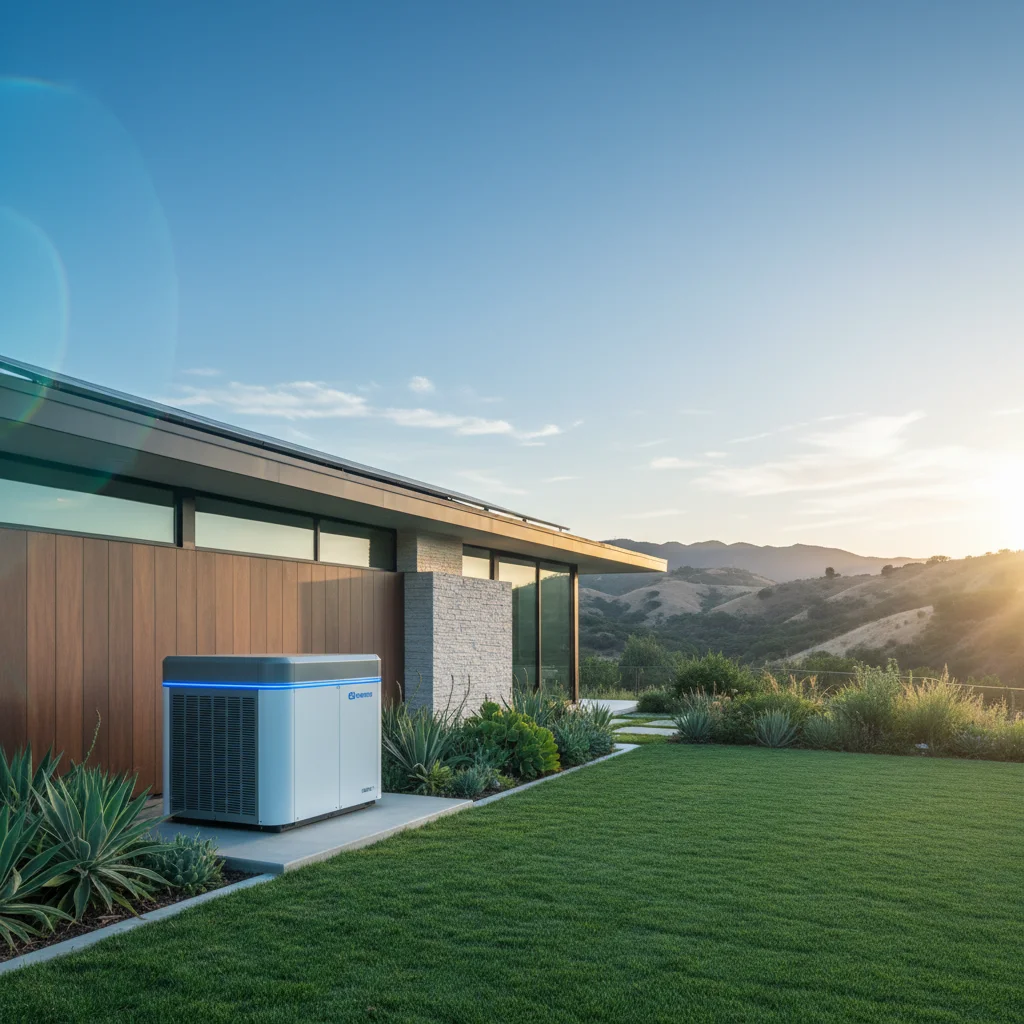
Los Angeles homeowners paid between $8,000 and $18,000 for heat pump installations in 2025, but 2026 federal tax credits and local utility rebates can cut that cost by up to 50%. And for a city where air conditioning runs 6-9 months a year, the question isn't whether heat pumps save money—it's how fast.
What's the Average Heat Pump Installation Cost in Los Angeles?
Heat pump installation costs in Los Angeles range from $8,000 to $18,000 for a complete system in 2026, with the average falling around $12,500. System size, equipment efficiency rating, existing ductwork condition, and installation complexity determine final pricing. But federal IRA tax credits cover 30% of total project costs through 2032, reducing average out-of-pocket expense to $8,750.
So what does this mean for LA homeowners facing $2,400-$3,600 annual cooling bills? Heat pumps replace both heating and cooling systems, delivering year-round climate control at 300%-400% efficiency compared to traditional HVAC equipment.
Equipment costs account for $4,000-$10,000 of total installation expenses. Labor adds $2,500-$5,000. And ductwork modifications, electrical upgrades, or structural changes can add $1,500-$3,000 to base pricing. But Southern California Edison and Los Angeles Department of Water and Power offer instant rebates of $1,000-$3,000 for qualifying heat pump installations, stacking with federal credits.
Cost Factors Specific to Los Angeles
LA's Mediterranean climate reduces heating requirements, allowing homeowners to install smaller systems than cold-climate regions need. A 2-ton system handles most 1,200-1,500 square foot homes, while 3-4 ton units serve 2,000-3,000 square foot properties. And existing central air conditioning infrastructure cuts installation costs by $1,500-$3,000 since ductwork already exists.
Permit fees in Los Angeles run $200-$500 depending on system size and installation complexity. But licensed contractors handle permitting, inspection scheduling, and utility coordination as part of base installation pricing.
Calculate your specific rebate amount using our free rebate calculator to see how federal credits and local utility programs reduce upfront costs.
How Long Does It Take to Recoup Your Heat Pump Investment in LA?
Los Angeles homeowners recoup heat pump installation costs in 6-10 years through reduced electricity bills and eliminated natural gas heating expenses. Annual energy savings average $1,200-$1,800 for homes switching from traditional HVAC systems to high-efficiency heat pumps. So a $12,500 installation minus $6,750 in combined federal credits and utility rebates leaves $5,750 net cost, recovered in approximately 4 years.
Peak summer cooling in LA's inland valleys drives electricity costs 40%-60% higher than winter months. Heat pumps deliver cooling at 50%-60% the operating cost of standard air conditioners rated 14 SEER or lower. And winter heating from heat pumps costs 30%-40% less than natural gas furnaces when California's tiered electricity rates are considered.
"Heat pumps can reduce electricity use for heating by approximately 50% compared to electric resistance heating." — U.S. Department of Energy
But payback periods vary by climate zone. Coastal neighborhoods with mild temperatures see 8-10 year payback. Inland areas like San Fernando Valley and Pasadena with extreme summer heat achieve 5-7 year payback. And homes currently using electric resistance heating recover costs in 3-5 years.
LA Climate Zones and ROI Impact
Los Angeles spans three distinct climate zones that affect heat pump performance and savings. Coastal zone properties (Santa Monica, Manhattan Beach, Venice) maintain 60-75°F year-round, requiring minimal heating and moderate cooling. And inland valleys (Sherman Oaks, Studio City, Pasadena) experience 90-105°F summers and 40-50°F winters, maximizing heat pump usage and accelerating payback.
LADWP's tiered electricity rates reward heat pump efficiency. Customers staying below 1,000 kWh monthly pay $0.14-$0.18 per kWh. But households exceeding 1,000 kWh face $0.25-$0.32 per kWh. Heat pumps keep most homes below tier thresholds, avoiding premium rates.
Is Your Los Angeles Home Climate Zone Suitable for Heat Pump Installation?
All Los Angeles climate zones support modern heat pump technology, with installations performing efficiently down to 20°F and up to 110°F. LA's coastal, valley, and foothill regions maintain temperatures within optimal heat pump operating range 98%-99% of annual hours. So climate suitability concerns affecting cold-weather regions don't apply to Southern California installations.
Modern cold-climate heat pumps maintain 100% heating capacity at 5°F and continue operating at reduced efficiency down to -15°F. But Los Angeles rarely experiences temperatures below 40°F, meaning standard heat pump models deliver full performance year-round. And summer temperatures reaching 105°F in inland valleys fall well within equipment design specifications.
Coastal vs. Inland Performance
Coastal properties benefit from ocean temperature moderation, maintaining 65-75°F ambient conditions that represent ideal heat pump operating parameters. Systems in these locations run at peak efficiency coefficients of 3.5-4.2 COP (Coefficient of Performance), delivering $3.50-$4.20 worth of heating or cooling for every $1.00 of electricity consumed.
Inland valleys experience more extreme temperature swings, but modern heat pumps handle 95-105°F cooling loads while maintaining 300%-350% efficiency. And mild 45-55°F winter temperatures allow heat pumps to extract ambient heat without supplemental resistance heating, unlike cold-climate regions requiring backup systems.
California Building Energy Efficiency Standards (Title 24) require specific SEER2 and HSPF2 ratings based on climate zone. Los Angeles falls under Zone 6 (coastal), Zone 9 (inland valleys), and Zone 10 (foothill areas), with minimum efficiency requirements of 15 SEER2 / 8.8 HSPF2 for air-source heat pumps.
Heat Pumps vs. Traditional Air Conditioning: Which Option Costs Less in LA?
Heat pumps cost $2,000-$5,000 more upfront than comparable SEER-rated air conditioners in 2026, but provide both heating and cooling, eliminating separate furnace installation expenses of $3,500-$7,000. Total HVAC replacement with heat pump runs $8,000-$18,000 versus $11,500-$19,000 for separate AC and furnace systems. So heat pumps deliver lower total system costs while providing superior efficiency.
Operating costs favor heat pumps by 30%-50% annually compared to traditional split HVAC systems. A 2,000 square foot home in Sherman Oaks running a 16 SEER AC plus 95% AFUE gas furnace spends approximately $2,800 annually on heating and cooling. The same home with an 18 SEER2 heat pump spends $1,800-$2,100 annually, saving $700-$1,000 per year.
But maintenance requirements differ between systems. Traditional AC units require annual servicing costing $100-$150. Furnaces need annual inspections at $80-$120. Heat pumps combine both systems, with annual maintenance running $150-$200 total. So maintenance costs essentially equal out.
Equipment Lifespan Comparison
Central air conditioners last 12-15 years in Los Angeles climate conditions. Gas furnaces typically operate 15-20 years. Heat pumps provide 15-18 years of service, matching or exceeding split system longevity. And newer inverter-driven compressor technology extends heat pump operational life while reducing energy consumption.
Energy tax credits available through 2032 apply exclusively to heat pump installations, not traditional AC-only systems. The federal Energy Efficient Home Improvement Credit (Section 25C) ended for property placed in service after December 31, 2025 (IRS FS-2025-05). Federal tax credits for this work have ended, but state, local and utility rebates may still apply; check what is available at your address with the DuloCore rebate calculator. Traditional AC systems qualify for zero federal credits, making heat pumps the clear winner for tax-advantaged HVAC replacement.
What Financial Incentives and Rebates Can Reduce Your Installation Costs?
The federal Energy Efficient Home Improvement Credit (Section 25C) ended for property placed in service after December 31, 2025 (IRS FS-2025-05). A $12,500 installation generates $3,750 in federal tax credits claimed when filing 2026 returns. And California's Tech Clean California program offers point-of-sale rebates of $1,000-$3,000 for moderate-income households, reducing upfront payment at installation.
LADWP provides instant rebates of $3,000 for qualified heat pump installations replacing electric resistance heating or natural gas furnaces. Southern California Edison offers $1,200-$2,000 instant rebates through participating contractors. And South Coast Air Quality Management District provides additional $3,000 rebates for low-income households switching from gas appliances to electric heat pumps.
The federal Energy Efficient Home Improvement Credit (Section 25C) ended for property placed in service after December 31, 2025 (IRS FS-2025-05).
So a moderate-income LA homeowner installing a $14,000 system receives $4,200 federal credit, $3,000 utility rebate, and $3,000 state rebate—$10,200 total, reducing net cost to $3,800.
Income Qualification Thresholds
Tech Clean California defines moderate income as 80%-150% of Area Median Income. For Los Angeles County in 2026, that means $76,800-$144,000 for households of four. Low-income qualifications set at 80% AMI unlock larger rebate amounts from state and air quality programs.
But federal tax credits require no income restrictions. All homeowners qualify for 30% back on heat pump rebates regardless of household earnings. And tax credits carry forward to future years if current-year tax liability doesn't cover full credit amount.
What's the Complete Installation Process and Timeline in Los Angeles?
Heat pump installation in Los Angeles takes 1-3 days from equipment delivery to final inspection, with permitting and scheduling adding 2-4 weeks to total project timeline. Contractors begin with load calculation determining correct system size, followed by equipment selection, permit submission to LA Building and Safety, and installation scheduling.
Permit approval typically processes in 5-10 business days for standard installations. But custom installations involving electrical panel upgrades or structural modifications extend permitting to 15-20 business days. And city inspectors must verify installation before utilities activate rebate processing.
Step-by-Step Installation Sequence
Day one involves removing existing HVAC equipment, installing outdoor heat pump condenser, and connecting refrigerant lines to indoor air handler. Electrical connections, thermostat wiring, and condensate drainage complete day-one work for most installations. Day two handles ductwork modifications if needed, system testing, and airflow balancing.
But electrical panel upgrades add one day to timeline. Homes with 100-amp service require 200-amp panel installation to support heat pump electrical loads. And Title 24 energy compliance verification adds 2-3 hours to installation as contractors document efficiency ratings and system specifications.
Final inspection scheduling happens within 48 hours of installation completion. Inspectors verify electrical connections, refrigerant charge, safety controls, and permit compliance. And rebate applications submit immediately after inspection approval, with utility rebates processing in 4-8 weeks and federal credits claimed on next tax return.
Official Sources
- DOE Heat Pump Systems — Federal guidance on heat pump efficiency and savings potential
- ENERGY STAR Heat Pumps — Qualified product listings and performance specifications
- DSIRE USA California Programs — Database of state incentives for renewables and efficiency
Frequently Asked Questions
How much does a heat pump installation cost in Los Angeles?
Heat pump installations in Los Angeles cost $8,000-$18,000 depending on system size, equipment efficiency, and installation complexity. Average installations run $12,500 for complete equipment and labor. But federal IRA tax credits reduce costs by 30%, lowering average net expense to $8,750. And utility rebates from LADWP or Southern California Edison cut costs by an additional $1,000-$3,000.
What rebates are available for heat pump installation in Los Angeles?
The federal Energy Efficient Home Improvement Credit (Section 25C) ended for property placed in service after December 31, 2025 (IRS FS-2025-05). LADWP offers $3,000 instant rebates for heat pump installations. Southern California Edison provides $1,200-$2,000 rebates through participating contractors. And Tech Clean California delivers $1,000-$3,000 point-of-sale rebates for moderate-income households, with South Coast AQMD adding $3,000 for low-income applicants switching from gas heating.
Do I qualify for heat pump rebates in Los Angeles?
All Los Angeles homeowners qualify for federal IRA tax credits with no income restrictions or caps. Tech Clean California moderate-income rebates require household income between 80%-150% of Area Median Income ($76,800-$144,000 for family of four in 2026). LADWP and Edison rebates require installation by licensed contractors and minimum efficiency ratings of 15 SEER2 / 8.8 HSPF2. And SCAQMD programs target low-income households earning below 80% AMI.
How long does it take to get a heat pump rebate in Los Angeles?
Federal tax credits claim on annual returns, with refunds processing in 21 days for e-filed returns or 6-8 weeks for paper filing. LADWP rebates process in 4-6 weeks after inspection approval. Southern California Edison rebates arrive in 6-8 weeks. And Tech Clean California point-of-sale rebates apply instantly at installation, reducing upfront payment. State rebate processing requires completed inspection and contractor verification submission.
Is a heat pump cheaper than air conditioning in Los Angeles?
Heat pumps cost $2,000-$5,000 more than comparable air conditioners upfront but eliminate separate furnace costs of $3,500-$7,000, reducing total HVAC system expense by $1,500-$2,000. Operating costs run 30%-50% lower than traditional AC plus furnace combinations, saving $700-$1,000 annually. And federal tax credits apply only to heat pumps, not AC-only installations, delivering $3,750 average tax savings that standard air conditioners don't qualify for.
Ready to calculate your exact savings? Use our free rebate calculator to see how much federal credits, utility rebates, and energy savings will reduce your heat pump installation costs. Get your personalized estimate in under 60 seconds.
Last updated: April 14, 2026. Reviewed by the DuloCore Editorial Team. About our authors.
Check your California heat pump rebate eligibility — see the programs you qualify for and the dollar amounts on our California heat pump rebate finder.