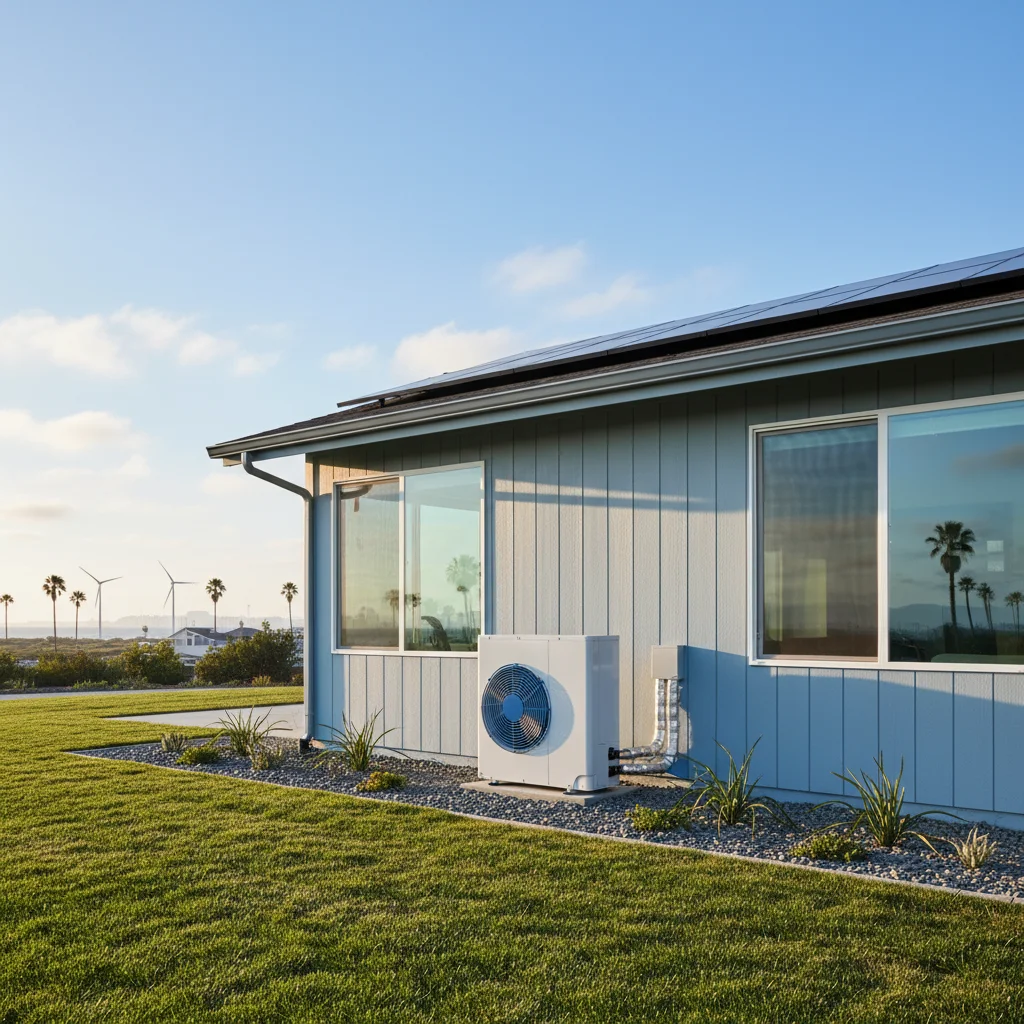
Heat Pump Installation Cost Long Beach
Heat Pump Installation Cost Long Beach: everything you need to know about eligibility, amounts, and the application process.
Long Beach homeowners installing heat pumps in 2026 pay $12,000 to $28,000 for complete systems, but federal and state rebates can cut that cost by $10,000 or more. And that's before the 30% federal tax credit under the Inflation Reduction Act kicks in. The average installation runs $18,500, with ductless mini-splits starting at $8,000 and whole-home ducted systems reaching $35,000 for larger properties.
What Is the Average Heat Pump Installation Cost in Long Beach?
Heat pump installation costs in Long Beach range from $12,000 to $28,000 for complete systems in 2026, with the average homeowner paying $18,500. Ductless mini-split systems start at $8,000 for single-zone installations, while whole-home ducted heat pumps reach $35,000 for properties exceeding 2,500 square feet. Installation labor accounts for 30-40% of total costs.
So why does Long Beach see costs 15-20% higher than inland California cities? Coastal building codes require corrosion-resistant components, and Long Beach's HVAC contractor demand drives labor rates to $125-$175 per hour compared to $90-$120 in Sacramento. But Long Beach homeowners recoup installation costs faster—mild winters and summers mean heat pumps run 40% more efficiently than in extreme climates, cutting energy bills by $1,200-$1,800 annually according to ENERGY STAR heat pump efficiency data.
Equipment alone costs $6,000-$15,000 depending on SEER2 rating and capacity. A 3-ton, 18 SEER2 system (suitable for 1,500-2,000 square feet) costs $8,500 wholesale, while a 5-ton, 22 SEER2 unit for 3,000+ square feet runs $14,000. Permits add $400-$800, electrical panel upgrades cost $1,500-$3,000, and ductwork modifications range from $2,000-$5,000 if existing ducts don't meet efficiency standards.
Long Beach's Climate Zone 6 designation means heat pumps operate at peak efficiency year-round. And the California Energy Commission reports Zone 6 properties with heat pumps use 35% less energy than those with gas furnaces and central AC.
How Long Does It Take to Recoup Your Investment With a Heat Pump?
Long Beach homeowners recoup heat pump installation costs in 5-8 years through energy savings, rebates, and tax credits. A household replacing a gas furnace and 14 SEER air conditioner with an 18 SEER2 heat pump saves $1,500 annually on electricity and gas bills. So a $20,000 installation drops to $10,000 after a $4,000 federal tax credit and $6,000 in combined state and utility rebates, creating a payback period of 6.7 years.
But payback accelerates for high-energy users. Homes exceeding 2,000 square feet with older HVAC systems (10+ SEER) see annual savings of $2,200-$2,800, cutting payback to 4-5 years. And natural gas prices factor heavily—Long Beach residents pay $1.85 per therm in 2026, 30% above the California average, making electric heat pumps 45% cheaper to operate than gas furnaces.
"Heat pumps in moderate climates like coastal California deliver 3-4 times more heating energy than the electricity they consume, reducing heating costs by 50% or more compared to electric resistance heating." — U.S. Department of Energy
The IRA federal tax credit covers 30% of equipment and installation costs through 2032, with no dollar cap. So a $25,000 installation generates a $7,500 credit. California's TECH Clean California program offers $3,000-$4,000 rebates for heat pump installations replacing gas systems. And Southern California Edison provides $1,500-$2,500 rebates for ENERGY STAR certified units. Calculate your exact savings with our free rebate calculator.
Is Your Long Beach Home in the Right Climate Zone for Heat Pump Efficiency?
Long Beach sits in California Climate Zone 6, the ideal environment for heat pump efficiency. Zone 6 properties experience 2,200 annual cooling hours and 1,400 heating hours, allowing heat pumps to operate at 300-400% efficiency year-round. Heat pumps in Zone 6 cost $850-$1,100 annually to operate, 42% less than gas furnace and AC combinations that run $1,500-$1,900.
Climate Zone 6 never drops below 35°F for sustained periods, eliminating the efficiency loss older heat pumps experienced in freezing temperatures. Modern cold-climate heat pumps maintain 100% heating capacity down to 5°F and continue operating at reduced capacity to -15°F. But Long Beach's mild winters mean standard heat pumps deliver full performance without cold-climate upgrades costing $2,000-$3,000 extra.
Coastal humidity benefits heat pump operation. Long Beach's average 65-75% humidity prevents the icing issues that plague heat pumps in dry mountain climates. And summer temperatures rarely exceed 85°F, so heat pumps cool homes without the auxiliary resistance heating that adds $40-$80 monthly in desert regions.
Properties within 3 miles of the coast see the highest efficiency gains. Salt air requires upgraded coil coatings adding $400-$600 to equipment costs, but these homes save $150-$200 more annually than inland properties because temperatures stay within the 65-75°F range where heat pumps operate at peak efficiency.
Heat Pumps vs. Traditional AC and Furnace Systems: Cost Comparison
Heat pumps cost $12,000-$28,000 installed compared to $8,000-$16,000 for separate AC and furnace systems in Long Beach. But heat pumps eliminate dual fuel costs, cutting annual energy expenses 35-45%. A Long Beach home with a 95% AFUE gas furnace and 16 SEER AC pays $1,650 yearly for heating and cooling, while the same home with an 18 SEER2 heat pump pays $950—a $700 annual savings.
Equipment longevity favors heat pumps. Heat pumps last 15-20 years with proper maintenance, while AC units require replacement every 12-15 years and furnaces every 15-18 years. So a homeowner installing separate systems pays for two replacements over 30 years ($32,000-$48,000 total) versus one heat pump replacement ($24,000-$42,000).
Installation complexity differs significantly. Heat pumps require a single outdoor unit and air handler, taking 8-12 hours to install. Traditional systems need separate AC condenser and furnace installations spanning 12-16 hours, adding $1,200-$2,000 in labor costs. And heat pumps use one thermostat and maintenance schedule, while dual systems require separate service calls costing $180-$240 annually versus $120-$160 for heat pump maintenance.
Rebate stacking amplifies heat pump advantages. Long Beach homeowners replacing gas systems access $8,000-$12,000 in combined federal, state, and utility incentives for heat pumps. AC and furnace replacements qualify for $2,000-$4,000 maximum. Learn more about available heat pump rebates for your property.
What Rebates and Tax Credits Can Lower Your Long Beach Heat Pump Installation Cost?
Long Beach homeowners access $10,000-$14,000 in combined rebates and tax credits for heat pump installations in 2026. The IRA federal tax credit covers 30% of equipment and installation costs with no cap, generating $3,600-$8,400 for typical installations. California's TECH Clean California program provides $3,000-$4,000 rebates for heat pump installations replacing gas heating systems. And Southern California Edison offers $1,500-$2,500 rebates for ENERGY STAR certified heat pumps rated 18 SEER2 or higher.
Income-qualified households access enhanced incentives. The IRA High-Efficiency Electric Home Rebate Program (HEEHRA) provides up to $8,000 for heat pump installations for households earning below 80% area median income ($83,200 for Long Beach families of four in 2026). And TECH Clean California doubles rebates to $6,000-$8,000 for income-qualified applicants.
"The Inflation Reduction Act provides tax credits and rebates covering up to 100% of heat pump costs for low- and moderate-income households, making clean heating accessible to all Americans." — U.S. Department of Energy
Stacking strategies maximize savings. Homeowners combine the 30% federal tax credit with TECH Clean California's $4,000 rebate and SCE's $2,000 rebate, reducing a $22,000 installation to $9,400 out-of-pocket. But rebates process at different speeds—SCE pays within 6-8 weeks, TECH Clean California takes 8-12 weeks, and federal tax credits apply when filing taxes.
Application requirements vary by program. TECH Clean California requires contractor pre-qualification and post-installation verification. SCE processes rebates through participating contractors at point of sale. And the federal tax credit needs IRS Form 5695 with manufacturer certification statements. Explore all available energy tax credits for your upgrade.
What's Included in a Professional Heat Pump Installation?
Professional heat pump installations in Long Beach include equipment, labor, permits, electrical work, and commissioning for $12,000-$28,000 total. Equipment costs cover the outdoor condenser unit, indoor air handler, refrigerant lines, thermostat, and all mounting hardware. Labor includes removal of existing systems, installation of new components, electrical connections, refrigerant charging, ductwork modifications, and 2-year warranty coverage on workmanship.
Permit fees of $400-$800 cover mechanical, electrical, and building inspections required by Long Beach building codes. Electrical panel upgrades cost $1,500-$3,000 for homes with 100-amp service needing 200-amp panels to support heat pump loads of 30-60 amps. And ductwork sealing and insulation runs $800-$2,000 to meet California Title 24 efficiency standards requiring less than 6% duct leakage.
Commissioning verifies proper operation. Contractors measure airflow at each register, test refrigerant charge within 5% of manufacturer specifications, and verify thermostat calibration. So properly commissioned systems deliver rated efficiency, while installations skipping this step lose 15-25% efficiency from refrigerant undercharge or airflow restrictions.
High-quality installations include additional services. Contractors seal all penetrations with expandable foam, install vibration dampeners reducing noise by 5-8 decibels, and provide homeowner training on thermostat programming and filter maintenance. And reputable contractors offer 10-year extended warranties on compressors and 5-year parts coverage beyond manufacturer warranties.
Official Sources
- U.S. Department of Energy: Heat Pump Systems — Federal guidance on heat pump technology, efficiency ratings, and energy savings calculations
- ENERGY STAR: Air Source Heat Pumps — Certification requirements, qualified product listings, and efficiency specifications for heat pumps
- DSIRE USA: California Incentives — Comprehensive database of state and utility rebates, tax credits, and incentive programs for energy efficiency upgrades
Frequently Asked Questions
How much does a heat pump installation cost in Long Beach?
Heat pump installation costs in Long Beach range from $12,000 to $28,000 for complete systems in 2026. Ductless mini-split systems start at $8,000 for single-zone installations covering 500-800 square feet. Whole-home ducted systems for 2,000-2,500 square feet average $18,500. Properties exceeding 3,000 square feet with high-efficiency 22 SEER2 units reach $35,000. Installation labor accounts for 30-40% of total costs at $125-$175 per hour in Long Beach.
What rebates and incentives are available for heat pump installation in Long Beach?
Long Beach homeowners access $10,000-$14,000 in combined rebates and tax credits in 2026. The IRA federal tax credit covers 30% of installation costs with no cap. California's TECH Clean California provides $3,000-$4,000 rebates for installations replacing gas systems. Southern California Edison offers $1,500-$2,500 for ENERGY STAR certified units. Income-qualified households earning below 80% area median income access enhanced rebates up to $8,000 through the HEEHRA program.
Am I eligible for heat pump rebate programs in Long Beach?
All Long Beach homeowners installing heat pumps qualify for the 30% federal tax credit through 2032. TECH Clean California requires replacing existing gas heating systems with ENERGY STAR certified heat pumps rated 18 SEER2 or higher. Southern California Edison rebates require contractor participation and installation verification. Income-qualified programs require household income below 80% area median income ($83,200 for families of four in 2026) verified through tax returns or California Alternate Rates for Energy documentation.
How long does the heat pump rebate application process take?
Rebate processing times vary by program in 2026. Southern California Edison processes rebates through participating contractors at point of sale or within 6-8 weeks for direct applications. TECH Clean California takes 8-12 weeks from post-installation verification to payment. The IRA federal tax credit applies when filing annual taxes using IRS Form 5695. Income-qualified HEEHRA rebates process in 10-16 weeks after contractors submit completion documentation and inspection reports.
What's the difference between heat pump installation costs and traditional air conditioning?
Heat pumps cost $12,000-$28,000 installed compared to $4,000-$9,000 for AC-only systems in Long Beach. But heat pumps provide both heating and cooling, eliminating the need for separate furnaces costing $4,000-$8,000. Annual operating costs favor heat pumps—$950 yearly for heat pump heating and cooling versus $1,650 for gas furnace and AC combinations. Heat pumps qualify for $10,000-$14,000 in rebates, while AC-only replacements receive $500-$1,500 maximum.
Ready to calculate your heat pump savings? Use our free rebate calculator to find exactly how much you'll save with federal tax credits, state rebates, and utility incentives. Get your personalized estimate in under 60 seconds—no email required.
Last updated: April 14, 2026. Reviewed by the DuloCore Editorial Team. About our authors.
Find Your Rebates
Use our calculator to see how much you can save on your home improvement project.
Calculate My Savings