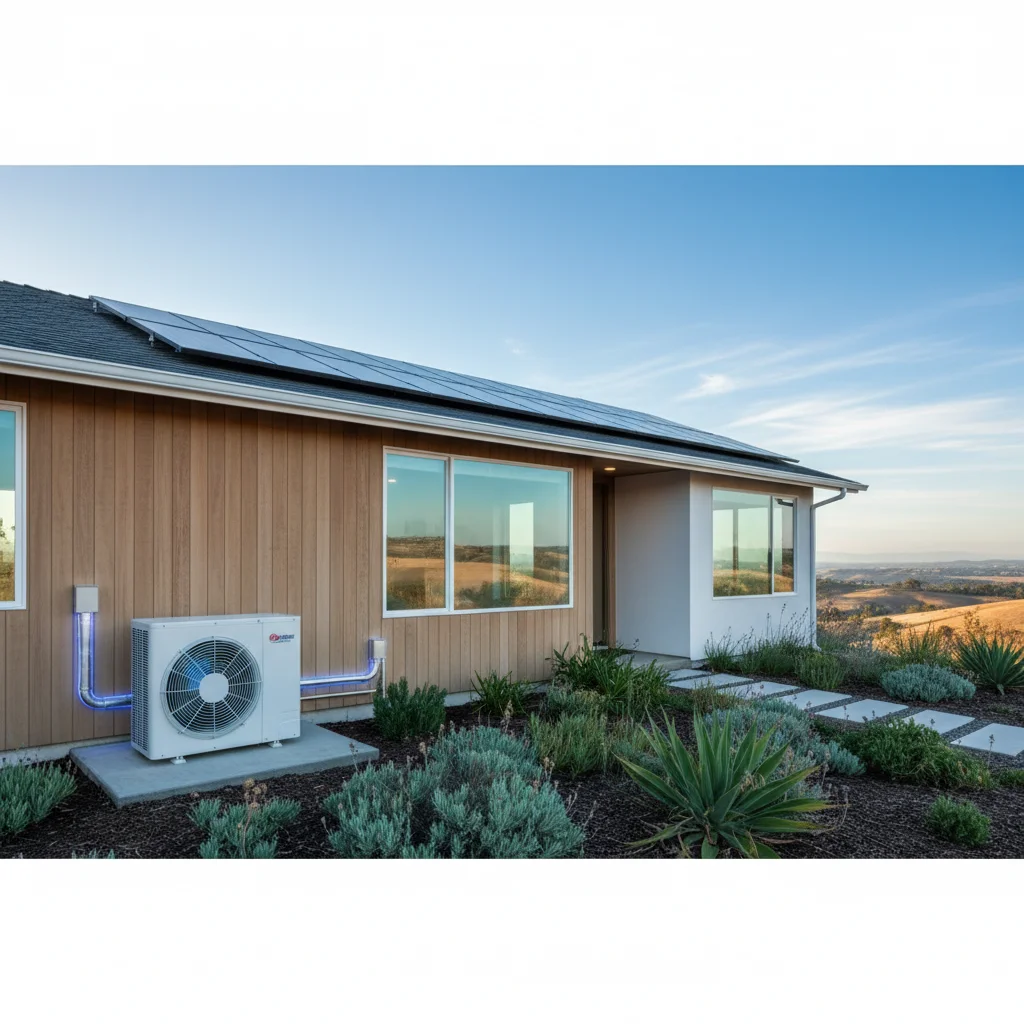
Central Valley homeowners paid between $8,500 and $22,000 for heat pump installations in 2026, but federal tax credits and California utility rebates cut those costs by $4,000 to $11,000—turning what looks like an expensive HVAC upgrade into one of the fastest-paying energy investments in residential construction. With summer temperatures routinely hitting 105°F and winter lows near freezing, the region's extreme climate makes inefficient heating and cooling systems a financial liability that compounds every billing cycle.
How Much Does Heat Pump Installation Cost in the Central Valley?
Heat pump installation costs in Central Valley range from $8,500 to $22,000 in 2026, with single-zone ductless systems starting at $3,500 and whole-home ducted systems averaging $15,000 to $18,000. Installation complexity, existing ductwork condition, and equipment efficiency ratings determine final pricing.
A 3-ton heat pump system—the most common size for 1,800 to 2,200 square-foot homes—costs $12,000 to $16,000 installed in Fresno, Modesto, and Stockton. And that includes electrical upgrades to handle the 240-volt circuit requirements most older homes lack. But homeowners with functional duct systems save $3,000 to $5,000 compared to properties requiring complete duct replacement or modification.
Equipment efficiency ratings shift costs by $2,000 to $4,000. A 16 SEER2 heat pump costs $10,000 to $13,000, while a 20 SEER2 cold-climate model reaches $16,000 to $20,000 before rebates. So the higher-efficiency systems qualify for larger utility incentives that close the price gap to $1,500 or less after rebate calculator deductions.
Labor accounts for 40% to 50% of total installation costs. Central Valley contractors charge $85 to $125 per hour, with complete installations requiring 12 to 20 hours depending on system complexity. Permits add $250 to $500 in Fresno County and $300 to $600 in San Joaquin County.
"Heat pump installations must meet California Title 24 energy standards and local building codes, which require licensed contractors and inspected electrical work." — California Energy Commission
What's the ROI and Payback Period for Heat Pump Installation?
Heat pump ROI in Central Valley averages 180% to 250% over 15 years, with payback periods of 4 to 8 years depending on replaced equipment and household energy consumption. Homeowners switching from electric resistance heating see payback in 3 to 5 years, while natural gas furnace replacements take 6 to 9 years.
A typical Central Valley household running a heat pump instead of a 15-year-old air conditioner and gas furnace saves $1,200 to $1,800 annually on combined heating and cooling costs. And federal tax credits covering 30% of installation costs—up to $2,000—reduce the effective payback period by 12 to 18 months. But natural gas price volatility affects ROI calculations. When PG&E rates spiked 28% in winter 2025, gas furnace operating costs exceeded heat pump electricity costs by $140 per month in Fresno and Modesto.
Electricity rates in SMUD and PG&E territories range from $0.16 to $0.42 per kWh in 2026, with time-of-use plans offering $0.13 to $0.18 per kWh during off-peak hours. So homeowners who shift heat pump usage to off-peak periods reduce operating costs by 35% to 45%, improving payback periods to 3 to 6 years.
Property value increases add unrealized ROI. Zillow data from 2025 showed Central Valley homes with heat pumps sold for 3.2% to 4.7% more than comparable properties with standard HVAC systems—adding $12,000 to $21,000 to sale prices in markets where median home values reach $450,000.
How Does Heat Pump Installation Cost Compare to Alternatives Like AC and Furnace?
Heat pump installation costs $8,500 to $22,000 compared to $5,500 to $12,000 for air conditioner and furnace combinations in 2026. But heat pumps eliminate the need for separate heating and cooling systems, reducing equipment count and long-term maintenance expenses by 35% to 50%.
A 3-ton AC unit costs $4,500 to $8,000, while an 80% AFUE gas furnace adds $3,000 to $6,000—totaling $7,500 to $14,000 for dual systems. And that requires maintaining two warranties, two service contracts, and two replacement cycles over 15 to 20 years. So the apparent cost savings evaporate when accounting for doubled maintenance schedules and staggered replacement timelines.
Operating costs shift the advantage to heat pumps. A heat pump with 10 HSPF2 efficiency costs $850 to $1,100 annually to heat a 2,000-square-foot Central Valley home, while an 80% AFUE gas furnace costs $1,200 to $1,500 at 2026 natural gas rates. But cooling efficiency matters more in the region's climate. Heat pumps with 18 SEER2 ratings cost $720 to $950 for summer cooling compared to $840 to $1,150 for 14 SEER air conditioners.
Ductless mini-split heat pumps cost $3,500 to $8,000 for single-zone systems—30% to 50% less than ducted systems—and offer targeted heating and cooling for additions, converted garages, and homes without existing ductwork. Or homeowners install multi-zone systems with 2 to 4 indoor units for $7,000 to $15,000, still avoiding the $5,000 to $9,000 duct installation costs.
Equipment lifespan comparisons show heat pumps lasting 15 to 20 years with proper maintenance, matching gas furnace longevity but outlasting air conditioners by 3 to 5 years. So the single-system design reduces replacement frequency and eliminates the risk of mismatched equipment efficiency after partial system failures.
Learn more about available incentives at heat pump rebates.
How Long Do Heat Pumps Last and What's the True Cost of Ownership?
Heat pumps last 15 to 20 years in Central Valley's climate, with total ownership costs ranging from $18,000 to $32,000 including installation, maintenance, repairs, and energy consumption. Annual maintenance costs $150 to $250, while major repairs average $400 to $800 over the system's lifespan.
True cost of ownership over 18 years—the median lifespan for ducted heat pumps—includes $15,000 initial installation, $2,700 to $4,500 in maintenance, $1,200 to $2,400 in repairs, and $15,300 to $19,800 in electricity costs at current Central Valley rates. And that totals $34,200 to $41,700. But homeowners replacing AC and furnace systems face combined ownership costs of $38,000 to $48,000 over the same period, including two HVAC replacements due to staggered equipment lifespans.
Heat pumps require biannual maintenance—spring and fall—compared to annual service for separate AC and furnace systems. So maintenance frequency doubles, but service costs remain 20% to 30% lower because technicians service a single integrated system. Filter replacements cost $40 to $120 annually, refrigerant top-offs add $150 to $300 every 5 to 7 years, and compressor failures—the most expensive repair—occur in 8% to 12% of systems after 12 to 15 years at costs of $1,800 to $2,800.
Central Valley's temperature extremes affect lifespan. Systems running year-round in cooling-dominant climates experience 15% to 25% more compressor cycles than moderate-climate installations, potentially reducing lifespan to 13 to 17 years. But cold-climate heat pumps with enhanced vapor injection technology maintain efficiency below 20°F and reduce compressor strain during winter operation.
Extended warranties cost $500 to $1,200 and cover compressor failures beyond the standard 5-year parts warranty. Or homeowners opt for home warranty plans at $600 to $900 annually that cover HVAC repairs but exclude pre-existing conditions and require $75 to $125 service call fees.
"Proper maintenance extends heat pump lifespan by 3 to 5 years and maintains efficiency within 5% of rated capacity throughout the system's operational life." — ENERGY STAR
What Rebates and Incentives Are Available for Heat Pump Installation in California?
The federal Energy Efficient Home Improvement Credit (Section 25C) ended for property placed in service after December 31, 2025 (IRS FS-2025-05). Federal tax credits for this work have ended, but state, local and utility rebates may still apply; check what is available at your address with the DuloCore rebate calculator. California utility companies offer $1,500 to $3,000 rebates for qualified systems, and low-income households access $4,000 to $8,000 through California's TECH Clean California program.
The federal Energy Efficient Home Improvement Credit (Section 25C) ended for property placed in service after December 31, 2025 (IRS FS-2025-05). Form 5695 only covers qualifying work completed by December 31, 2025 and claimed on a 2025 return; the federal 25C and 25D credits ended after that date (IRS FS-2025-05). But the credit phases down to 26% in 2033 and 22% in 2034 before expiring.
PG&E customers qualify for $2,000 to $3,000 rebates on ducted heat pumps rated 16 SEER2 or higher, while SMUD offers $1,500 to $2,500 for systems replacing electric resistance heating. And TECH Clean California provides $4,000 to $8,000 for income-qualified households—defined as 80% or below area median income—with additional $2,000 bonuses for all-electric home conversions.
Combining incentives reduces net installation costs by 45% to 60%. A $15,000 heat pump system receives a $2,000 federal tax credit, $2,500 utility rebate, and—for qualifying households—a $6,000 TECH Clean California grant, lowering out-of-pocket costs to $4,500 or 30% of the original price.
Check current program details and calculate your potential savings with the rebate calculator tool.
Utility rebates require pre-approval and contractor verification of equipment specifications. Applications submitted after installation receive automatic denials. Or homeowners work with participating contractors who handle rebate paperwork as part of installation service contracts.
Explore additional federal programs at energy tax credits.
What's the Installation Process and Timeline for Heat Pumps in the Central Valley?
Heat pump installation takes 1 to 3 days for ducted systems and 4 to 8 hours for ductless mini-splits in Central Valley homes. The process includes load calculations, equipment sizing, electrical upgrades, refrigerant line installation, and county inspections that add 3 to 7 days to project timelines.
Day 1 involves load calculations using Manual J methodology to determine heating and cooling requirements based on home size, insulation levels, window efficiency, and occupancy patterns. And contractors assess existing ductwork for leaks, inadequate sizing, and insulation gaps that reduce system efficiency by 20% to 40%. But homes without functional ducts require 2 to 4 additional days for duct installation or ductless mini-split configuration.
Day 2 begins with electrical panel evaluation. Heat pumps require dedicated 240-volt circuits with 30 to 60-amp breakers depending on system size. So homes with 100-amp service panels need $1,500 to $3,000 electrical upgrades to 200-amp capacity before heat pump installation proceeds. Contractors install outdoor condenser units on concrete pads 12 to 24 inches from exterior walls, then run refrigerant lines and condensate drains through exterior walls or attic spaces.
Day 3 covers indoor air handler installation, thermostat wiring, refrigerant charging, and system startup. And county inspectors verify electrical work, refrigerant handling, and Title 24 compliance—adding 3 to 7 days between installation completion and final approval. But scheduling conflicts during peak summer and winter seasons extend timelines to 2 to 3 weeks from initial consultation to operational system.
Ductless mini-split installations take 4 to 8 hours. Technicians mount indoor wall units, drill 3-inch holes for refrigerant lines and electrical connections, install outdoor condensers, and complete startup procedures in a single visit. Or multi-zone systems with 3 to 4 indoor units require 8 to 12 hours across 1 to 2 days.
Official Sources
- U.S. Department of Energy - Energy Saver — Federal guidance on heat pump technology, efficiency ratings, and energy savings calculations.
- ENERGY STAR Heat Pumps — Certification requirements, product finder, and efficiency standards for qualified systems.
- DSIRE USA — Comprehensive database of state, local, and federal incentives for renewable energy and energy efficiency programs.
Frequently Asked Questions
How much does a heat pump installation cost in the Central Valley?
Heat pump installation costs $8,500 to $22,000 in Central Valley in 2026, with 3-ton ducted systems averaging $12,000 to $16,000. Ductless mini-split systems start at $3,500 for single-zone installations. And electrical upgrades add $800 to $3,000 depending on existing panel capacity and circuit requirements.
What rebates are available for heat pump installation in California?
California homeowners access $1,500 to $3,000 utility rebates from PG&E and SMUD, plus 30% federal tax credits up to $2,000 under the Inflation Reduction Act. TECH Clean California provides $4,000 to $8,000 for income-qualified households. Combined incentives reduce net costs by 45% to 60% for most installations.
Are heat pumps eligible for federal tax credits in 2026?
The federal Energy Efficient Home Improvement Credit (Section 25C) ended for property placed in service after December 31, 2025 (IRS FS-2025-05). Form 5695 only covers qualifying work completed by December 31, 2025 and claimed on a 2025 return; the federal 25C and 25D credits ended after that date (IRS FS-2025-05).
How long does it take to install a heat pump system?
Ducted heat pump installation takes 1 to 3 days, while ductless mini-splits require 4 to 8 hours. And county inspections add 3 to 7 days to project timelines. Homes needing electrical panel upgrades or duct modifications extend installation periods to 1 to 2 weeks from initial consultation to operational system.
What is the difference between a heat pump and an air conditioner for cooling costs?
Heat pumps with 18 SEER2 ratings cost $720 to $950 annually for cooling 2,000-square-foot Central Valley homes compared to $840 to $1,150 for 14 SEER air conditioners. And heat pumps eliminate gas furnace costs by providing heating at $850 to $1,100 per year—reducing combined HVAC expenses by 30% to 45%.
Ready to calculate your heat pump savings? Use the free rebate calculator to see exactly how much you'll save with federal tax credits, California utility rebates, and reduced energy costs in your Central Valley home.
Last reviewed: April 14, 2026. Reviewed by DuloCore Energy Specialists. About the team.
Check your California heat pump rebate eligibility — see the programs you qualify for and the dollar amounts on our California heat pump rebate finder.