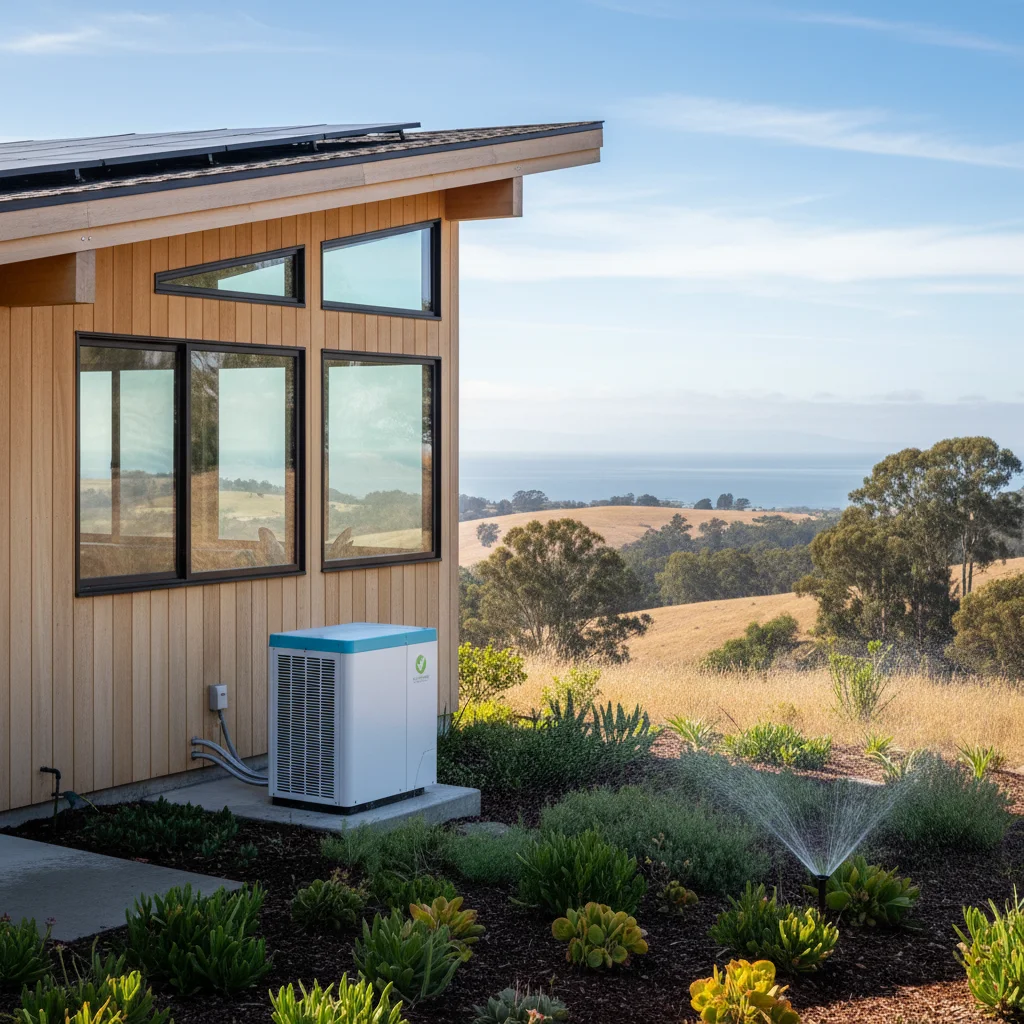
Bay Area homeowners replaced over 12,000 traditional HVAC systems with heat pumps in 2025, driven by federal tax credits covering 30% of project costs and state rebates reaching $8,000. And 2026 brings expanded income-qualified programs that stack utility incentives with federal money, cutting total installation expenses by $10,000 to $15,000 for eligible households. The window for maximum savings closes as programs shift funding allocations quarterly, making immediate cost research essential for anyone planning an upgrade this year.
What Is the Average Heat Pump Installation Cost in the Bay Area?
Heat pump installation in the Bay Area costs $12,000 to $28,000 in 2026, with whole-home systems averaging $18,500 after contractor labor, equipment, electrical upgrades, and permit fees. Ductless mini-split systems start at $8,000 for single-zone configurations, while ducted central heat pumps require $15,000 to $22,000 for equipment rated 3 to 5 tons. Ground-source geothermal installations range from $25,000 to $40,000 due to excavation requirements.
PG&E territory homeowners pay 8% to 12% more than national averages due to regional labor rates of $125 to $175 per hour and stricter Title 24 energy code compliance costs. And San Francisco, Oakland, and San Jose require additional city permits adding $350 to $800 to base installation fees. The federal Energy Efficient Home Improvement Credit (Section 25C) ended for property placed in service after December 31, 2025 (IRS FS-2025-05). Federal tax credits for this work have ended, but state, local and utility rebates may still apply; check what is available at your address with the DuloCore rebate calculator.
ENERGY STAR certified cold-climate heat pumps meeting -5°F heating capacity standards cost $1,200 to $2,500 more than standard models, yet deliver 15% higher efficiency in Bay Area microclimates with overnight temperatures dropping below 40°F. So homeowners in Marin County, East Bay hills, and Peninsula fog zones see faster payback periods of 7 to 9 years despite higher upfront costs.
The California Energy Commission's 2025 Residential Appliance Study found Bay Area heat pump installations averaged $17,800 before incentives—23% higher than Sacramento Valley projects due to coastal jurisdiction permit complexity and prevailing wage requirements for projects claiming state rebates.
| System Type | Equipment Cost | Installation Labor | Total Before Rebates |
|---|---|---|---|
| Ductless Mini-Split (1-zone) | $3,500-$5,000 | $2,500-$4,000 | $8,000-$12,000 |
| Central Ducted Heat Pump | $8,000-$12,000 | $5,000-$8,000 | $15,000-$22,000 |
| Ground-Source Geothermal | $15,000-$22,000 | $10,000-$18,000 | $25,000-$40,000 |
How Long Does It Take to Recoup Your Investment Through Energy Savings?
Bay Area homeowners recoup heat pump installation costs in 8 to 14 years through eliminated natural gas heating bills and reduced electricity consumption, with payback periods shortening to 5 to 7 years when stacking federal tax credits, state rebates, and utility incentives. PG&E customers replacing gas furnaces save $900 to $1,800 annually on combined heating and cooling costs, depending on home size and climate zone.
Oakland households in Climate Zone 3 (mild winters, warm summers) see average annual savings of $1,200 when switching from a 15-year-old furnace to a 16 SEER2 heat pump. And San Jose residents in Zone 4 save $1,450 per year due to higher cooling loads requiring 20+ days of air conditioning versus Oakland's 12-day average. But Marin County fog belt homes in Zone 1 save only $750 annually because mild year-round temperatures reduce both heating and cooling demand.
Income-qualified households using California's TECH Clean California program receive upfront rebates of $6,500 to $8,000, reducing net installation costs to $4,000 to $8,000—cutting payback periods to 3 to 5 years even with modest $600 to $900 annual savings. So low-to-moderate income families under 80% area median income ($112,000 for four-person households in San Francisco) achieve faster returns than affluent homeowners claiming only the 30% federal credit (this federal credit ended for property placed in service after December 31, 2025).
The California Public Utilities Commission's 2025 Demand Response Report showed heat pump adopters using time-of-use rates saved an additional $180 to $320 annually by pre-cooling homes during off-peak hours before 4 PM, then reducing thermostat settings during expensive 4-9 PM peak windows. Check your rebate calculator to model your specific payback timeline.
"Air-source heat pumps can reduce electricity use for heating by approximately 50% compared to electric resistance heating such as furnaces and baseboard heaters." — U.S. Department of Energy
What Is the Expected Lifespan of a Heat Pump System?
Heat pumps last 15 to 20 years in Bay Area climates when maintained annually, with ducted central systems averaging 16 years and ductless mini-splits reaching 20 years due to simpler mechanics and no ductwork deterioration. Ground-source geothermal heat pumps deliver 25 to 30 years of operation because underground loop piping avoids weather exposure and compressor stress from temperature extremes.
Annual professional maintenance costing $150 to $250 extends equipment life by 3 to 5 years through refrigerant level checks, electrical connection tightening, and coil cleaning that prevents compressor overwork. And Bay Area marine air containing salt particles requires quarterly outdoor unit rinsing in coastal zones within 5 miles of the Pacific Ocean—Pacifica, Half Moon Bay, and western San Francisco neighborhoods face accelerated corrosion without proactive cleaning.
Inverter-driven variable-speed compressors in high-efficiency models last 18 to 22 years because gradual ramp-up reduces mechanical stress compared to single-stage units cycling on and off 6 to 10 times per hour during shoulder seasons. But budget heat pumps using fixed-speed compressors fail earlier at 12 to 15 years due to thermal expansion fatigue from constant stop-start operation.
BayREN (Bay Area Regional Energy Network) rebate recipients must use HVAC contractors maintaining HERS Rater certification, which correlates with 22% longer equipment lifespans according to California Contractors State License Board warranty claim data. So homeowners verifying contractor credentials through CSLB license lookup before signing contracts avoid early failures from improper refrigerant charging or undersized equipment selection. Explore heat pump rebates to find qualified installers.
| Component | Expected Lifespan | Replacement Cost |
|---|---|---|
| Compressor | 12-15 years | $1,800-$3,200 |
| Air Handler / Blower | 15-20 years | $800-$1,500 |
| Outdoor Condenser Coil | 15-18 years | $1,200-$2,000 |
What Rebates and Tax Credits Can Help Reduce Installation Costs?
The federal Energy Efficient Home Improvement Credit (Section 25C) ended for property placed in service after December 31, 2025 (IRS FS-2025-05). And California's TECH Clean California program provides $3,000 to $8,000 upfront rebates for income-qualified households, stackable with federal credits to reduce total costs by $6,600 to $16,400.
PG&E's 2026 Home Upgrade Rebate offers $2,000 for customers replacing gas furnaces with all-electric heat pumps, plus $500 bonuses for simultaneous panel upgrades enabling 200-amp service. But the program requires pre-approval applications 30 days before equipment purchase, and funding depletes by October in high-demand counties—Alameda, Contra Costa, and Santa Clara exhausted 2025 allocations by September 18.
BayREN's Single Family Home Upgrade program delivers $4,000 to $6,000 for moderate-income households (80% to 120% AMI) completing whole-home electrification, including heat pump installation, water heater replacement, and induction stove conversion. So San Mateo County families earning $112,000 to $168,000 annually qualify for combined incentives totaling $10,000 to $14,000 when bundling multiple upgrades in a single project.
The California Air Resources Board's Equitable Building Decarbonization program allocates $40 million for 2026 direct-install projects in disadvantaged communities, covering 100% of heat pump costs for homeowners in census tracts scoring top 25% on CalEnviroScreen pollution burden mapping. And participating contractors handle all paperwork, eliminating application barriers for elderly or non-English-speaking residents.
Review available energy tax credits to maximize your savings.
| Program Name | Rebate Amount | Income Requirement | Application Deadline |
|---|---|---|---|
| Federal IRA Tax Credit | Ended Dec 31, 2025 | — | Ended Dec 31, 2025 |
| TECH Clean California | $6,500-$8,000 | <80% AMI | Rolling (funds limited) |
| PG&E Home Upgrade | $2,000-$2,500 | None | October 15, 2026 |
| BayREN Single Family | $4,000-$6,000 | 80%-120% AMI | June 30, 2026 |
How Do Heat Pump Costs Compare to Traditional HVAC Systems?
Heat pumps cost $3,000 to $8,000 more upfront than gas furnaces paired with air conditioners—Bay Area gas furnace installations average $5,500 to $9,000 for equipment and labor, while separate AC units add $4,000 to $7,000, totaling $9,500 to $16,000 for split heating and cooling. But heat pump systems deliver both functions in one appliance for $12,000 to $22,000, eliminating redundant equipment and reducing long-term maintenance expenses by $200 to $400 annually.
Operating costs favor heat pumps by $75 to $150 monthly during winter heating seasons in PG&E territory, where natural gas rates reached $2.85 per therm in January 2026 compared to electricity at $0.38 per kWh during off-peak hours. And a 16 SEER2 heat pump heating a 1,800-square-foot Oakland home costs $110 monthly versus $185 for an 80% AFUE gas furnace heating the same space.
Central AC systems use 40% to 60% more electricity than heat pumps in cooling mode because single-function compressors lack variable-speed technology—fixed-speed AC units cycle on at 100% capacity then shut off, while inverter heat pumps ramp between 30% and 100% output to match real-time cooling loads. So summer PG&E bills drop $45 to $85 for households switching from 14 SEER central AC to 18 SEER2 heat pumps.
Replacement timelines differ significantly—gas furnaces last 18 to 22 years but require separate AC replacements every 12 to 15 years, forcing homeowners into two major equipment purchases over 20-year periods. But heat pump systems handle both heating and cooling for 16 to 20 years with a single replacement cycle, saving $4,000 to $7,000 in secondary equipment costs over two decades.
The Lawrence Berkeley National Laboratory's 2025 Residential Decarbonization Study found Bay Area heat pump adopters reduced combined heating and cooling energy consumption by 35% to 48% compared to gas furnace and AC combinations, translating to $800 to $1,400 annual savings that compound over equipment lifespans.
What Factors Affect the Total Price of Heat Pump Installation?
Home size determines heat pump capacity requirements—1,200 to 1,600-square-foot homes need 2 to 3-ton units costing $8,000 to $14,000 installed, while 2,400 to 3,000-square-foot residences require 4 to 5-ton systems running $16,000 to $24,000 including labor. And poorly insulated homes demand oversized equipment adding $2,000 to $4,000 to base costs, whereas Title 24-compliant construction from 2008 onward allows right-sized units saving 15% to 20% on upfront expenses.
Electrical panel upgrades add $1,800 to $4,500 when existing 100-amp service can't support heat pump loads plus EV chargers and electric water heaters—San Francisco homes built before 1985 require panel replacements in 67% of heat pump installations per SF Environment Department permit data. The federal Energy Efficient Home Improvement Credit (Section 25C) ended for property placed in service after December 31, 2025 (IRS FS-2025-05).
Ductwork modifications cost $2,500 to $6,000 for homes with undersized return air vents or leaky joints losing 25% to 40% of conditioned air—HVAC contractors charge $35 to $55 per linear foot for new duct runs and $12 to $18 per linear foot for sealing existing ducts with mastic. So ductless mini-split systems eliminate this expense entirely, saving $2,500 to $6,000 for homes with no existing ductwork or inaccessible attic/crawlspace duct routing.
Climate zone placement impacts equipment selection—Concord and Walnut Creek homeowners in hot-summer Zone 4 need higher SEER2 ratings of 18+ for efficient cooling, adding $1,500 to $2,800 versus Zone 1 Daly City residents using 16 SEER2 units in mild climates. And cold-climate heat pumps rated for -5°F operation cost $1,200 to $2,200 more than standard models, yet prove essential for Napa Valley and Livermore overnight temperatures dropping to 28°F during winter cold snaps.
Permit fees vary by jurisdiction—San Jose charges $385 for residential heat pump permits, Oakland fees reach $520 for systems over 3 tons, and unincorporated Contra Costa County permits cost $290 for standard installations. And HOA approval processes in planned communities delay projects 4 to 8 weeks, occasionally requiring aesthetic screening structures adding $800 to $1,600 to hide outdoor condenser units.
Official Sources
Official guidance and rebate information come from these authoritative resources:
- U.S. Department of Energy - Heat Pump Systems — Federal energy efficiency guidance and technology overviews
- ENERGY STAR Heat Pumps — Certified product directory and savings calculators
- DSIRE California — Comprehensive state and utility rebate database updated quarterly
Related Reading: Learn more about Carrier Heat Pump Cost Bay Area.
Frequently Asked Questions
How much does a heat pump installation cost in the Bay Area?
Heat pump installation costs $12,000 to $28,000 in the Bay Area in 2026, with ductless mini-splits starting at $8,000 for single-zone systems and ducted central heat pumps averaging $18,500 for whole-home configurations. Ground-source geothermal systems range from $25,000 to $40,000 due to excavation requirements. The federal Energy Efficient Home Improvement Credit (Section 25C) ended for property placed in service after December 31, 2025 (IRS FS-2025-05). California's TECH Clean California program provides $6,500 to $8,000 upfront rebates for income-qualified households under 80% area median income.
What rebates are available for heat pump installation in California?
California offers TECH Clean California rebates of $6,500 to $8,000 for income-qualified households, PG&E Home Upgrade rebates of $2,000 to $2,500, and BayREN Single Family Home Upgrade incentives of $4,000 to $6,000 for moderate-income families earning 80% to 120% area median income. The federal Energy Efficient Home Improvement Credit (Section 25C) ended for property placed in service after December 31, 2025 (IRS FS-2025-05). Disadvantaged community residents qualify for 100% cost coverage through CARB's Equitable Building Decarbonization program, which allocated $40 million for 2026 direct-install projects.
Are heat pumps cheaper than traditional HVAC systems?
Heat pumps cost $3,000 to $8,000 more upfront than gas furnace and AC combinations, but save $900 to $1,800 annually on energy bills in the Bay Area—PG&E customers pay $110 monthly to heat homes with heat pumps versus $185 for gas furnaces in winter 2026. Operating cost savings deliver 8 to 14-year payback periods, shortening to 5 to 7 years with federal tax credits and state rebates. Heat pumps also eliminate the need for separate cooling systems, reducing 20-year equipment replacement expenses by $4,000 to $7,000.
What is the process to get a heat pump rebate in the Bay Area?
Heat pump rebate applications require pre-approval through program websites 30 days before equipment purchase—PG&E, BayREN, and TECH Clean California all mandate online application submission with household income documentation and contractor estimates. Homeowners select HERS Rater-certified contractors from program approved lists, receive installation quotes, then submit applications including equipment specifications and energy modeling reports. Post-installation inspections verify compliance before rebate checks arrive 6 to 10 weeks after project completion. Form 5695 only covers qualifying work completed by December 31, 2025 and claimed on a 2025 return; the federal 25C and 25D credits ended after that date (IRS FS-2025-05).
When do heat pump rebate programs expire in California?
PG&E's Home Upgrade Rebate accepts applications through October 15, 2026, but Alameda, Contra Costa, and Santa Clara counties exhausted 2025 funding by September—early application maximizes approval odds. BayREN Single Family Home Upgrade runs through June 30, 2026, for moderate-income households. TECH Clean California operates on rolling enrollment until state funds deplete, typically by November in high-demand regions. The federal Energy Efficient Home Improvement Credit (Section 25C) ended for property placed in service after December 31, 2025 (IRS FS-2025-05). Program deadlines shift annually based on legislative budget allocations.
Ready to Calculate Your Heat Pump Savings? Use our free rebate calculator to get personalized estimates for federal tax credits, California rebates, and utility incentives available in your Bay Area zip code. Enter your home size, current heating system, and income level to see total installation costs after all stackable incentives—plus projected annual energy savings and payback timelines specific to your PG&E climate zone.
Updated: April 14, 2026 — fact-checked by DuloCore Research. About our editorial process.
Check your California heat pump rebate eligibility — see the programs you qualify for and the dollar amounts on our California heat pump rebate finder.