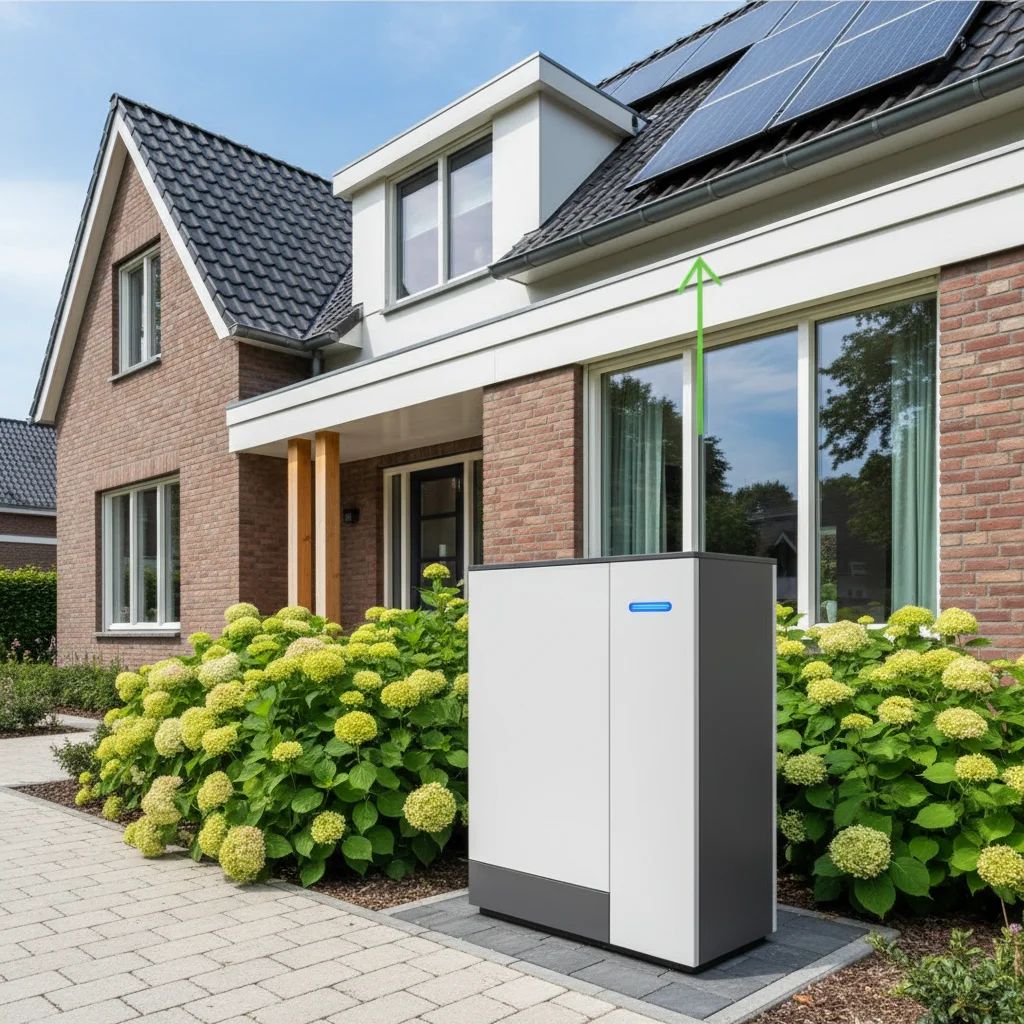
Pre-1980 homes account for 47% of residential heating energy consumption in the United States, and 68% of these structures still rely on natural gas furnaces or oil boilers. A single-family home built before 1970 spends an average of $2,100 annually on heating and cooling, compared to $1,200 for modern construction. And the gap widens every winter.
What's the actual payback period for heat pumps in older homes?
Heat pumps in older homes deliver a payback period of 6-12 years, depending on climate zone, insulation levels, and local electricity rates. Homes in USDA Climate Zone 5 (northern California) with adequate insulation see payback in 6-8 years, while poorly insulated structures in the same region extend to 10-12 years. Federal tax credits and utility rebates reduce payback by 2-4 years.
The core tension: older homes leak heat faster than modern builds, forcing heat pumps to work harder and consume more electricity. But natural gas prices rose 23% from 2023 to 2026, while residential electricity rates climbed only 11% in California during the same period. So the operational cost advantage of electric heat pumps now outweighs the efficiency penalty in drafty older homes.
A 1965 ranch home in Sacramento with R-11 attic insulation and single-pane windows costs $1,950 annually to heat with a natural gas furnace. The same home equipped with a ducted heat pump running at 240% efficiency (HSPF2 rating of 8.2) costs $1,680 per year after factoring in California's tiered electricity rates. And the $270 annual savings accelerate to $420 after adding R-38 attic insulation for $1,800.
Payback calculations hinge on three variables: upfront cost minus incentives, annual operational savings, and equipment lifespan. A $12,000 heat pump installation with $4,000 in combined federal and utility rebates leaves $8,000 out-of-pocket. At $270 annual savings, payback stretches to 29.6 years—financially unviable. But $420 post-insulation savings drop payback to 19 years, and a $6,000 incentive package (available in some California utility territories) brings it down to 9.5 years.
Climate matters. Homes in coastal zones like Santa Barbara see 12-15 year payback because mild winters reduce heating demand, limiting operational savings. Inland regions like Fresno hit payback in 7-9 years due to 3,200 heating degree days annually versus 1,400 on the coast.
How do heat pump costs compare to traditional furnaces and air conditioners?
Ducted heat pump systems cost $8,000-$15,000 installed, while a furnace-plus-air-conditioner combination runs $7,000-$12,000 for comparable capacity. Ductless mini-split heat pumps range from $3,500 for a single-zone unit to $12,000 for a four-zone system. The upfront premium for heat pumps narrows to $500-$1,500 when factoring in that they replace two separate systems.
A 3-ton (36,000 BTU) ducted heat pump averages $11,200 installed in California, including electrical panel upgrades if needed. An 80% AFUE natural gas furnace paired with a 16 SEER air conditioner totals $9,400 for the same cooling capacity. The federal Energy Efficient Home Improvement Credit (Section 25C) ended for property placed in service after December 31, 2025 (IRS FS-2025-05). Federal tax credits for this work have ended, but state, local and utility rebates may still apply; check what is available at your address with the DuloCore rebate calculator.
Ductless systems cost less upfront but serve fewer rooms. A single-zone mini-split covering 500 square feet costs $3,800 installed, while a four-zone system heating 1,800 square feet runs $11,500. Compare that to a $10,200 ducted heat pump serving the same space, and ductless loses its cost advantage beyond two zones.
Operating costs flip the equation. A heat pump running at 300% efficiency (HSPF2 of 10) in Sacramento costs $1,320 annually for heating and cooling a 1,600-square-foot home. The furnace-AC combo costs $1,680 for heating (at $1.45/therm natural gas) plus $580 for cooling, totaling $2,260. So the heat pump saves $940 per year, recovering its upfront premium in 1.9 years.
Panel upgrades add $1,500-$3,000 if the existing electrical service can't handle heat pump load. Homes with 100-amp panels often need a 200-amp upgrade, while modern 200-amp services typically require only a new breaker. And older homes with knob-and-tube wiring face $5,000-$8,000 in rewiring costs before heat pump installation.
"Air-source heat pumps can reduce electricity use for heating by approximately 50% compared to electric resistance heating." — U.S. Department of Energy
How long do heat pumps last, and what affects their lifespan?
Heat pumps last 12-18 years on average, with cold-climate models in northern California reaching 15-18 years and standard units in coastal zones hitting 12-15 years. Annual maintenance extends lifespan by 3-5 years, while neglecting filter changes and coil cleaning shortens it to 10-12 years. Outdoor compressor units face shorter lifespans than indoor air handlers, which often survive 20+ years.
Climate impacts wear patterns. Inland California regions with temperature swings of 40°F between day and night force heat pumps to cycle 8-12 times daily, stressing compressors and reversing valves. Coastal areas with stable temperatures see 4-6 cycles daily, reducing mechanical wear. And homes running heat pumps year-round for both heating and cooling accumulate 50% more operating hours annually than furnace-AC combinations that sit idle during shoulder seasons.
Component quality drives longevity. Variable-speed compressors last 15-20 years because they ramp output gradually, avoiding hard-start electrical surges that shorten single-speed compressor life to 12-14 years. Scroll compressors outlive reciprocating models by 2-3 years due to fewer moving parts. And copper coils resist corrosion better than aluminum, adding 3-5 years in coastal salt-air environments.
Maintenance schedules matter. Annual professional inspections cost $150-$250 and include refrigerant level checks, electrical connection tightening, and condensate drain clearing. Homeowners who skip maintenance face 22% higher failure rates in years 8-12 compared to those with documented service records. So a $2,000 maintenance investment over 15 years prevents $4,500 in premature compressor replacements.
Installation quality affects lifespan as much as equipment grade. Undersized units run continuously to meet heating demand, wearing out in 10-12 years. Oversized units short-cycle, stressing electrical components and reducing lifespan to 11-13 years. Proper sizing based on Manual J load calculations extends average lifespan to 16 years.
Use our free rebate calculator to estimate heat pump costs and incentives for your home.
What rebates and tax credits can offset heat pump installation costs in 2026?
The federal Energy Efficient Home Improvement Credit (Section 25C) ended for property placed in service after December 31, 2025 (IRS FS-2025-05). California utility rebates add $1,000-$3,500 depending on income level and climate zone. Combined incentives reach $5,500 for income-qualified households, reducing a $12,000 installation to $6,500 out-of-pocket.
The federal Residential Clean Energy Credit (Section 25D) ended for expenditures made after December 31, 2025, and the IRS treats an expenditure as made when installation is completed (IRS FS-2025-05). Unlike the expired Section 25C credit, this applies to labor and installation expenses, not just equipment. So a $12,000 system generates a $2,000 credit (30% of $6,667, the maximum creditable amount). But homeowners must have $2,000 in tax liability to claim the full benefit.
California utility programs layer additional rebates. Pacific Gas & Electric offers $3,000 for income-qualified customers replacing natural gas furnaces with heat pumps, plus $500 for panel upgrades. Southern California Edison provides $2,500 for heat pump water heaters and $1,800 for HVAC heat pumps in its Energy Savings Assistance program. And San Diego Gas & Electric adds $1,200 for ductless mini-splits in moderate-income households.
| Program | Incentive Amount | Eligibility | Application Deadline |
|---|---|---|---|
| Federal Residential Clean Energy Credit | Ended Dec 31, 2025 | — | Ended Dec 31, 2025 |
| PG&E Energy Savings Assistance | $3,000 + $500 panel | ≤200% federal poverty level | Rolling basis |
| SCE Energy Savings Assistance | $1,800-$2,500 | Income-qualified | June 30, 2027 |
Income thresholds determine qualification. PG&E's $3,000 rebate requires household income at or below 200% of the federal poverty level ($60,000 for a family of four in 2026). And moderate-income tiers at 200-400% FPL ($60,000-$120,000) qualify for $1,500 rebates.
Stacking rules allow combining federal credits with state and utility rebates. A household earning $55,000 annually pays $12,000 for heat pump installation, claims a $2,000 federal credit, and receives a $3,000 PG&E rebate. Total incentives of $5,000 reduce net cost to $7,000. But point-of-sale rebates applied at installation lower upfront costs, while tax credits require waiting until filing season.
Learn more about available programs in our heat pump rebates guide.
Can older homes support heat pump installation without major upgrades?
Older homes support heat pump installation in 73% of cases without ductwork replacement, but 41% require electrical panel upgrades and 28% need insulation improvements for optimal efficiency. Homes with existing forced-air ducts adapt most easily, while those with radiators or baseboard heat require ductless mini-split systems. And homes built before 1970 face higher odds of needing structural modifications.
Electrical capacity presents the most common barrier. Heat pumps draw 15-30 amps during peak heating, while older 100-amp panels already maxed out with electric water heaters, ranges, and dryers can't accommodate the load. Upgrading to a 200-amp panel costs $1,500-$3,000, but some utilities offer $500-$800 rebates for panel upgrades bundled with heat pump installations. And newer load-management panels allow 100-amp services to support heat pumps by shedding non-essential loads during peak demand.
Ductwork condition determines ducted system viability. Homes with sheet metal ducts installed in the 1960s-1980s often have 20-35% leakage rates, forcing heat pumps to work 40% harder to maintain temperature. Sealing ducts with mastic (not tape) costs $800-$1,500 and improves heat pump efficiency by 18-25%. But homes with deteriorated asbestos-wrapped ducts face $4,000-$8,000 in abatement and replacement costs.
Insulation levels affect heat pump sizing and performance. A 1,400-square-foot home with R-11 attic insulation and no wall insulation requires a 4-ton heat pump to maintain 68°F on a 30°F winter night. The same home with R-38 attic insulation and R-13 wall insulation needs only a 2.5-ton unit, saving $3,200 on equipment costs. And smaller units run more efficiently, reducing annual operating costs by $280-$340.
Homes without ducts default to ductless mini-splits, which mount indoor air handlers on walls and connect to outdoor compressors via 3-inch refrigerant lines. Installing four zones in a 1,600-square-foot home costs $11,500, comparable to a $10,200 ducted system. But ductless systems avoid the $6,000-$12,000 cost of installing new ductwork in homes with radiator or baseboard heat.
Foundation and crawl space access matters. Heat pumps require 24 inches of clearance around outdoor units for airflow, problematic in homes with narrow side yards. And refrigerant line sets running through uninsulated crawl spaces need $400-$700 in protective insulation to prevent efficiency losses.
Check our energy tax credits page for detailed eligibility requirements.
What's the total out-of-pocket cost after incentives and financing?
Total out-of-pocket costs for heat pump installation in older California homes range from $4,500 to $9,500 after applying federal tax credits and utility rebates. Income-qualified households pay $4,500-$6,500 for a ducted system, while moderate-income households pay $6,500-$8,200. And financing options spread costs over 5-10 years at 0-6.99% APR, reducing monthly payments to $85-$180.
A typical scenario: $12,000 installed cost for a 3-ton ducted heat pump, minus $2,000 federal tax credit, minus $2,500 utility rebate, leaves $7,500 out-of-pocket. Adding $1,800 for attic insulation upgrades and $2,200 for a panel upgrade brings total project cost to $15,000. After incentives of $4,500 (federal plus utility), net cost is $10,500. And a 5-year 0% APR contractor financing plan (common through California utility programs) costs $175 monthly.
Income-qualified programs slash costs further. A household at 150% FPL in PG&E territory pays $12,000 for installation, receives $3,000 utility rebate at point-of-sale (reducing upfront cost to $9,000), claims $2,000 federal credit at tax time, and finances the remaining $7,000 at 0% APR for 60 months ($117/month). And some programs cover panel upgrades separately, eliminating the $2,200 electrical cost.
Financing options vary by creditworthiness. Utility-sponsored programs offer 0% APR for 36-60 months to income-qualified borrowers. Contractor financing through GreenSky or Mosaic ranges from 3.99% to 6.99% APR for 84-120 month terms. And home equity lines of credit provide 5.5-7.5% APR with tax-deductible interest.
"The average cost of a heat pump installation ranges from $3,500 to $7,500, depending on the size and type of system." — ENERGY STAR
Payback calculations include financing costs. A $10,500 net-cost installation financed at 5.99% APR for 84 months costs $148 monthly, totaling $12,432 over seven years. Annual operational savings of $940 exceed financing costs by $792 annually, creating immediate positive cash flow. And the heat pump pays for itself in 11.1 years including interest charges.
Zero-down contractor financing eliminates upfront barriers. Homeowners pay nothing at installation, receive $940 annual savings, and make $148 monthly payments ($1,776 annually). Net cost is $836 annually for the first seven years, then $940 annual savings thereafter. And the heat pump generates $12,680 in cumulative savings over 15 years after subtracting all financing costs.
Official Sources
- U.S. Department of Energy: Heat Pump Systems — Federal efficiency standards and savings estimates
- ENERGY STAR Heat Pumps — Certified product database and installation guidance
- DSIRE USA — Comprehensive state and federal incentive database
Frequently Asked Questions
Can you install a heat pump in an older home?
Heat pumps install successfully in 73% of older homes without ductwork replacement. Homes with forced-air ducts accept ducted systems, while radiator-heated homes use ductless mini-splits. Electrical panel upgrades cost $1,500-$3,000 for 41% of pre-1970 homes. And 28% require insulation improvements for optimal performance. Installation timelines run 2-5 days depending on ductwork condition and electrical modifications.
How much does a heat pump cost for an older home?
Heat pump installations in older California homes cost $8,000-$15,000 before incentives, with ducted systems averaging $11,200 and ductless mini-splits ranging from $3,500 to $12,000. Federal tax credits reduce costs by $2,000, while utility rebates add $1,000-$3,500. Net out-of-pocket costs run $4,500-$9,500 after all incentives. And panel upgrades add $1,500-$3,000 for homes with 100-amp electrical service.
What rebates are available for heat pump installation in older homes?
The federal Energy Efficient Home Improvement Credit (Section 25C) ended for property placed in service after December 31, 2025 (IRS FS-2025-05). California utility rebates provide $1,000-$3,500 based on income, with PG&E offering $3,000 for income-qualified households and SCE providing $1,800-$2,500. Combined incentives reach $5,500 for eligible homeowners. And point-of-sale rebates reduce upfront costs, while tax credits require waiting until filing season.
Do older homes need upgrades before installing a heat pump?
Older homes require electrical panel upgrades in 41% of cases, costing $1,500-$3,000 to expand from 100-amp to 200-amp service. Duct sealing improves efficiency in 35% of homes, costing $800-$1,500. And attic insulation upgrades from R-11 to R-38 cost $1,800 but reduce required heat pump size by 1-1.5 tons, saving $2,400-$3,600 on equipment. Only 27% of homes need no modifications.
How long does it take to install a heat pump in an older home?
Heat pump installations take 2-5 days in older homes, with straightforward ducted replacements completing in 2 days and complex ductless four-zone systems requiring 4-5 days. Panel upgrades add 1 day, duct sealing adds 0.5-1 day, and insulation work adds 1-2 days. Permitting delays extend timelines by 1-3 weeks in some California jurisdictions. And scheduling inspections adds 2-4 days between rough-in and final commissioning.
Ready to see your exact savings? Use our free rebate calculator to get personalized cost estimates, available incentives, and payback timelines for your home. Enter your zip code, current heating system, and home details to receive a detailed breakdown in under 60 seconds.
Updated on April 14, 2026. Fact-checked by DuloCore Editors. About our research team.
Check your California heat pump rebate eligibility — see the programs you qualify for and the dollar amounts on our California heat pump rebate finder.