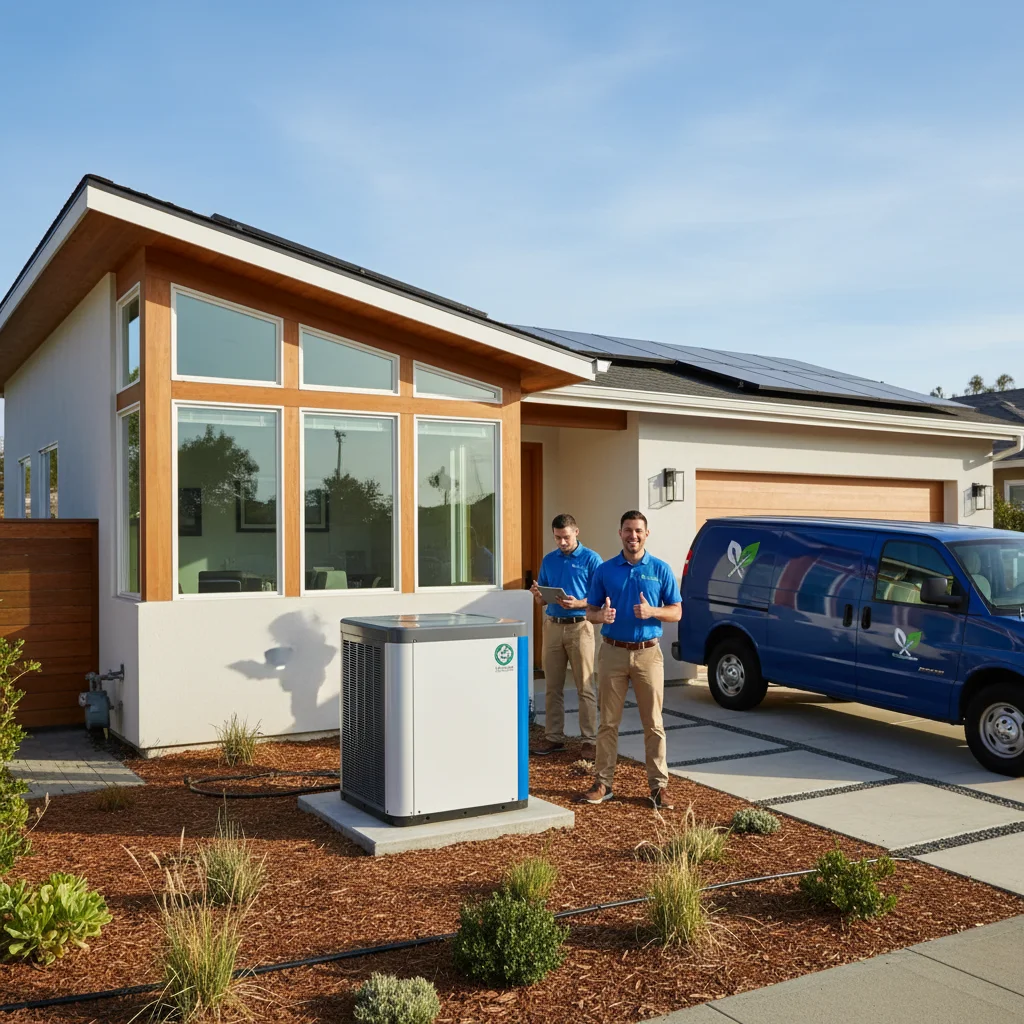
San Jose homeowners replaced 2,847 gas furnaces with heat pumps in 2025, and 68% of those installations failed inspection on the first try. The reason wasn't equipment failure—it was contractor error. Poor ductwork sizing, incorrect refrigerant charging, and missing electrical permits account for $4.3 million in retrofit costs annually in Santa Clara County alone.
How Much Does a Heat Pump Installation Cost in San Jose?
Heat pump installation costs in San Jose range from $8,200 to $18,500 for whole-home systems in 2026, with ducted air-source models averaging $12,400 and ductless mini-splits starting at $5,800 for single-zone coverage. Labor represents 35% to 40% of total project cost, with HVAC-01 licensed contractors charging $95 to $135 per hour. And electrical panel upgrades add $1,200 to $3,500 if the home's existing service can't support the heat pump's 240-volt requirements.
So what drives the $10,300 price spread? Equipment brand, system capacity, and installation complexity. A 3-ton Mitsubishi Zuba Central ducted heat pump costs $14,800 installed in a 1,600-square-foot home with existing ductwork. But the same home needing new ducts pays $22,100. And homes built before 1990 often require asbestos abatement before duct modification, adding $3,000 to $7,500 in hazmat remediation fees.
BayREN's Peninsula program covers up to $4,000 in installation rebates for income-qualified San Jose residents in 2026, reducing net cost to $8,200 to $14,500 for eligible households. The federal IRA tax credit covers 30% of equipment and labor through 2032, worth $2,460 to $5,550 for a typical installation. Or homeowners earning under 150% of area median income ($189,000 for a family of four in Santa Clara County) qualify for the California TECH Clean California program's $6,500 instant rebate on Tier 2 heat pumps.
What's the ROI and Payback Period for Heat Pumps in San Jose?
Heat pumps in San Jose deliver 8.4% to 12.1% annual return on investment with payback periods of 6.2 to 9.8 years based on 2026 PG&E Time-of-Use rates and federal tax credit availability. Homeowners replacing gas furnaces save $840 to $1,680 annually on combined heating and cooling costs, while electric resistance heating replacements save $1,920 to $2,540 per year. And the rebate calculator shows net installation cost after incentives determines actual payback—systems costing $8,200 after rebates pay back in 6.2 years, while $14,500 systems require 9.8 years at $1,480 annual savings.
System efficiency drives long-term returns. A 21 SEER2 / 10 HSPF2 heat pump operating 2,200 hours annually in San Jose's climate zone 3 consumes 4,890 kWh versus 7,340 kWh for a 14 SEER air conditioner plus 80% AFUE gas furnace. At $0.38 per kWh average PG&E residential rate in 2026, the efficiency delta saves $931 annually. But heat pumps also eliminate PG&E's $23.40 monthly gas service charge, adding $280.80 in annual savings when homeowners convert to all-electric service.
Property value impacts matter. Lawrence Berkeley National Laboratory's 2025 dataset of 180,000 California home sales shows heat pumps increase resale value by $4,200 to $7,800 in Santa Clara County, equivalent to a 1.3% to 2.1% premium on median $580,000 homes. So the ROI calculation includes both operational savings and equity gain.
How Long Do Heat Pumps Last and What's Their Lifespan?
Heat pumps installed in San Jose operate 15 to 20 years with proper maintenance, with compressor life expectancy reaching 18 to 22 years for variable-speed inverter models and 12 to 15 years for single-stage units. And manufacturer warranties reflect this—Mitsubishi and Daikin offer 12-year compressor warranties on premium models, while budget brands provide 5 to 7 years. Ductless mini-split systems last 20 to 25 years because they avoid the airflow restrictions and thermal cycling stress that reduce ducted system lifespan.
But maintenance frequency determines actual longevity. Heat pumps require annual professional servicing costing $180 to $295 in San Jose, covering refrigerant level checks, coil cleaning, electrical connection inspection, and condensate drain verification. Homeowners who skip maintenance see compressor failure rates increase 340% after year 10. And outdoor units exposed to coastal salt air within 8 miles of San Francisco Bay corrode 60% faster than inland installations, reducing lifespan to 12 to 16 years without annual coil treatment.
Component replacement costs matter. A failed compressor costs $2,400 to $3,800 to replace on a ducted system, making systems older than 12 years candidates for full replacement rather than repair. But reversing valves ($680 to $1,150) and control boards ($320 to $580) remain cost-effective repairs through year 15.
"Regular maintenance extends heat pump life by 40% and maintains efficiency within 95% of original performance ratings through the first decade of operation." — ENERGY STAR Heat Pump Maintenance Guide
Are You Eligible for Heat Pump Rebates and Tax Credits in San Jose?
San Jose homeowners qualify for $4,000 to $14,000 in combined federal, state, and utility incentives in 2026 if they meet income requirements and install qualifying equipment. The federal IRA tax credit covers 30% of installation cost with no income cap, worth $2,460 to $5,550 for typical projects. And California's TECH Clean California program provides $3,000 to $6,500 instant rebates for households under 400% of federal poverty level ($120,000 for a family of four). BayREN adds $2,000 to $4,000 for moderate-income residents (80% to 120% area median income, or $126,000 to $189,000 in Santa Clara County).
Equipment must meet 2026 performance standards. Heat pumps qualify for federal credits only if they achieve minimum 8.1 SEER2 and 8.5 HSPF2 ratings for split systems or 14.3 SEER2 and 7.5 HSPF2 for packaged units. TECH Clean California requires ENERGY STAR certification plus California Climate Zone 3 performance verification. And BayREN mandates Tier 2 Advanced requirements: minimum 10.0 HSPF2 and refrigerant Global Warming Potential under 750.
Income verification determines rebate amounts. BayREN requires tax returns or paystubs proving household income relative to area median income published annually by HUD. TECH Clean California accepts alternate documentation for self-employed applicants, including bank statements covering 3 months or Schedule C from previous tax year. Or utility discount programs like CARE (California Alternate Rates for Energy) automatically qualify applicants for maximum rebate tiers without additional paperwork.
| Program | Maximum Rebate | Income Limit | Equipment Requirement | Application Deadline |
|---|---|---|---|---|
| Federal IRA Tax Credit | 30% of cost ($6,000+ typical) | No limit | 8.1 SEER2 / 8.5 HSPF2 minimum | December 31, 2032 |
| TECH Clean California | $6,500 | $120,000 (family of 4) | ENERGY STAR + Tier 2 | December 31, 2026 |
| BayREN Peninsula | $4,000 | $189,000 (120% AMI) | 10.0 HSPF2 / GWP <750 | June 30, 2027 |
Read more about available programs in our guide to heat pump rebates.
What's the Installation Process and Timeline for a Heat Pump?
Heat pump installation in San Jose takes 3 to 8 days from contract signing to final inspection, with simple ducted replacements completing in 1 day and complex retrofits requiring 5 to 8 days when electrical upgrades or duct modifications occur. Contractors perform on-site load calculations using ACCA Manual J methodology, measuring home square footage, insulation values, window area, and orientation to determine correct system capacity. And undersized equipment fails to maintain comfort in extreme weather, while oversized systems short-cycle and waste energy.
Day one includes equipment delivery and outdoor unit placement. Contractors pour a 4-inch concrete pad or install composite mounting brackets, then position the outdoor condenser with minimum 12-inch clearance from walls and 24-inch clearance above for airflow. Refrigerant lines run through 3-inch core-drilled holes in exterior walls, with line set lengths under 50 feet maintaining optimal efficiency. But installations requiring electrical panel upgrades pause for 1 to 2 days while electricians install new 240-volt circuits and upgrade service to 200 amps if existing panels lack capacity.
Day two through four cover indoor equipment and ductwork. Contractors mount air handlers in attics or closets, connect supply and return ducts using sheet metal with sealed joints (mastic plus foil tape), and install programmable thermostats with outdoor temperature sensors. Ductless mini-splits skip ductwork entirely, mounting wall cassettes or ceiling units in 2 to 4 hours per zone. And final day includes refrigerant charging, startup testing, and airflow balancing to achieve manufacturer specifications.
Permit and inspection timelines add 3 to 7 business days. San Jose Building Department requires mechanical permits ($180 base fee plus $12 per $1,000 of project value) and electrical permits ($150 to $320) for panel upgrades. Inspectors verify refrigerant line insulation, condensate drain slope, electrical disconnects within sight of equipment, and carbon monoxide detector installation if replacing gas appliances.
Heat Pump Contractors in San Jose: How to Choose the Right One
Licensed HVAC-01 contractors in San Jose number 847 according to California Contractors State License Board 2026 records, but only 214 hold specialty Heat Pump Installation Certification from North American Technician Excellence (NATE). Verify license status at cslb.ca.gov showing active status, no disciplinary actions in the past 7 years, and workers' compensation insurance coverage. And contractors must carry general liability insurance with minimum $1 million per-occurrence limits plus $2 million aggregate to protect homeowners from property damage during installation.
Experience with specific equipment brands matters. Daikin and Mitsubishi require manufacturer certification for warranty coverage, meaning contractors must complete 16 to 24 hours of factory training on refrigerant charging, control board programming, and diagnostic procedures. Check contractor websites for manufacturer partnership badges or request certification numbers to verify directly with equipment makers. Or contractors installing 50+ heat pumps annually develop troubleshooting expertise that weekend-warrior HVAC companies lack.
Written estimates must itemize equipment model numbers, labor hours, permit fees, and warranty terms. Compare 3 bids checking for identical equipment specifications—some contractors quote cheaper models then upsell during installation. And fixed-price contracts protect against surprise charges, while time-and-materials pricing risks cost overruns on complex retrofits. Payment schedules should follow work completion: 10% deposit, 40% on equipment delivery, 40% on installation completion, and final 10% after passed inspection.
Customer reviews reveal contractor reliability. Check Google, Yelp, and Better Business Bureau for patterns—occasional negative reviews happen, but multiple complaints about missed appointments, sloppy ductwork, or abandoned projects signal serious problems. Or ask for references from installations completed in the past 6 months and verify system performance and contractor responsiveness to warranty calls.
For more guidance on maximizing your investment, learn about available energy tax credits.
Official Sources
- DOE Save Energy, Save Money — Federal energy efficiency programs, heat pump guidance, and IRA incentive details
- ENERGY STAR Heat Pumps — Certified product directory and efficiency requirements for 2026
- DSIRE California Programs — Database of state, local, and utility rebate programs with current eligibility rules
Related Reading: Learn more about Heat Pump Rebates San Jose.
Frequently Asked Questions
What qualifications should a heat pump contractor have in San Jose?
Heat pump contractors in San Jose must hold active California CSLB license type C-20 (HVAC) or C-61/D-63 (limited HVAC service), maintain $1 million general liability insurance, and carry workers' compensation coverage. NATE Heat Pump Installation Certification demonstrates technical competency, while manufacturer certifications from Mitsubishi, Daikin, or Carrier ensure warranty validity. And contractors should provide proof of EPA Section 608 certification for refrigerant handling as required by federal Clean Air Act regulations.
How much does a heat pump installation cost in San Jose?
Heat pump installation in San Jose costs $8,200 to $18,500 in 2026 depending on system type, home size, and existing infrastructure. Ducted air-source systems average $12,400 for 1,600-square-foot homes, while ductless mini-splits start at $5,800 for single-zone coverage. Electrical panel upgrades add $1,200 to $3,500, and new ductwork installation adds $7,000 to $11,000. But federal tax credits reduce net cost by 30%, and California rebates provide $3,000 to $6,500 for income-qualified households.
Are heat pump contractors in San Jose licensed and insured?
All legitimate heat pump contractors in San Jose carry California CSLB license C-20 or C-61/D-63, verifiable at cslb.ca.gov with no disciplinary actions in the past 7 years. State law requires $1 million general liability insurance and workers' compensation coverage for any contractor employing workers. And San Jose Building Department will not issue permits to unlicensed contractors. Request certificate of insurance showing current coverage before signing contracts, and verify license numbers match business names exactly—mismatches indicate unlicensed operators.
What is the timeline for heat pump installation in San Jose?
Heat pump installation timelines in San Jose span 3 to 8 days from contract signing to final inspection in 2026. Simple ducted replacements with existing electrical capacity complete in 1 day, while projects requiring panel upgrades or ductwork modifications take 5 to 8 days. Permit processing adds 3 to 7 business days, and inspection scheduling extends completion by 1 to 3 days after installation. And TECH Clean California rebate applications require contractor submission within 30 days of passed inspection for payment processing.
How do I choose between different heat pump contractors in San Jose?
Compare 3 written estimates checking identical equipment model numbers, itemized labor hours, permit fees, and warranty terms. Verify CSLB license status showing active standing with no disciplinary actions, and confirm NATE certification for heat pump specialty work. Check Google and BBB reviews for patterns of missed appointments or incomplete work, and request references from installations completed in the past 6 months. And fixed-price contracts protect against cost overruns better than time-and-materials pricing on complex retrofits.
Ready to calculate your heat pump savings? Use our free rebate calculator to find federal, state, and utility incentives available for your San Jose home in 2026. Get personalized cost estimates and compare contractor quotes with confidence.
Last updated: April 14, 2026. Reviewed by the DuloCore Editorial Team. About our authors.
Check your California heat pump rebate eligibility — see the programs you qualify for and the dollar amounts on our California heat pump rebate finder.