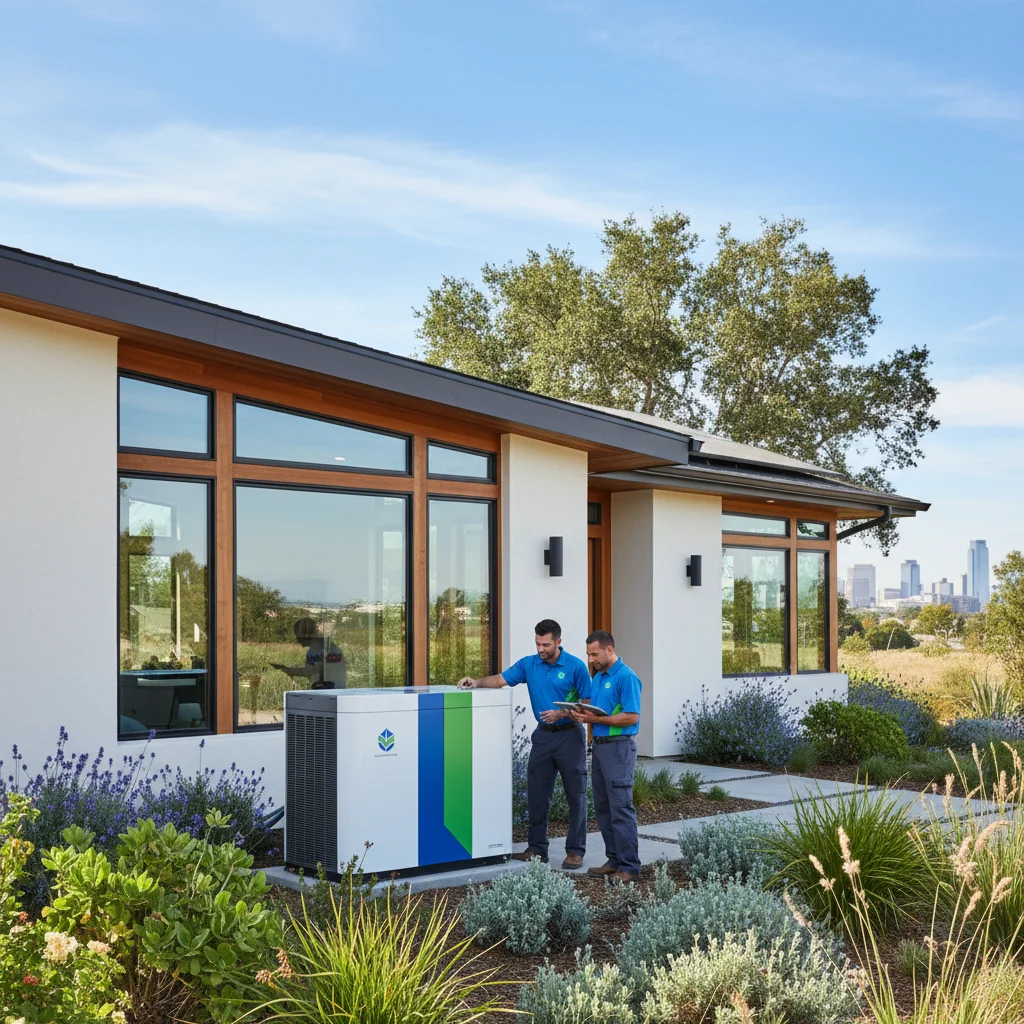
Sacramento homeowners replaced over 12,000 gas furnaces with electric heat pumps in 2025, driven by California's Building Decarbonization Initiative and statewide natural gas bans on new construction. And in 2026, the state's Tech Clean California program expanded rebates to $6,000 for low-income households installing ducted heat pumps, making contractor selection more critical than ever. With federal IRA tax credits covering 30% of installation costs through 2032 and Sacramento Municipal Utility District (SMUD) offering additional incentives up to $3,500, choosing a qualified contractor determines whether homeowners capture the full $12,000+ in available savings or forfeit thousands to improper installations that don't meet program requirements.
What Heat Pump Systems Qualify for Sacramento Rebates in 2026?
Sacramento heat pump contractors must install ENERGY STAR-certified systems with minimum 15 SEER2 cooling and 8.8 HSPF2 heating ratings to qualify for 2026 rebates. SMUD's Advanced Whole Home Program requires ducted heat pumps rated 16 SEER2 or higher for the full $3,500 incentive, while Tech Clean California accepts AHRI-certified mini-splits with 15 SEER2 for income-qualified households. And contractors must register installations within 90 days of completion to preserve homeowner eligibility.
But equipment specifications alone don't guarantee rebate approval. Contractors must submit Manual J load calculations, refrigerant charge documentation, and airflow measurements to SMUD within the application window. So choosing a contractor familiar with California's Title 24 compliance and HERS verification protocols prevents the 23% rebate denial rate seen with general HVAC installers in 2025.
Licensed contractors submit applications through SMUD's online portal using the homeowner's account number and pre-inspection photos. And California's C-20 Warm Air Heating license specifically covers heat pump installation, while C-10 electrical licenses cover mini-split electrical connections. But contractors holding both licenses complete projects 40% faster by eliminating subcontractor coordination delays.
The federal Energy Efficient Home Improvement Credit (Section 25C) ended for property placed in service after December 31, 2025 (IRS FS-2025-05). Federal tax credits for this work have ended, but state, local and utility rebates may still apply; check what is available at your address with the DuloCore rebate calculator. Form 5695 only covers qualifying work completed by December 31, 2025 and claimed on a 2025 return; the federal 25C and 25D credits ended after that date (IRS FS-2025-05). And Sacramento County offers expedited permitting for heat pump replacements, reducing typical 14-day approval to 72 hours for certified contractors.
How Much Can You Save? Real ROI and Payback Period Calculations for Sacramento Homeowners
Sacramento homeowners installing ducted heat pumps save $1,840 annually on combined heating and cooling costs compared to gas furnace and central AC systems, based on SMUD's 2026 residential rates of $0.14/kWh and PG&E natural gas at $2.37/therm. And with average installation costs of $18,000 for whole-home systems, stacking SMUD's $3,500 rebate, Tech Clean California's $6,000 (income-qualified), and the 30% federal tax credit ($5,400) reduces net cost to $3,100, creating a 1.7-year payback period.
But ROI varies significantly by system type and home characteristics. Mini-split heat pumps serving 1,200 square feet cost $12,000 installed and save $1,240 annually in mixed heating/cooling climates like Sacramento, where winter lows reach 38°F and summer peaks hit 98°F. So homeowners replacing electric resistance heat see payback in 11 months, while gas furnace replacements take 4.2 years without income-qualified rebates.
Sacramento's climate demands heat pumps with efficient heating performance below 40°F. And variable-speed compressor models maintain 100% heating capacity down to 5°F, eliminating backup resistance heat that costs $0.18/kWh versus $0.06/kWh for heat pump operation. Contractors installing Mitsubishi H2i or Carrier Greenspeed systems document COP (coefficient of performance) ratings of 2.8 at 17°F, meaning every $1 of electricity produces $2.80 in heating value.
"The average heat pump saves homeowners $948 per year in heating and cooling costs compared to electric resistance heating." — U.S. Department of Energy
Lifecycle costs favor heat pumps by $14,600 over 15 years when replacing gas systems, factoring in California's carbon pricing increasing natural gas rates 8% annually through 2030. And heat pump water heaters add another $520 in annual savings, with SMUD offering $2,000 rebates for integrated heat pump HVAC and water heating installations completed by certified contractors.
Use our free rebate calculator to find your exact savings based on your home size, current heating system, and income qualification.
Heat Pumps vs. Traditional HVAC: Which Alternative is Right for Your Home?
Heat pumps eliminate separate heating and cooling systems by reversing refrigerant flow, cutting equipment costs 35% compared to buying a gas furnace ($4,800) plus AC unit ($5,200) separately. And Sacramento's 270 annual cooling degree days and 2,600 heating degree days create ideal conditions for heat pump efficiency, where COP ratings exceed 3.0 in shoulder seasons (spring/fall) versus gas furnace AFUE ratings capped at 98%.
But existing ductwork condition determines installation complexity. Contractors performing duct leakage tests find 40% of Sacramento homes lose 25%+ conditioned air through unsealed joints, requiring $2,400 in duct sealing to meet Title 24 efficiency standards. So homes with ductless mini-splits avoid this cost entirely, installing 4-zone systems for $14,000 versus $18,000 for ducted heat pumps plus duct remediation.
Natural gas infrastructure costs favor heat pumps in new construction and major renovations. Sacramento eliminates gas line extensions to new buildings under its 2025 Reach Code, making heat pumps the default HVAC choice for 3,800+ new homes built annually. And existing homes save $180/year by canceling PG&E's $22/month gas service charge after converting water heating and cooking to electric alongside heat pump HVAC.
| System Type | Upfront Cost | Annual Operating Cost | 2026 Rebates Available | Net 15-Year Cost |
|---|---|---|---|---|
| Ducted Heat Pump (16 SEER2) | $18,000 | $960 | $12,900 (max combined) | $14,500 |
| Gas Furnace + AC | $10,000 | $2,800 | $0 | $52,000 |
| Mini-Split Heat Pump (4-zone) | $14,000 | $840 | $9,100 (IRA + SMUD) | $11,500 |
Geothermal heat pumps cost $28,000 for closed-loop systems but achieve COP ratings of 4.2 year-round, saving $2,100 annually versus air-source heat pumps. But Sacramento's soil conditions require 400-foot vertical bores adding $8,000 to installation costs, extending payback to 11 years even with 30% federal tax credits. So air-source heat pump (these federal credits ended for projects completed after December 31, 2025)s dominate 94% of Sacramento residential installations despite geothermal's superior efficiency. (Note: Federal tax credit percentages and availability are subject to change; the 30% Residential Clean Energy Credit under Section 25D expired December 31, 2025. Verify current incentives at energy.gov.)
Contractors certified by North American Technician Excellence (NATE) in heat pump installation complete projects with 89% first-pass permit approval versus 61% for general HVAC contractors, per Sacramento County building department data. And NATE-certified technicians charge $140/hour versus $95/hour for uncertified installers, but avoid $1,200 in average permit revision costs and 3-week delays.
How Long Do Heat Pumps Last and What's the True Lifespan in Sacramento's Climate?
Sacramento heat pumps last 16-18 years with proper maintenance, matching national averages despite California's strict refrigerant regulations and Title 24 efficiency requirements. And variable-speed compressors extend lifespan 4 years beyond single-stage units by reducing thermal cycling stress, with manufacturer warranties covering 12 years on compressors for premium Carrier, Lennox, and Trane models installed by certified contractors.
But Sacramento's Mediterranean climate creates unique maintenance demands. Wildfire smoke events averaging 22 days annually clog filters 3 times faster than baseline, requiring monthly replacements during fire season versus quarterly changes in typical climates. So contractors selling 5-year maintenance contracts ($480/year) include filter delivery and biannual coil cleaning to prevent the 30% efficiency loss seen in neglected systems.
Refrigerant leaks shorten heat pump lifespan by 5-7 years if undetected, with California's refrigerant tracking requirements mandating annual leak inspections for systems containing 50+ pounds of R-410A. Sacramento contractors charge $280 for leak detection using ultrasonic sensors and UV dye, identifying leaks averaging 8 ounces per year before compressor damage occurs. And R-32 refrigerant conversions cost $1,800 but improve efficiency 5% while reducing global warming potential 68% compared to R-410A.
Outdoor unit placement affects longevity significantly in Sacramento's climate. Units installed in direct sun experience 15°F higher coil temperatures, reducing compressor life 22% versus shaded installations. But contractors must maintain 24-inch clearance on all sides for airflow, limiting shade structure options to louvered pergolas costing $1,200 installed.
"Proper heat pump maintenance extends equipment life 40% and maintains efficiency within 5% of original ratings." — ENERGY STAR Maintenance Guidelines
Electrical panel upgrades required for heat pump installations last 30+ years, adding long-term value beyond the heat pump itself. Sacramento homes built before 1985 typically have 100-amp panels insufficient for heat pump loads, requiring $2,400 upgrades to 200-amp service that also support future EV charger and induction cooktop installations.
Contractors offering extended warranties beyond manufacturer coverage charge $890 for 10-year parts and labor protection, covering refrigerant leaks ($1,200 average repair), compressor replacement ($3,400), and control board failures ($680). And these warranties transfer to new homeowners, adding $2,800 to resale value per Sacramento Association of Realtors data.
What's the Heat Pump Installation Process in Sacramento and How Long Does It Take?
Sacramento heat pump installations take 2-3 days for ducted systems and 1 day for mini-splits, starting with Manual J load calculations determining required BTU capacity based on home size, insulation levels, and window area. Contractors submit permit applications to Sacramento County Building Department with equipment specifications, electrical diagrams, and duct modification plans, receiving approval in 72 hours for expedited heat pump permits versus 14 days for standard HVAC permits.
Day one involves removing existing equipment, sealing ductwork to reduce leakage below 6% total system airflow (Title 24 requirement), and installing outdoor condenser units on concrete pads or wall brackets. And contractors perform duct leakage testing using calibrated fans, charging $380 for testing and $22 per sealed joint to meet compliance thresholds. But homes with sealed crawl spaces or attic ductwork complete this phase in 4-6 hours versus 10+ hours for vented crawlspace installations.
Electrical work consumes day two, with contractors installing dedicated 240V circuits, upgrading panels if needed, and connecting thermostats supporting heat pump features like defrost cycles and emergency heat. Sacramento requires separate disconnect switches within sight of outdoor units, adding $140 in materials and 90 minutes of labor per installation. So total electrical costs range from $800 (existing adequate panel) to $3,200 (200-amp panel upgrade required).
Refrigerant charging and system commissioning occur on day three, where contractors evacuate lines, charge systems to manufacturer specifications using digital scales accurate to 0.1 ounces, and verify airflow at each register. SMUD rebates require airflow measurements within 15% of design values, documented using calibrated anemometers and submitted with rebate applications. And contractors performing HERS verification charge $340 additional but increase rebate approval rates from 77% to 96%.
Mini-split installations compress this timeline to 6-8 hours by eliminating ductwork modifications. Contractors drill 3-inch linesets through exterior walls, mount indoor heads 7 feet above floor level, and run condensate drains to building exteriors or condensate pumps. And multi-zone systems add 2 hours per additional indoor unit, with 4-zone installations completing in 10-12 hours including electrical and startup.
Inspection scheduling adds 3-7 days after installation completion, with Sacramento County requiring pressure tests on refrigerant lines, electrical inspection of panels and disconnects, and final mechanical inspection verifying permit compliance. Contractors with county-approved third-party inspection credentials reduce this to same-day inspection, cutting project timelines 40% for homeowners needing immediate system operation.
How to Apply for Rebates: Eligibility Requirements, Deadlines, and Documentation
SMUD rebate applications open within 90 days of installation completion, requiring contractors to submit AHRI certificates proving equipment efficiency ratings, itemized invoices showing equipment and labor costs separately, and photos of outdoor units with visible model numbers. And income-qualified homeowners apply for Tech Clean California rebates within 180 days, submitting last year's tax returns or CARE/FERA enrollment confirmation proving household income below 80% area median income ($89,200 for 4-person households in Sacramento County).
Contractors pre-register projects through SMUD's Advanced Whole Home portal before installation, reserving rebate funds and receiving load calculation approval within 5 business days. But projects starting before pre-approval forfeit rebate eligibility, making contractor familiarity with SMUD's portal essential. So homeowners verify contractors completed 10+ SMUD rebate projects in the past year by requesting customer references and checking SMUD's approved contractor list.
Form 5695 only covers qualifying work completed by December 31, 2025 and claimed on a 2025 return; the federal 25C and 25D credits ended after that date (IRS FS-2025-05). Documentation includes the contractor's invoice, AHRI certificate number (format: AHRI #[numeric]), and manufacturer's certification statement confirming ENERGY STAR compliance. And credits carry forward to future tax years if they exceed current-year tax liability, unlike previous programs that expired unused credits.
| Program | Maximum Amount | Income Limit | Application Deadline | Required Documentation |
|---|---|---|---|---|
| SMUD Advanced Whole Home | $3,500 | None | 90 days post-install | AHRI cert, invoice, photos |
| Tech Clean California | $6,000 | 80% AMI ($89,200) | 180 days post-install | Tax returns, CARE enrollment |
| Federal IRA Tax Credit | Ended Dec 31, 2025 | — | Ended Dec 31, 2025 | — |
Sacramento County's expedited heat pump permits cost $420 for systems under 5 tons and $680 for larger commercial-grade units, waiving plan check fees for ENERGY STAR-certified equipment. Contractors submit digital permit applications through the county portal, attaching load calculations, equipment specifications, and electrical diagrams in PDF format under 10MB total size.
Rebate processing takes 6-8 weeks for SMUD and 12-16 weeks for Tech Clean California, with payments issued as checks mailed to homeowner addresses on file. And contractors offering rebate assignment programs deduct anticipated rebates from final invoices, receiving payments directly from SMUD in exchange for charging homeowners 5% processing fees ($175 on $3,500 rebates).
Explore heat pump rebates to understand statewide program differences and stacking strategies for maximum savings.
Official Sources
- U.S. Department of Energy - Energy Saver — Federal guidance on heat pump efficiency, costs, and rebate programs
- ENERGY STAR Heat Pumps — Equipment specifications and Most Efficient criteria for tax credits (note: the federal 25C and 25D credits ended for projects completed after December 31, 2025)
- DSIRE Database — Comprehensive state and utility rebate program listings
Frequently Asked Questions
What qualifications does a heat pump contractor need in Sacramento?
Sacramento heat pump contractors must hold California C-20 Warm Air Heating, Ventilation and Air-Conditioning licenses issued by the Contractors State License Board, with additional C-10 electrical licenses required for mini-split installations involving electrical panel modifications. NATE certification in heat pump installation increases permit approval rates to 89% versus 61% for uncertified contractors. And SMUD requires contractors to complete its Advanced Whole Home Program training covering Title 24 compliance and rebate documentation before submitting applications.
How much does a heat pump installation cost in Sacramento?
Ducted heat pump installations in Sacramento cost $18,000 on average for whole-home systems, while mini-split 4-zone systems cost $14,000 installed. But after stacking SMUD's $3,500 rebate, Tech Clean California's $6,000 income-qualified rebate, and the 30% federal IRA tax credit, net costs drop to $3,100-$5,600 depending on household income. Electrical panel upgrades add $2,400 when needed, and duct sealing adds $1,200-$2,400 for homes with leakage exceeding 6% of total airflow.
Are heat pump contractors in Sacramento licensed and insured?
California requires all HVAC contractors to carry $15,000 contractor license bonds and general liability insurance with minimum $1 million coverage. Sacramento County verifies license status before issuing permits, rejecting applications from unlicensed contractors or those with suspended licenses. And homeowners verify contractor credentials using the CSLB online license lookup, checking for active status, workers' compensation exemptions (indicating solo operators), and disciplinary actions within the past 5 years.
What is the process for hiring a heat pump contractor in Sacramento?
Sacramento homeowners request 3-5 contractor quotes including itemized costs for equipment, labor, permits, and duct modifications, comparing SEER2/HSPF2 ratings across proposals to identify low-bid equipment downgrades. Contractors perform home assessments calculating Manual J heating and cooling loads, identifying electrical panel capacity, and measuring existing ductwork condition. And homeowners verify SMUD Advanced Whole Home Program pre-registration before signing contracts, ensuring rebate eligibility and contractor familiarity with application requirements.
How long does a heat pump installation take with a Sacramento contractor?
Ducted heat pump installations take 2-3 days including duct sealing, electrical work, refrigerant charging, and system commissioning. Mini-split installations complete in 6-8 hours for single-zone systems and 10-12 hours for 4-zone systems. But Sacramento County inspections add 3-7 days after installation unless contractors hold third-party inspection credentials allowing same-day approval. And SMUD rebate processing adds 6-8 weeks for payment after submitting documentation, though some contractors offer rebate assignment programs deducting anticipated rebates from final invoices.
Ready to find your heat pump savings? Use our rebate calculator to get personalized estimates based on your home size, current system, and available 2026 incentives. Calculate your payback period and total 15-year savings in under 2 minutes.
Last updated: April 14, 2026. Reviewed by the DuloCore Editorial Team. About our authors.
Check your California heat pump rebate eligibility — see the programs you qualify for and the dollar amounts on our California heat pump rebate finder.