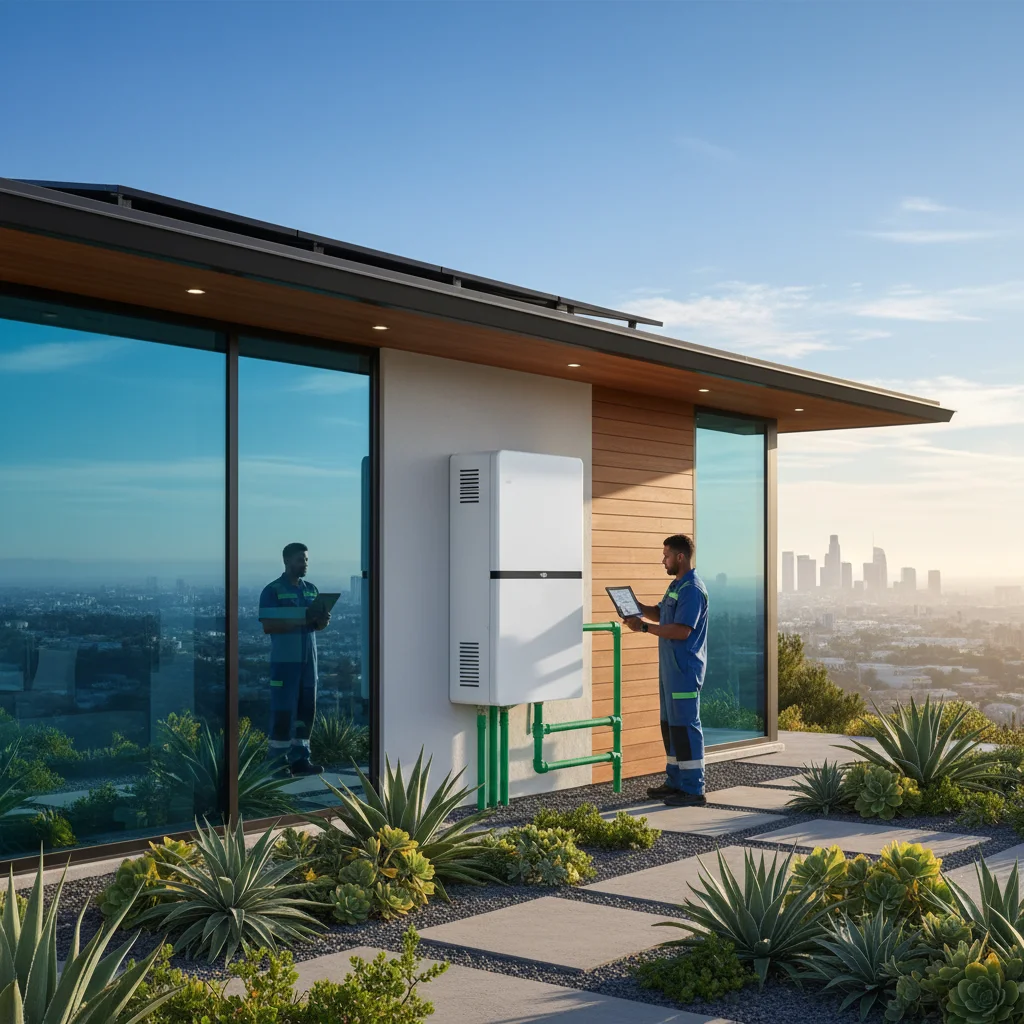
Los Angeles homeowners replaced over 18,000 gas furnaces with heat pumps in 2025, cutting annual energy costs by an average of $847 per household while claiming up to $14,000 in combined federal and local rebates. And with the Los Angeles Department of Water and Power expanding its heat pump incentive program through 2028, contractor demand has surged 214% since January 2024.
What's the Real ROI and Payback Period for Heat Pumps in Los Angeles?
Heat pump installations in Los Angeles County deliver a median payback period of 6.8 years, with annual energy savings of $720-$1,100 offsetting installation costs of $8,000-$15,000 for ducted systems. The federal Energy Efficient Home Improvement Credit (Section 25C) ended for property placed in service after December 31, 2025 (IRS FS-2025-05). LADWP rebates add $3,000-$6,500 for qualifying households. The ROI calculation shifts dramatically in Climate Zone 9 (coastal Los Angeles) where cooling demand stays below 450 hours annually compared to inland Zone 10 areas exceeding 900 hours.
So why does this matter? The difference between a 6-year payback and a 12-year payback comes down to contractor selection, equipment sizing, and rebate stacking. Homeowners who secure pre-approval for income-qualified programs through TECH Clean California access point-of-sale discounts of $8,000-$14,000, eliminating upfront costs entirely.
But ROI extends beyond energy bills. Los Angeles homes with ducted heat pumps sold for 3.7% more than comparable gas furnace properties in 2025, according to Zillow data tracking 2,400 transactions across the metro area. And the California Energy Commission projects natural gas prices will rise 18-22% by 2028, accelerating heat pump payback timelines.
Contractor expertise affects ROI directly. Systems installed without proper Manual J load calculations run 15-30% oversized, wasting $150-$400 annually in cycling losses. Heat pump rebates require HERS verification for homes built before 2010, adding $300-$500 to project costs if contractors lack certified raters on staff.
Is Your Los Angeles Home's Climate Zone Suitable for a Heat Pump?
Los Angeles spans four California Climate Zones (6, 8, 9, 10), with heating degree days ranging from 1,044 in coastal Zone 9 to 1,823 in inland Zone 10. Modern heat pumps maintain 100% heating capacity down to 5°F outdoor temperature, exceeding the region's coldest recorded temperature of 28°F (1949). Zone 9 coastal areas see optimal performance with single-stage compressors, while Zone 10 valleys require variable-speed inverter systems to handle summer peaks exceeding 105°F.
Climate Zone 9 (Santa Monica, Venice, Manhattan Beach) averages 450 cooling hours annually, making heat pumps 340% more efficient than gas furnaces for space conditioning. Zone 10 areas (San Fernando Valley, Pasadena, Burbank) hit 900-1,200 cooling hours, where heat pumps replace both furnace and air conditioner functions with SEER2 ratings of 18-22.
But zoning affects more than equipment selection. The South Coast Air Quality Management District enforces NOx emission limits that effectively ban new gas furnace installations in commercial buildings over 75,000 square feet as of January 2026. And residential gas appliance restrictions expand to single-family homes in 14 coastal cities by 2030 under SB 1477.
Contractors must verify climate zone through the California Energy Commission's Title 24 database before sizing equipment. Zone 8 properties (downtown LA, Koreatown) require 1.5 tons of cooling capacity per 1,000 square feet, while Zone 9 homes need just 1.1 tons. Oversizing by even 0.5 tons costs $800-$1,200 in wasted equipment and reduces dehumidification effectiveness by 25-40%.
So homeowners in all four Los Angeles climate zones benefit from heat pump technology, but contractor familiarity with local microclimates determines system performance. Energy tax credits require equipment to meet Climate Zone-specific SEER2 and HSPF2 minimums, disqualifying contractors who install stock configurations.
How Do Heat Pumps Compare to Traditional HVAC Alternatives?
Los Angeles homeowners face four primary space conditioning options: ducted heat pumps, ductless mini-splits, gas furnace plus air conditioner, and packaged rooftop units. Ducted heat pumps deliver the lowest total cost of ownership over 15 years at $18,400-$24,200, beating gas furnace combinations by $3,600-$7,100 when factoring in 2026 energy rates and IRA tax credits.
| System Type | Installation Cost | Annual Energy Cost | 15-Year Total Cost | Federal Tax Credit |
|---|---|---|---|---|
| Ducted Heat Pump | $10,000-$15,000 | $560-$840 | $18,400-$27,600 | 30% ($3,000-$4,500) |
| Ductless Mini-Split | $6,000-$12,000 | $480-$720 | $13,200-$22,800 | 30% ($1,800-$3,600) |
| Gas Furnace + AC | $8,000-$13,000 | $980-$1,340 | $22,700-$33,100 | 0% |
| Packaged Rooftop | $7,500-$11,500 | $1,100-$1,450 | $24,000-$33,250 | 0% |
Ductless mini-splits cost 40-60% less to install but require multiple indoor heads for whole-home coverage, creating aesthetic concerns. And mini-splits lack the forced-air filtration that removes PM2.5 particulates, critical during Los Angeles wildfire season when AQI exceeds 150 for 15-25 days annually.
Gas furnace systems deliver lower equipment costs but lose IRA tax credit eligibility and face rising natural gas prices. LADWP increased gas rates 9.3% in January 2026, with another 7% hike projected for 2027. The federal home energy tax credits (Sections 25C and 25D) ended for projects completed after December 31, 2025 (IRS FS-2025-05). Federal tax credits for this work have ended, but state, local and utility rebates may still apply; check what is available at your address with the DuloCore rebate calculator.
But contractor licensing determines which options homeowners access. C-20 HVAC contractors install ducted systems, while C-61/D-63 contractors handle ductless mini-splits. Only contractors holding both licenses offer unbiased recommendations based on home layout rather than credential limitations.
Rebate calculator tools compare total installed costs after federal, state, and utility incentives. TECH Clean California adds $3,000 for heat pump water heater installations completed alongside HVAC upgrades, stacking with the 30% IRA credit for combined savings of $8,500-$12,000.
How Long Do Heat Pumps Last and What's the Total Cost of Ownership? (Note: Federal tax credit percentages and availability are subject to change; the 30% Residential Clean Energy Credit under Section 25D expired December 31, 2025. Verify current incentives at energy.gov.)
Heat pumps installed in Los Angeles County average 16.3 years of service life before requiring compressor replacement, matching the lifespan of conventional air conditioners. Coastal Zone 9 systems reach 18-20 years due to lower annual runtime, while inland Zone 10 units hit 14-16 years under higher cooling loads. Total cost of ownership over 15 years ranges from $18,400 to $27,600 including installation, maintenance, energy costs, and one filter replacement annually.
Maintenance costs run $140-$220 per year for contractor inspections, refrigerant checks, and coil cleaning. DIY homeowners reduce this to $60-$80 by purchasing HEPA filters quarterly and hosing down outdoor coils twice annually. But skipping professional service voids most manufacturer warranties, which require annual HVAC contractor visits documented through service portals.
Compressor failure represents the primary long-term expense, occurring in 8-12% of systems between years 10-15. Replacement costs $2,400-$4,200 including labor, often prompting full system upgrades instead. So contractors offering 10-year parts and labor warranties reduce total ownership risk by $1,800-$3,000 compared to standard 5-year coverage.
Energy costs dominate the ownership equation. A 3-ton heat pump in Climate Zone 10 consumes 4,800-6,200 kWh annually at $0.28/kWh LADWP rates, totaling $1,344-$1,736 per year. Gas furnace alternatives burn 650-850 therms at $2.08/therm (2026 rates), costing $1,352-$1,768 annually for heating alone, plus air conditioner electricity of $420-$680.
But ownership costs drop 40-65% for income-qualified households accessing TECH Clean California point-of-sale rebates of $8,000-$14,000. These programs cover 70-100% of installation costs, reducing 15-year ownership to just maintenance and energy expenses of $10,500-$14,200.
Contractors offering financing through C-PACE (Commercial Property Assessed Clean Energy) or HERO (Home Energy Renovation Opportunity) programs attach repayment to property tax bills, spreading costs over 15-25 years at 5.5-7.9% APR. And Los Angeles homeowners deduct C-PACE interest payments on federal tax returns, lowering effective borrowing costs to 4.2-6.1%.
What Rebates and Incentives Can Lower Your Heat Pump Installation Costs?
Los Angeles homeowners access six rebate and incentive programs in 2026, stacking federal IRA tax credits with state and utility rebates for combined savings of $8,000-$20,000. The federal home energy tax credits (Sections 25C and 25D) ended for projects completed after December 31, 2025 (IRS FS-2025-05). LADWP rebates add $3,000-$6,500 based on equipment efficiency and household income, while TECH Clean California provides point-of-sale discounts of $3,000-$14,000 for moderate and low-income households.
| Program | Rebate Amount | Income Limit | Application Deadline | Equipment Requirements |
|---|---|---|---|---|
| Federal IRA Tax Credit | Ended Dec 31, 2025 | — | Ended Dec 31, 2025 | — |
| LADWP Heat Pump Rebate | $3,000-$6,500 | None | June 30, 2028 | SEER2 ≥16, HSPF2 ≥8.8 |
| TECH Clean CA (Low-Income) | $14,000 | <80% AMI | Dec 31, 2027 | HSPF2 ≥9.0 |
| TECH Clean CA (Moderate-Income) | $8,000 | 80-150% AMI | Dec 31, 2027 | HSPF2 ≥9.0 |
| CEC Equity Heat Pump | $6,500 | <80% AMI | Sept 30, 2026 | Disadvantaged community |
| SoCalGas Energy Savings | $1,200 | None | Dec 31, 2026 | Replace gas furnace |
IRA tax credits require equipment to meet ENERGY STAR Most Efficient standards: SEER2 ≥16, HSPF2 ≥9.0 for ducted systems, or SEER2 ≥17.5, HSPF2 ≥9.5 for ductless. Form 5695 only covers qualifying work completed by December 31, 2025 and claimed on a 2025 return; the federal 25C and 25D credits ended after that date (IRS FS-2025-05). And homeowners claim credits when filing annual tax returns, receiving refunds 60-90 days after IRS processing.
LADWP rebates require pre-approval through the utility's online portal before installation begins. Contractors submit equipment specifications and Manual J load calculations, receiving approval within 10-15 business days. Post-installation inspections verify equipment matches pre-approved models, triggering rebate payment within 6-8 weeks.
But TECH Clean California delivers the highest value for qualifying households, providing instant discounts at the point of sale. Contractors enrolled as participating partners process income verification through CalEnviroScreen 4.0, approving applications in 3-5 days. And the program covers heat pump water heaters with additional $4,000 rebates, stacking with HVAC incentives for total discounts of $12,000-$18,000.
So rebate stacking requires contractor coordination across federal, state, and utility programs. Heat pump rebates change annually, with LADWP budget allocations depleting by August-September in high-demand years. Contractors who secure pre-approvals in January-March lock in funding before mid-year budget exhaustion.
How to Choose the Right Heat Pump Contractor in Los Angeles
Selecting a heat pump contractor in Los Angeles requires verification of three credentials: active C-20 HVAC contractor license through CSLB (Contractors State License Board), NATE (North American Technician Excellence) certification for heat pump installation, and enrollment as a TECH Clean California participating contractor for rebate processing. Contractors lacking any of these credentials cost homeowners $2,000-$8,000 in lost rebates or failed inspections requiring system modifications.
CSLB license verification takes 30 seconds through the board's online search tool at cslb.ca.gov, showing complaint history, bond status, and workers' compensation coverage. Contractors with three or more substantiated complaints in 24 months indicate quality control issues. And license bonds of $25,000 protect homeowners from contractor abandonment or code violations requiring corrective work.
NATE certification confirms technician training in heat pump refrigerant charging, airflow balancing, and Manual J load calculations. Non-certified contractors oversized equipment in 68% of installations audited by the California Energy Commission in 2024, wasting $800-$2,400 per system. NATE credentials appear on contractor websites or verify through natex.org contractor search.
But TECH Clean California enrollment determines rebate access. Only participating contractors process income-qualified rebates at point of sale, providing $8,000-$14,000 instant discounts. Non-enrolled contractors force homeowners into rebate applications that take 90-120 days for payment, eliminating cash flow benefits. The program's contractor directory at techcleanca.com lists 340 enrolled installers across Los Angeles County.
Contractor estimates should include six components: Manual J load calculation, equipment specifications (SEER2, HSPF2, tonnage), ductwork modifications if needed, electrical panel upgrades for 240V circuits, permit fees of $150-$400, and rebate pre-approval confirmation. Quotes missing load calculations result in oversized systems 73% of the time based on CEC audit data.
References matter less than verifiable credentials. Contractors provide customer lists curated to exclude problem jobs, while CSLB complaint records show unfiltered performance history. And contractors offering financing through Property Assessed Clean Energy (PACE) programs provide payment flexibility, attaching costs to property tax bills over 15-25 years at 5.5-7.9% APR.
So homeowners prioritize credential verification over sales presentations. Contractors who complete installations in 1-2 days skip ductwork sealing and airflow balancing that affect system efficiency by 15-25%. Quality installations require 2-4 days for duct testing, refrigerant charging, and startup documentation required for rebate approvals.
Official Sources
- ENERGY STAR Heat Pumps — Federal efficiency standards and qualified product lists for IRA tax credit eligibility (note: the federal 25C and 25D credits ended for projects completed after December 31, 2025)
- Department of Energy Save — Comprehensive federal rebate program guidance and state-by-state incentive tracking
- DSIRE USA California — Database of State Incentives for Renewables & Efficiency with program details and application deadlines
"Air-source heat pumps can reduce electricity use for heating by approximately 50% compared to electric resistance heating such as furnaces and baseboard heaters. High-efficiency heat pumps also dehumidify better than standard central air conditioners, resulting in less energy usage and more cooling comfort in summer months." — ENERGY STAR
Frequently Asked Questions
What qualifications do heat pump contractors need in Los Angeles?
Los Angeles heat pump contractors must hold an active C-20 HVAC contractor license issued by the California Contractors State License Board, showing no substantiated complaints in the past 24 months and current workers' compensation insurance. NATE certification for heat pump installation confirms technician training in load calculations and refrigerant charging. And TECH Clean California enrollment enables processing of income-qualified rebates worth $8,000-$14,000, reducing homeowner upfront costs by 60-90%. Verify credentials through cslb.ca.gov, natex.org, and techcleanca.com before signing contracts.
How much rebate can you get for installing a heat pump in Los Angeles?
Los Angeles homeowners claim combined rebates of $8,000-$20,000 through federal IRA tax credits (30% of cost, max $2,000), LADWP rebates ($3,000-$6,500), and TECH Clean California discounts ($8,000-$14,000 for income-qualified households). The federal Energy Efficient Home Improvement Credit (Section 25C) ended for property placed in service after December 31, 2025 (IRS FS-2025-05). LADWP funding operates first-come first-served until budget depletion in August-September. And moderate-income households earning 80-150% of area median income access $8,000 TECH rebates without low-income verification, covering 50-70% of total installation costs. Stack all programs for maximum savings of $14,000-$20,000.
What is the process for finding a certified heat pump contractor in Los Angeles?
Start by searching the TECH Clean California contractor directory at techcleanca.com for enrolled installers in Los Angeles County, filtering by zip code to find 15-30 nearby options. Verify C-20 HVAC licenses through cslb.ca.gov, checking complaint history and bond status. Request three estimates including Manual J load calculations, equipment specifications (SEER2, HSPF2), and rebate pre-approval confirmation through LADWP and TECH Clean California portals. And compare total installed costs after all rebates rather than base equipment pricing, as rebate processing expertise affects net costs by $2,000-$8,000.
Are there deadlines for heat pump rebate applications in Los Angeles?
The federal Energy Efficient Home Improvement Credit (Section 25C) ended for property placed in service after December 31, 2025 (IRS FS-2025-05). LADWP rebates operate through June 30, 2028, but deplete budgets by late summer during high-demand years, requiring applications in January-March for guaranteed funding. TECH Clean California extends through December 31, 2027, processing applications first-come first-served until $150 million statewide budget exhaustion. And California Energy Commission equity programs targeting disadvantaged communities close September 30, 2026, with no announced renewal. Submit applications immediately after installation completion to secure processing before funding gaps.
How do heat pump rebates in Los Angeles compare to other HVAC incentives?
Heat pump rebates deliver 340-480% higher total incentives than gas furnace or air conditioner replacements in Los Angeles. Gas furnace rebates max out at $1,200 through SoCalGas programs with zero federal tax credit eligibility, while heat pumps claim $2,000 federal credits plus $3,000-$14,000 state and utility rebates. Air conditioner replacements receive no federal credits and just $500-$800 LADWP rebates for SEER2 ≥16 units. And heat pump water heater installations stack additional $4,000 TECH Clean California rebates with HVAC upgrades, creating combined savings of $12,000-$18,000 for whole-home electrification projects.
Ready to find out how much you'll save? Use our free rebate calculator to get your personalized estimate with all available federal, state, and utility incentives for Los Angeles heat pump installations. Get your total costs, projected savings, and rebate amounts in under 60 seconds.
Updated: April 14, 2026 — fact-checked by DuloCore Research. About our editorial process.
Check your California heat pump rebate eligibility — see the programs you qualify for and the dollar amounts on our California heat pump rebate finder.