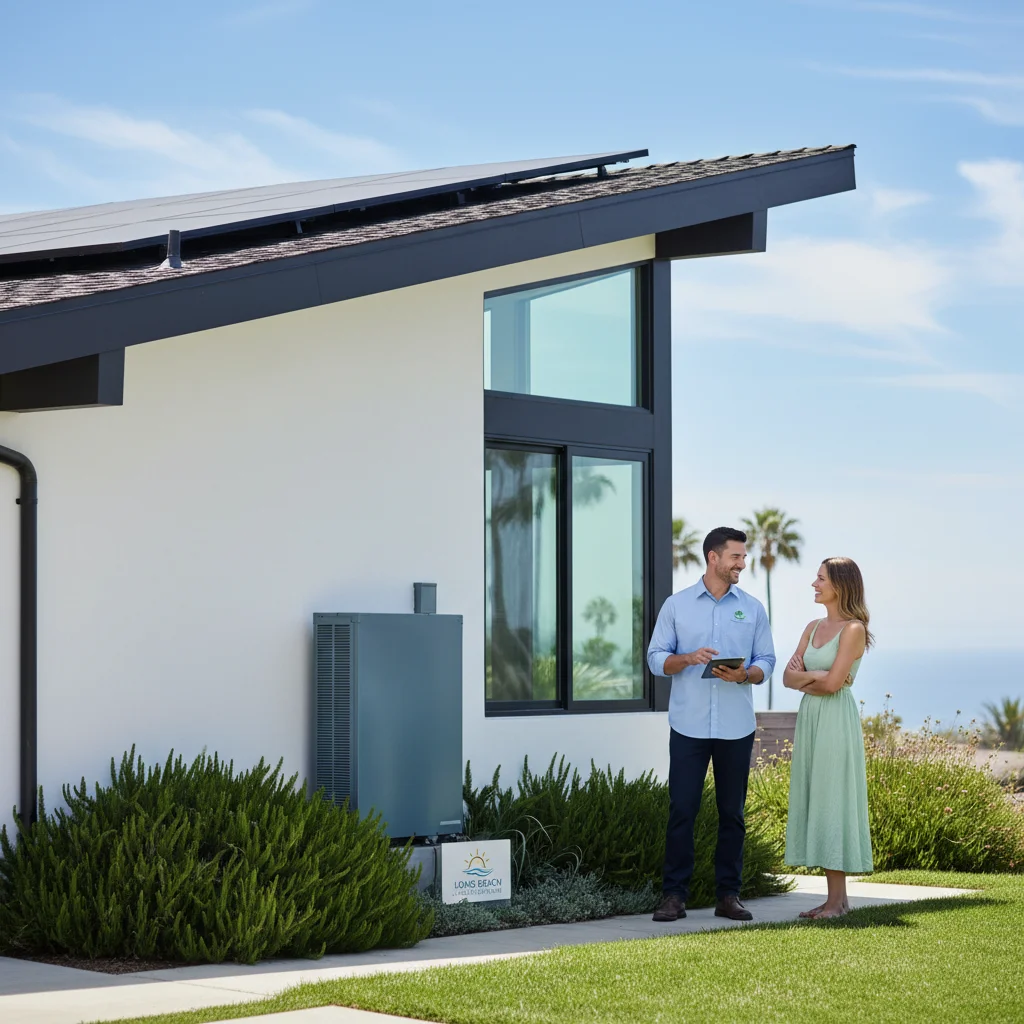
Long Beach homeowners replaced 3,200 furnaces and air conditioning systems with heat pumps in 2025, triple the number from 2023. And the rush isn't slowing down. Federal tax credits covering 30% of installation costs, paired with Southern California Edison rebates reaching $3,000, make 2026 the most financially advantageous year yet to switch to electric heating and cooling.
What's the ROI and Payback Period for a Heat Pump Installation in Long Beach?
Heat pump installations in Long Beach generate returns through reduced energy bills and upfront incentives that slash initial costs by $6,000 to $10,000. Air-source systems averaging $12,000 installed deliver payback periods of 6-8 years based on natural gas displacement savings of $840 to $1,200 annually. Ground-source installations require 12-15 years to break even but last 25+ years versus 15 for air-source units.
Southern California's mild winters accelerate returns. Long Beach heating degree days total 1,230 annually—67% below the national average—meaning heat pumps operate in high-efficiency cooling mode most of the year. A 16 SEER ducted system cuts cooling costs 40% compared to a 10 SEER central air conditioner.
"Heat pumps can reduce electricity use for heating by approximately 50% compared to electric resistance heating such as furnaces and baseboard heaters." — U.S. Department of Energy
But upfront costs remain the barrier. Financing programs through California's TECH Clean California initiative offer zero-interest loans up to $10,000 with 10-year repayment terms. The federal Energy Efficient Home Improvement Credit (Section 25C) ended for property placed in service after December 31, 2025 (IRS FS-2025-05). Federal tax credits for this work have ended, but state, local and utility rebates may still apply; check what is available at your address with the DuloCore rebate calculator.
So the average Long Beach homeowner installing a $12,000 air-source heat pump receives $2,000 federal credit, $1,500 SCE rebate, and saves $1,000 yearly—recovering costs in 7.2 years while eliminating natural gas service entirely. Use our free rebate calculator to estimate your specific return based on current utility rates and home size.
How Do Heat Pumps Compare to Traditional HVAC Systems in Long Beach?
Heat pumps deliver both heating and cooling from a single system, eliminating the need for separate furnaces and air conditioners that cost $8,000 to $14,000 combined. A ducted air-source heat pump averages $10,000 to $18,000 installed compared to $12,000 for a furnace-plus-AC combination with lower efficiency ratings.
Operating costs favor heat pumps in Long Beach's climate. Natural gas furnaces cost $640 annually to heat a 1,800-square-foot home, while a cold-climate heat pump uses $580 in electricity for the same heating load. But cooling costs drop 45% because heat pumps achieve 16-20 SEER efficiency versus 13-14 SEER for standalone air conditioners.
Maintenance requirements differ. Gas furnaces need annual inspections costing $120 to check heat exchangers and carbon monoxide levels. Heat pumps require filter changes every 90 days and coil cleaning annually—total maintenance costs of $180 yearly. And heat pumps eliminate carbon monoxide risks and natural gas leak concerns entirely.
Lifespan comparisons show ground-source heat pumps lasting 25 years, air-source systems reaching 15 years, and gas furnaces averaging 18 years. Air conditioners fail around 12-15 years. So a heat pump matches or exceeds traditional equipment longevity while delivering both functions. Learn more about specific heat pump rebates available in California.
What Are the Costs of Different Heat Pump Types Available in Long Beach?
Air-source ducted systems range from $10,000 to $18,000 installed depending on tonnage and SEER rating. A 3-ton 16 SEER unit suitable for 1,500-1,800 square feet costs $12,500 including labor. Upgrading to 18 SEER adds $2,000 but cuts cooling costs an additional 12%.
Ductless mini-split systems cost $3,500 to $5,500 per indoor head unit. A three-head installation covering 1,200 square feet runs $11,000 to $14,000. And mini-splits eliminate ductwork expenses of $4,000 to $8,000 required when converting from wall heaters or radiant systems.
Ground-source heat pumps demand $18,000 to $30,000 for horizontal loop fields requiring 0.25-acre minimum lots. Vertical bore systems fit smaller properties but cost $25,000 to $35,000 for three 200-foot wells. But geothermal systems achieve 400% efficiency versus 250-300% for air-source units.
| System Type | Installed Cost | Efficiency | Best For |
|---|---|---|---|
| Air-source ducted | $10,000-$18,000 | 16-20 SEER | Existing ductwork, whole-home |
| Ductless mini-split | $11,000-$14,000 | 18-25 SEER | No ducts, zone control |
| Ground-source | $18,000-$35,000 | 20-30 EER | Large lots, maximum efficiency |
Labor accounts for 35-40% of total costs. Long Beach contractors charge $85 to $125 hourly, with ducted installations requiring 16-24 hours and ground-source systems taking 3-5 days. Permit fees add $200 to $400 depending on system complexity and electrical panel upgrades.
How to Choose Between Air-Source and Ground-Source Heat Pumps for Your Home?
Lot size determines ground-source feasibility. Horizontal loops need 1,500-3,000 feet of trenching requiring 0.25-acre minimum. Vertical bore systems fit 6,000-square-foot lots but drill costs reach $40 per foot—$8,000 for a single 200-foot well, $24,000 for three wells on a 2,500-square-foot home.
Air-source systems install on properties of any size. Outdoor condensers need 24-inch clearance and avoid direct sun exposure to maintain efficiency. And coastal locations within 3,000 feet of the Pacific require corrosion-resistant coils adding $800 to $1,200 to equipment costs.
Climate performance differs. Long Beach winter lows average 48°F—well above the 5°F threshold where standard air-source heat pumps lose efficiency. Cold-climate models maintain 100% heating capacity to -15°F but cost 20% more upfront. Ground-source systems deliver consistent performance regardless of outdoor temperature because earth temperature stays 55-60°F year-round.
Budget constraints matter. Air-source installations recover costs in 6-8 years versus 12-15 for geothermal. But ground-source systems last 25 years and eliminate compressor replacements costing $2,500 to $4,000 on air-source units at year 12-15. Calculate long-term savings with California's energy tax credits factored in.
So homeowners with large lots, 20+ year ownership plans, and $25,000+ budgets choose ground-source. Those needing immediate savings, smaller properties, or planning to move within 10 years select air-source systems.
What Rebates and Incentives Can Help Offset Heat Pump Costs in Long Beach?
The federal Energy Efficient Home Improvement Credit (Section 25C) ended for property placed in service after December 31, 2025 (IRS FS-2025-05). Ground-source heat pumps qualify for uncapped 30% credits—$7,500 on a $25,000 installation. And the credit applies to equipment, labor, and electrical upgrades required for the system.
Southern California Edison offers $3,000 rebates for ducted heat pumps replacing gas furnaces and $1,500 for ductless mini-splits. Income-qualified customers earning below 80% area median income—$74,600 for a family of four in Los Angeles County—receive enhanced rebates of $5,500 ducted, $3,000 ductless.
California's TECH Clean California provides point-of-sale rebates reducing contractor invoices immediately. Standard rebates reach $3,000 for whole-home systems, while income-qualified households access $7,000 to $8,500 depending on system type. And zero-interest financing covers remaining costs up to $10,000 with 10-year terms.
| Program | Amount | Eligibility | Application |
|---|---|---|---|
| Federal ITC | 30% ($2,000 cap air-source) | All homeowners | IRS Form 5695 with tax return |
| SCE Rebate | $1,500-$5,500 | SCE customers | Online pre-approval required |
| TECH Clean California | $3,000-$8,500 | California residents | Point-of-sale through contractor |
Long Beach municipal utility customers access separate rebates. Long Beach Energy Resources Division offers $1,200 for 16+ SEER systems and $1,800 for 18+ SEER units. And utility rebates stack with federal credits—total incentives reach $6,000 to $10,500 depending on income and system specifications.
What's the Installation Process and Timeline for Heat Pump Contractors in Long Beach?
Site assessments require 60-90 minutes. Contractors calculate Manual J load calculations determining tonnage needs based on square footage, insulation levels, window area, and air leakage. Duct inspections identify leaks reducing efficiency by 20-30%, adding $1,200 to $2,400 for sealing and insulation upgrades.
Permitting takes 3-7 business days in Long Beach. Applications require stamped load calculations, equipment specifications, and electrical panel capacity verification. Electrical panel upgrades from 100-amp to 200-amp service cost $2,000 to $3,500 when heat pumps exceed existing capacity.
Installation timelines vary by system. Ducted air-source replacements take 1-2 days when using existing ductwork. Mini-split installations require 6-8 hours per indoor head. And ground-source systems need 3-5 days for loop field excavation, boring, equipment installation, and startup.
Post-installation inspections verify refrigerant charge, airflow rates, and thermostat programming. Contractors provide commissioning reports documenting system performance for rebate applications. SCE rebates require inspection photos and equipment serial numbers. TECH Clean California processes point-of-sale rebates within 10 business days.
So the complete timeline from initial consultation to rebate receipt spans 3-6 weeks for air-source systems, 6-10 weeks for ground-source installations requiring geological surveys and drilling permits.
Official Sources
- U.S. Department of Energy - Heat Pump Systems — Federal guidance on heat pump efficiency and performance
- ENERGY STAR Heat Pumps — Certification requirements and qualified equipment database
- DSIRE USA California Incentives — Comprehensive database of state and utility rebate programs
Frequently Asked Questions
What qualifications do heat pump contractors in Long Beach need to have?
Licensed contractors hold active C-20 Warm-Air Heating, Ventilation, and Air-Conditioning licenses issued by the California Contractors State License Board. HVAC Excellence or NATE certifications verify technician competency in heat pump installation and refrigerant handling. And manufacturers require factory training completion before authorizing warranty coverage—Mitsubishi Diamond Contractors and Carrier Factory Authorized Dealers complete 40+ hours annual training on specific equipment lines.
How much does a heat pump installation cost in Long Beach?
Air-source ducted systems cost $10,000 to $18,000 installed including equipment, labor, permits, and electrical work. Ductless mini-splits range from $11,000 to $14,000 for three-head whole-home coverage. Ground-source installations require $18,000 to $35,000 depending on loop field type and property geology. But federal credits covering 30% and utility rebates reaching $5,500 reduce net costs by $6,000 to $10,500.
Are heat pump rebates available for Long Beach residents in 2026?
Southern California Edison offers $1,500 to $5,500 rebates for heat pump installations replacing gas furnaces. TECH Clean California provides $3,000 to $8,500 point-of-sale incentives with zero-interest financing. The federal Energy Efficient Home Improvement Credit (Section 25C) ended for property placed in service after December 31, 2025 (IRS FS-2025-05). Income-qualified households earning below 80% area median income access enhanced rebates reaching $8,500 for ducted systems. Visit our rebate calculator to find programs matching your household income and system type.
What is the difference between a heat pump and an air conditioner?
Air conditioners cool only by transferring heat outdoors. Heat pumps reverse refrigerant flow to provide both cooling and heating from a single system. Both achieve similar cooling efficiency—16 to 20 SEER—but heat pumps eliminate separate furnace costs and deliver heating at 250-300% efficiency versus 95% for gas furnaces. And heat pumps cost $2,000 to $4,000 more upfront than air conditioners but save $8,000 to $10,000 by replacing both furnace and AC.
How long does it take to install a heat pump in Long Beach?
Ducted air-source installations require 1-2 days when using existing ductwork. Ductless mini-split systems take 6-8 hours per indoor head unit—a three-head installation completes in 1 day. Ground-source systems need 3-5 days for excavation, boring, equipment setup, and startup testing. But the complete timeline from contractor selection to final inspection spans 3-6 weeks including permitting, rebate pre-approval, and equipment delivery.
Ready to start saving on heating and cooling costs? Use our free rebate calculator to discover exactly how much you can save with federal tax credits and California rebates on your Long Beach heat pump installation. Get your personalized estimate in 60 seconds.
Last reviewed: April 14, 2026. Reviewed by DuloCore Energy Specialists. About the team.
Check your California heat pump rebate eligibility — see the programs you qualify for and the dollar amounts on our California heat pump rebate finder.